Chapter 10 – Pure Monopoly
10–12
Price (P)
Quantity
Demanded
(Q)
Marginal
Revenue
(MR)
Marginal
Cost
(MC)
$115
0
NA
NA
100
1
$100
$45
83
2
66
40
71
3
47
35
63
4
39
30
55
5
23
35
48
6
13
40
42
7
6
45
37
8
2
55
33
9
1
65
29
10
75
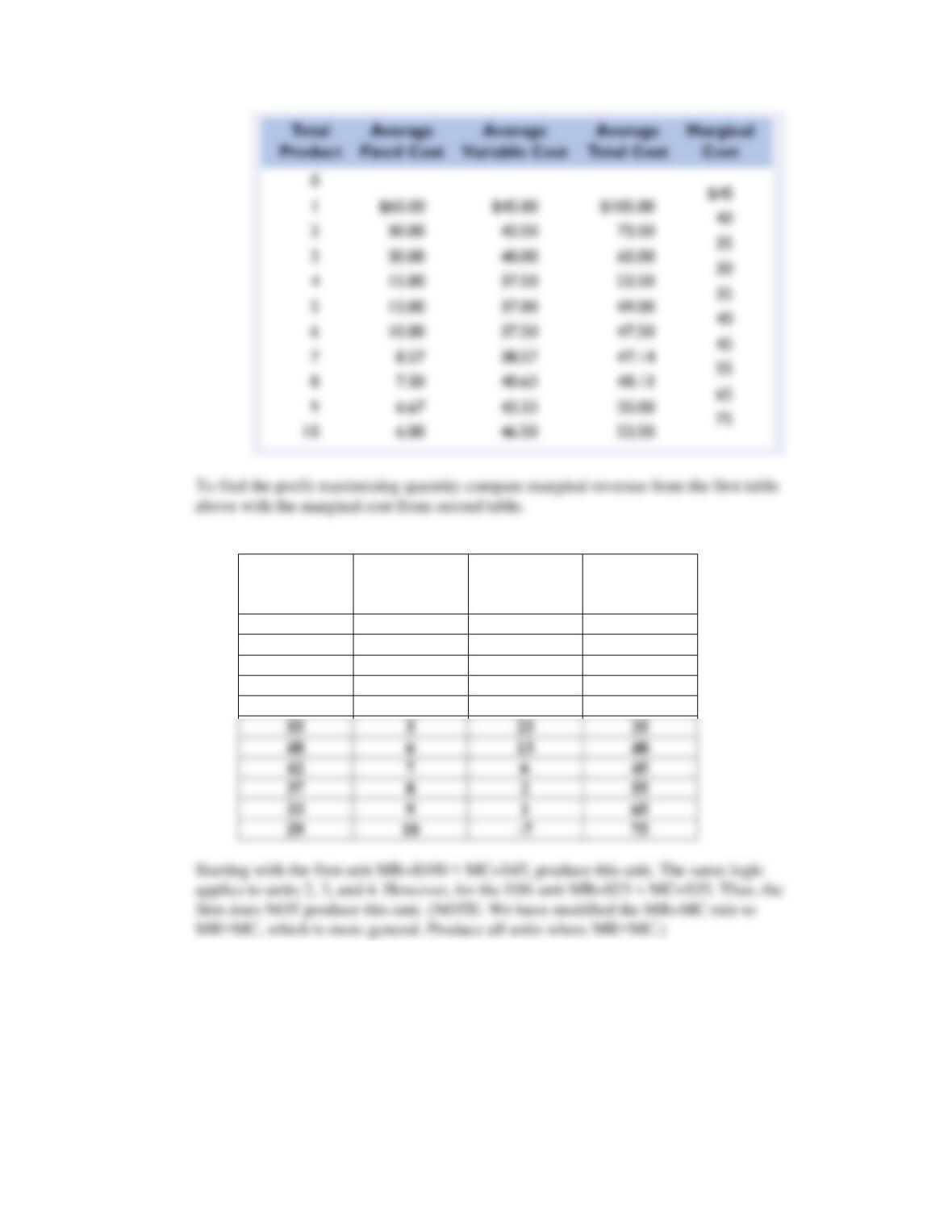
The profit maximizing quantity produced is 4 units.
The profit maximizing price is the price associated with the profit maximizing quantity, 4
units. Thus, the profit maximizing price is $63.
Chapter 10 – Pure Monopoly
10–13
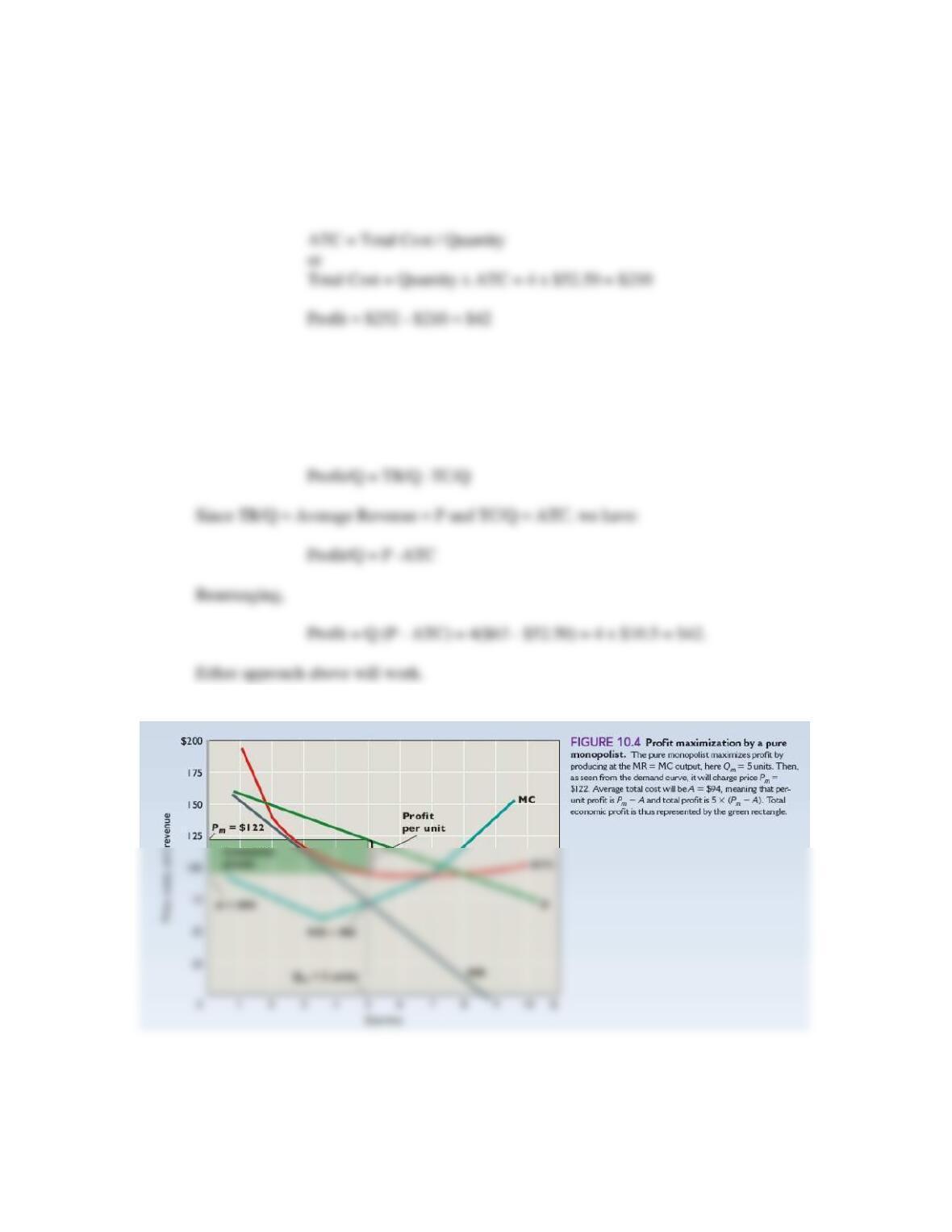
The monopolist’s profit equals total revenue minus total cost. Total revenue equals $252
at 4 units of output. We still need total cost. From the ‘cost data’ table we see that average
total cost (ATC) equals $52.50. Since ATC equals total cost divided by quantity we can
determine total cost from the ATC cost data.
Another approach is to use the following relationship.
Profit = TR –TC
Divide through by Q
The graph should have the general shape of Figure 10.4.
Chapter 10 – Pure Monopoly
10–14
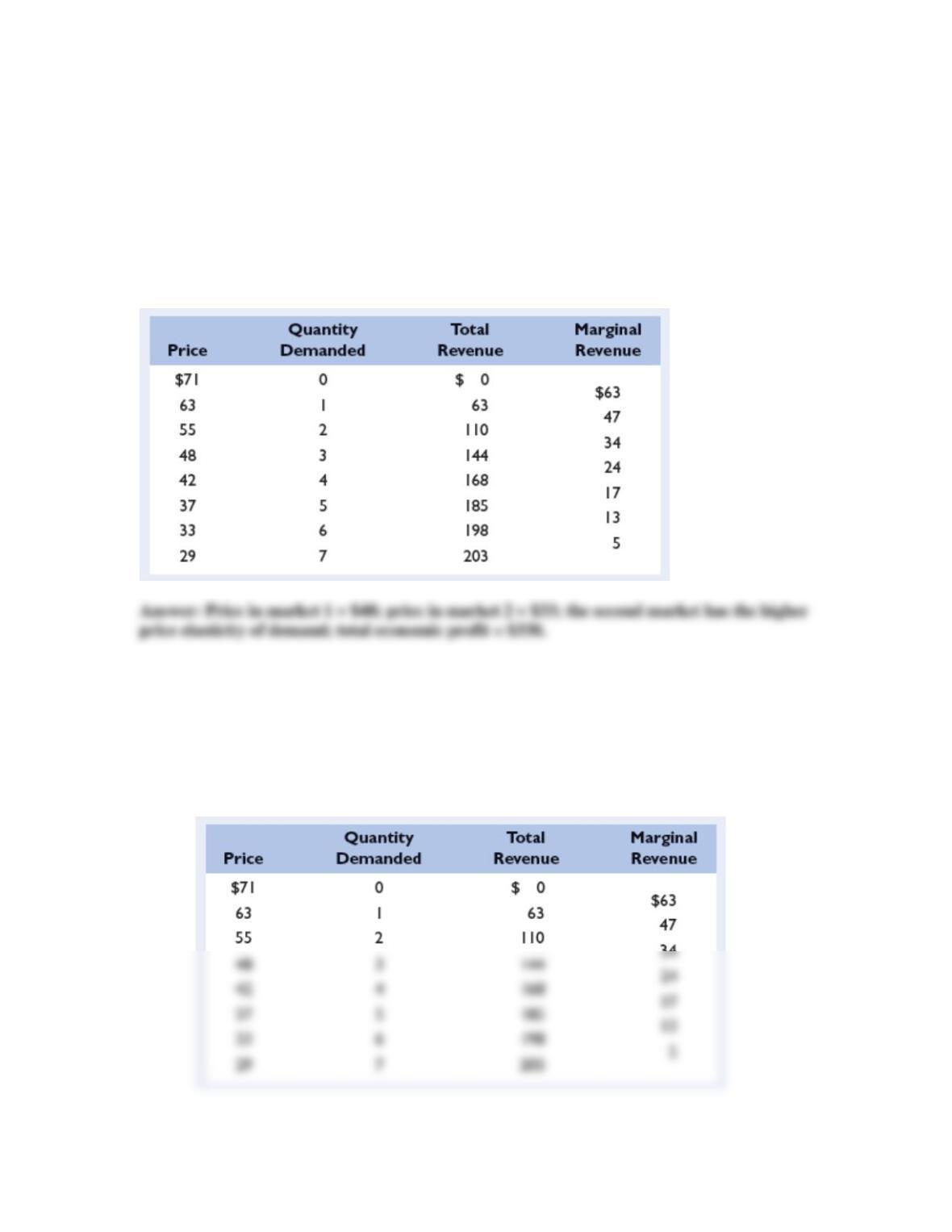
2. Suppose that a price‐discriminating monopolist has segregated its market into two groups of
buyers. The first group described by the demand and revenue data that you developed for
problem 1. The demand and revenue data for the second group of buyers is shown in the
accompanying table. Assume that MC is $13 in both markets and MC = ATC at all output levels.
What price will the firm charge in each market? Based solely on these two prices, which market
has the higher price elasticity of demand? What will be this monopolist’s total economic profit?
LO4
Feedback: Consider the following example. Suppose that a price‐discriminating
monopolist has segregated its market into two groups of buyers, the first group described
by the demand and revenue data that you developed for problem 1. The demand and
revenue data for the second group of buyers is shown in the accompanying table. Assume
that MC is $13 in both markets and MC = ATC at all output levels. What price will the
firm charge in each market? Based solely on these two prices, which market has the
higher price elasticity of demand? What will be this monopolist’s total economic profit?
Chapter 10 – Pure Monopoly
10–15
Price (P)
Quantity
Demanded
(Q)
Total
Revenue
(TR)
Marginal
Revenue
(MR)
$115
0
$0
NA
100
1
100
100
83
2
166
66
71
3
213
47
4
252
55
5
275
23
6
288
42
7
294
6
8
296
2
33
9
297
1
29
10
290
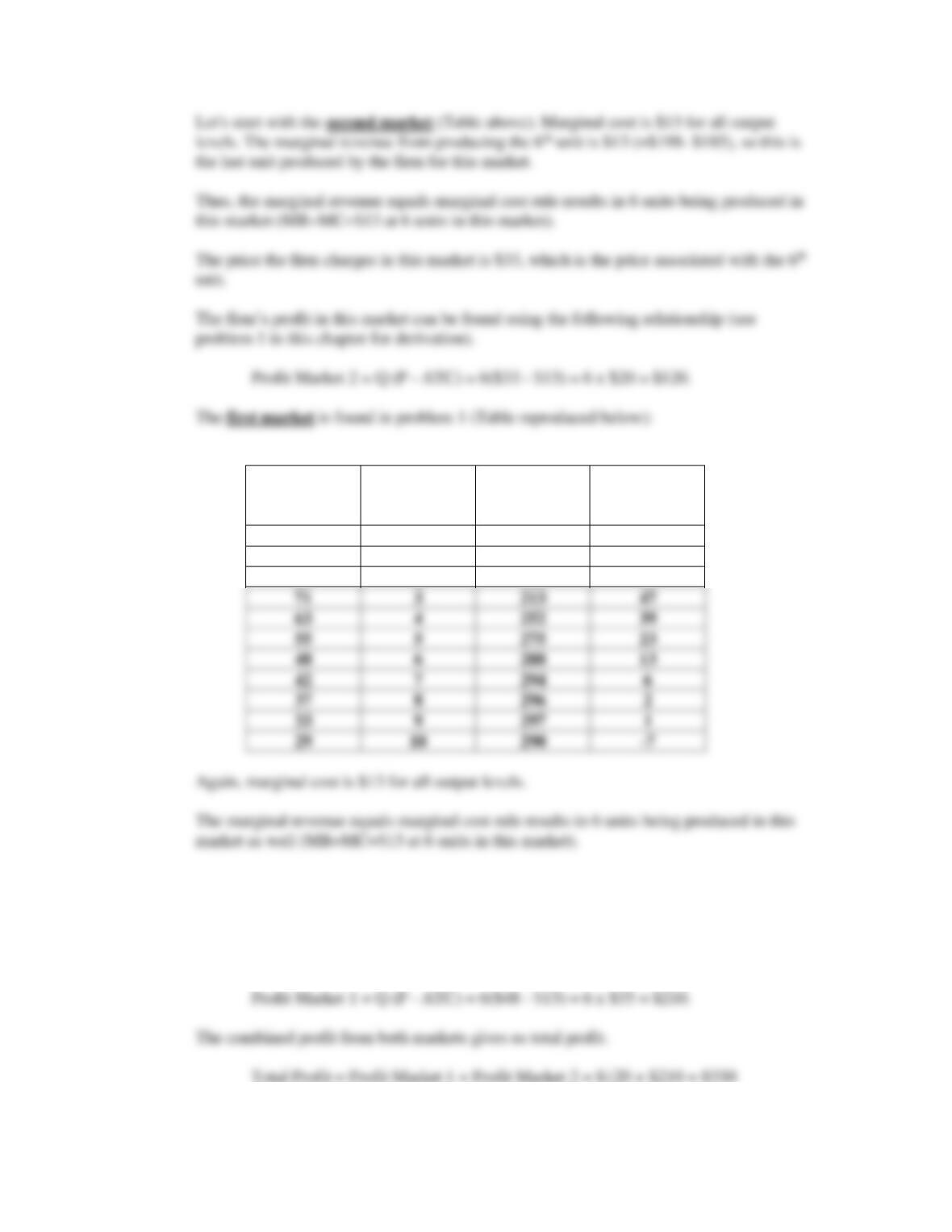
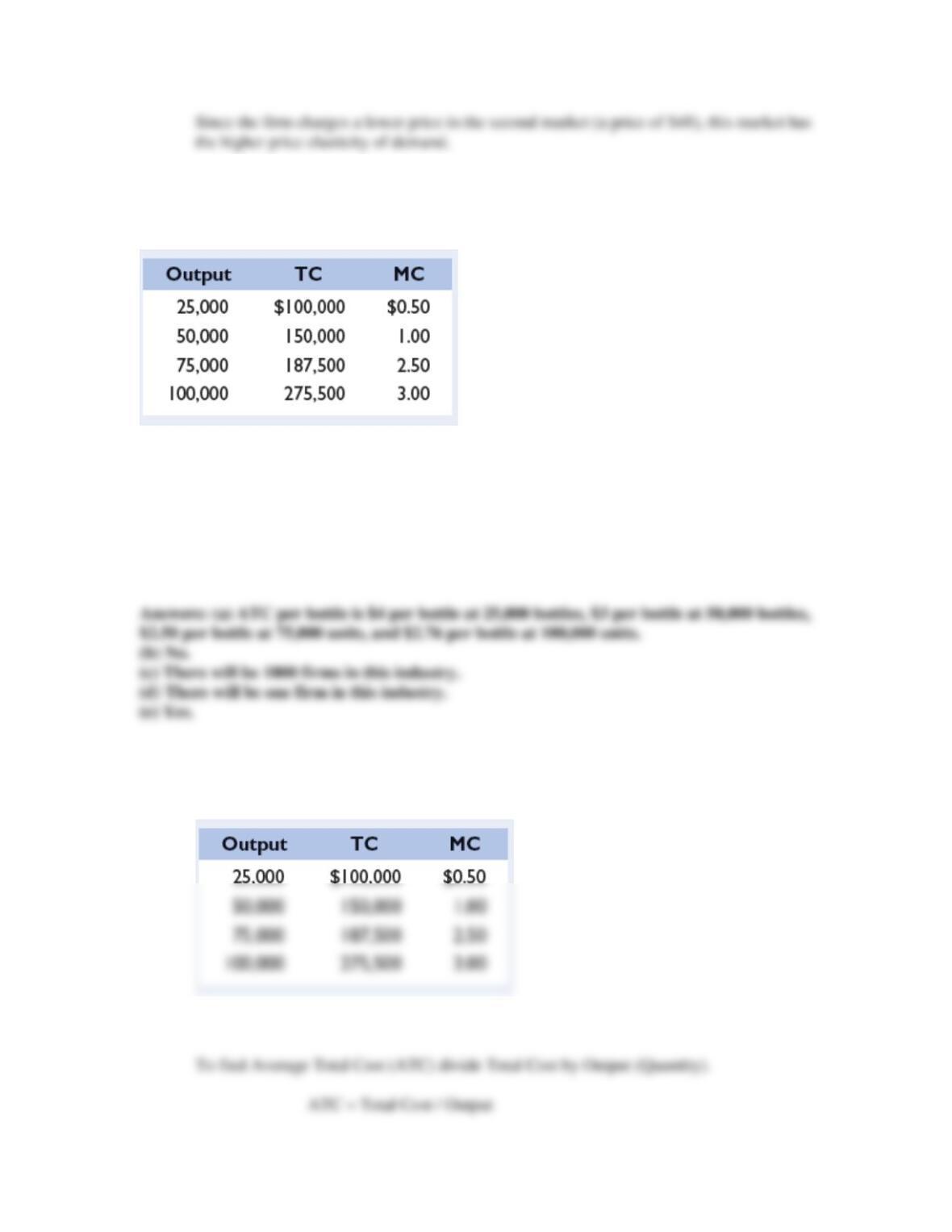
The price the firm charges in this market is $48, which is the price associated with the 6th
unit.
The firm’s profit in this market can be found using the following relationship (see
problem 1 in this chapter for derivation).
Chapter 10 – Pure Monopoly
10–16
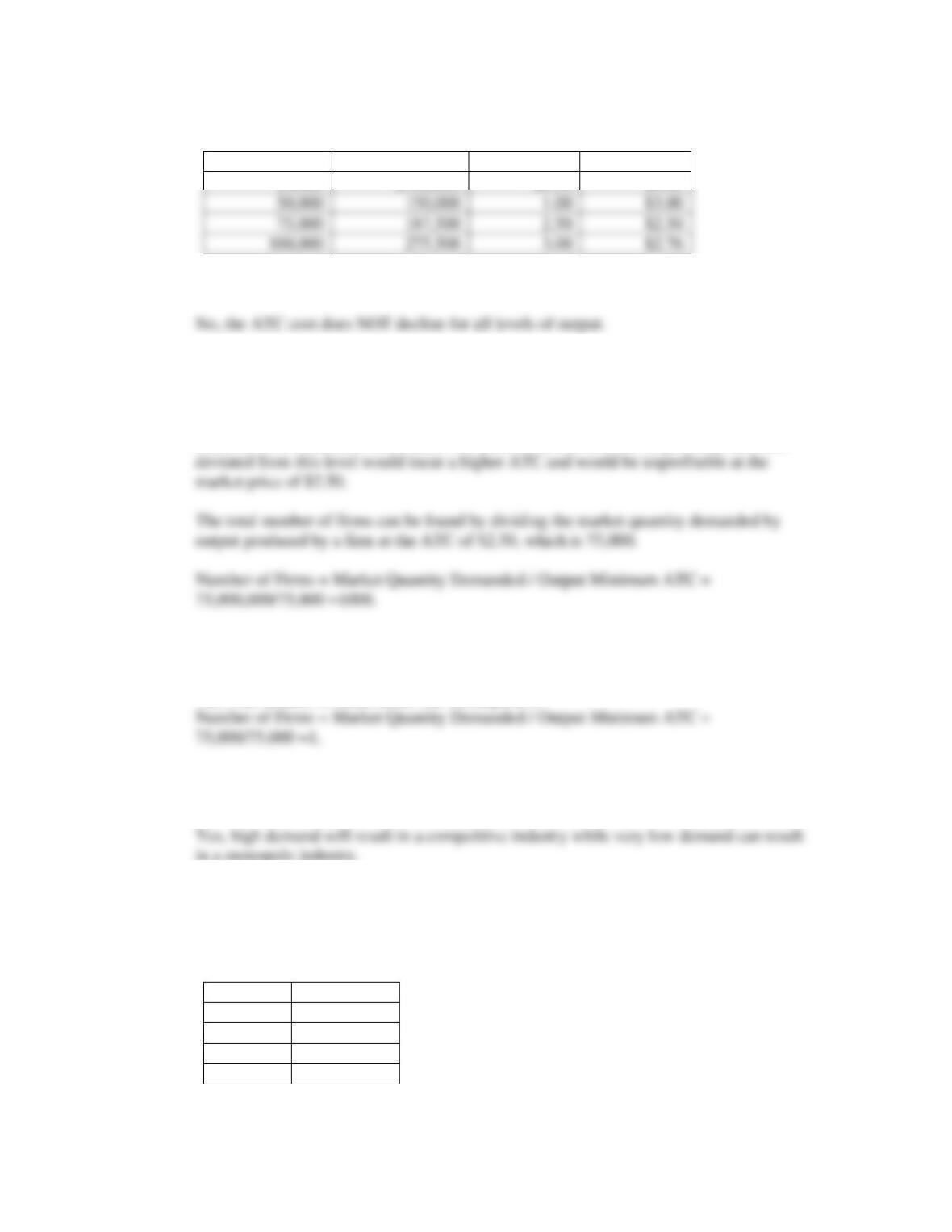
3. Assume that the most efficient production technology available for making vitamin pills has
the cost structure given in the following table. Note that output is measured as the number of
bottles of vitamins produced per day and that costs include a normal profit. LO4
a. What is ATC per unit for each level of output listed in the table?
b. Is this a decreasing‐cost industry? (Answer yes or no).
c. Suppose that the market price for a bottle of vitamins is $2.50 and that at that price the total
market quantity demanded is 75,000,000 bottles. How many firms will there be in this industry?
d. Suppose that instead the market quantity demanded at a price of $2.50 is only 75,000. How
many firms do you expect there to be in this industry?
e. Review your answers to parts b, c, and d. Does the level of demand determine this industry’s
market structure?
Feedback: Consider the following example. Assume that the most efficient production
technology available for making vitamin pills has the cost structure given in the
following table. Note that output is measured as the number of bottles of vitamins
produced per day and that costs include a normal profit.
a. What is ATC per unit for each level of output listed in the table?
Chapter 10 – Pure Monopoly
10–17
Output
TC
MC
ATC
25,000
$100,000
$0.50
$4.00
b. Is this a decreasing‐cost industry? (Answer yes or no).
c. Suppose that the market price for a bottle of vitamins is $2.50 and that at that price the
total market quantity demanded is 75,000,000 bottles. How many firms will there be in
this industry?
Since $2.50 is minimum ATC, firms will produce at this level of output. Any firm that
d. Suppose that instead the market quantity demanded at a price of $2.50 is only 75,000.
How many firms do you expect there to be in this industry?
The total number of firms under this assumption is:
e. Review your answers to parts b, c, and d. Does the level of demand determine this
industry’s market structure?
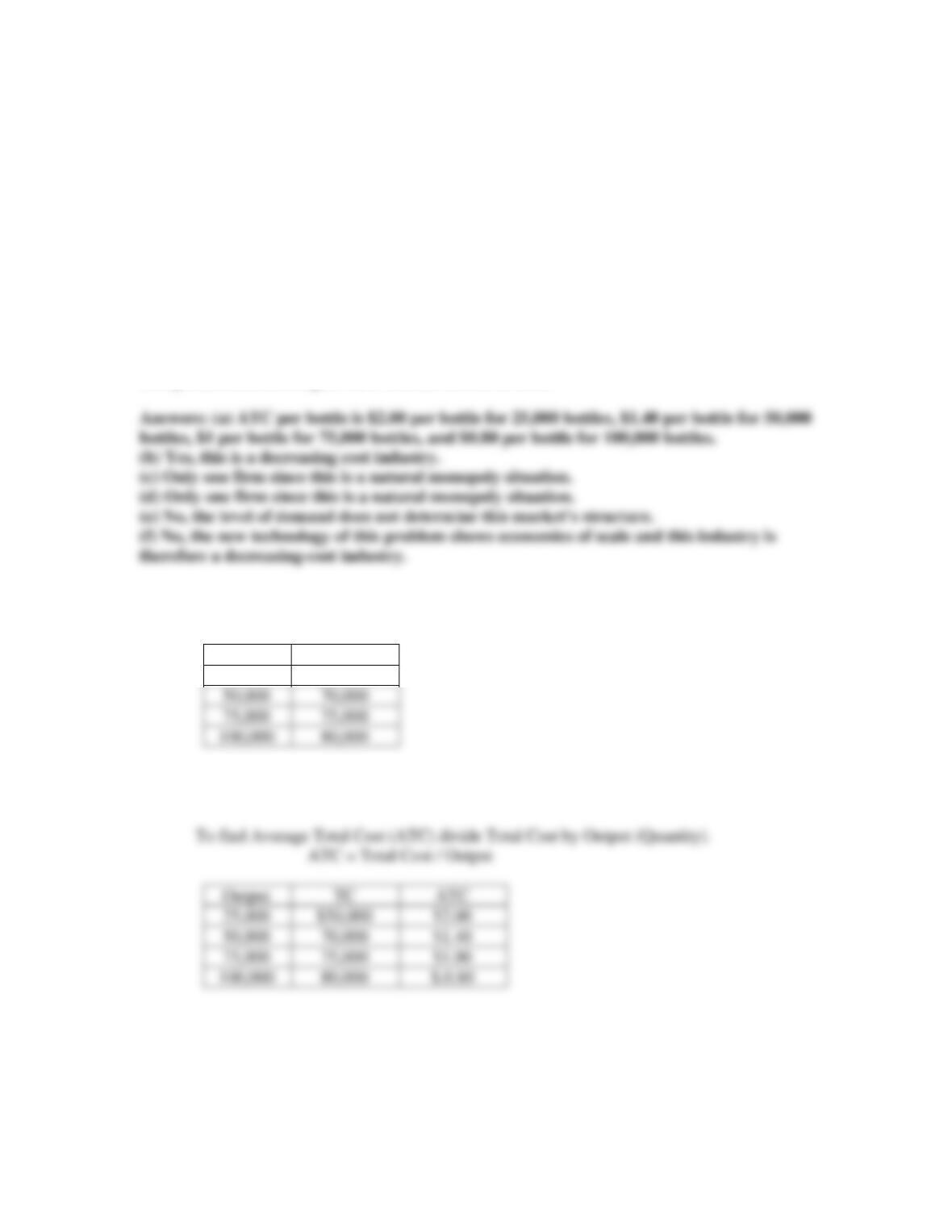
4. A new production technology for making vitamins is invented by a college professor who
decides not to patent it. Thus, it is available for anybody to copy and put into use. The TC per
bottle for production up to 100,000 bottles per day is given in the following table.
Output
TC
25,000
$50,000
50,000
70,000
75,000
75,000
100,000
80,000
75,000
187,500
2.50
$2.50
Chapter 10 – Pure Monopoly
10–18
a. What is ATC for each level of output listed in the table?
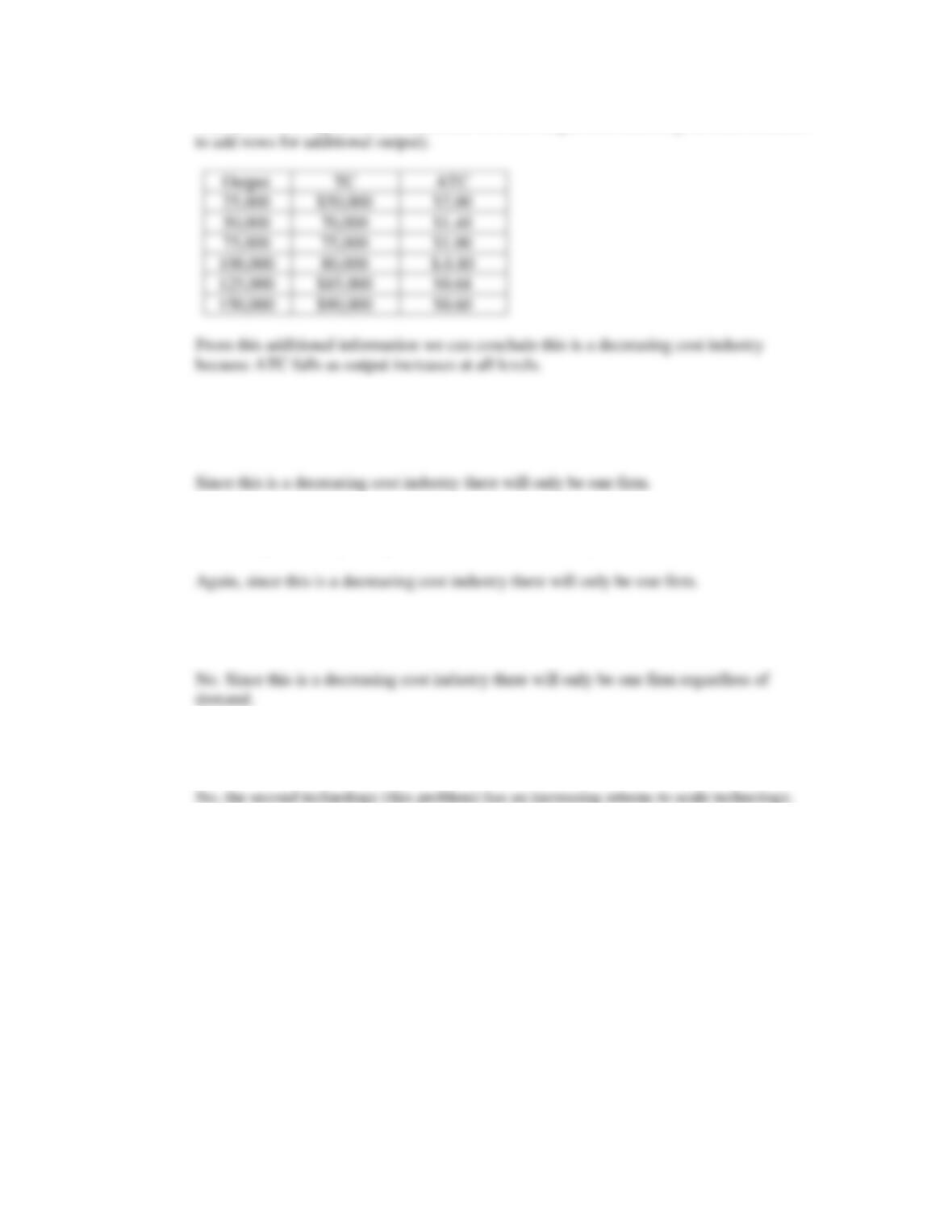
b. Suppose that for each 25,000‐bottle per day increase in production above
100,000 bottles per day, TC increases by $5000 (so that, for instance, 125,000 bottles per day
would generate total costs of $85,000 and 150,000 bottles per day would generate total costs of
$90,000). Is this a decreasing‐cost industry?
c. Suppose that the price of a bottle of vitamins is $1.33 and that at that price the total quantity
demanded by consumers is 75,000,000 bottles. How many firms will there be in this industry?
d. Suppose that instead the market quantity demanded at a price of $1.33 is only 75,000. How
many firms do you expect there to be in this industry?
e. Review your answers to parts b, c, and d. Does the level of demand determine this industry’s
market structure?
f. Compare your answer to part d of this question with your answer to part d of problem 3. Do
both production technologies show constant returns to scale?
Feedback: Consider the following example. The TC per bottle for production up to
100,000 bottles per day is given in the following table.
Output
TC
25,000
$50,000
50,000
75,000
a. What is ATC for each level of output listed in the table?
Output
TC
25,000
$50,000
50,000
75,000
b. Suppose that for each 25,000‐bottle per day increase in production above
100,000 bottles per day, TC increases by $5000 (so that, for instance, 125,000 bottles per
day would generate total costs of $85,000 and 150,000 bottles per day would generate
total costs of $90,000). Is this a decreasing‐cost industry?
Chapter 10 – Pure Monopoly
10–19
The last two rows provide the additional cost and output information (you could continue
c. Suppose that the price of a bottle of vitamins is $2.50 and that at that price the total
quantity demanded by consumers is 75,000,000 bottles. How many firms will there be in
this industry?
d. Suppose that instead the market quantity demanded at a price of $2.50 is only 75,000.
How many firms do you expect there to be in this industry?
e. Review your answers to parts b, c, and d. Does the level of demand determine this
industry’s market structure?
f. Compare your answer to part d of this question with your answer to part d of problem
3. Do both production technologies show constant returns to scale?
5. Suppose you have been tasked with regulating a single monopoly firm that sells 50‐pound bags
of concrete. The firm has fixed costs of $10 million per year and a variable cost of $1 per bag no
matter how many bags are produced. LO5
a. If this firm kept on increasing its output level, would ATC per bag ever increase? Is this a
decreasing‐cost industry?
b. If you wished to regulate this monopoly by charging the socially optimal price, what price
would you charge? At that price, what would be the size of the firm’s profit or loss? Would the
firm want to exit the industry?
c. You find out that if you set the price at $2 per bag, consumers will demand 10 million bags.
How big will the firm’s profit or loss be at that price?
d. If consumers instead demanded 20 million bags at a price of $2 per bag, how big would the
firm’s profit or loss be?
Chapter 10 – Pure Monopoly
10–20
e. Suppose that demand is perfectly inelastic at 20 million bags, so that consumers demand 20
million bags no matter what the price is. What price should you charge if you want the firm to
earn only fair rate of return? Assume as always that TC includes a normal profit.
Feedback: Consider the following example. Suppose you have been tasked with
regulating a single monopoly firm that sells 50‐pound bags of concrete. The firm has
fixed costs of $10 million per year and a variable cost of $1 per bag no matter how many
bags are produced.
a. If this firm kept on increasing its output level, would ATC per bag ever increase? Is
this a decreasing‐cost industry?
ATC will never increase. This is a decreasing cost industry. The intuition is that FC get
b. If you wished to regulate this monopoly by charging the socially optimal price, what
price would you charge? At that price, what would be the size of the firm’s profit or loss?
Would the firm want to exit the industry?
Charge $1 per bag since the MC of all bags is $1 per bag. At that price, the firm would
c. You find out that if you set the price at $2 per bag, consumers will demand 10 million
bags. How big will the firm’s profit or loss be at that price?
The firm’s revenue equals $20,000,000 ( = $2 (price) x 10,000,000 (quantity)).
d. If consumers instead demanded 20 million bags at a price of $2 per bag, how big
would the firm’s profit or loss be?
The firm’s revenue equals $40,000,000 ( = $2 (price) x 20,000,000 (quantity)).
Chapter 10 – Pure Monopoly
10–21
e. Suppose that demand is perfectly inelastic at 20 million bags, so that consumers
demand 20 million bags no matter what the price is. What price should you charge if you
want the firm to earn only fair rate of return? Assume as always that TC includes a
normal profit.
The fair rate of return is where economic profit is zero (Total Cost above includes normal
profit).