A n s w e r s t o t h e R e v i e w Q u i z z e s
Page 245 (page 653 in Economics)
1. If the price level and the money wage rate rise by the same percentage, what happens to the
quantity of real GDP supplied? Along which aggregate supply curve does the economy move?
2. If the price level rises and the money wage rate remains constant, what happens to the quantity of
real GDP supplied? Along which aggregate supply curve does the economy move?
3. If potential GDP increases, what happens to aggregate supply? Does the LAS curve shift or is there
a movement along the LAS curve? Does the SAS curve shift or is there a movement along the SAS
curve?
4. If the money wage rate rises and potential GDP remains the same, does the LAS curve or the SAS
curve shift or is there a movement along the LAS curve or the SAS curve?
Page 249 (page 657 in Economics)
1. What does the aggregate demand curve show? What factors change and what factors remain the
same when there is a movement along the aggregate demand curve?
2. Why does the aggregate demand curve slope downward?
The aggregate demand curve slopes downward because of the wealth effect and two substitution
10
AGGREGATE
SUPPLY AND
AGGREGATE
DEMAND**
C h a p t e r
1 2 6 C H A P T E R 1 0
3. How do changes in expectations, fiscal policy and monetary policy, and the world economy
change aggregate demand and the aggregate demand curve?
Page 255 (page 663 in Economics)
1. Does economic growth result from increases in aggregate demand, short-run aggregate supply, or
long-run aggregate supply?
2. Does inflation result from increases in aggregate demand, short-run aggregate supply, or long-run
aggregate supply?
3. Describe three types of short-run macroeconomic equilibrium.
Short-run macroeconomic equilibrium occurs when the quantity of real GDP demanded equals the
4. How do fluctuations in aggregate demand and short-run aggregate supply bring fluctuations in real
GDP around potential GDP?
Fluctuations in aggregate demand with no change in short–run aggregate supply bring fluctuations in real
Page 257 (page 665 in Economics)
1. What are the defining features of classical macroeconomics and what policies do classical
macroeconomists recommend?
2. What are the defining features of Keynesian macroeconomics and what policies do Keynesian
macroeconomists recommend?
3. What are the defining features of monetarist macroeconomics and what policies do monetarist
macroeconomists recommend?

A G G R E G A T E S U P P L Y A N D A G G R E G A T E D E M A N D 1 2 7
1 2 8 C H A P T E R 1 0
A n s w e rs t o t he S t u dy P l an P ro b l e m s a n d A pp li c at io n s
1. Explain the influence of each of the following events on the quantity of real GDP supplied and
aggregate supply in India and use a graph to illustrate.
• U.S. firms move their call handling, IT, and data functions to India.
Moving call-handling, IT, and data functions to India
increases short-run and long-run aggregate supply
• Fuel prices rise.
The rise in fuel prices raises firms’ costs. Short-run
aggregate supply decreases and the short-run
• Wal-Mart and Starbucks open in India.
When Starbucks and Wal-mart open in India,
• Universities in India increase the number of engineering graduates.
• The money wage rate rises.
An increase in the money wage rate increases firms’ costs. Short-run aggregate supply decreases but
A G G R E G A T E S U P P L Y A N D A G G R E G A T E D E M A N D 1 2 9
employment does not change. This situation is illustrated in Figure 10.2, in which the short-run
aggregate supply curve shifts leftward and the long-run aggregate supply curve does not change.
• The price level in India increases.
In the short run, an increase in the price level
increases the quantity of real GDP supplied. In the
2. Labor productivity is rising at a rapid rate in China and wages are rising at a similar rate. Explain
how a rise in labor productivity and wages in China will influence the quantity of real GDP
supplied and aggregate supply in China.
The rise in labor productivity increases potential GDP and increases aggregate supply. The short-run
3. Canada trades with the United States. Explain the effect of each of the following events on
Canada’s aggregate demand.
• The government of Canada cuts income taxes.
4. The Fed cuts the quantity of money and all other things remain the same. Explain the effect of the
cut in the quantity of money on aggregate demand in the short run.
5. Gross Domestic Product for the Second Quarter of 2012
The increase in real GDP in the second quarter primarily reflected increases in personal
consumption expenditures, exports, and investment. Government spending decreased.
Source: Bureau of Economic Analysis, August 29, 2012
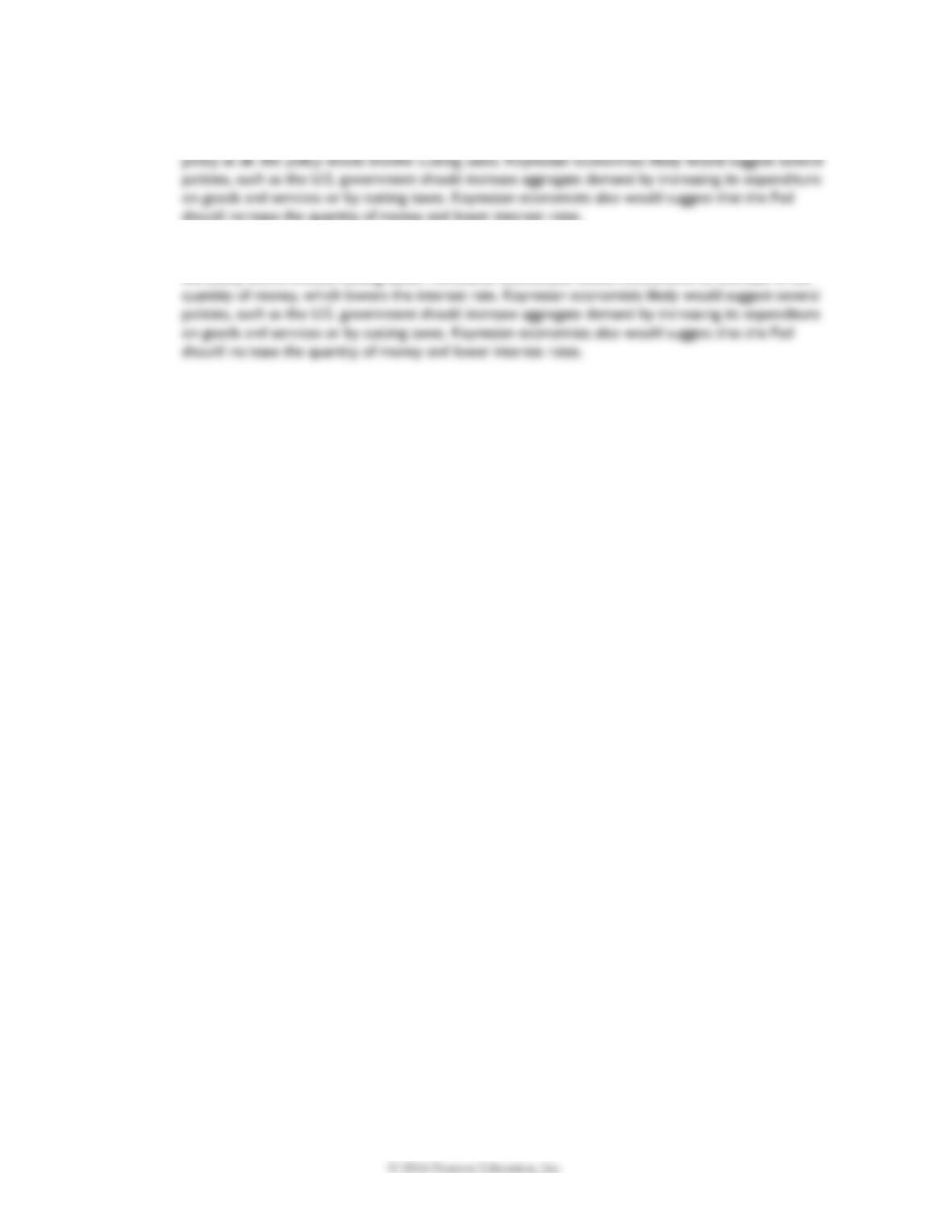
Use Figure 10.4 to work Problems 6 to 8.
Initially, the short-run aggregate supply curve is SAS0
and the aggregate demand curve is AD0.
6. Some events change aggregate demand from AD0
to AD1. Describe two events that could have
created this change in aggregate demand. What
is the equilibrium after aggregate demand
changed? If potential GDP is $1 trillion, the
economy is at what the type of macroeconomic
equilibrium?
Aggregate demand increases when the aggregate
demand curve shifts from AD0 to AD1. Aggregate
7. Some events change aggregate supply from SAS0 to SAS1. Describe two events that could have
created this change in aggregate supply. What is the equilibrium after aggregate supply changed? If
potential GDP is $1 trillion, does the economy have an inflationary gap, a recessionary gap, or no
output gap?
8. Some events change aggregate demand from AD0 to AD1 and aggregate supply from SAS0 to SAS1.
What is the new macroeconomic equilibrium?
9. Describe the policy change that a classical macroeconomist, a Keynesian, and a monetarist would
recommend for U.S. policymakers to adopt in response to each of the following events:
a. Growth in the world economy slows.
Classical economists probably would recommend no policy action. If they suggested any policy at all,
A G G R E G A T E S U P P L Y A N D A G G R E G A T E D E M A N D 1 3 1
b. The world price of oil rises.
Classical and monetarist economists probably would recommend no policy action. If they suggested any
should increase the quantity of money and lower interest rates.
c. U.S. labor productivity declines.
Classical economists probably would recommend no policy action. If they suggested any policy at all,
the policy would involve cutting taxes. Monetarist economists would recommend an increase in the
1 3 2 C H A P T E R 1 0
Answers to Additional Problems and Applications
10. Explain for each event whether it changes the quantity of real GDP supplied, short-run aggregate
supply, long-run aggregate supply, or a combination of them.
• Automotive firms in the United States switch to a new technology that raises productivity.
When firms switch to a new technology, both the short-run aggregate supply and the long-run
aggregate supply increase.
• Toyota and Honda build additional plants in the United States.
11. Explain for each event whether it changes the quantity of real GDP demanded or aggregate
demand in the United States.
• U.S exports to the European Union boom.
12. Inventory Investment Decreases
When real GDP increased in the second quarter of 2012, consumption expenditure, exports, and
fixed investment increased but business inventory investment fell.
13. Exports and Imports Increase
Real exports of goods and services increased 6.0 percent in the second quarter, compared with
an increase of 4.4 percent in the first. Real imports of goods and services increased 2.9 percent,
compared with an increase of 3.1 percent.
Source: Bureau of Economic Analysis, August 29, 2012
Explain how the changes in exports and imports reported here influence the quantity of real GDP
demanded and aggregate demand. In which of the two quarters reported did exports and imports
make the greater contribution to aggregate demand growth?
A G G R E G A T E S U P P L Y A N D A G G R E G A T E D E M A N D 1 3 3
Use the following information to work Problems 14 to 16.
The following events have occurred at times in the history of the United States:
• The world economy goes into an expansion.
14. Explain for each event whether it changes short-run aggregate supply, long-run aggregate supply,
aggregate demand, or some combination of them.
15. Explain the separate effects of each event on U.S. real GDP and the price level, starting from a
position of long-run equilibrium.
16. Explain the combined effects of these events on U.S. real GDP and the price level, starting from a
position of long-run equilibrium.
The combined effect of an expansion in the world economy, the expectation of higher profits in the
1 3 4 C H A P T E R 1 0
95
500
500
105
450
550
115
400
600
Use the following information to work Problems 17 and 18.
In Japan, potential GDP is 600 trillion yen. The
table shows the aggregate demand and short-
run aggregate supply schedules.
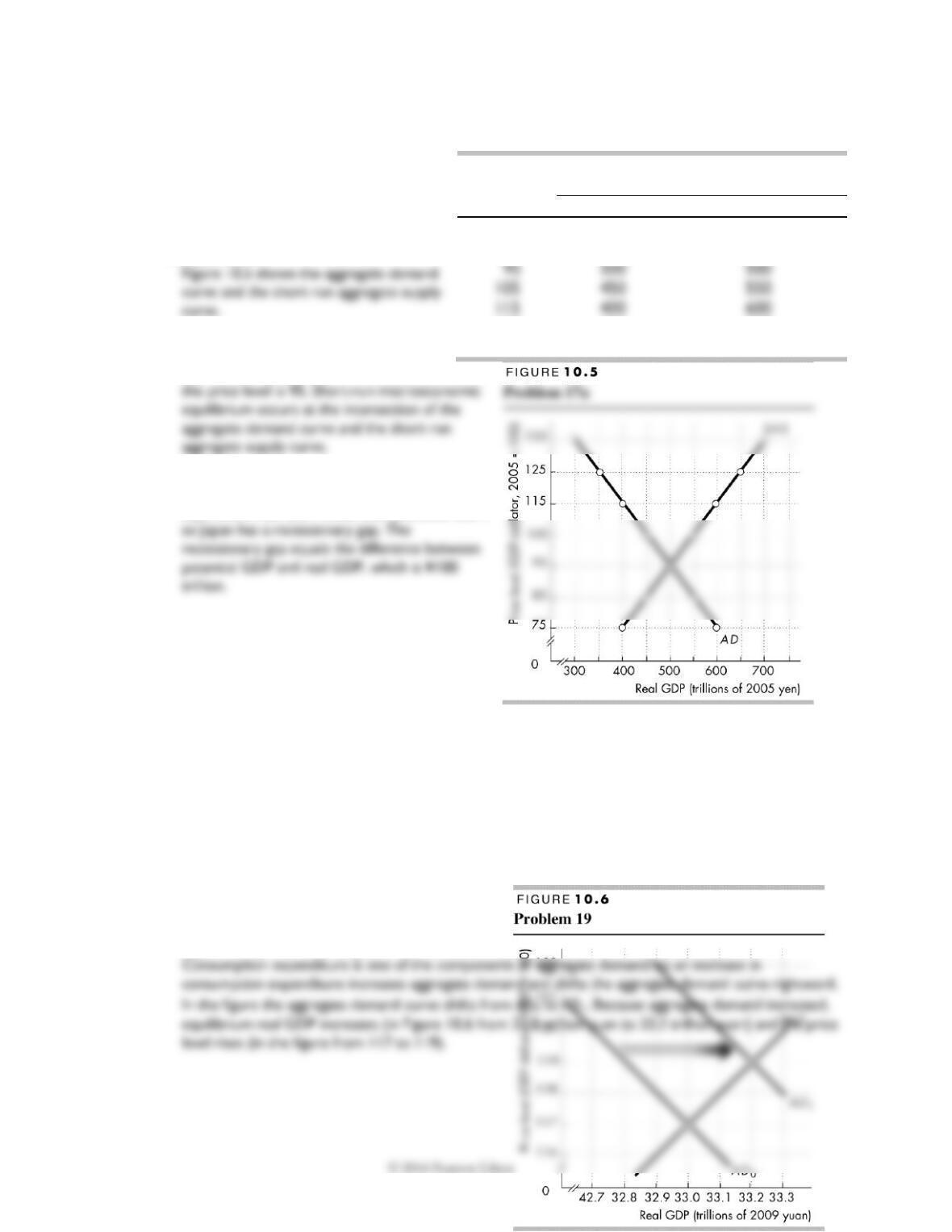
17. a. Draw a graph of the aggregate demand
curve and the short-run aggregate
supply curve.
b. What is the short-run equilibrium real
GDP and price level?
Equilibrium real GDP is ¥500 trillion and
18. Does Japan have an inflationary gap or a
recessionary gap and what is its magnitude?
Equilibrium real GDP is less than potential GDP,
Use the following information to work Problems 19 and 20.
Spending by Women Jumps
The magazine Women of China reported that Chinese women in big cities spent 63% of their income on
consumer goods last year, up from 26% in 2007. Clothing accounted for the biggest chunk of that
spending, at nearly 30%, followed by digital products such as cellphones (11%) and travel (10%). Chinese
consumption as a whole grew faster than the overall economy and is expected to reach 42% of GDP by
2020, up from the current 36%.
Source: The Wall Street Journal, August 27, 2010
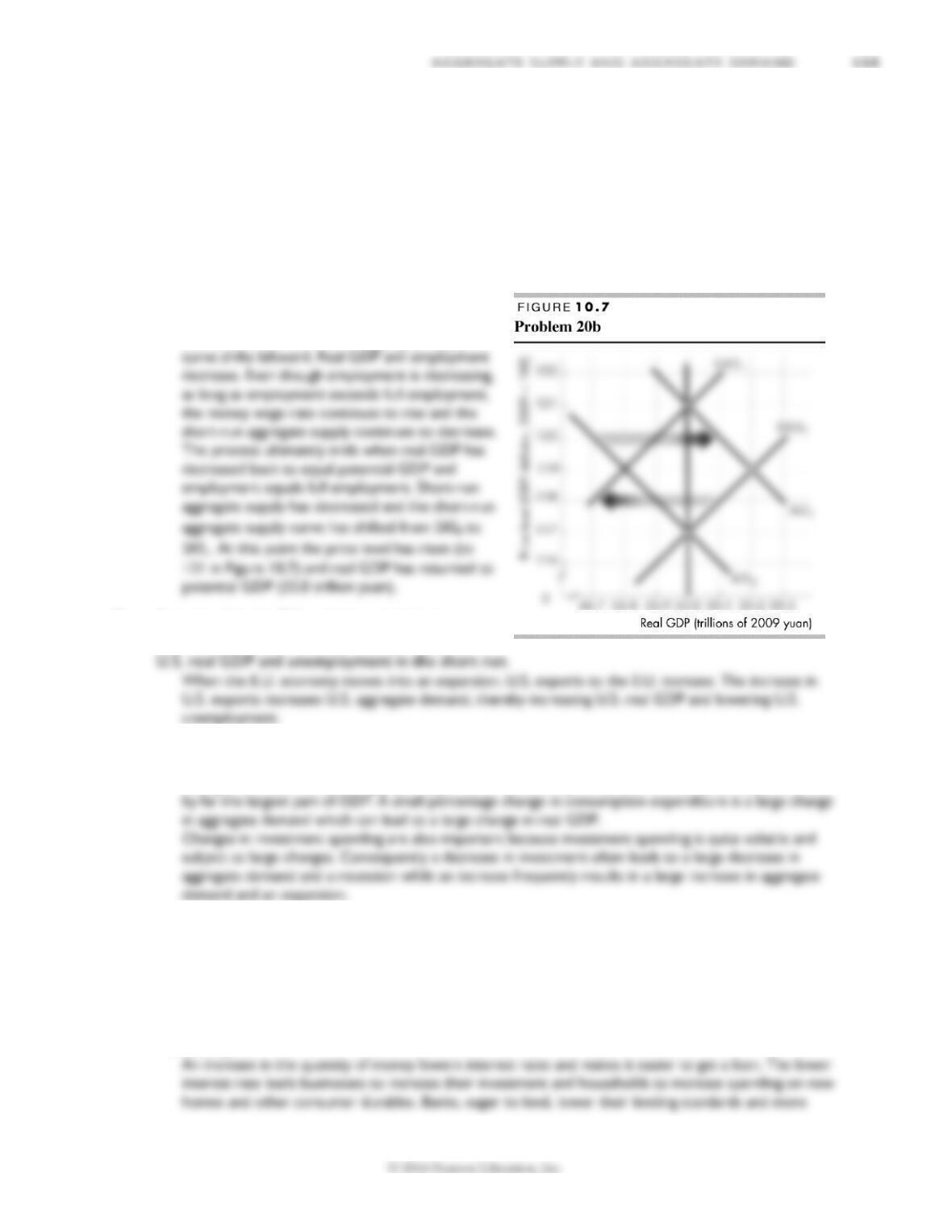
19. Explain the effect of a rise in consumption expenditure on real GDP and the price level in the
short run.
Figure 10.6 (on the next page) shows the effect from the increase in consumption expenditure.
Price level
Real GDP
demanded
Real GDP supplied in
the short run
(trillions of 2005 yen)
75
600
400
85
550
450
125
350
650
135
300
700
20. If the economy had been operating at a full-employment equilibrium,
a. Describe the macroeconomic equilibrium after the rise in consumer spending.
If the economy had been operating at a full-employment equilibrium before the increase in consumer
expenditure, after the increase equilibrium real GDP exceeds potential GDP. The economy is at an
above full-employment equilibrium with an inflationary gap.
b. Explain and draw a graph to illustrate how the economy can adjust in the long run to restore a
full-employment equilibrium.
Figure 10.7 shows how the economy can adjust to its long-run equilibrium. In the short run, real GDP
exceeds potential GDP. Employment exceeds full employment. The tight labor market means that the
money wage rate starts to rise. As the money
wage rate rises short-run aggregate supply
decreases and the short-run aggregate supply
21. Suppose that the E.U. economy goes into an
expansion. Explain the effect of the expansion on
22. Explain why changes in consumer spending and business investment play a large role in the
business cycle.
Changes in consumer spending play a large role in business cycles because consumption expenditure is
23. How to Avoid Recession? Let the Fed Do Its Work
Greg Mankiw wrote in 2007 on the eve of the Global Financial Crisis, “Congress made its most
important contribution to taming the business cycle back in 1913, when it created the Federal
Reserve System. Today, the Fed remains the first line of defense against recession.”
Source: The New York Times, December 23, 2007
a. Describe the process by which action by the Fed in times of recession flows through the
economy.
1 3 6 C H A P T E R 1 0
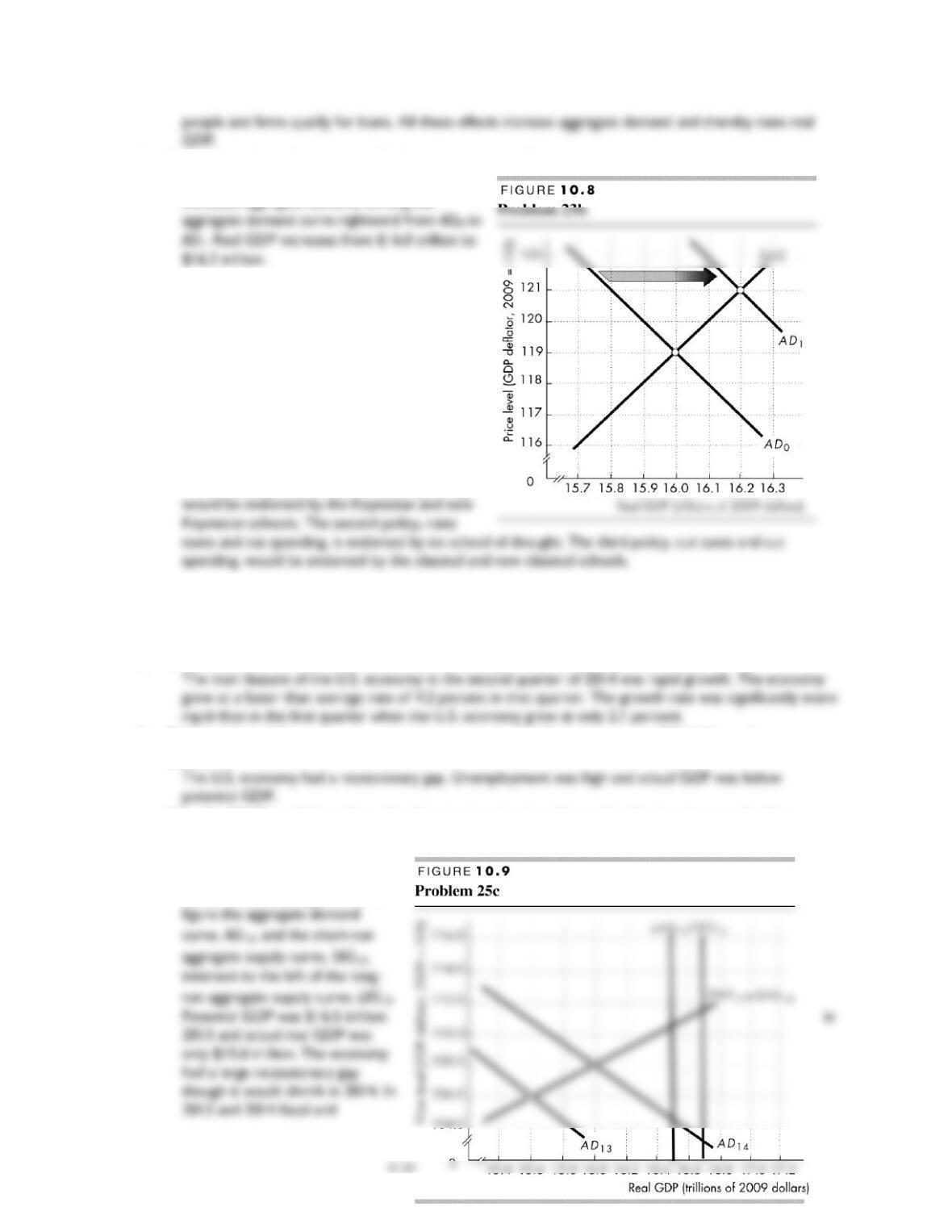
b. Draw a graph to illustrate the Fed’s action and its effect.
Figure 10.8 shows how the Fed’s action
increases aggregate demand, shifting the
24. Cut Taxes and Boost Spending? Raise
Taxes and Cut Spending? Cut Taxes and
Cut Spending
This headline expresses three views about
what to do to get the U.S. economy growing
more rapidly and contribute to closing a large
recessionary gap. Economists from which
macroeconomic school of thought would
recommend pursuing policies described by
each of these views?
The first policy, cut taxes and boost spending,
Economics in the News
25. After you have studied Economics in the News on pp. 258–259 (666–667 in Economics), answer the
following questions.
a. What are the main features of the U.S. economy in the second quarter of 2014?
b. Did the United States have a recessionary gap or an inflationary gap in 2014? How do you
know?
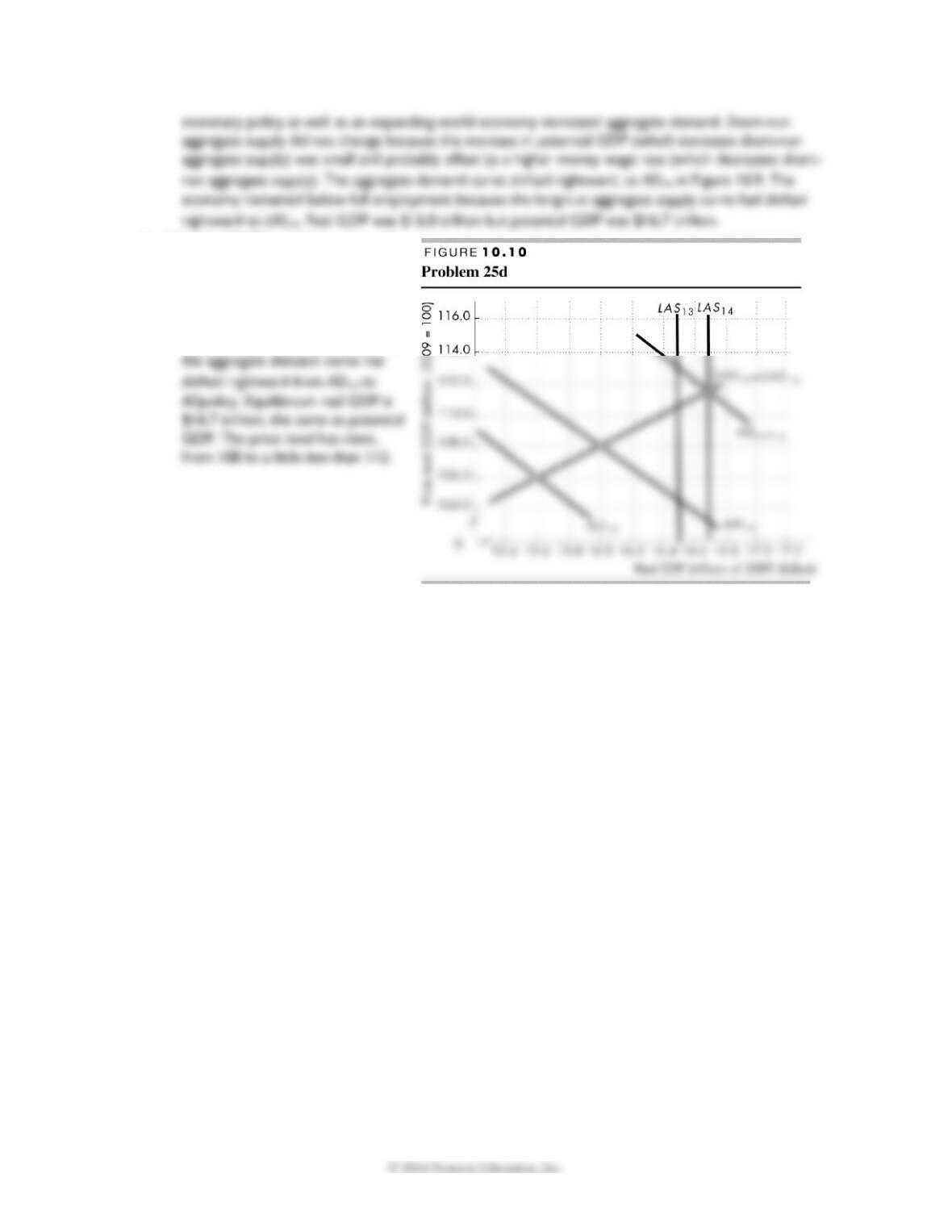
c. Use the AS–AD model to show the changes in aggregate demand and aggregate supply that
occurred in 2013 and 2014 that brought the economy to its situation in mid-2014.
Figure 10.9 shows the changes
between 2013 and 2014. There
was a recessionary gap so in the
A G G R E G A T E S U P P L Y A N D A G G R E G A T E D E M A N D 1 3 7
d. Use the AS–AD model to show the
changes in aggregate demand and
aggregate supply that will have
occurred when full employment is
restored.
Figure 10.10 shows this result. In it
1 3 8 C H A P T E R 1 0
e. Use the AS–AD model to show the changes in aggregate demand and aggregate supply that would
occur if the federal government increased its expenditure on goods and services or cut taxes by
trillion, the same as potential GDP. The price level has risen, from 108 to 112.
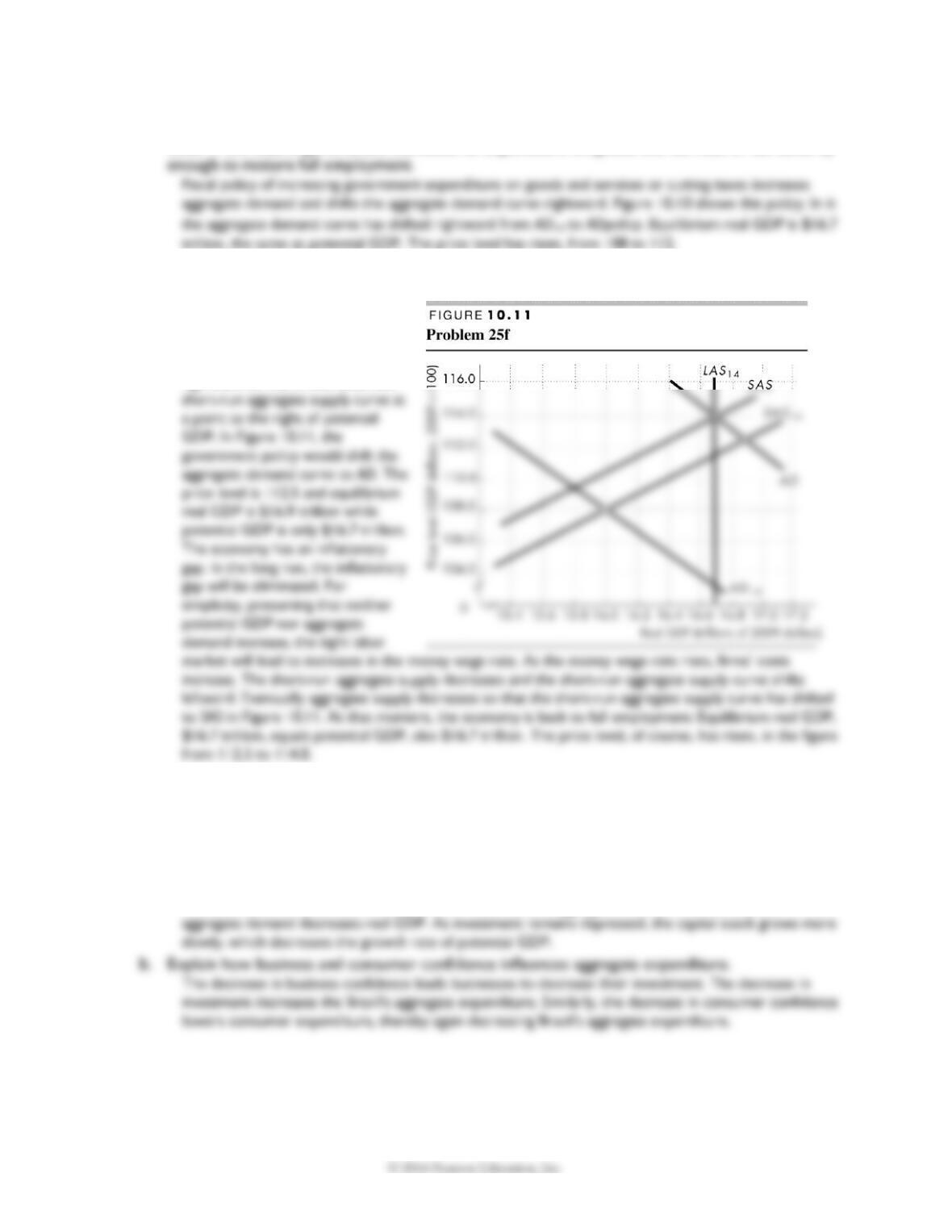
f. Use the AS–AD model to show the changes in aggregate demand and aggregate supply that would
occur if the economy moved into an inflationary gap. Show the short-run and the long-run
effects.
If government policy leads to an
inflationary gap, the aggregate
demand curve will have shifted
rightward so that it intersects the
26. Brazil Falls into Recession
A decade ago, Brazil had rapid growth but now its economy is experiencing a slowdown with
investment falling, and inventories increasing. Potential GDP growth rate has slowed. Business and
consumer confidence has fallen.
Source: BBC News, August 29, 2014
a. Explain the effect of a decrease in investment on real GDP and potential GDP.
The first effect of a decrease in investment is a decrease in aggregate demand. The decrease in