Chapter 10: The Cost of Capital
Comprehensive/Spreadsheet Problem
271
c.
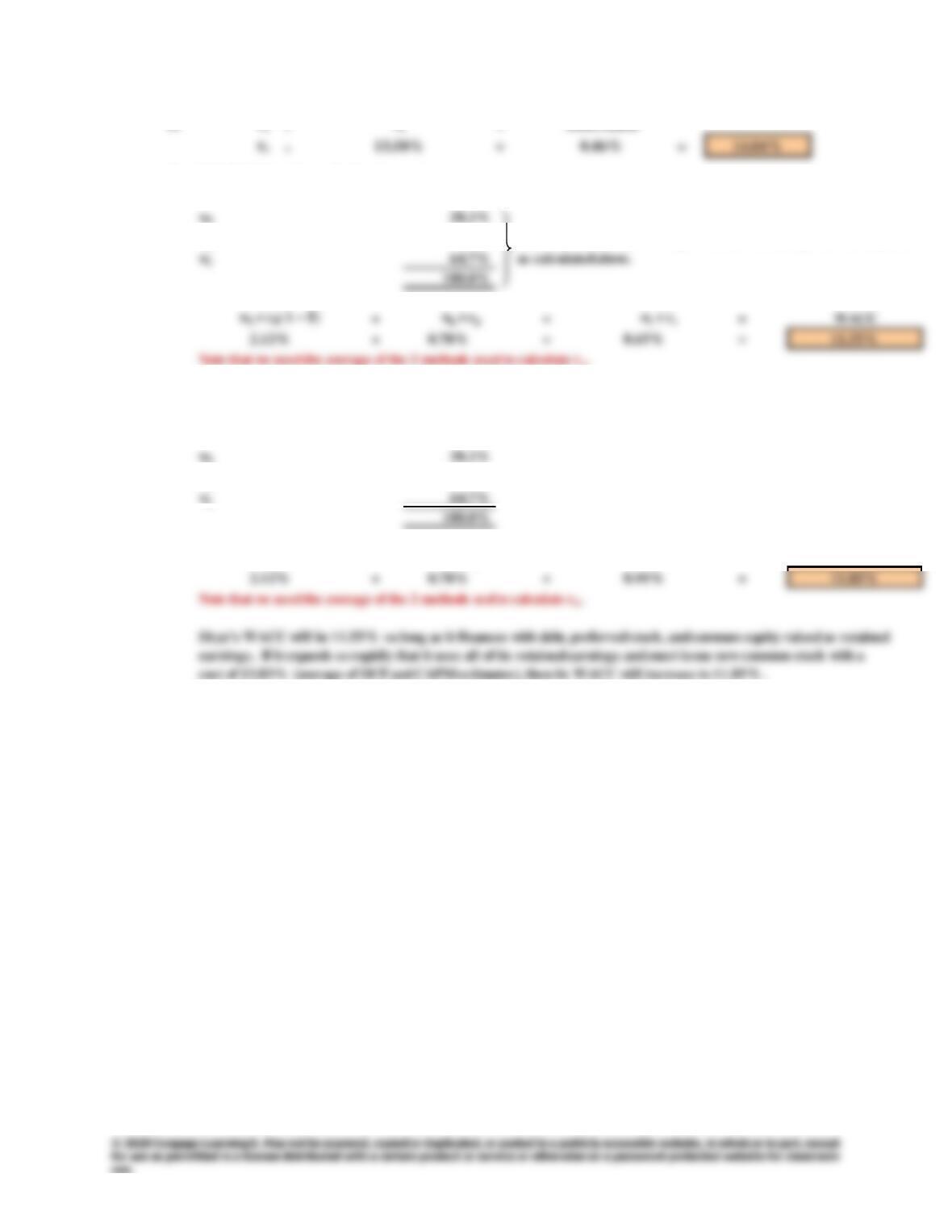
d. (1) WACC using retained earnings
wd28.2%
wp7.1% Note that we used the MV cap. structure excluding current liabilities
(2) WACC using new common stock
wp7.1%
wd × rd( 1 – T) + wp × rp + wc × re = WACC
re = rs+ Differential
272
Integrated Case
Chapter 10: The Cost of Capital
Integrated Case
10–22
Coleman Technologies Inc.
Cost of Capital
Coleman Technologies is considering a major expansion program that has
been proposed by the company’s information technology group. Before
proceeding with the expansion, the company must estimate its cost of capital.
2. The current price of Coleman’s 12% coupon, semiannual payment,
3. The current price of the firm’s 10%, $100.00 par value, quarterly
dividend, perpetual preferred stock is $111.10.
4. Coleman’s common stock is currently selling for $50.00 per share. Its last
1.2, the yield on T-bonds is 7%, and the market risk premium is
5. Coleman’s target capital structure is 30% debt, 10% preferred stock, and
60% common equity.
Chapter 10: The Cost of Capital
Integrated Case
273
To structure the task somewhat, Lehman has asked you to answer the
following questions.
A. (1) What sources of capital should be included when you estimate
Coleman’s WACC?
Answer: [Show S10–1 through S10–4 here.] The WACC is used primarily for
making long-term capital investment decisions, i.e., for capital
budgeting. Thus, the WACC should include the types of capital used to
pay for long-term assets, and this is typically interest-bearing debt,
preferred stock (if used), and common stock. Total debt consists of
A. (2) Should the component costs be figured on a before-tax or an after-
tax basis?
Answer: [Show S10-5 here.] Stockholders are concerned primarily with
those corporate cash flows that are available for their use, namely,
those cash flows available to pay dividends or to reinvest. Since
274
Integrated Case
Chapter 10: The Cost of Capital
A. (3) Should the costs be historical (embedded) costs or new (marginal)
costs?
Answer: [Show S10-6 and S10-7 here.] In financial management, the cost
of capital is used primarily to make decisions that involve raising
marginal costs rather than historical costs.
B. What is the market interest rate on Coleman’s debt and its
component cost of debt?
Answer: [Show S10-8 through S10–12 here.] Coleman’s 12% bond with 15
years to maturity is currently selling for $1,153.72. Thus, its yield
to maturity is 10%:
0 1 2 3 29 30
| | | | • • • | |
-1,153.72 60 60 60 60 60
1,000
Enter N = 2 × 15 = 30, PV = -1153.72, PMT = [(0.12)($1,000)]/2 =
60, and FV = 1000, and then press the I/YR button to find rd/2 =
Chapter 10: The Cost of Capital
Integrated Case
275
Optional Question
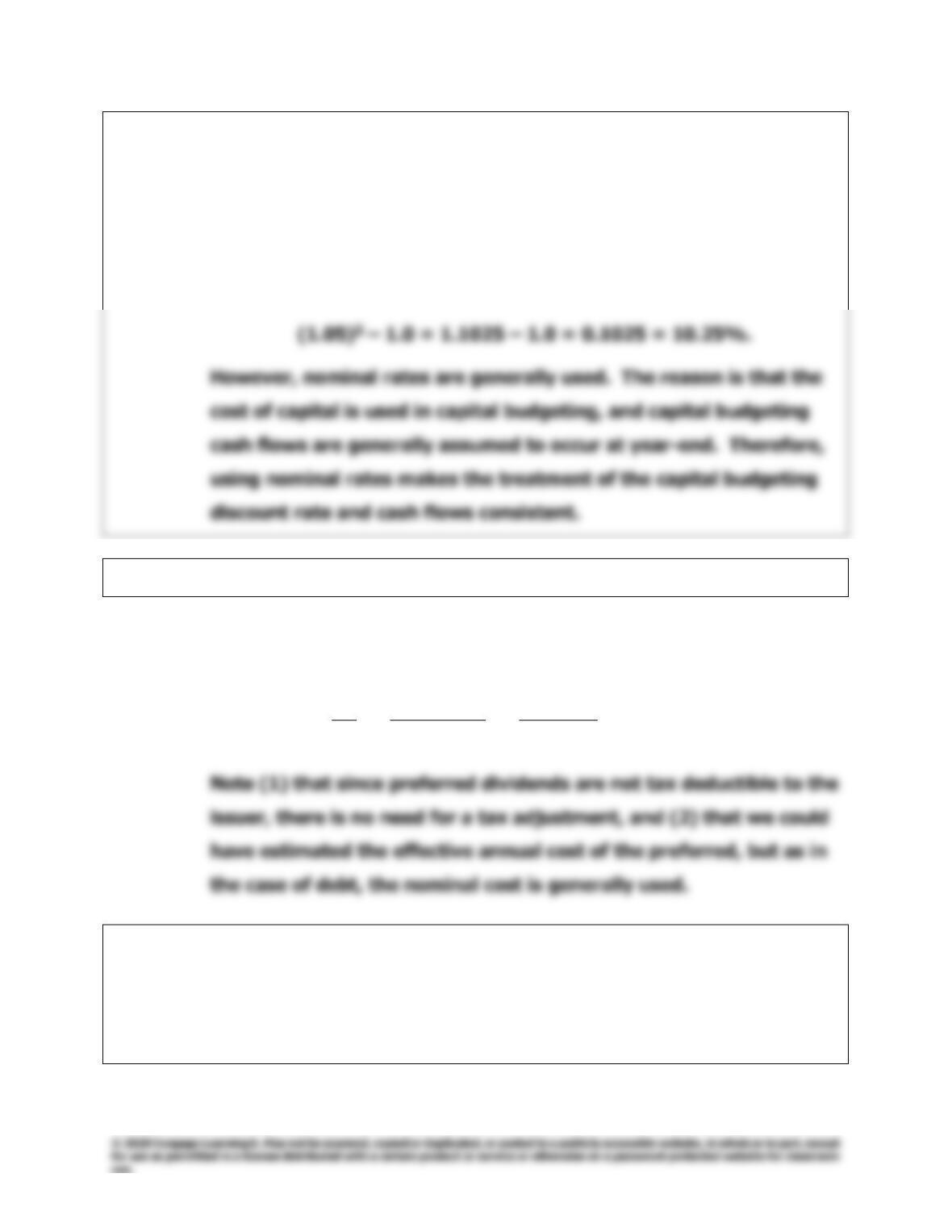
Should you use the nominal cost of debt or the effective annual cost?
Answer: Our 10% pre-tax estimate is the nominal cost of debt. Since the
firm’s debt has semiannual coupons, its effective annual rate is
10.25%:
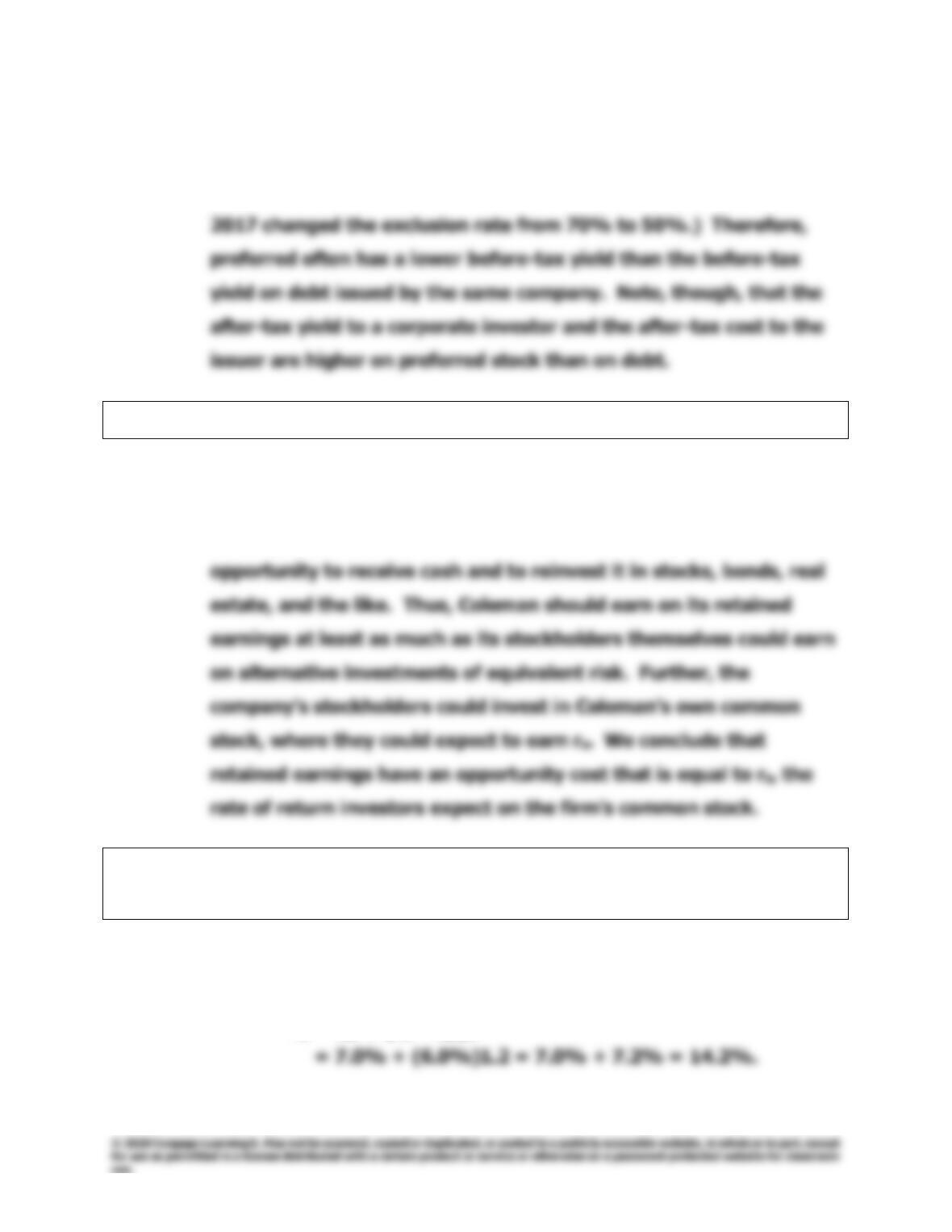
C. (1) What is the firm’s cost of preferred stock?
Answer: [Show S10-13 and S10-14 here.] Since the preferred issue is
perpetual, its cost is estimated as follows:
rp =
p
p
P
D
=
10.111$
)100($1.0
=
10.111$
10$
= 0.090 = 9.0%.
C. (2) Coleman’s preferred stock is riskier to investors than its debt, yet
the preferred’s yield to investors is lower than the yield to maturity
on the debt. Does this suggest that you have made a mistake?
(Hint: Think about taxes.)
276
Integrated Case
Chapter 10: The Cost of Capital
Answer: [Show S10-15 and S10-16 here.] Corporate investors own most
preferred stock, so 50% of preferred dividends received by
corporations are nontaxable. (The new tax law passed in December
D. (1) Why is there a cost associated with retained earnings?
Answer: [Show S10-17 and S10-18 here.] Coleman’s earnings can either be
retained and reinvested in the business or paid out as dividends. If
earnings are retained, Coleman’s shareholders forgo the
D. (2) What is Coleman’s estimated cost of common equity using the
CAPM approach?
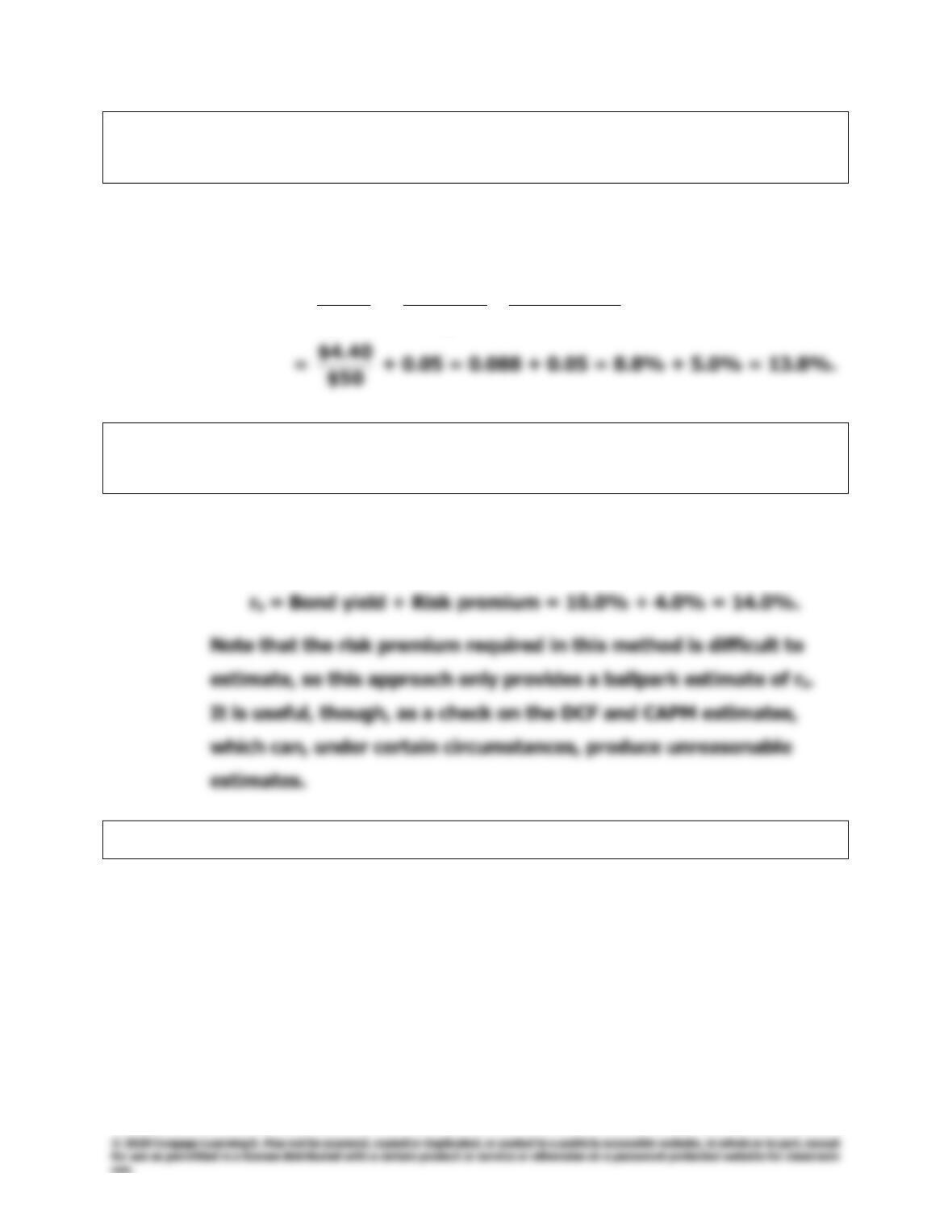
Answer: [Show S10-19 and S10–20 here.] The CAPM estimate for Coleman’s
cost of common equity is 14.2%:
rs = rRF + (rM – rRF)b
Chapter 10: The Cost of Capital
Integrated Case
277
E. What is the estimated cost of common equity using the DCF
approach?
Answer: [Show S10-21 and S10-22 here.] Since Coleman is a constant
growth stock, the constant growth model can be used:
s
r
=
s
r
ˆ
=
gP
D
0
1
+
=
05.0
50$
)05.1(19.4$
P
)g1(D
0
0++
+
F. What is the bond-yield-plus-risk-premium estimate for Coleman’s
cost of common equity?
Answer: [Show S10–23 here.] The bond–yield–plus–risk–premium estimate is
14%:
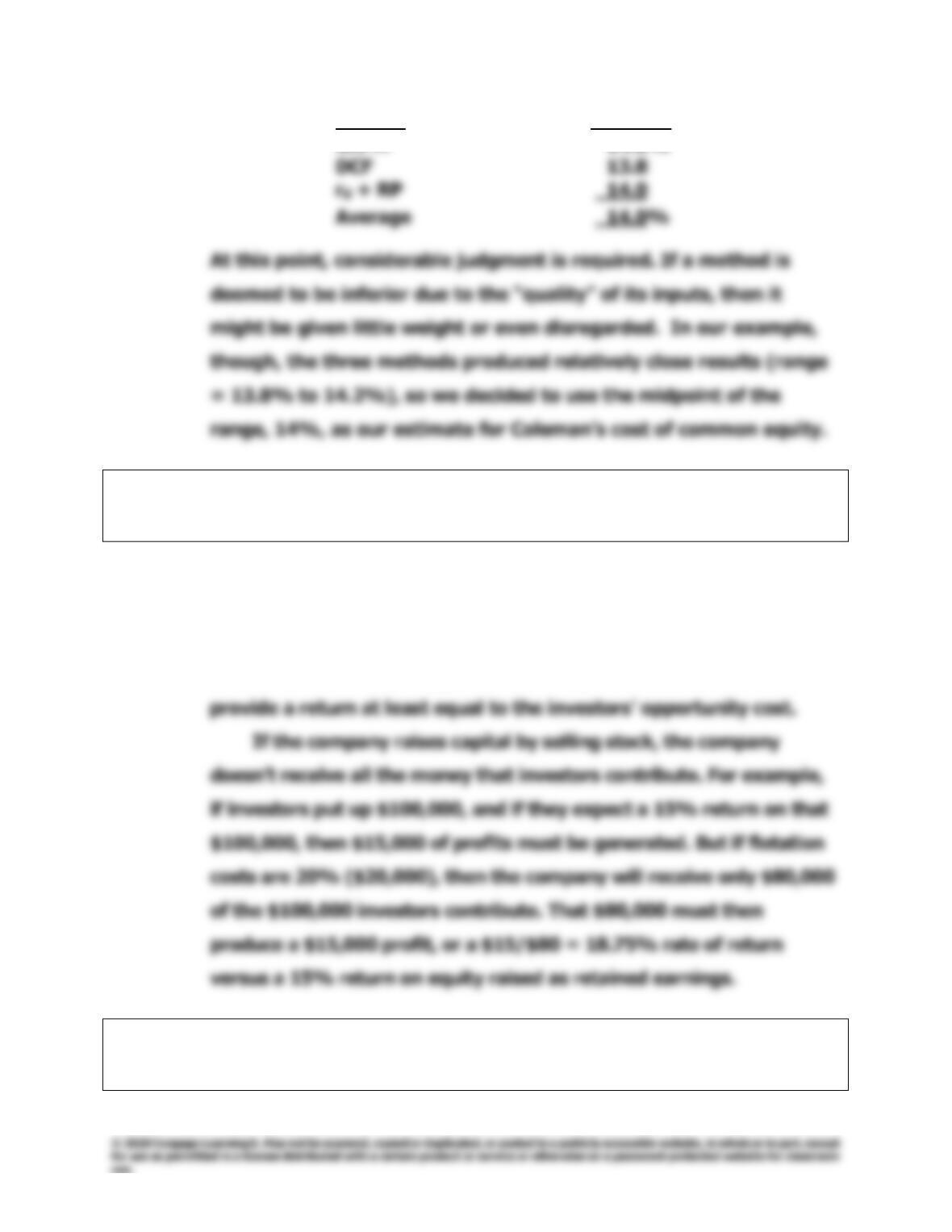
G. What is your final estimate for rs?
Answer: [Show S10–24 here.] The following table summarizes the rs
estimates:
278
Integrated Case
Chapter 10: The Cost of Capital
Method Estimate
CAPM 14.2%
H. Explain in words why new common stock has a higher cost than
retained earnings.
Answer: [Show S10-25 here.] The company is raising money to make an
investment. The money has a cost, and this cost is based primarily
on the investors’ required rate of return, considering risk and
alternative investment opportunities. So, the new investment must
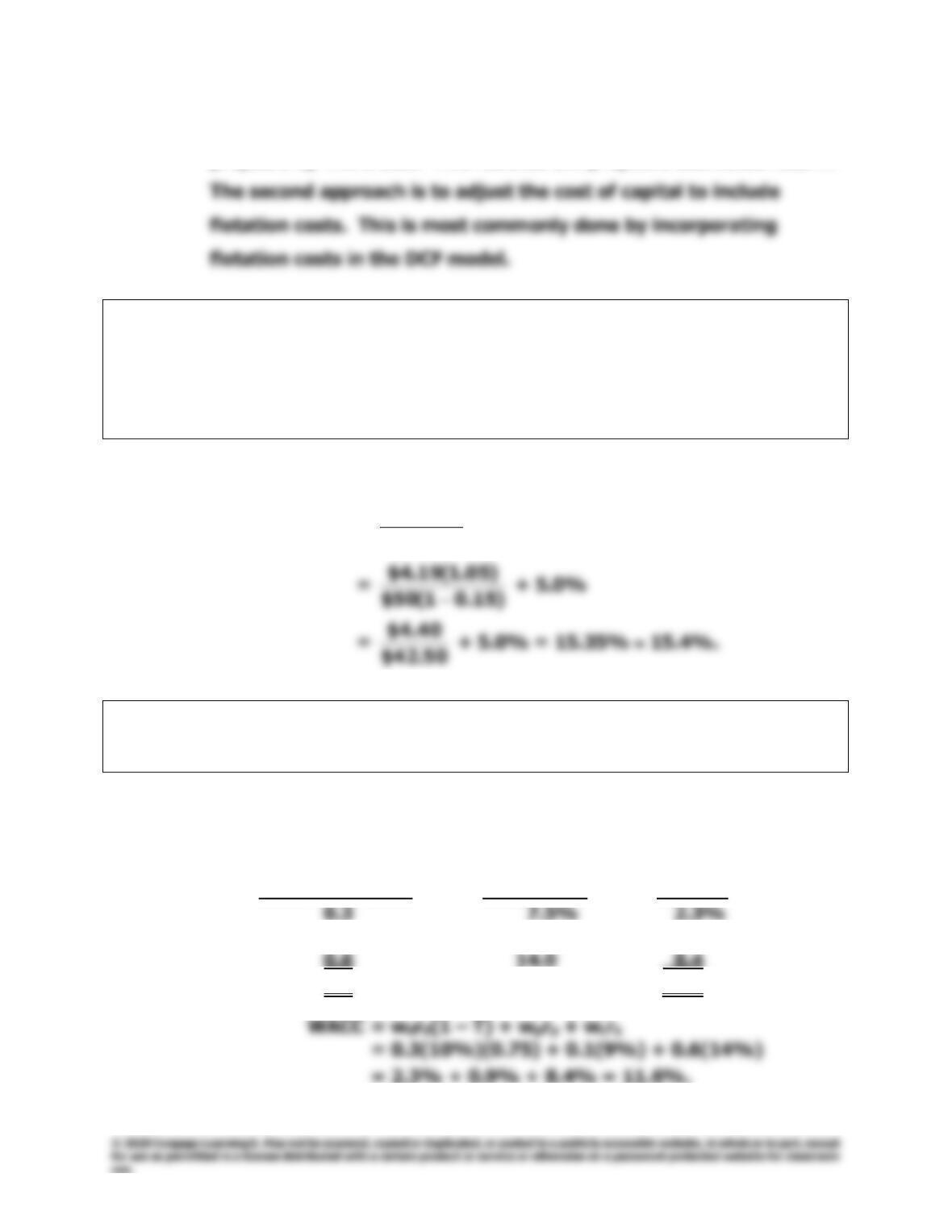
I. (1) What are two approaches that can be used to adjust for flotation
costs?
Chapter 10: The Cost of Capital
Integrated Case
279
Answer: The first approach is to include the flotation costs as part of the
project’s up-front cost. This reduces the project’s estimated return.
I. (2) Coleman estimates that if it issues new common stock, the flotation
cost will be 15%. Coleman incorporates the flotation costs into the
DCF approach. What is the estimated cost of newly issued common
stock, considering the flotation cost?
Answer: [Show S10–26 here.]
re =
)F1(P
)g1(D
0
0
−
+
+ g
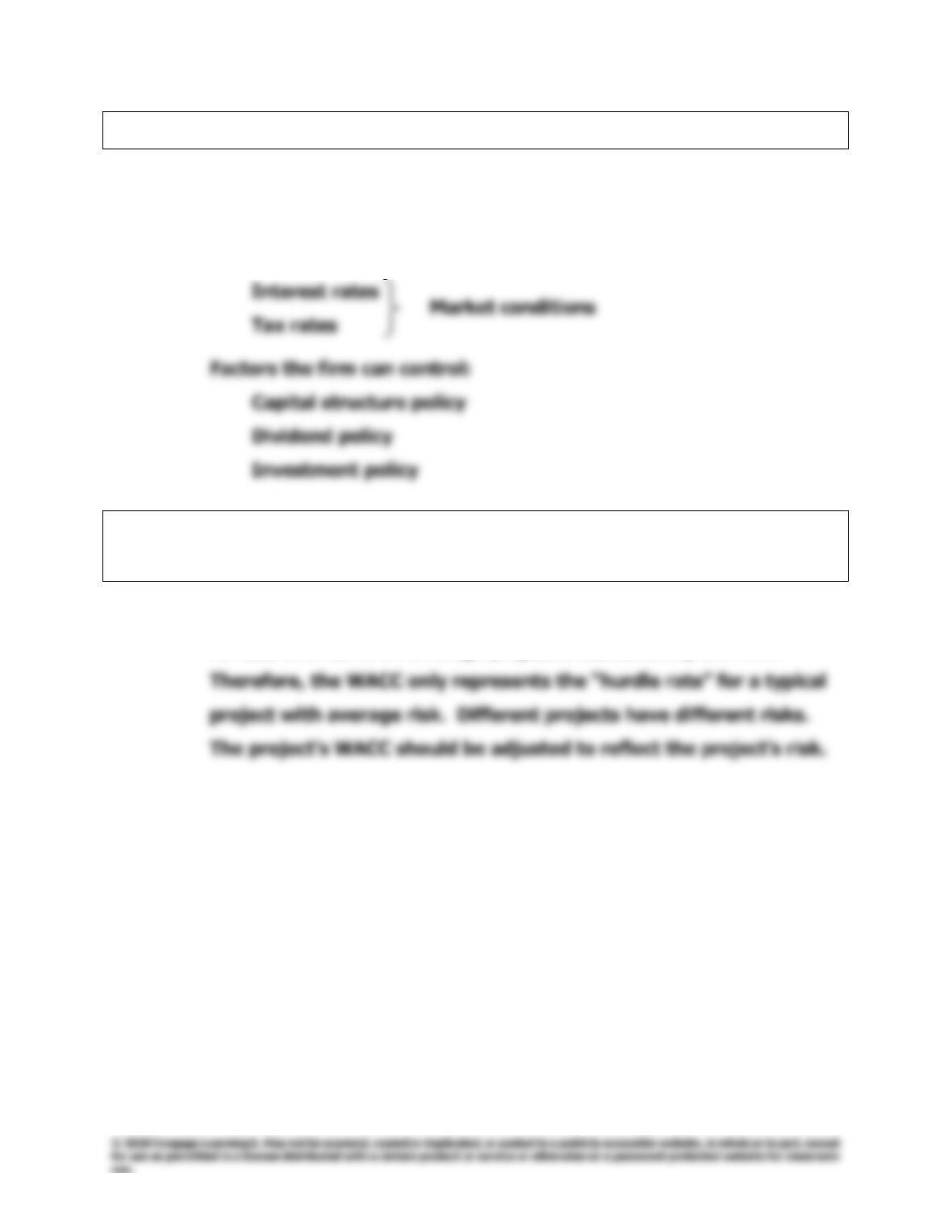
J. What is Coleman’s overall, or weighted average, cost of capital
(WACC)? Ignore flotation costs.
Answer: [Show S10-27 here.] Coleman’s WACC is 11.6%.
A-T
Capital Structure Component
Weights Costs = Product
0.1 9.0 0.9
1.0 WACC = 11.6%
280
Integrated Case
Chapter 10: The Cost of Capital
K. What factors influence Coleman’s composite WACC?
Answer: [Show S10-28 here.] There are factors that the firm cannot control
and those that they can control that influence WACC.
Factors the firm cannot control:
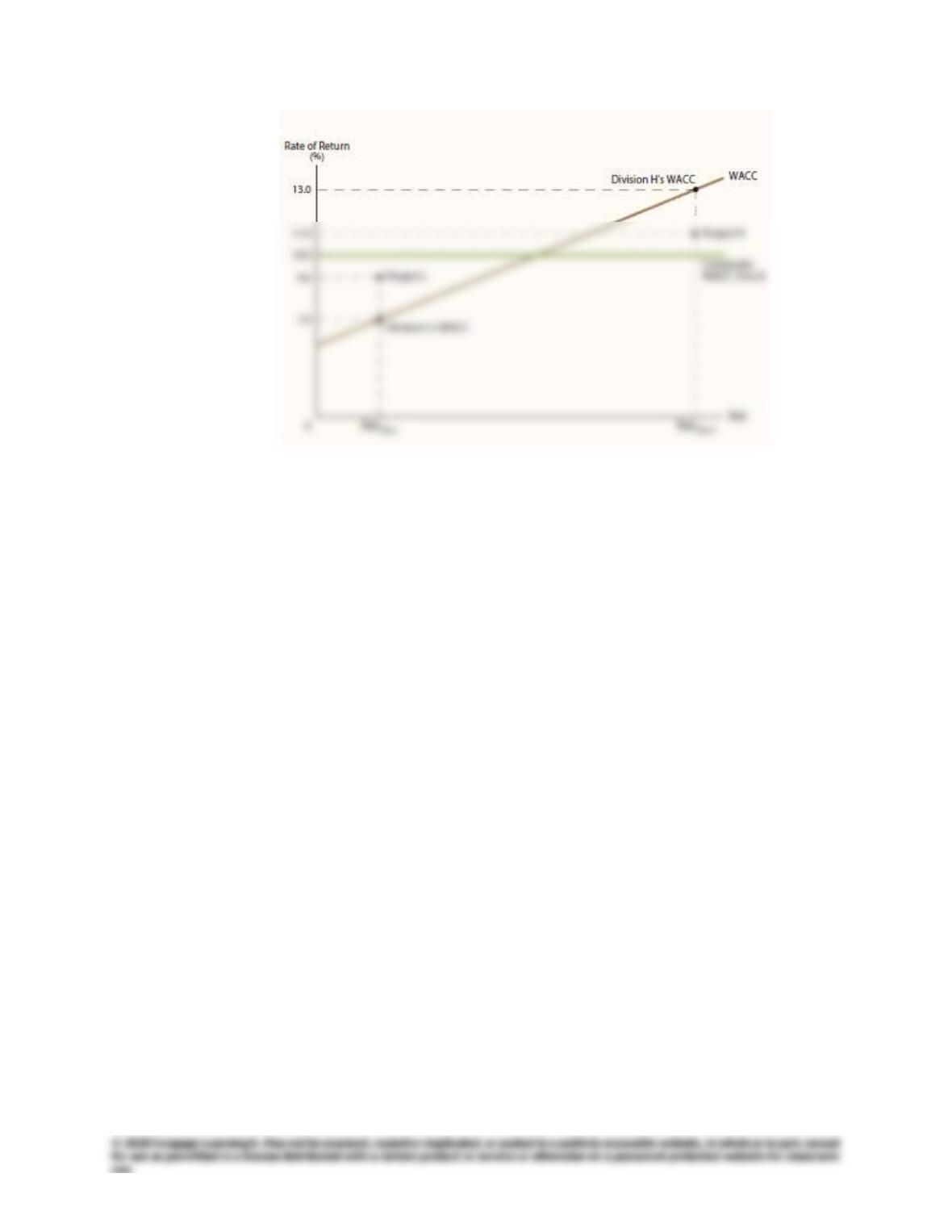
L. Should the company use the composite WACC as the hurdle rate for
each of its projects? Explain.
Answer: [Show S10–29 through S10–31 here.] No. The composite WACC
reflects the risk of an average project undertaken by the firm.
Chapter 10: The Cost of Capital
Integrated Case
281