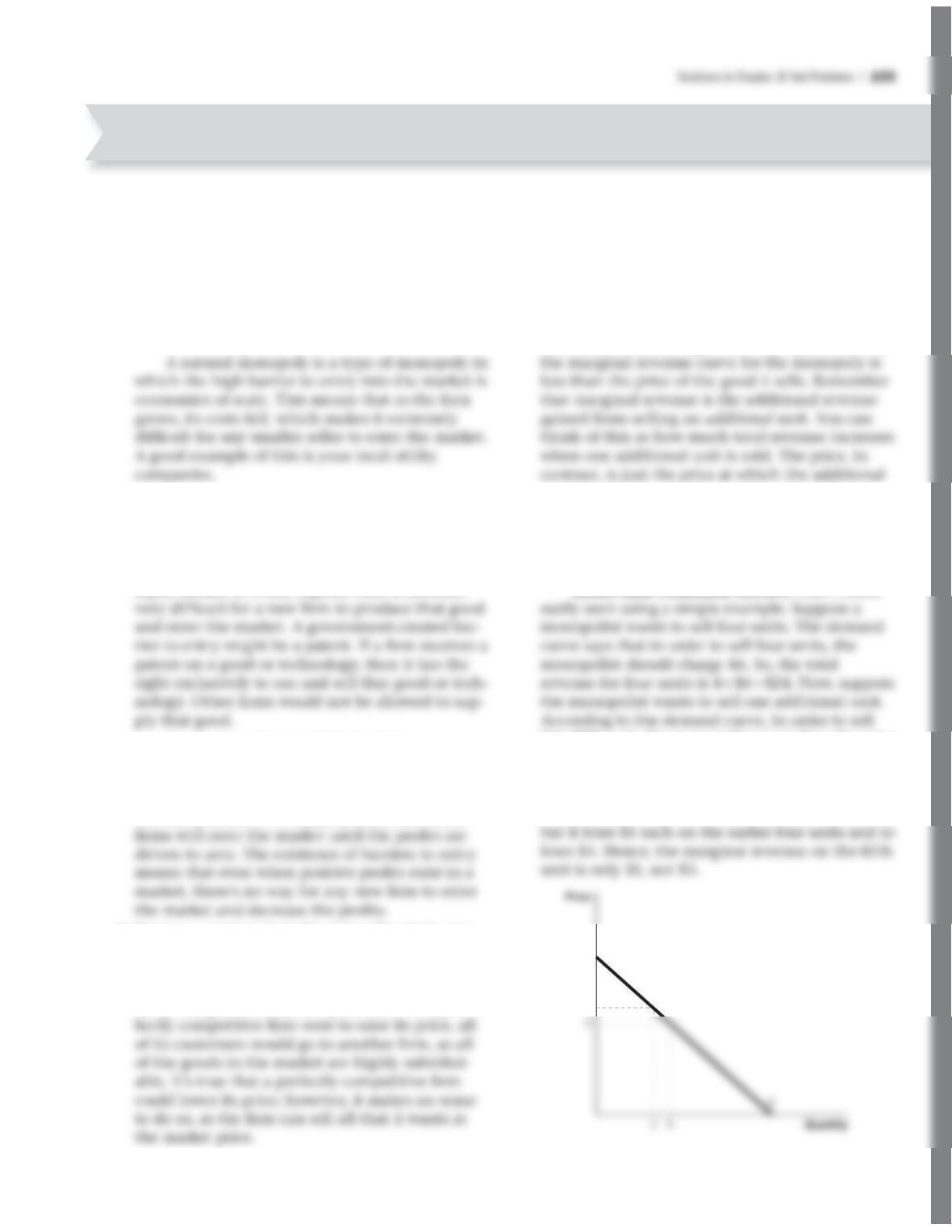
4. A monopolist faces a trade- off when it sets a
price. Because it is the only seller in the market, if
the mono poly wants to sell an additional unit, it
must lower the price because it has sold all it
could sell at the original price. When it lowers
the price on the next unit, it also has to lower the
price of all units. This means that all the units
that came before bring in less revenue; therefore,
unit is sold— the number on the sticker. For a
mono poly, the additional revenue gained from
selling one more unit is actually less than the
price at which the unit sells because it loses
money on all the units that came before it.
this fifth unit, the monopolist must drop the price
to $5. So, the monopolist’s total revenue selling
five units is 5 w $5 “ $25. This means that the
marginal revenue of the fifth unit is $25 $24 “ $1.
This is because the firm earns $5 on the fifth unit,
6
For the fifth unit,
P = 5
MR = 1
Questions for Review
1. A mono poly is a type of market in which there is
only a single seller, which produces a well- defined
good that has no good substitutes. Either the
seller itself or the type of market can be referred
to as the mono poly. A mono poly operates in a
market with high barriers to entry.
2. A barrier to entry is a restriction in a market that
makes it very difficult for competitors to enter.
Barriers can be natu ral or government created.
One example of a natu ral barrier is control of
resources. If a single seller has control of all the
Barriers to entry are impor tant for
monopolies because they allow for the existence
of potential long- run profits. If there are no
barriers to entry (as in a perfectly competitive
market) and one firm enjoys profits, then other
3. Because a mono poly is the only seller in its mar-
ket, it has some control over the price it sets. It
can lower or raise its own price (to a certain
extent) and still sell its goods. In contrast, a per-
fectly competitive firm is a price taker. If a per–
Solutions to Chapterfi10 Text Prob lems
competition). However, this regulation would be
difficult because it would force the firm to operate
at a loss and possibly exit the market.
Study Prob lems
1. The monopolist will produce where MR “ MC,
which is at Q2. The firm will charge the price
given from the demand curve, which is P2. This
charges more than a perfectly competitive firm.
2. a. Your local water com pany is a mono poly; it is
the only com pany in the town that provides
water. It is also likely a natu ral mono poly.
large market share, Walmart does face compe-
tition. You are able to buy toothpaste and
books from Amazon . com or from your local
supermarket and bookstore. Walmart does
have low prices, which might keep some com-
petition out, but it is not a mono poly.
3.
Price Quantity TR MR FC VC TC MC
$10 0 0 8 0 8
91 9985135
8216788163
5. The profit– maximizing output for any firm
(monopolist or not) is to produce where MR “ MC.
This is because if MR # MC, the firm can earn
additional profit by producing another unit, so it
should produce more. If MR !MC, then a firm is
losing money on the last unit and should produce
less. Therefore, firms maximize profits when
MR “ MC.
So, the firm takes the following steps:
1. The firm finds the point where MR “ MC.
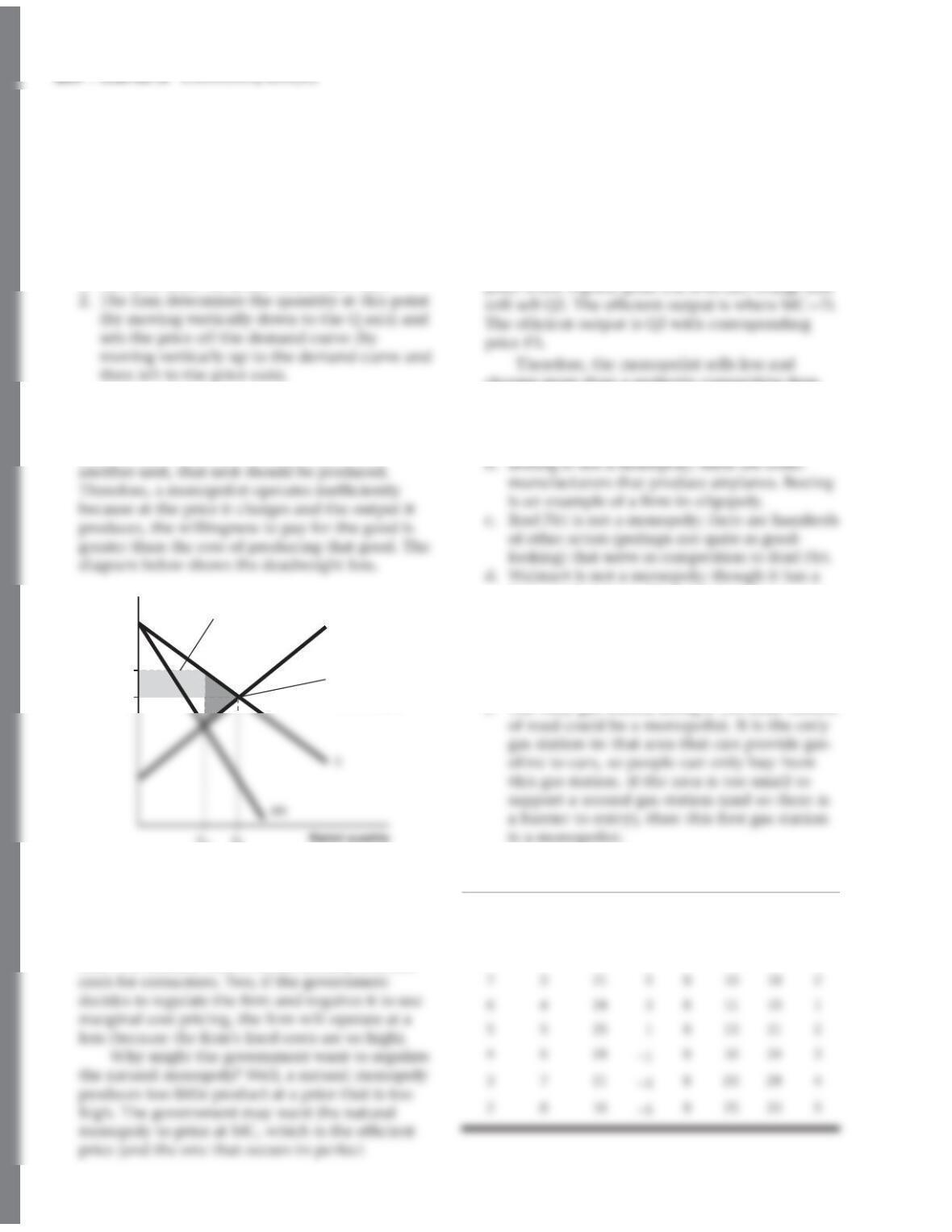
6. The efficient output is where the customer’s will-
ingness to pay is exactly equal to the marginal
cost of the last unit. As long as someone is willing
to pay more than what it costs to produce
Price and
cost
MC
Deadweight loss
associated
with monopoly
Lost consumer
surplus
P
C
Q
C
Q
M
P
M
7. It is difficult to regulate a natu ral mono poly for a
few reasons. One, it is not practical to try to use
the power of competition to regulate a natu ral
mono poly. Because it is a natu ral mono poly, any
competition would face very high costs in order to
enter the market, which would actually increase
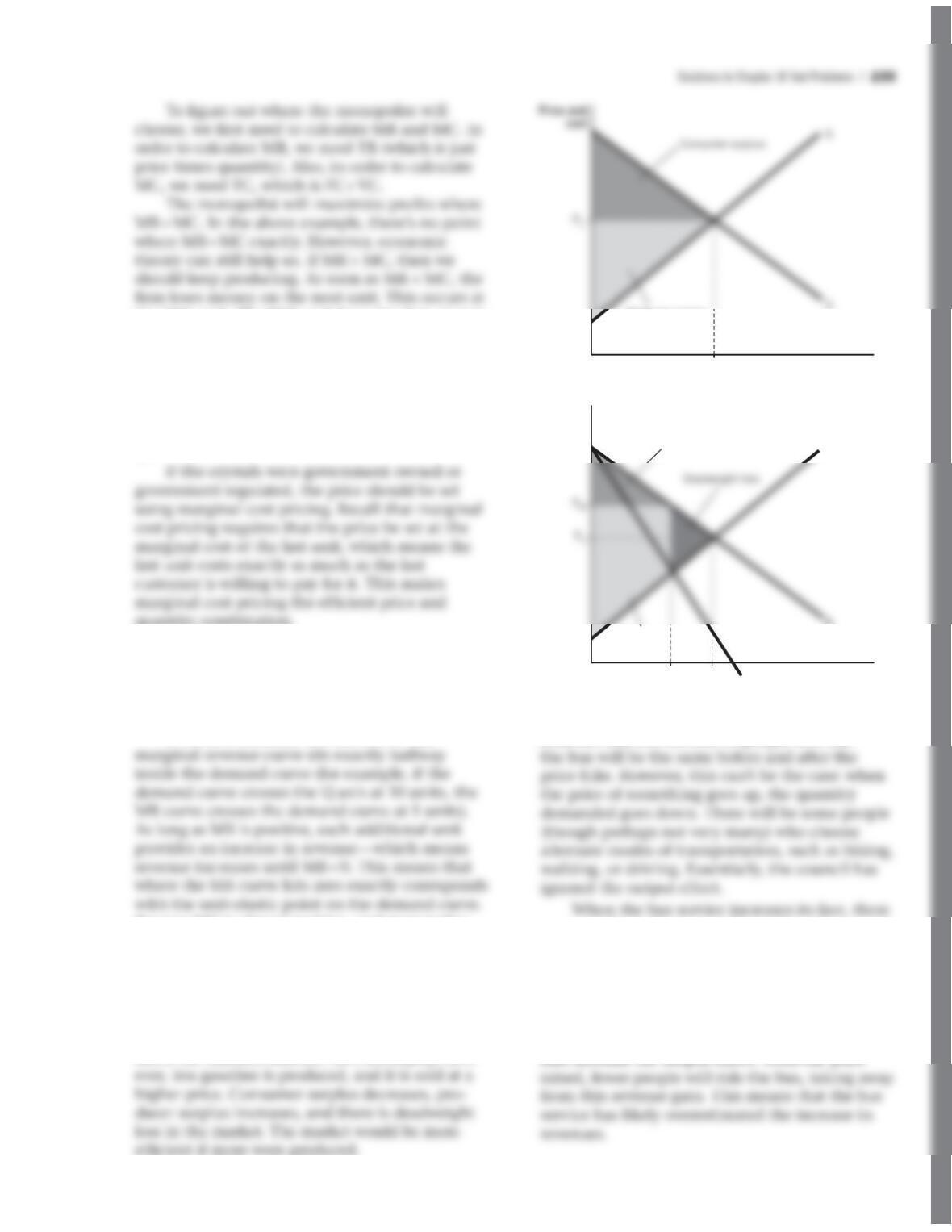
Market
quantity
Producer surplus
QC
D
Market
quantity
QC
D
Price and
cost
MRQM
D
MC
Producer
surplus
Consumer surplus
9. The council’s reasoning is awed because it
are two effects. The price effect tells us how much
revenues will change because of the change in
price, ignoring any change in customer base. If,
indeed, no customers stopped taking the bus, the
price effect would be the only effect, and the bus
ser vice would be able to generate 25% more
revenue. However, the council should also take
the fifth unit. The fifth unit loses the firm money,
so the firm should produce only four units.
4. If there is only one source of dilithium crystals
and no more are found, then the necessary condi-
tions are met for a mono poly. If one firm or
entity buys up or controls the sole source of crys–
tals, then that firm would have a mono poly on
space- time travel.
quantity combination.
7. Recall that the unit– elastic point on the demand
curve is where total revenue is maximized. The
upper portion of the demand curve above this
unit– elastic point is elastic, while the lower por–
tion of the demand curve is inelastic.
Now, let’s examine the MR curve. The
Because MC is always positive, and monopolies
produce where MR “ MC, this intersection must
be where MR is positive. This means that
monopolies produce on the elastic portion of the
demand curve.
8. In a perfectly competitive market, there is no
deadweight loss. Because P “ MC, the market pro–
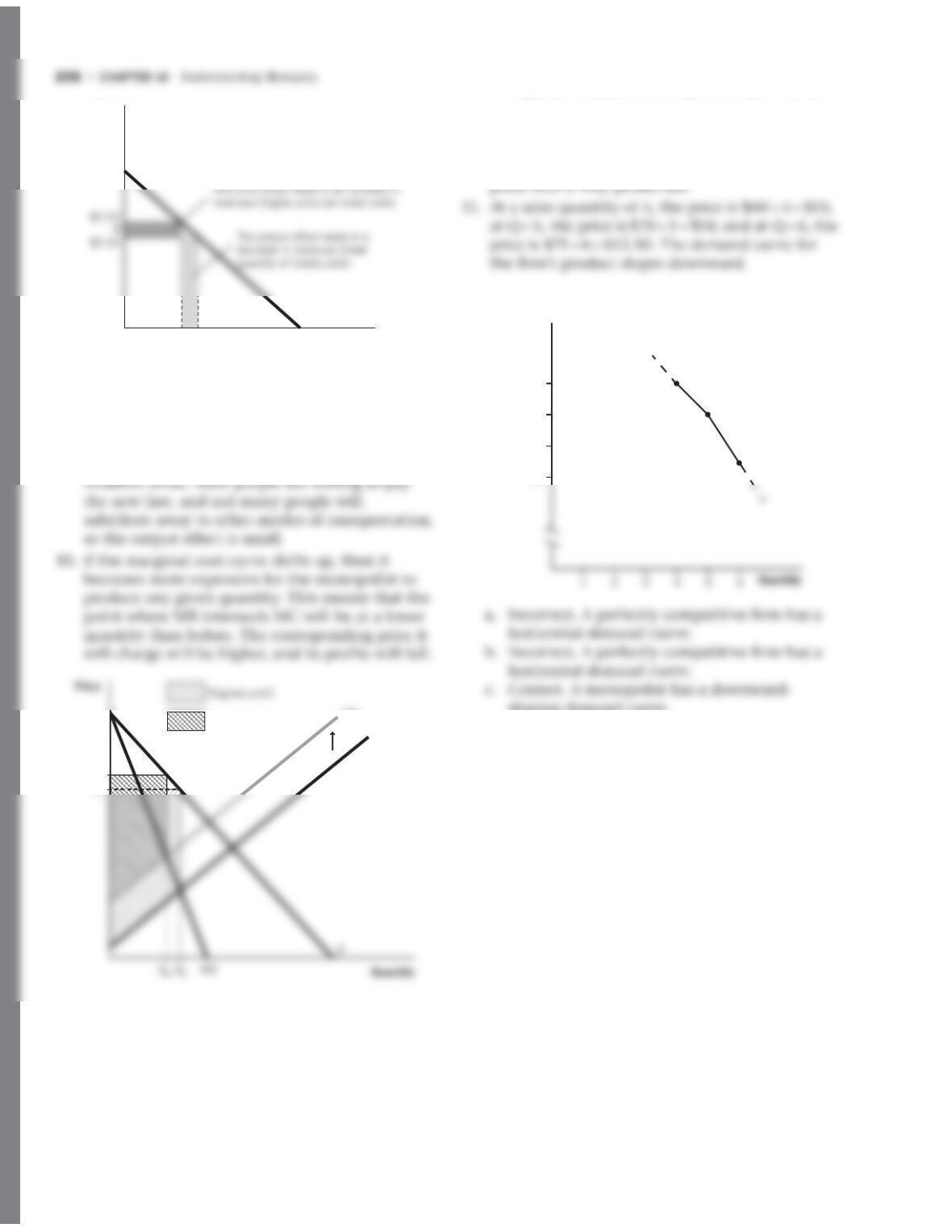
Hints and Common Errors: Though the
price increases, you can still tell graphically that
overall profits will fall. Mathematically, the
increase in costs is greater than the increase in
Price ($)
13
14
15
sloping demand curve.
Price
Q2Q1Quantity
D
Hints and Common Errors: How much
the bus ser vice’s revenues would increase
depends on the elasticity of demand. If demand
is very inelastic (i.e., people are not very
responsive to price), then the price effect will
outweigh the output effect. This should make
MC2
MC1
P2
New profit