CHAPTER 10
(MACRO CHAPTER 10)
Income and Expenditures Equilibrium
FUNDAMENTAL QUESTIONS
1. What does equilibrium mean in macroeconomics?
2. How do aggregate expenditures affect income, or real GDP?
3. What are the leakages from and injections to spending?
OVERVIEW AND OBJECTIVES
The primary purpose of this chapter is to explain the income-expenditure model. This model is the
foundation of modern macroeconomics.
The unique feature of this chapter is the income-expenditure model, which shows how aggregate
expenditures determine the level of real GDP and employment. The concept of macroeconomic
equilibrium—a condition in which leakages equal injections and aggregate expenditures equal real
GDP—is also presented. This chapter also discusses the concept of the multiplier. The appendix to this
chapter shows an algebraic income-expenditures model that is solved for equilibrium real GDP and for
the multiplier.
After reading and reviewing this chapter, the student should be able to:
1. Define equilibrium.
2. Explain the impact of changes in aggregate expenditures on real GDP.
KEY TERM REVIEW
spending multiplier
Chapter 10: Income and Expenditures Equilibrium 73
recessionary gap
LECTURE OUTLINE AND TEACHING STRATEGIES
I. Equilibrium Income and Expenditures
Equilibrium is a point from which there is no tendency to move.
A. Expenditures and income: The
AE
function represents planned expenditures at different
levels of incomes. When expenditures are less than real GDP, inventories are accumulated,
B. Leakages and injections: Leakages reduce autonomous aggregate expenditures. For
equilibrium to occur, leakages must be offset by corresponding injections. When saving,
taxes, and imports are equal to investment, government spending, and exports, leakages
equal injections and the economy is in equilibrium.
II. Changes in Equilibrium Income and Expenditures
Changes in autonomous expenditures shift the aggregate expenditures function and lead to
changes in income.
Teaching Strategy: Point out that the aggregate expenditure model describes how changes in
spending affect the economy in the short run, before prices start changing.
Teaching Strategy: Point out that the aggregate expenditure model developed in this section
illustrates the case where demand creates its own supply.
A. The spending multiplier: The multiplier is the change in equilibrium income that results
example of the multiplier process step by step.
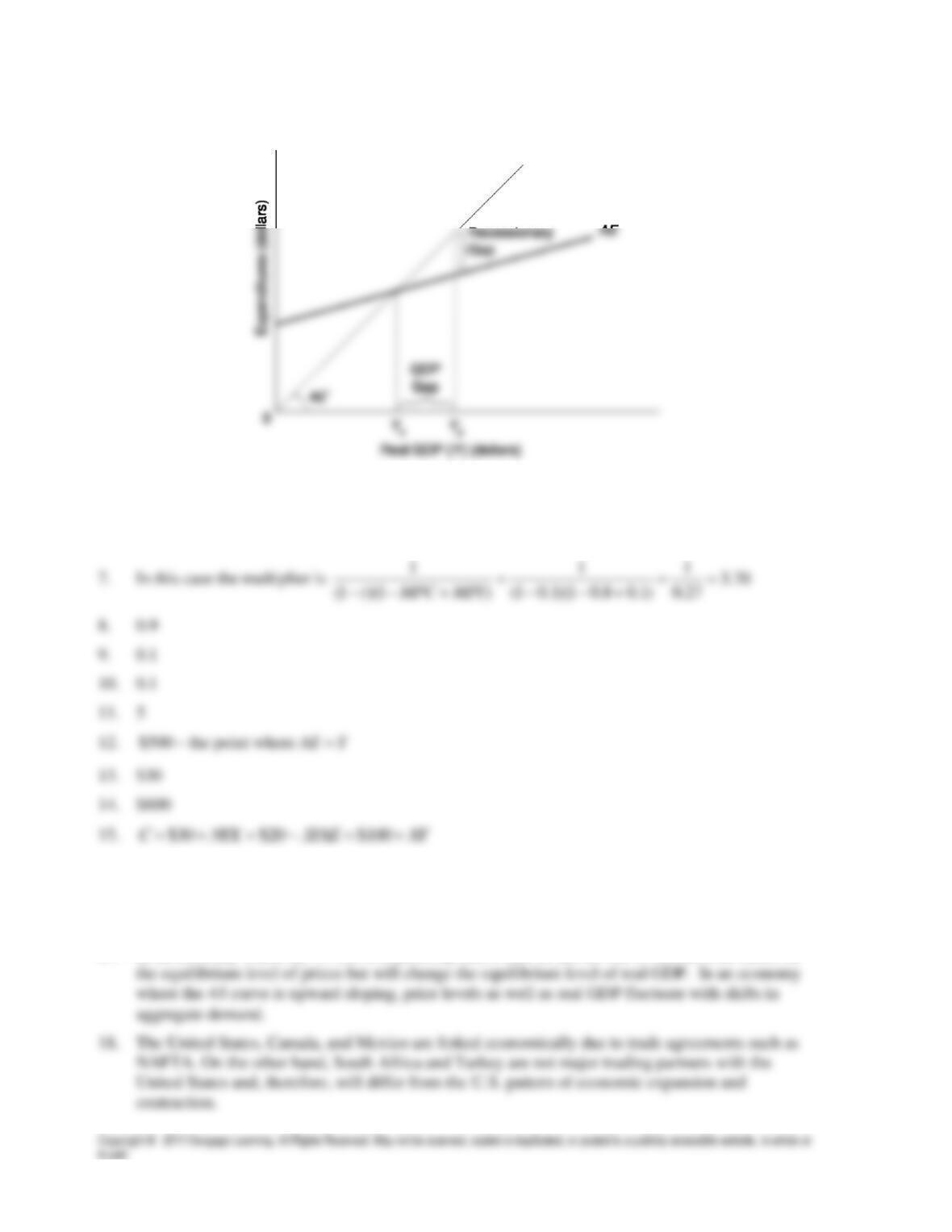
B. The spending multiplier and equilibrium: The recessionary gap is the amount that aggregate
expenditures must increase, given the multiplier, to close the GDP gap. Recall that the
74 Chapter 10: Income and Expenditures Equilibrium
C. Real-world complications
1. Foreign repercussions of domestic imports: Because of foreign repercussions, the
multiplier underestimates true multiplier effects. Price changes and taxes cause the
III. Aggregate Expenditures and Aggregate Demand
Teaching Strategy: Point out that the Keynesian model is best used to analyze what happens in
the short-run, before prices begin to change. Remind students that the Keynesian model assumes
that the supply of goods and services adjusts to
AE
and, therefore, there is no need for price
changes.
A. Aggregate expenditures and changing price levels: The
AE
curve will shift with changes in
OPPORTUNITIES FOR DISCUSSION
1. In what ways is macroeconomic equilibrium similar to individual demand and supply
equilibrium?
2. What real world items complicate the basic spending multiplier? Why do we choose to ignore
these?
ANSWERS TO EXERCISES
1. Inventories always act to make up for any difference between expenditures and income.
Whenever income is greater than expenditures, businesses realize increases in inventories that
Chapter 10: Income and Expenditures Equilibrium 75
2.
3. The equilibrium level of real GDP falls.
4.
a. 5
Income
(Y)
Consumption
(C)
Investment
(I)
Government
Spending
(G)
Aggregate
Expenditures
(AE)
Unplanned
Change in
Inventories
Changes
in Real
GDP
030 50 70 150 –150 Increase
76 Chapter 10: Income and Expenditures Equilibrium
5.
6. When the domestic economy expands, the demand for imports increases. This leads to the
expansion of foreign economies, which leads in turn to additional demand for the output of the
domestic economy by foreigners. Because of this, the actual multiplier is larger than that implied
by our model.
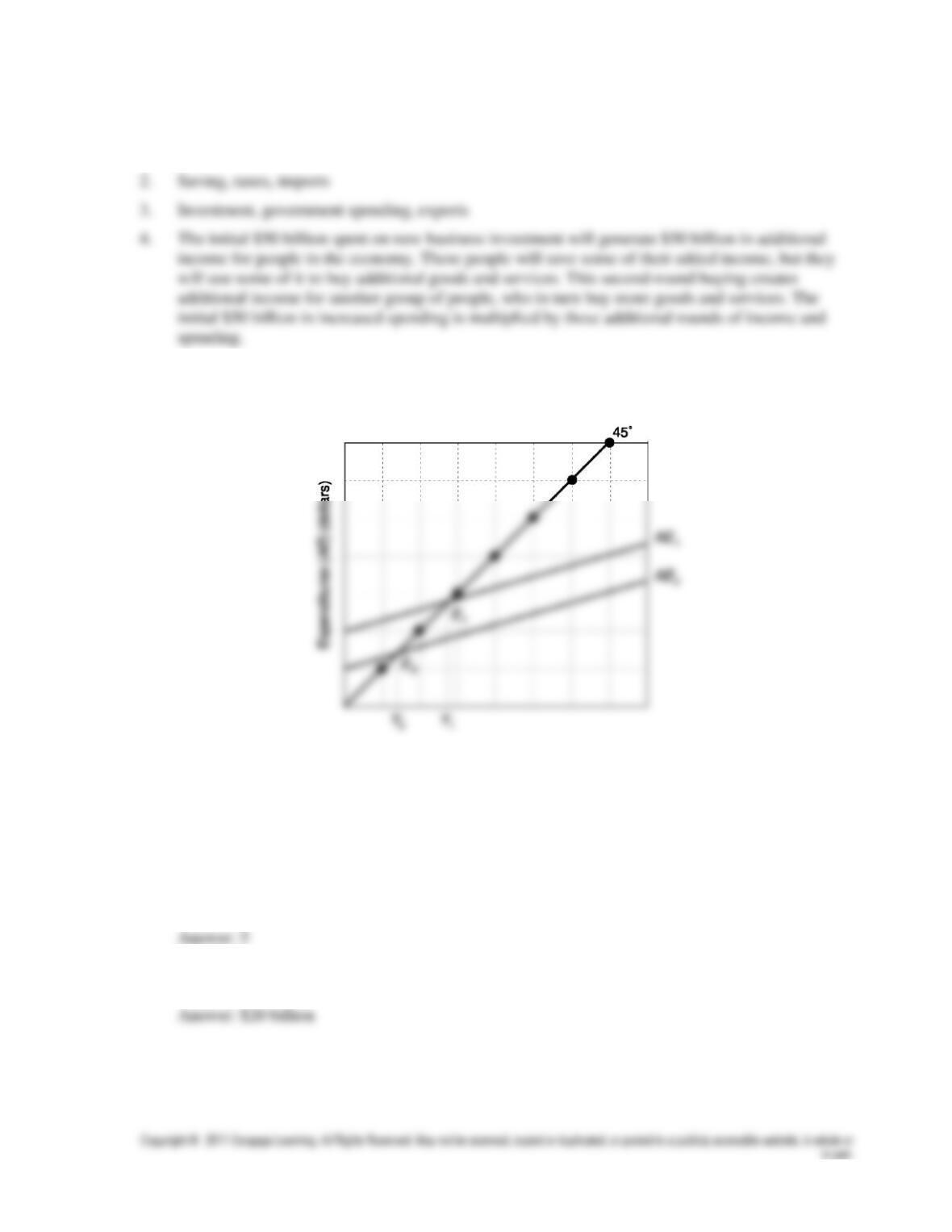
16. See Figure 6 in the text for an example of the derivation. Each point on the aggregate demand
curve corresponds to an aggregate expenditures equilibrium at a particular price level. Movements
along the aggregate demand curve correspond to the aggregate expenditure line moving along the
45-degree line in response to a changing price level.
17. In an economy where the
AS
curve is perfectly flat, a shift in the
AD
curve will have no effect on
Chapter 10: Income and Expenditures Equilibrium 77
ANSWERS TO STUDY GUIDE HOMEWORK
1. Real GDP
5. An increase in interest rates would decrease investment, leading to lower aggregate expenditures
and lower real GDP, as shown in the diagram. A drop in real GDP would hurt a president’s
chances of reelection.
ACTIVE LEARNING EXERCISES
This exercise will test your students’ understanding of the spending multiplier and its relationship to
GDP. When assigning the exercise, be sure to emphasize the importance of these concepts to
understanding business cycles and macroeconomic equilibrium. You will call on different pairs of
students for their answers.
Form the class into pairs of students. Each pair works on the following questions:
1. What is the spending multiplier if the MPC = .8 and the MPI = 0?
2. Given the multiplier found in question 1, if potential real GDP equals $800 billion and current real
GDP equals $700 billion, what is the size of the recessionary gap?
78 Chapter 10: Income and Expenditures Equilibrium
3. How much would investment spending, exports, or government spending have to increase to make
current real GDP equal to potential real GDP?