Chapter 1
NATURE AND SCOPE OF MANAGERIAL ECONOMICS
QUESTIONS & ANSWERS
Q1.1 Is it appropriate to view firms primarily as economic entities?
Q1.1 ANSWER
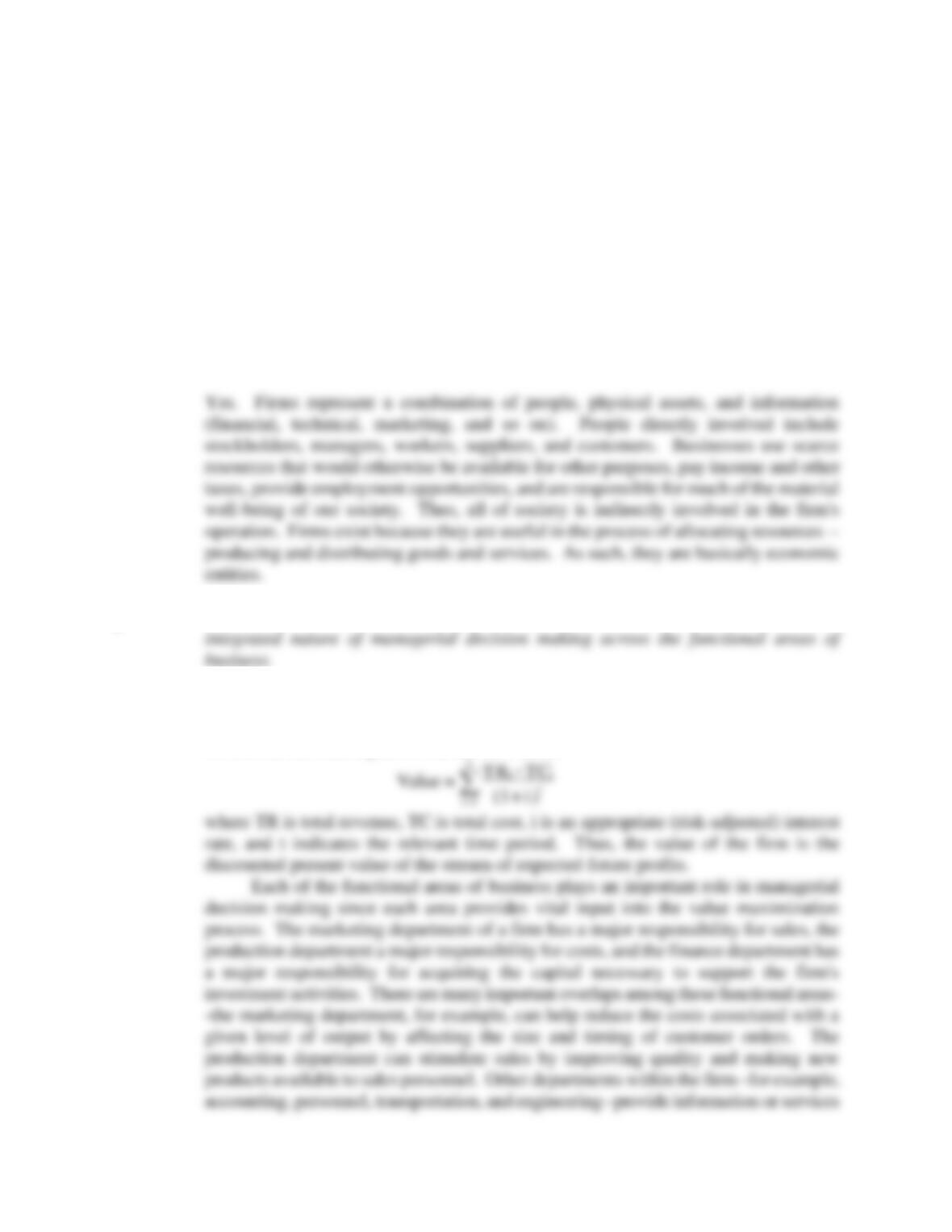
Yes. Firms represent a combination of people, physical assets, and information
Q1.2 Explain how the valuation model given in Equation 1.2 could be used to describe the
Q1.2 ANSWER
As seen in the text, Equation 1.2 can be written:
2 Chapter 1
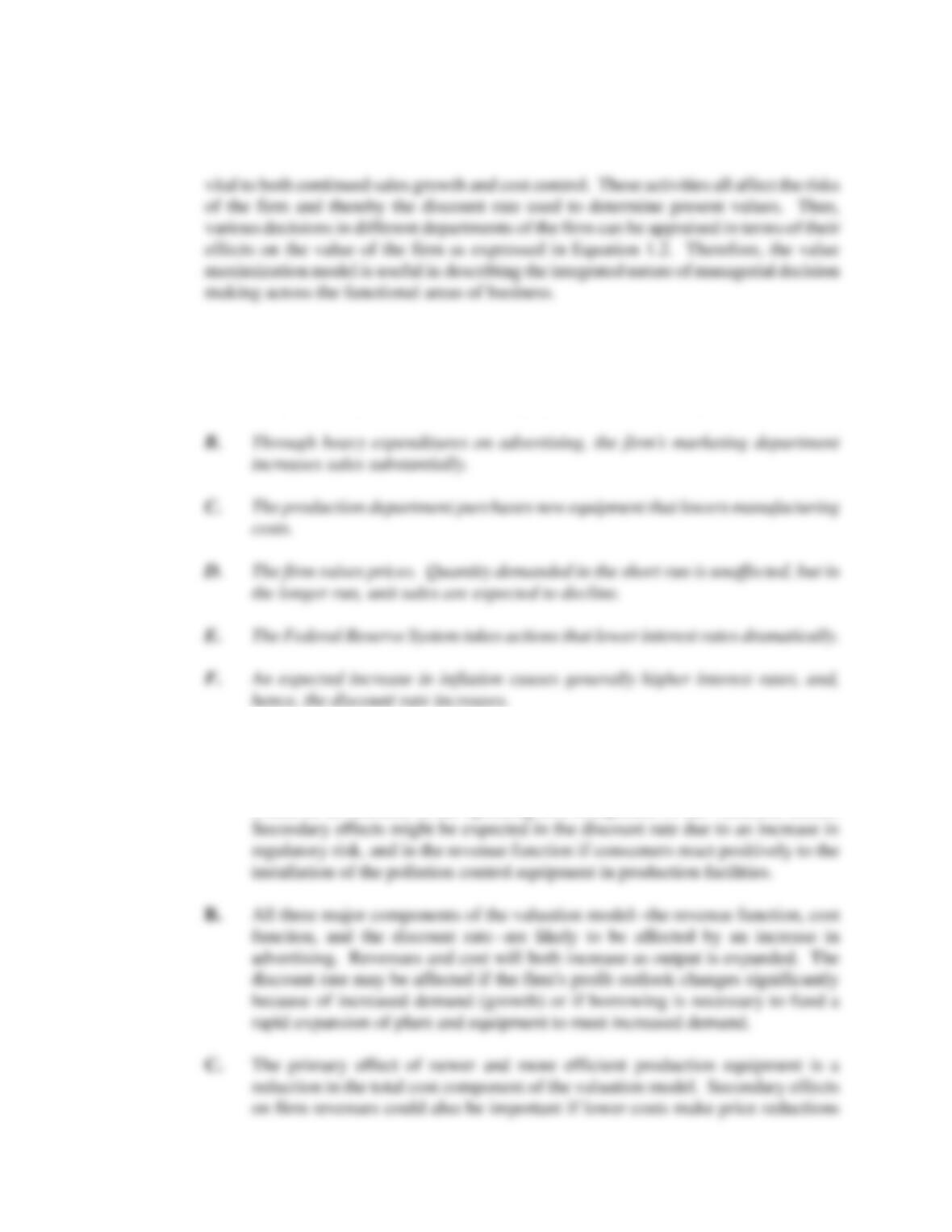
Q1.3 Describe the effects of each of the following managerial decisions or economic
influences on the value of the firm:
A. The firm is required to install new equipment to reduce air pollution.
Q1.3 ANSWER
A. The most direct effect of a requirement to install new pollution control equipment
would be an increase in the operating cost component of the valuation model.
Nature and Scope of Managerial Economics 3
Q1.4 In the wake of corporate scandals at Enron, Tyco, and WorldCom, some argue that
managers of large, publicly owned firms sometimes make decisions to maximize their
own welfare as opposed to that of stockholders. Does such behavior create problems in
using value maximization as a basis for examining managerial decision making?
Q1.4 ANSWER
Q1.5 How is the popular notion of business profit different from the economic profit concept?
What role does the idea of normal profits play in this difference?
Q1.5 ANSWER
The key distinction is that business or accounting profit provides a measure of the total
4 Chapter 1
Q1.6 Which concept—the business profit concept or the economic profit concept—provides
the more appropriate basis for evaluating business operations? Why?
Q1.6 ANSWER
The economic profit concept provides the most appropriate basis for evaluating the
Q1.7 Some argue that prescription drug manufacturers, like Pfizer, gouge consumers with
high prices and make excessive profits. Others contend that high profits are necessary
to give leading pharmaceutical companies the incentive to conduct risky research and
development. What factors should be considered in examining the adequacy of profits
for a firm or industry?
Q1.7 ANSWER
The primary factors one needs to include in an analysis of the adequacy of profits are
interest rate levels and risk. Normal profits must be large enough to fully compensate
Q1.8 Why is the concept of enlightened self-interest important in economics?
Q1.8 ANSWER
The concept of self-interest is important because it provides the underlying rationale for
economic decisions. Consumers and producers make economic decisions in such a
Nature and Scope of Managerial Economics 5
Q1.9 “In the long run, a profit-maximizing firm would never knowingly market unsafe
products. However, in the short run, unsafe products can do a lot of damage.” Discuss
this statement.
Q1.9 ANSWER
The marketing of unsafe products is clearly inconsistent with long-run profit
maximization. For example, no pharmaceutical manufacturer would knowingly market
Q1.10 Is it reasonable to expect firms to take actions that are in the public interest but are
detrimental to stockholders? Is regulation always necessary and appropriate to induce
firms to act in the public interest?
Q1.10 ANSWER
6 Chapter 1
CASE STUDY FOR CHAPTER 1
Is Coca-Cola the “Perfect” Business?
1
What does a perfect business look like? For Warren Buffett and his partner Charlie Munger, vice–
chairman of Berkshire Hathaway, Inc., it looks a lot like Coca-Cola. To see why, imagine going
back in time to 1885, to Atlanta, Georgia, and trying to invent from scratch a nonalcoholic beverage
that would make you, your family, and all of your friends rich.
To keep the lollapalooza effects coming, you will want to advertise. If people associate
your beverage with happy times, they will tend to reach for it whenever they are happy, or want to be
happy. (Isn’t that always, as in “Always Coca-Cola”?) Make it available at sporting events,
concerts, the beach, and at theme parks—wherever and whenever people have fun. Enclose your
product in bright, upbeat colors that customers tend to associate with festive occasions (another
combinatorial effect). Red and white packaging would be a good choice. Also make sure that
customers associate your beverage with festive occasions. Well-timed advertising and price
promotions can help in this regard—annual price promotions tied to the Fourth of July holiday, for
example, would be a good idea.
Nature and Scope of Managerial Economics 7
correctly price the key syrup ingredient, you can ensure that the enormous profits generated by
carefully developed lollapalooza effects accrue to your company, and not to the bottlers. Of course,
you want to offer independent bottlers the potential for highly satisfactory profits in order to provide
the necessary incentive for them to push your product. You not only want to “leave something on
the table” for the bottlers in terms of the bottlers’ profit potential, but they in turn must also be
return on invested capital, Coca-Cola earns three and four times as much. Typical profit rates, let
alone operating losses, are unheard of at Coca-Cola. It enjoys large and growing profits, and
requires practically no tangible capital investment. Almost its entire value is derived from brand
equity derived from generations of advertising and carefully nurtured positive lollapalooza effects.
On an overall basis, it is easy to see why Buffett and Munger regard Coca-Cola as a “perfect”
business.
A. One of the most important skills to learn in managerial economics is the ability
to identify a good business. Discuss at least four characteristics of a good
business.
B. Identify and talk about at least four companies that you regard as having the
8 Chapter 1
CASE STUDY SOLUTION
A. Interesting perspective on the characteristics of wonderful businesses has been given by
legendary Wall Street investors T. Rowe Price and Warren E. Buffett. The late T.
Rowe Price was founder of Baltimore-based T. Rowe Price and Associates, Inc., one of
To apply Price’s and Buffett’s investment criteria successfully, business
managers and investors must be sensitive to fundamental economic and demographic
trends. Perhaps the most obvious of these is the aging of the population. Health-care
demands will continue to soar. In recognition of this fact, investors have bid up the
shares of companies offering prescription drugs, health care, and health-care cost
containment (e.g., home health agencies). Perhaps less obvious is that an aging and
increasingly wealthy population will save growing amounts for their children’s
education and retirement. This bodes well for mutual fund operators, insurance
companies, and other firms that offer distinctive financial services.
B. The American Express Company, Coca-Cola, Procter & Gamble, and Wells Fargo are
well-known examples of major common stock holdings of Warren Buffett’s Berkshire
Hathaway, Inc. Each of Berkshire’s major holdings are large capital-intensive
companies with long operating histories of above-average rates of return. Like any
Nature and Scope of Managerial Economics 9
case, attractive financial and operating statistics reflect essentially attractive economic
characteristics of each company.
The American Express Company is a premier travel and financial services firm
that is strategically positioned to benefit from aging baby boomers. The Coca-Cola
The late T. Rowe Price was prone to invest in high-tech companies that produced
distinctive products. On the other hand, Buffett is fond of saying that he doesn’t
“understand” high-tech and doesn’t want to be blown out of business by a few guys
“working in a garage somewhere.” Of course, Buffett’s thinly-veiled reference to
C. Above-normal returns from investing in wonderful businesses are only possible to the
extent that such advantages are not fully recognized by other investors. In the case of
T. Rowe Price, early investments in Avon Products, Xerox, and IBM generated
fantastic returns because Price saw their awesome potential far in advance of other
investors. On the other hand, Buffett has profited by taking major positions in
wonderful companies that suffer from some significant, but curable, malady. In 1991,

10 Chapter 1