Chapter 1
The United States in a Global Economy
◼ Outline
Introduction: International Economic Integration
Elements of International Economic Integration
The Growth of World Trade
Capital and Labor Mobility
Features of Contemporary International Economic Relations
Trade and Economic Growth
Twelve Themes in International Economics
The Gains from Trade and New Trade Theory (Chapters 3, 4, and 5)
Wages, Jobs, and Protection (Chapters 3, 6, 7, and 8)
Trade Deficits (Chapters 9, 11, and 12)
Regional Trade Agreements (Chapters 2, 13, and 14)
The Resolution of Trade Conflicts (Chapters 2, 7, and 8)
◼ A Thumbnail Sketch of the Material Covered in Chapter 1
The goal of Chapter 1 is to examine international economic integration in historical perspective. Most
features of globalization aren’t new, and international economic integration is described as re-emerging
after a period of disruption during World War I, the Great Depression, and World War II. The chapter adds
a brief discussion of new features in the current wave of globalization, including regional trade agreements
and multilateral organizations. It also briefly discusses three types of evidence to support the idea of gains
from trade: historical experiences of similar countries such as North and South Korea; economic theory;
and large statistical comparisons of countries.
2 Gerber • International Economics, Sixth Edition
There are three aspects of international economic integration considered:
1. The growth of world trade. World trade has grown over the last sixty or seventy years but is roughly
comparable in percentage terms to trade in 1900.
Trade has become a larger share of national economies as measured by the:
2. Capital and labor mobility. Labor is much less mobile internationally now than it was in 1900.
For capital, it is somewhat more mobile. There is a difference between financial capital and physical
capital. Foreign Direct Investment (FDI) is the flow of capital representing physical assets such as
real estate, factories, and businesses. While capital flows to developing countries have increased in
recent decades, the level of investment in any country is still correlated with its domestic level of
savings, making national savings rates an important element in national economies.
Capital flows today differ from earlier periods in three ways. More types of financial instruments
3. Movement of prices in different markets. The text does not develop this, but points out that in the
late 1800s wheat farmers, meat packers, and fruit growers all produced for a global market where
international, rather than domestic, supply and demand determined prices. News reports today could
easily demonstrate this for most commodities.
New issues in international trade and investment:
1. Deeper integration. Barriers to manufactured goods have fallen significantly as a result of a process
that began at the end of WWII. As formal restrictions on imports have been reduced, domestic
2. Regional trade agreements. Since the 1960s, and increasingly after 1990, nations have formed
preferential trade agreements with one or more other nations. The European Union, NAFTA,
3. Multilateral organizations. While the number of preferential trade agreements has grown
dramatically, it has occurred within an international economic environment that contains several
key international institutions: the WTO, IMF, and World Bank are each important and are the main
institutions discussed in the text. Their roles are discussed more fully in Chapter 2.
Economists are in agreement that the benefits of trade outweigh the costs, although there is a great deal of
◼ What Students Should Know after Reading Chapter 1
Chapter 1 challenges the belief that the world has embarked on an entirely new and unprecedented era of
globalization. In the long run, it seems clear that the period 1870 to 1914 was an earlier era with similar
trends. Those years experienced rapid technological change, which came into widespread use in the form of
railways, steamships, and telegraphs; they underwent business and financial sector innovation through
rapid growth in the corporate form of business organization, the invention and spread of demand deposits,
and the development of stock markets; trade policies were liberalized in many nations; and there were
widespread protests against immigration and the global economy. In the United States, the protest
movement was centered in populist movements that are reminiscent of the rhetoric of some politicians and
commentators today.
This is not an argument about history repeating itself. Rather, it is an attempt to encourage students to
think of the period from World War I to the end of World War II as an aberration in the last 150 years of
world history. The long-run trend is toward integration, punctuated by protests and nationalistic
It is useful for students to realize two points. First, much of what has happened over the last fifty years has
been aimed at fixing something that was broken, not creating a new phenomenon. Second, the
4 Gerber • International Economics, Sixth Edition
◼ Assignment Ideas
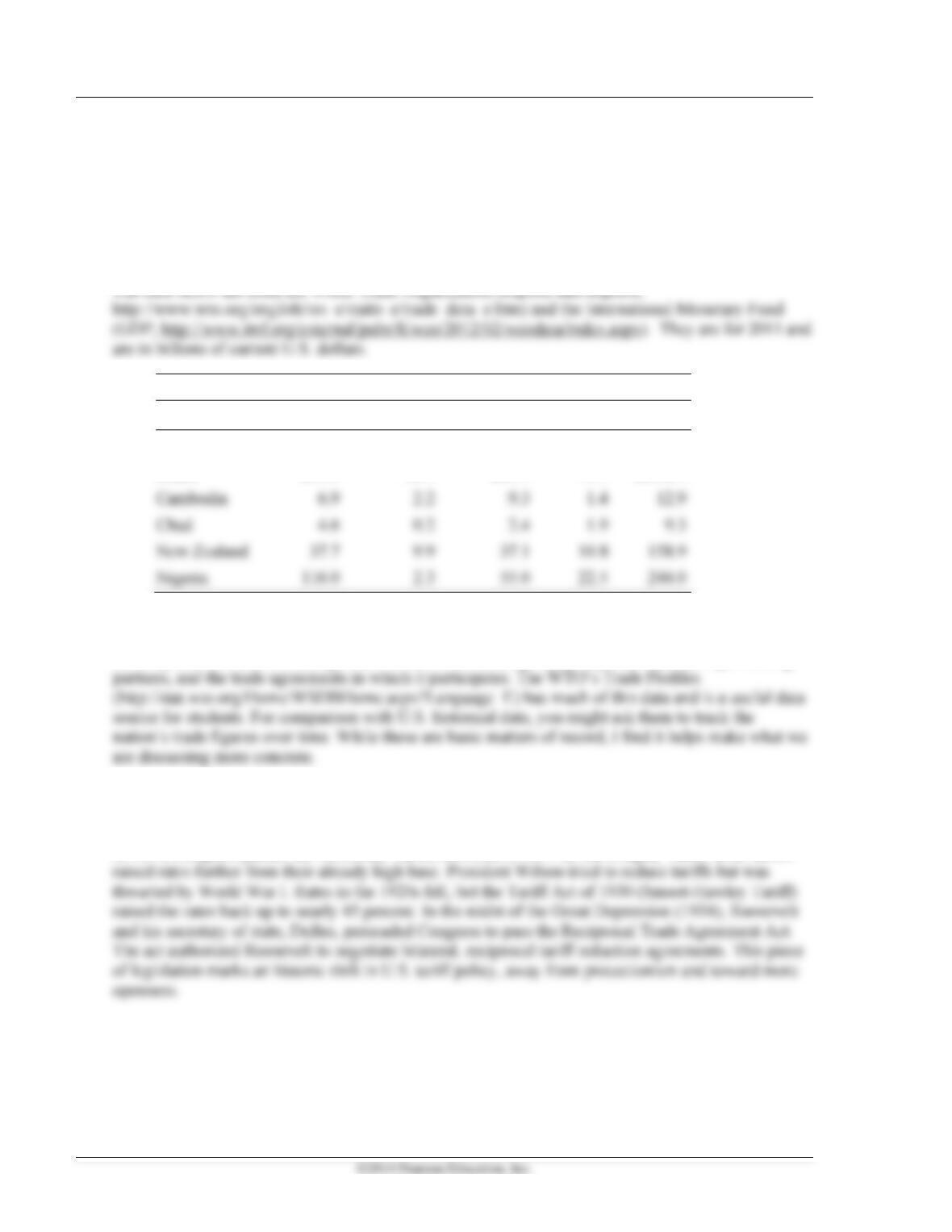
1. I like to use the trade-to-GDP ratio to contrast the importance of trade to various nations and to drive
home the fact that relative value matters. The United States is a huge participant in trade in dollar
terms, but it is not as dependent on trade as many other countries. Some countries’ entire economies
are dependent on international trade. I find students need some practice calculating and interpreting
the trade-to-GDP ratio.
Country
Exports
Imports
GDP
Goods
Services
Goods
Services
Bahrain
19.6
3.0
12.7
1.8
25.9
Brazil
256.0
36.7
236.9
73.1
2,492.9
Cambodia
2.2
9.3
1.4
12.9
Chad
0.2
2.4
1.9
9.3
New Zealand
37.7
37.1
10.8
158.9
2. For homework very early in the course, I sometimes assign each student a nation to study, with its
trade-to-GDP ratio as one of the pieces of information to collect. I also ask them to find out its
currency and its current exchange rate with the U.S. dollar, primary exports, imports, major trading
3. The chapter also lends itself to students developing some factual knowledge about U.S. trade history.
One possibility is to look at U.S. trade policy through various time periods. The U.S. had relatively
high tariffs (greater than 40 percent on average) throughout the second half of the nineteenth century.
In 1890, Congress passed the McKinley Tariff, followed in 1897 by the Dingley Tariff. Both tariffs
Chapter 1 The United States in a Global Economy 5
◼ Answers to End-of-Chapter Questions
1. How can globalization and international economic integration be measured?
2. In what sense is the U.S. economy more integrated with the world today than it was a century ago?
In what ways is it less integrated?
Answer: The WTO’s Trade Profile for the United States gives an average trade-to-GDP ratio of
28.3 for 2009-2011. That implies that the United States’ ratio is about 150 percent greater
3. What does the trade-to-GDP ratio measure? Does a low value indicate that a country is closed to
trade with the outside world?
Answer: The trade-to-GDP ratio is a measure of the relative importance of trade to a national
economy. It is measured by the ratio of exports plus imports to GDP.
4. Describe the pattern over the last century shown by the trade-to-GDP ratio for leading industrial
economies.
Answer: The ratio fell between 1913 and 1950, but then began to rise relatively rapidly. The main
5. Trade and capital flows were described and measured in relative rather than absolute terms. Explain
the difference. Which term seems more valid—relative or absolute? Why?
Answer: Absolute values are the dollar amounts of trade and capital flows. Relative values are the
6. In relative terms, international capital flows may not be much greater today than they were
a hundred years ago, although they are certainly greater than they were fifty years ago. Qualitatively,
however, capital flows are different today. Explain.
Answer: Major qualitative difference between late nineteenth and late twentieth century capital
7. What are the new issues in international trade and investment? In what sense do they expose national
economies to outside influences?
Answer: The new issues involve policy differences between nations that until recently were
considered the exclusive responsibility of local or national governments. Examples
8. Describe the three kinds of evidence economists use to support the assertion that economies open to
the world grow faster than economies that are closed.
Answer: These are: (1) casual empirical evidence of historical experience; (2) economic logic and
(1) The historical evidence examines the experiences of countries that tried to isolate
(2) The logic of economic theory also suggests a strong causal relation between trade and
faster economic growth. The following is a summary of this linkage:
(3) Even though the statistical evidence is not quite conclusive (mainly due to measuring