Mishkin • Instructor’s Manual for The Economics of Money, Banking, and Financial Markets, Twelfth Edition 51
Chapter 1
ANSWERS TO QUESTIONS
1. What is the typical relationship among interest rates on three-month Treasury bills, long-
term Treasury bonds, and Baa corporate bonds?
2. What effect might a fall in stock prices have on business investment?
3. Explain the main difference between a bond and a common stock.
A bond is a debt instrument, which entitles the owner to receive periodic amounts of money
(predetermined by the characteristics of the bond) until its maturity date. A common stock,
4. Explain the link between well-performing financial markets and economic growth. Name one
channel through which financial markets might affect economic growth and poverty.
Well performing financial markets tend to allocate funds to its more efficient use, thereby
5. What was the main cause of the recession that began in 2007?
The United States’ economy was hit by the worst financial crisis since the Great Depression.
6. Can you think of a reason why people in general do not lend money to one another to buy a
house or a car? How would your answer explain the existence of banks?
In general, people do not lend large amounts of money to one another because of several
information problems. In particular, people do not know about the capacity of other people of
7. What are the other important financial intermediaries in the economy, besides banks?
8. Can you date the latest financial crisis in the United States or in Europe? Are there reasons
to think that these crises might have been related? Why?
The latest financial crisis in the United States and Europe occurred in 2007–2009. At the
beginning, it hit mostly the US financial system, but it then quickly moved to Europe, since
9. Has the inflation rate in the United States increased or decreased in the past few years?
What about interest rates?
From 2014 to mid-2017, inflation has been somewhat low, but increased more recently to
10. If history repeats itself and we see a decline in the rate of money growth, what might you
expect to happen to
a. real output?
b. the inflation rate?
c. interest rates?
11. When interest rates decrease, how might businesses and consumers change their economic
behavior?
Businesses would increase investment spending because the cost of financing this spending is
12. Is everybody worse off when interest rates rise?
13. Why do managers of financial institutions care so much about the activities of the Federal
Reserve System?
14. How does the current size of the U.S. budget deficit compare to the historical budget deficit
or surplus for the time period since 1950?
15. How would a fall in the value of the pound sterling affect British consumers?
16. How would an increase in the value of the pound sterling affect American businesses?
17. How can changes in foreign exchange rates affect the profitability of financial institutions?
18. According to Figure 8, in which years would you have chosen to visit the Grand Canyon in
Arizona rather than the Tower of London?
In the mid- to late 1970s, the late 1980s to early 1990s, and 2008 to 2015, the value of the
dollar was low, making travel abroad relatively more expensive; thus, it was a good time to
Mishkin • Instructor’s Manual for The Economics of Money, Banking, and Financial Markets, Twelfth Edition 54
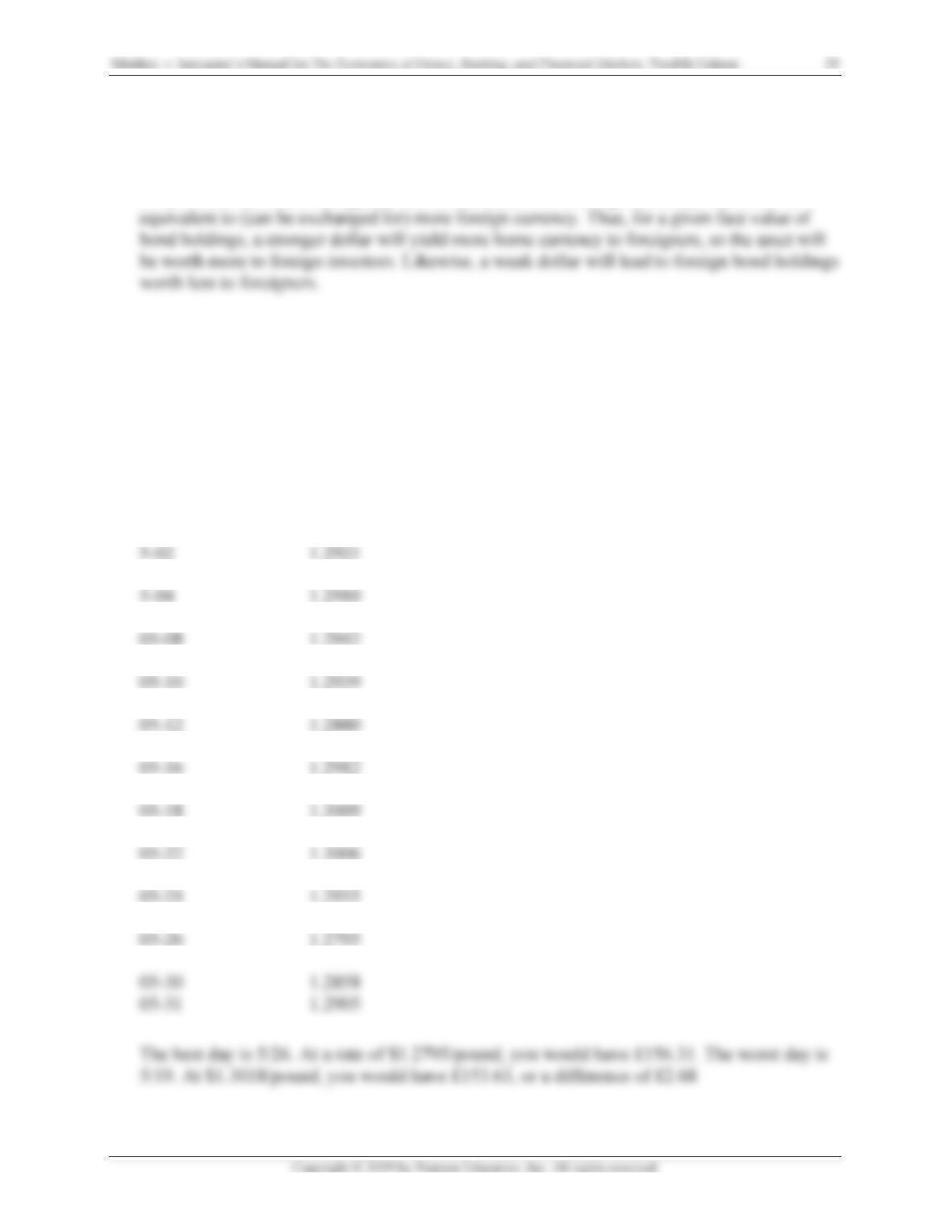
The following table lists the foreign exchange rate between U.S. dollars and British pounds
(GBP) during May 2017. Which day would have been the best for converting $200 into British
pounds? Which day would have been the worst? What would be the difference in pounds?
Date $/£
5-01 1.2917
5-03 1.2916
5-05 1.2950
05-09 1.2939
05-11 1.2885
05-15 1.2917
05-17 1.2944
05-19 1.3018
05-23 1.2984
05-25 1.2954
05-30 1.2858
19. When the dollar is worth more in relation to currencies of other countries, are you more
likely to buy American-made or foreign-made jeans? Are U.S. companies that manufacture
jeans happier when the dollar is strong or when it is weak? What about an American
company that is in the business of importing jeans into the United States?
When the dollar increases in value, foreign goods become less expensive relative to
American goods; thus, you are more likely to buy French-made jeans than American-made
20. Much of the U.S. government debt is held by foreign investors as treasury bonds and bills.
How do fluctuations in the dollar exchange rate affect the value of that debt held by
foreigners?
As the dollar becomes stronger (worth more) relative to a foreign currency, one dollar is
ANSWERS TO APPLIED PROBLEMS
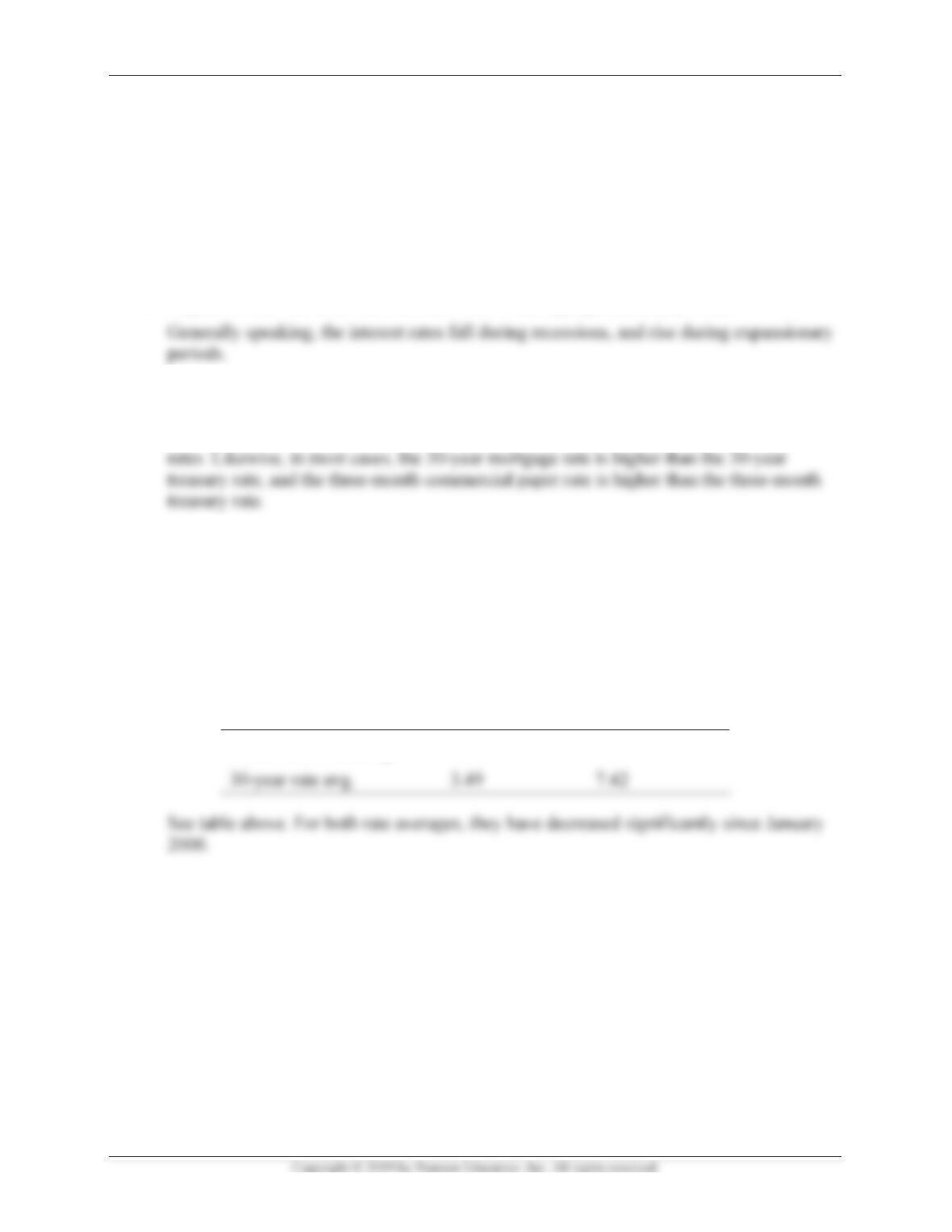
21. The following table lists the foreign exchange rate between U.S. dollars and British pounds
(GBP) during May 2017. Which day would have been the best for converting $200 into
British pounds? Which day would have been the worst? What would be the difference in
pounds?
5-01 1.2917
5-03 1.2916
5-05 1.2950
05-09 1.2939
05-11 1.2885
05-15 1.2917
05-17 1.2944
05-19 1.3018
05-23 1.2984
05-25 1.2954
Mishkin • Instructor’s Manual for The Economics of Money, Banking, and Financial Markets, Twelfth Edition 56
ANSWERS TO DATA ANALYSIS PROBLEMS
1. Go to the St. Louis Federal Reserve FRED database and find data on the three-month
treasury bill rate (TB3MS), the three-month AA nonfinancial commercial paper rate
(CPN3M), the 30-year treasury bond rate (GS30), the 30-year fixed rate mortgage average
(MORTGAGE30US), and the NBER recession indicators (USREC). For the mortgage rate
indicator, set the frequency setting to ‘monthly’.
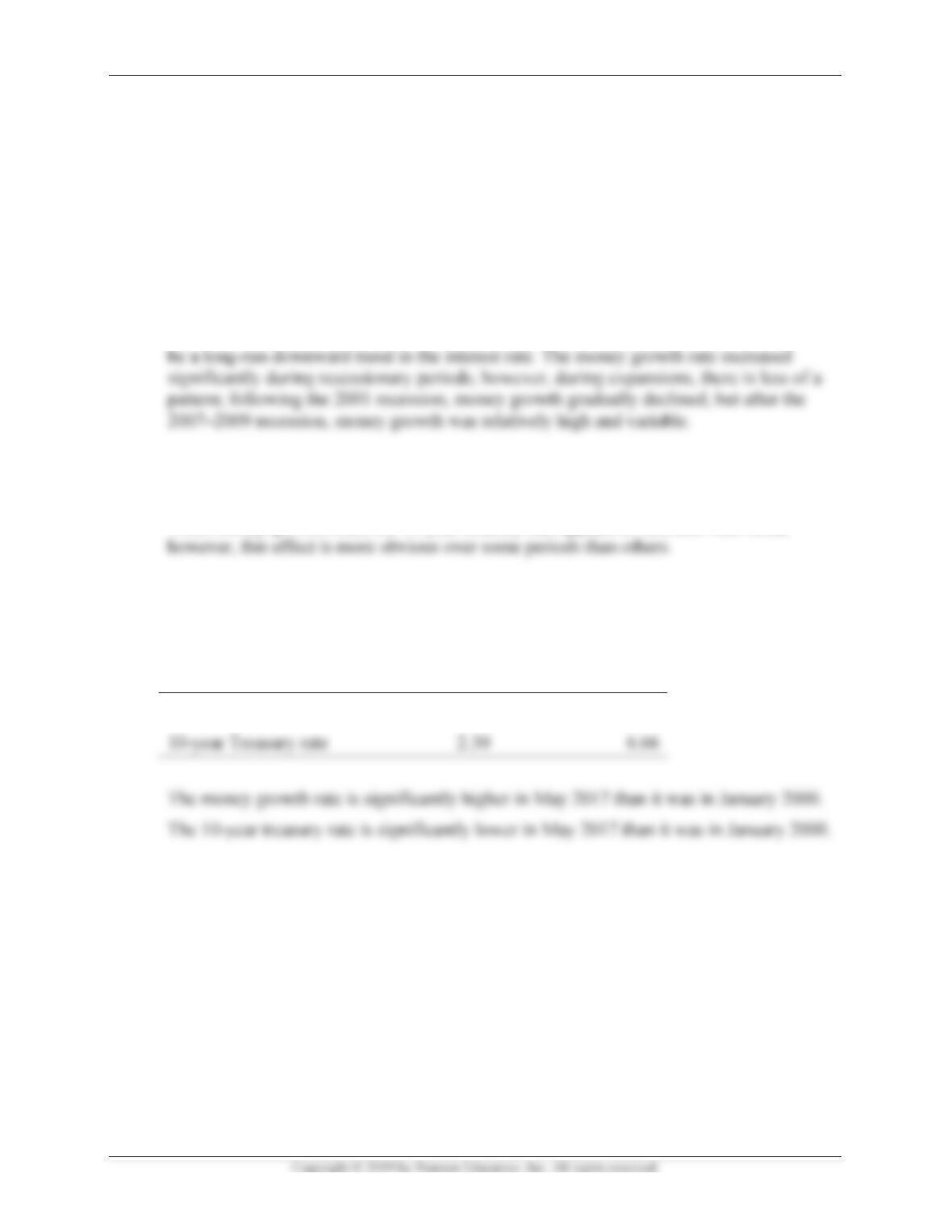
a. In general, how do these interest rates behave during expansionary periods?
b. In general, how do the three-month interest rates compare to the 30-year rates? How do
the Treasury rates compare to the respective commercial paper and mortgage rates?
In nearly all instances, the 30-year rates are significantly higher than the three-month
c. For the most recent available month of data, take the average of each of the three-month
rates and compare it to the average of the three-month rates from January 2000. How do
the averages compare?
d. For the most recent available month of data, take the average of each of the 30-year
rates and compare it to the average of the 30-year rates from January 2000. How do the
averages compare?
May 2017 January 2000
Three-month rate avg. 0.92 5.53
Mishkin • Instructor’s Manual for The Economics of Money, Banking, and Financial Markets, Twelfth Edition 57
2. Go to the St. Louis Federal Reserve FRED database and find data on the M1 money supply
(M1SL) and the 10-year treasury bond rate (GS10). Add the two series into a single graph by
using the “Add Data Series” feature. Transform the M1 money supply variable into the M1
growth rate by adjusting the units for the M1 money supply to “Percent Change from Year
Ago.”
a. In general, how have the growth rate of the M1 money supply and the 10-year treasury
bond rate behaved during recessions and during expansionary periods since the year
2000?
Generally, the 10-year treasury rate fell during the recessionary periods of 2001 and
2007–2009; during expansionary periods, there was less of a pattern, but there seems to
b. In general, is there an obvious, stable relationship between money growth and the
10-year interest rate since the year 2000?
When money growth rises, the 10-year treasury rate appears to fall, and vice-versa;
c. Compare the money growth rate and the 10-year interest rate for the most recent month
available to the rates for January 2000. How do the rates compare?
May 2017 January 2000
M1 Money Growth 8.00 2.19