
INSTRUCTOR’S MANUAL
Teaching in Today’s
Inclusive
Classrooms
A Universal Design for Learning
Approach
Third Edition
Syllabus Examples
16-week course
Course Name:
Instructor Name:
Office Location and Office Hours:
Course Description:
Course Objectives/Student Learning Outcomes:
Textbook:
Grading Policies:
Other College Policies:
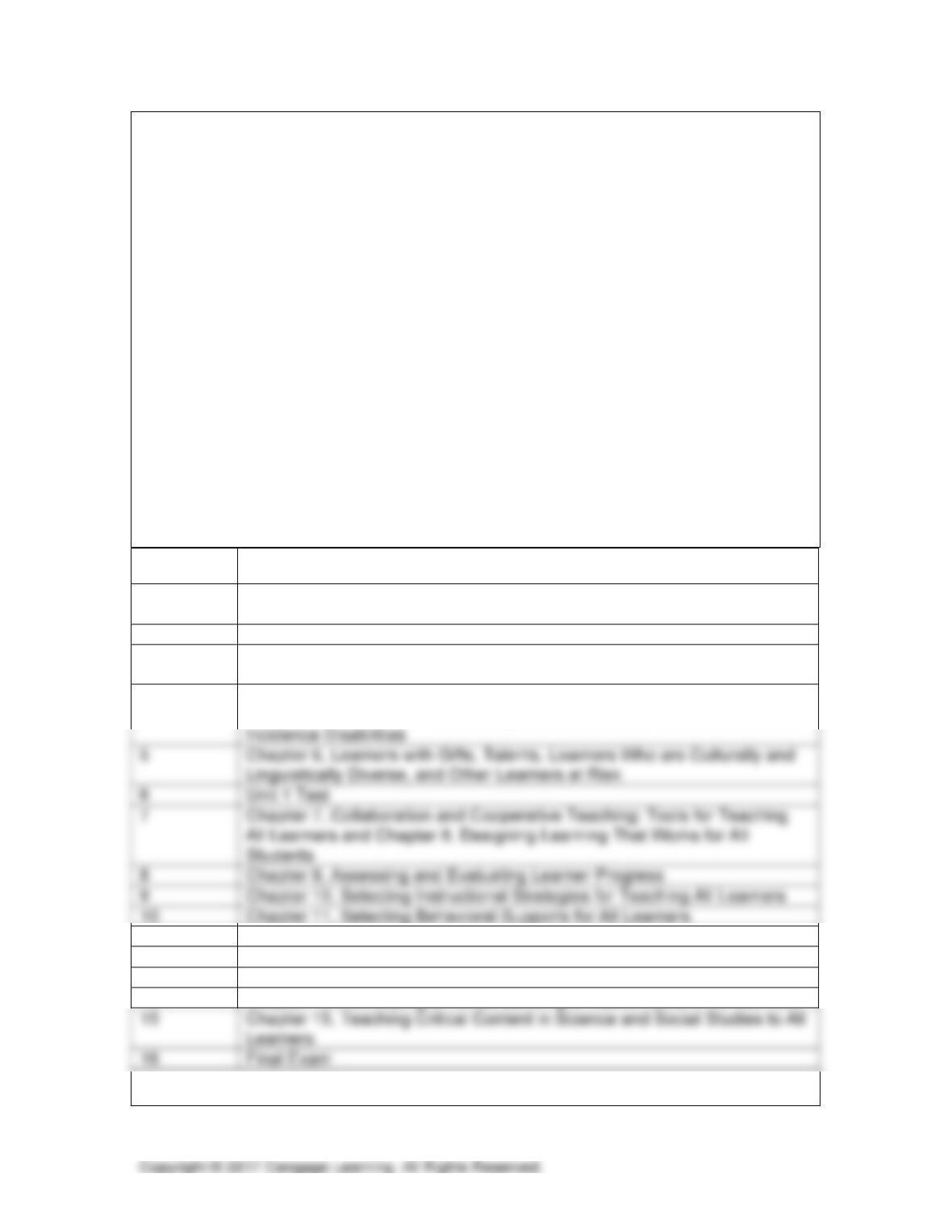
Class Schedule:
Week
Chapter
1
Introduction, Syllabus Overview, Chapter 1, Teaching in Today’s Inclusive
Classroom
2
Chapter 2, Introducing Universal Design for Learning
3
Chapter 3, Policies, Practices, and Processes for Special Education and
Inclusive Education
4
5
Chapter 6, Learners with Gifts, Talents, Learners Who are Culturally and
Linguistically Diverse, and Other Learners at Risk
6
Unit 1 Test
Chapter 7, Collaboration and Cooperative Teaching: Tools for Teaching
8
Chapter 9, Assessing and Evaluating Learner Progress
9
Chapter 10, Selecting Instructional Strategies for Teaching All Learners
Chapter 11, Selecting Behavioral Supports for All Learners
Chapter 4, Diversity in the Classroom: Learners with High–Incidence
Disabilities and Chapter 5, Diversity in the Classroom: Students with Low–
11
Unit 2 Test
12
Chapter 12, Assistive Technologies and Innovative Learning Tools
13
Chapter 13, Creating Literacy–Rich Environments for All Learners
14
Chapter 14, Developing an Understanding of Mathematics in All Learners
Chapter 15, Teaching Critical Content in Science and Social Studies to All
Learners
16
8-week course
Course Name:
Instructor Name:
Office Location and Office Hours:
Course Description:
Course Objectives/Student Learning Outcomes:
Textbook:
Grading Policies:
Other College Policies:
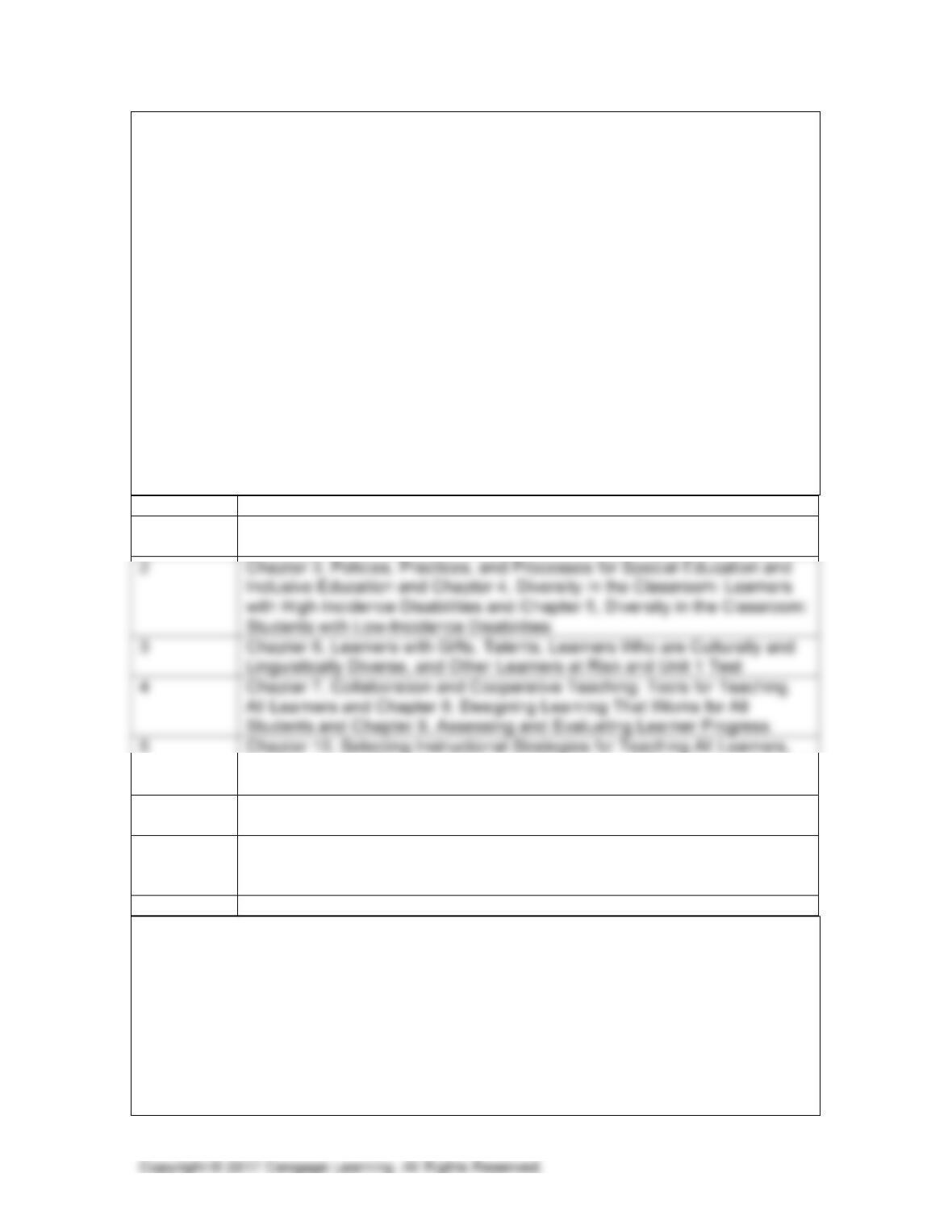
Class Schedule:
Week
Chapter
1
Introduction, Syllabus Overview, Chapter 1, Teaching in Today’s Inclusive
Classroom and Chapter 2, Introducing Universal Design for Learning
4
5
and Chapter 11, Selecting Behavioral Supports for All Learners and Unit 2
Test
6
Chapter 12, Assistive Technologies and Innovative Learning Tools, and
Chapter 13, Creating Literacy–Rich Environments for All Learners
7
Chapter 14, Developing an Understanding of Mathematics in All Learners,
and Chapter 15, Teaching Critical Content in Science and Social Studies
to All Learners
8
Final Exam
5-week course
Course Name:
Instructor Name:
Office Location and Office Hours:
Course Description:
Course Objectives/Student Learning Outcomes:
Textbook:
Grading Policies:
Other College Policies:
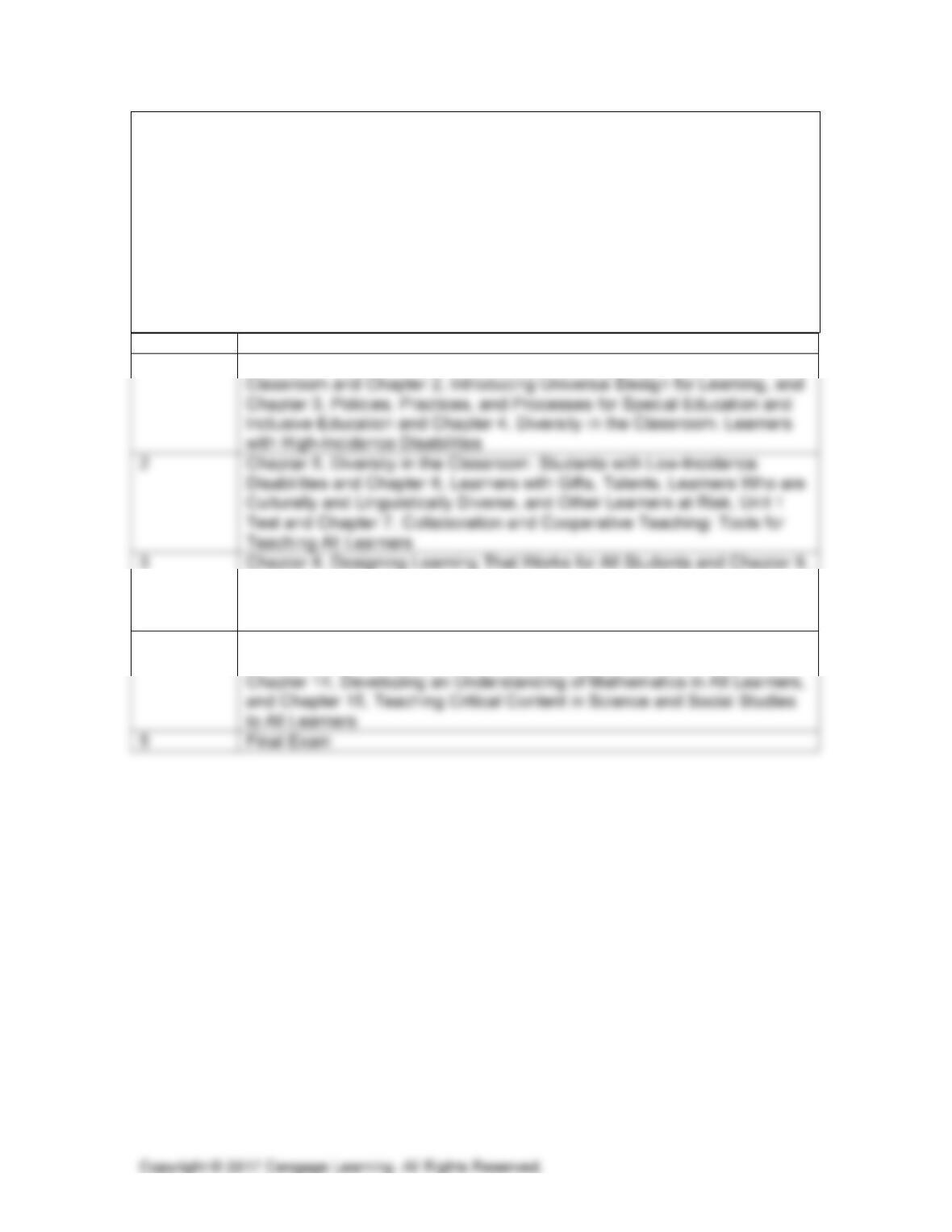
Class Schedule:
Week
Chapter
1
Classroom and Chapter 2, Introducing Universal Design for Learning, and
Disabilities and Chapter 6, Learners with Gifts, Talents, Learners Who are
Chapter 8, Designing Learning That Works for All Students and Chapter 9,
Introduction, Syllabus Overview, Chapter 1, Teaching in Today’s Inclusive
Assessing and Evaluating Learner Progress, Chapter 10, Selecting
Instructional Strategies for Teaching All Learners, Chapter 11, Selecting
Behavioral Supports for All Learners and Unit 2 Test
4
Chapter 12, Assistive Technologies and Innovative Learning Tools, and
Chapter 13, Creating Literacy–Rich Environments for All Learners, and
1: Teaching in Today’s Inclusive Classrooms:
Your Journey Begins
Learning Outcomes
After studying this chapter, students should be able to:
• 1-1 Identify the various types of learners in today’s classrooms.
• 1-2 Describe placement options for educating students with special needs.
• 1-3 Explain the concept of universal design for learning (UDL).
• 1-4 Describe the role of the courts in special education.
• 1-5 Explain the effects of educational reform on students and teachers.
INTASC Standards
Standard #1: Learner Development. The teacher understands how learners grow and develop,
recognizing that patterns of learning and development vary individually within and across the
cognitive, linguistic, social, emotional, and physical areas, and designs and implements
Council for Exceptional Children
Special educators are to have knowledge of the following:
Standard #1: Learner Development and Individual Learning Differences. Beginning special
education professionals understand how exceptionalities may interact with development
and learning and use this knowledge to provide meaningful and challenging learning
Chapter Outline
1-1 Learners in Today’s Classrooms
1-1a Learners in Need of Special Services
1-2 Placement Options for Educating Students with Special Needs
1-2a Educational Placements
1-2b A Cascade of Service Delivery Options
1-3 Introducing Universal Design for Learning
1-4 The Role of the Courts in Special Education
1-4a Key Judicial Decisions
1-4b Key Special Education Legislation
1. Individuals with Disabilities Education Act: 1975-1997
3. Public Law 99-457 (1986 Amendments to PL 94-142)
5. Public Law 105-17 (1997 Amendments to IDEA)
1-5 Educational Reform for Students and Teachers
1-5a No Child Left Behind Act of 2001
1-5b Common Core State Standards
1-5c Individuals with Disabilities Education Improvement Act of
2004
1. Individualized Education Program (IEP) Process
2. Identifying Students with Specific Learning Disabilities
4. Discipline
6. Evaluation of Students
1-5d Civil Rights Legislation
2. Americans with Disabilities Act
Key Concepts and Terms
evidence–based practices: The use of scientifically validated instructional practices or
teaching strategies that research has documented to be effective.
inclusion: The movement toward, and the practice of, educating students with
disabilities and other learners with exceptionalities in general education classrooms
alongside their typical peers with appropriate supports and services provided as
necessary.
least restrictive environment (LRE): A legal term interpreted to mean that individuals
with disabilities are to be educated in environments as close as possible to the general
education classroom setting; a concept, not a place.
response to intervention (RTI): A process used to determine if the pupil responds to
universal design for learning (UDL): Curriculum and instruction that include
alternatives to make these accessible and appropriate for individuals with different
backgrounds, learning preferences, abilities, and disabilities in widely varied learning
contexts.
Lecture Notes
Today’s students bring a diversity to the classroom that is different from the past.
Teachers are confronted with the challenge of teaching students with disabilities,
learners who are culturally and linguistically diverse, individuals at risk for not achieving
success in the classroom, and students recognized as gifted and talented as well as the
typical child.
It is becoming increasingly common to have all of the above students in the general
education classroom. The classroom teacher no longer prepares one lesson to teach to
the group, but one lesson with several modifications, based upon the learning needs of
those in the group.
Suggestions for In–Class or Online Activities
1. Show the video mentioned in the MindTap content. Use the discussion questions
as a whole group activity or as a small group activity.
3. Either give the students a lesson plan or have them create a lesson plan, then
4. Have students journal on one or more of the following questions:
a. Is the general classroom the least restrictive environment for every child?
Explain why or why not.
b. Should students with disabilities be placed based on their chronological
age or their academic ability? Explain why.
c. What are some arguments in favor of full inclusion of students with
disabilities in the general classroom?
5. Reflect on your own school experience. Were children with disabilities in class
with you? Describe your experience.
Discussion Questions
1. What is your current understanding of least restrictive environment?
2. What does it mean when I say “people first language?”
3. Do you feel that all students should be able to receive a free public education?
4. Do you think that gifted students should be given special treatment similar to
children with disabilities?
5. When you were in school, did you ever notice if the teacher planned different
activities for different children? Maybe there were reading or math groups at your
6. Do you think the number of students being identified with disabilities is on the
rise? Give reasons to defend your opinion.
7. What role does the law play in the educational rights of students?
8. Does litigation and legislation have a role when it comes to educating students?
Field Experiences
1. Visit your local public school or Head Start. Ask if you can observe in a general
education classroom. Make note of all the different learning activities that are
taking place. Can you identify possible students with disabilities? Why do you
think those students have a disability?
Videos
1. What does inclusive learning look like? Watch this video to see inclusive learning
in practice.
2. Describe how this school system has made inclusion work.
1. Helen Turnbull has a unique perception on inclusion. Defend whether you agree
or disagree with her.
2. How could you use her message to explain inclusion to your neighbor?
Web Resources