CHAPTER 1
Introduction
KEY IDEAS IN THIS CHAPTER
1. The primary questions of interest in macroeconomics involve the causes of long-run
2. Modern macroeconomics analyzes issues associated with long-run growth and
business cycles, using models that are based on microeconomic principles.
3. Macroeconomists rely primarily on abstract models to draw conclusions about how
4. There is relatively little disagreement among macroeconomists concerning
approaches to modeling economic growth, but there are contentious issues in
modeling business cycles.
NEW IN THE FOURTH EDITION
1. A new chapter on search and unemployment (Chapter 6) necessitated new material in
this introductory chapter.
3. The revised discussion on recent and current macroeconomic events incorporates
information contained in newly available data.
TEACHING GOALS
Macroeconomics is a field of economics which primarily studies economic growth and
business cycles. Over time, there is a prevailing upward trend in the standard of living.
However, such growth can be rather erratic. There are some periods of rapid growth,
some periods of rather anemic growth, and also some periods of temporary economic
decline. Explanations for the overall upward trend in standards of living are the subject of
economic growth analysis. Explanations of variations in growth over shorter time
horizons are the subject of business cycle analysis. Students should be able to distinguish
between microeconomic topics and macroeconomic topics. Students should understand
the distinction between growth analysis and business cycle analysis.
Instructor’s Manual for Macroeconomics, Fourth Canadian Edition
Although microeconomics and macroeconomics are separate branches of study, both
branches are guided by the same set of economic principles. Standard economic theory is
guided by the assumption of maximizing behaviour. As a first approximation, we
therefore view the macroeconomy as a collection of markets with maximizing
participants. These participants are price-taking agents and the economy is closely
approximated by a competitive equilibrium.
Because the economy as a whole is extremely complex, macroeconomists must rely on
somewhat abstract models. Although the structure of such models does not correspond to
all the details of life in a complex society, these models offer the best hope of providing
simple, yet accurate, descriptions of how the macroeconomy works, and how government
policies may affect macroeconomic outcomes.
CLASSROOM DISCUSSION TOPICS
One good way to get the ball rolling is to list some macroeconomic concerns like stagnant
economic growth, unemployment, inflation, government budget deficits, tax burdens,
balance of trade deficits, financing of social security, and the like. Ask students whether
they are personally concerned about such problems and what original prejudices they
might have about causes and effects. Sometimes students express concerns about topics
which are perhaps more microeconomic in nature, like inequality in the distribution of
income and environmental concerns. Emphasize that economic growth may provide
enough extra resources to help deal with these issues.
It would be worthwhile to take a little time to review the definition of macroeconomics
and review the distinction between microeconomics and macroeconomics. Take care to
point out that their understanding of how the demand and supply model of
microeconomics works is the key to the understanding how markets in macroeconomics
work. This approach should help retain students’ motivation as they switch from
microeconomics to macroeconomics.
Students often have conflicting ideas about the current state of the economy. Sometimes
their perspectives may be governed by their individual circumstances, what they read in
the paper, what they see on TV, and so forth. Ask them whether they believe that times
are currently good or bad. Ask them why they think the way they do. Ask them how they
can more objectively back up or check out their casual impressions about the current state
of the economy.
Chapter 1: Introduction
Students are interested in economic growth, unemployment, inflation, government budget
deficits, and trade deficits. An effective way to motivate this chapter and attract students’
attention would be to cast these topics in terms of what the economy will be like when
they graduate. The quantity of goods and services has expanded more than twenty-fold in
the last 100 years. Ask them whether they expect this to continue. Ask them if they think
the economy will be booming or in a recession when they graduate. Will jobs be plentiful
OUTLINE
1. What Is Macroeconomics?
2. Gross Domestic Product, Economic Growth, and Business Cycles
a) Adjustments for Inflation and Population Growth
b) Historical Per Capita Real GDP Growth Perspectives
3. Macroeconomic Models
4. Microeconomic Principles
a) When Do Microeconomic Reactions Affect Macroeconomic Outcomes?
5. Disagreement in Macroeconomics
a) Solow Growth Model and Endogenous Growth Models
b) Keynesian and non-Keynesian Models
6. What Do We Learn from Macroeconomic Analysis?
a) Fundamentals: Preferences and Productive Capacity
b) The Efficiency of Economic Outcomes
c) The Role of Unemployment
d) Technological Progress and the Standard of Living
h) Causes of Business Cycles
i) Gains from International Trade and Effects on Business Cycles
j) Inflation and Money Growth
k) Inflation and the Phillips Curve
7. Understanding Recent and Current Macroeconomic Events
a) The Productivity Slowdown
i) Average Labour Productivity
ii) Productivity Slowdowns
b) Government Income, Government Outlays, and the Government Deficit
i) The Upward Trend in the Size of Government
ii) Crowding Out the Private Sector
iii) The Government Deficit and Government Saving
iv) Ricardian Equivalence Theorem
c) Unemployment
i) Search and Unemployment
ii) Unemployment Rates in Canada and the U.S.
d) Inflation
i) The Historical Record
ii) Inflation and Money Growth
e) Interest Rates
i) Nominal and Real Interest Rates
ii) Inflation and Nominal Interest Rates
f) Trade and the Current Account Surplus
i) The Current Account and International Financial Transactions
ii) What Makes the Current Account Surplus Fluctuate?
iii)
h) The Financial Crisis
i) Brief Review of Events
ii) Importance for Canada
TEXTBOOK PROBLEM SOLUTIONS
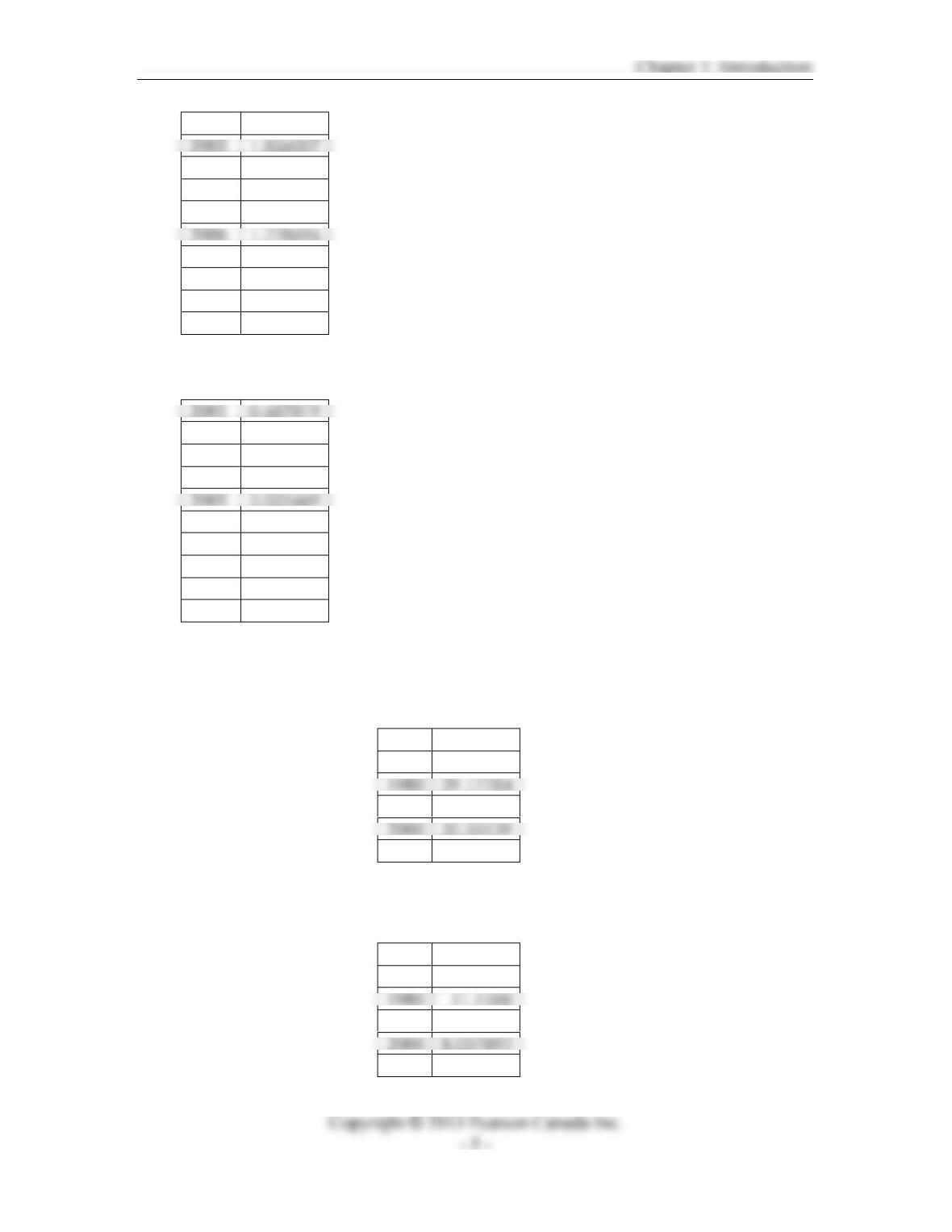
1. Calculating Growth Rates Data:
a) Actual Percentage Growth Rates, 2001-2010
2001 0.69019
2003 0.960105
2004 2.148177
2005 2.046121
2007 1.102505
2008 -0.48802
2009 -3.95337
2010 2.015733
b) Approximate Percentage Growth Rates, 2001-2010
2002 1.809535
2003 0.955525
2004 2.125429
2006 1.763063
2007 1.096472
2008 -0.48922
2009 -4.03364
2010 1.995686
The approximation is close. The approximation works well for small growth rates.
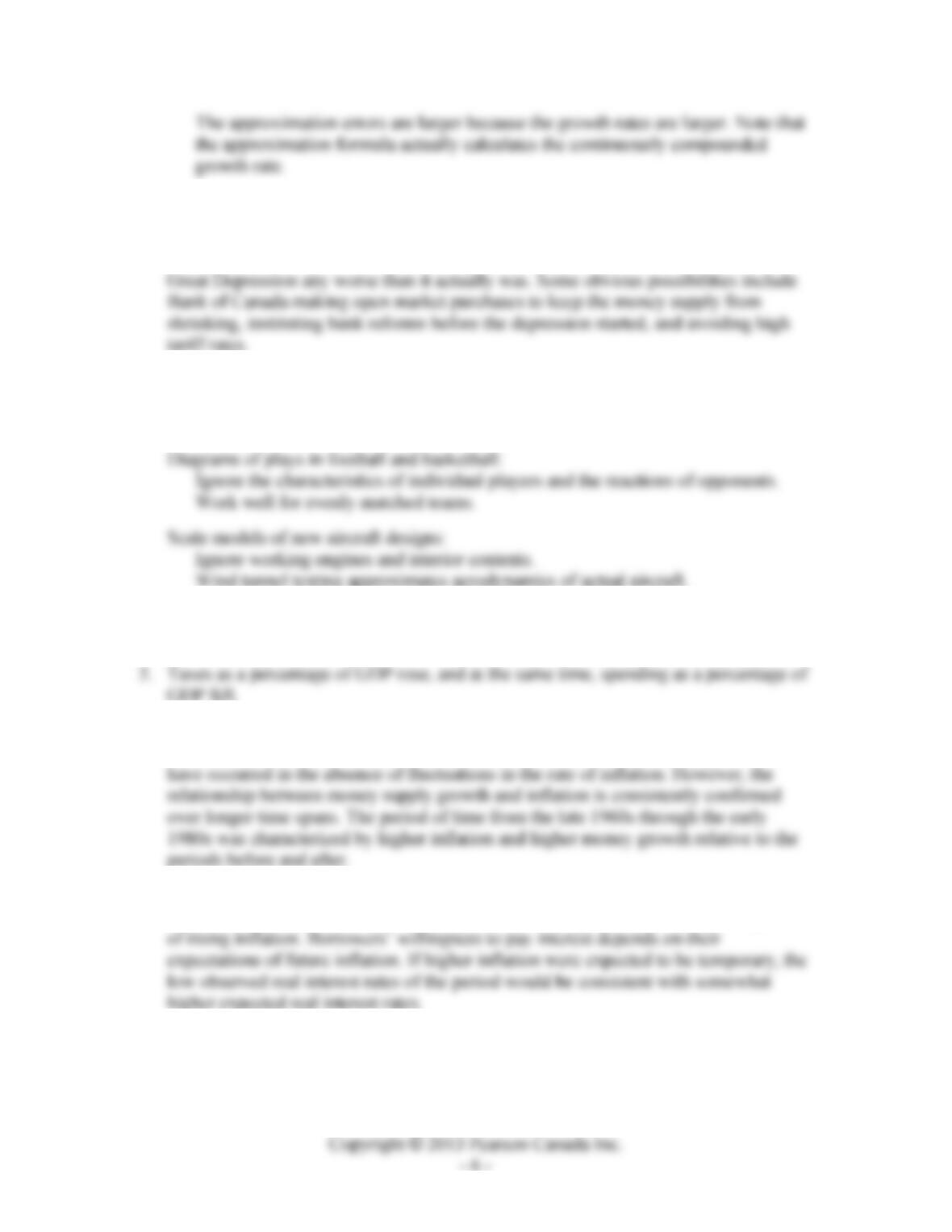
c) Actual Percentage Growth Rates for Decades, 1950–2010
Approximate Percentage Growth Rates, 1950–2010
1960 21.00426
1970 37.10902
1990 16.8306
2010 8.25955
1960 8.280064
1970 13.7066
1990 6.755662
2010 3.446622
Instructor’s Manual for Macroeconomics, Fourth Canadian Edition
d) Growth is highest in the 1960s. Growth is lowest in for 2000-2010.
2. A problem with controlled experiments in economics is that we may cause irreparable
harm. However, it would be hard to imagine a policy change that would make the
3. Newton’s model of falling bodies:
Ignores air resistance.
Works well for most dense objects and does not work well for feathers.
4. During a recession, the government spends more on unemployment insurance
compensation and other social insurance programs.
6. In the early 1980s, inflation and money supply growth were moving in opposite
directions. Also, since the mid-1980s, fluctuations in the money supply growth rate
7. As one possibility, fundamental changes in the supply and demand for lending may
explain changes in the real rate of interest. Alternatively, the mid-1970s was a period
8. Exports as a percentage of GDP were rising and rising higher than imports as a
percentage of GDP.