Chapter 1
The Nature of Economics
◼ Overview
This chapter introduces economics as a science. Economics is defined, and its subareas, macroeconomics
and microeconomics, are introduced. The chapter also discusses the three fundamental questions faced by
every nation of what to produce, how to produce, and for whom to produce. The chapter then presents the
two types of economic systems, command and control or the price system, used to answer the three
fundamental questions. Economic rationality and self-interest are discussed along with their implications
◼ Learning Objectives
After studying this chapter, students should be able to:
• 1.1 Define economics and discuss the difference between microeconomics and macroeconomics
• 1.2 Identify the three basic economic questions and the two opposing sets of answers
◼ Outline
I. The Power of Economic Analysis: The analytical framework of the course is the economic way of
thinking. The economic way of thinking permits the student to reach informed conclusions about
what is happening in the world.
A. Defining Economics: The study of how people allocate their limited resources to satisfy their
unlimited wants. The ultimate purpose of economics is to explain how people make choices.
B. Microeconomics versus Macroeconomics: Economics is divided into two types of analysis:
macroeconomics and microeconomics.
2. Macroeconomics: The part of economic analysis that studies the behavior of the economy
2 Miller • Economics Today, Nineteenth Edition
II. The Three Basic Economic Questions and Two Opposing Sets of Answers: Every nation must
address three fundamental questions that concern the problem of how an economic system
allocates a society’s scarce resources.
A. The Three Basic Questions: (1) What will be produced? (2) How will items be produced?
(3) For whom will it be produced?
B. Two Opposing Sets of Answers
1. Centralized Command and Control: Also called a command and control system, this
2. The Price System: Also called a market system, a price system is an economic system that
answers the three basic questions using decentralized decision making. In a pure price
system, individuals own all of the scarce resources used in production. This means those
3. Mixed Economic Systems: The economic systems of the world incorporate aspects of
both centralized command and control and the decentralized price systems.
III. The Economic Approach: Systematic Decisions: Economists assume that individuals act as if
they pursue self-motivated interests and respond predictably to perceived opportunities to obtain
those interests.
A. The Rationality Assumption: The assumption that individuals will not intentionally make
decisions that would leave them worse off.
B. Responding to Incentives: An incentive is the reward for engaging in a given activity. People
react to an incentive by making a rough comparison of costs and benefits. A negative incentive
IV. Economics as a Science: Economics is a social science that utilizes the same types of methods
used in biology, chemistry, and physics. Economic models or theories, which are simplified
representations of the real world, are developed and used as aids in understanding, explaining, and
predicting economic phenomena in the real world.
A. Models and Realism: A model should capture the essential relationships that are sufficient to
analyze the specific problem or answer the specific question being asked. No economic model
Chapter 1 The Nature of Economics 3
B. Assumptions: Assumptions define the set of circumstances in which a model is most likely to
be applicable. Every model, therefore, must be based on a set of assumptions.
1. The Ceteris Paribus Assumption: All Other Things Being Equal: The assumption that
C. Deciding on the Usefulness of a Model: A model is useful if it yields usable predictions
supported by real-world observations. If a model makes a prediction and factual evidence
D. Models of Behavior, Not Thought Processes: Models relate to the way people act in using
limited resources and not to the way they think. Models normally generalize people’s behavior.
E. Behavioral Economics and Bounded Rationality: An approach to consumer behavior that
emphasizes psychological limitations and complications that potentially interfere with rational
decision making.
1. Bounded Rationality: The idea that people are nearly, but not fully, rational so that they
2. Rules of Thumb: A behavioral implication of bounded rationality is that people will use
3. Behavioral Economics: A Work in Progress: So far, proponents of behavioral economics
V. Positive versus Normative Economics: Positive economics deals with what is. Positive economic
statements are “if–then” statements. Normative economics deals with what some person thinks
ought to be. Normative economic statements involve value judgments and normally have the words
“ought” or “should” in them. Because positive economics predicts consequences of actions, it can
be used to predict the effects of various policies to see if the policies aid in achieving desired goals.
Positive economics cannot provide criteria for choosing which outcomes or goals are preferable.
A. Distinguishing between Positive and Normative Economics: Positive economics is analysis
B. A Warning: Recognize Normative Analysis: Although it is easy to define positive
economics, it is often difficult to identify unlabeled normative statements, even in a textbook.
◼ Points to Emphasize
The Discipline of Economics
Economics is the study of how people make choices to satisfy their wants. Wants have a special meaning
in economics. Wants represent those things that people would buy if they had unlimited income. In
economics, we note that income is in fact limited, and thus, people must make choices. These choices are
4 Miller • Economics Today, Nineteenth Edition
Economic Systems and the Allocation of Scarce Resources
Because resources are scarce, every nation must answer the three fundamental questions of what and how
much of each item to produce, how each item will be produced, and for whom items will be produced.
Emphasize that there are not enough resources to produce as much of everything that the citizens of any
Economic Models
Economic models are simplified representations of the real world. Economic models frequently present
problems for students because they are so abstract. The goal is for students to realize that only essential
relationships are needed to deal with the problem at hand. A classic example of using an abstract theory
Prediction—The Test of a Theory
A model is useful only if it predicts, i.e., if it yields useful implications of how things happen in the real
world. It is not correct to fault a model because its assumptions are not realistic or because it is too
The Individual in Economic Analysis
The unit of analysis is the individual. It is often difficult for students to distinguish between the
individual as an abstraction and a given individual in the real world. The difference between the two can
be explained in the following way. The individual as an abstraction is a hypothetical typical individual
or as psychologists would say a normal individual. This is a “person” whose behavior is that which is
Chapter 1 The Nature of Economics 5
Positive versus Normative Economics
The text points out that normative economics can be identified by the use of the word “should.” Other
words that provide a flag that a normative statement instead of a positive statement is being made are
good, bad, best, desirable, undesirable, better, and worse. Examples of these are as follows:
1. An increase in extended unemployment benefits is good because the benefits reduce the hardship
faced by the unemployed.
3. The best policy to get the economy out of a recession is to cut taxes.
5. It would be desirable to lower the prices of drugs to combat AIDS in poor countries.
7. It is better to increase the progressive income tax than to increase a regressive sales tax.
◼ For Those Who Wish to Stress Theory
Unrealistic Assumptions of Economic Models?
One of the more frustrating aspects of economic analysis is what appears to be the unrealistic assumptions
of many economic models. For example, in the realm of macroeconomics, the rational expectations
hypothesis in its pure form talks about workers not being fooled by expected changes in the money supply
by the Federal Reserve. It is true that most workers cannot tell you what the latest money supply growth
◼ Further Questions for Class Discussion
1. Political disturbances such as wars and threats of wars in the Middle East often lead to increases in
the price of oil. You will often hear people say that the U.S. government should not let the price
rise. Ask your students the difference between these statements. Obviously, the first is a positive
2. It is worth examining the idea that changes in incentives cause people to change their behavior.
For example, any decrease in costs tends to encourage an activity, ceteris paribus. In recent years,
cell phone texting as a part of many plan service contracts has become unlimited at the fixed
3. An important issue raised after the financial meltdown in 2008 and the resulting recession has
been how to deal with the recession. The economic stimulus policies of cutting taxes and
increasing government spending contributed to a very large increase in the federal government’s
deficit. As a result, the recession moderated, and economic growth replaced the falling gross
4. Some widely reported and watched polls are viewed as economic indicators of future levels of
economic activity and as various measures of “consumer confidence.” The Conference Board, the
University of Michigan, and ABC News/Money Magazine all use polls of consumers to measure
5. Scarcity forces society to come up with a mechanism to determine how output is to be distributed.
Students can be asked if price is not to be used as an allocative mechanism, then what do they
suggest? Suggest that the university allocate seats in courses on the basis of price. Let students bid
for available seats in classes, rather than using a first-come, first-served system based on some sort
of administrative procedure. An objection to this allocation method is almost certainly that the
Chapter 1 The Nature of Economics 7
◼ Answers to Questions for Critical Analysis
Microeconomic and Macroeconomic Implications of the Gig Economy (p. 3)
Why do you suppose that economists sometimes disagree about whether to classify freelancers who
provide paid consulting services to businesses as “workers” or “firms”?
Greece Discovers That Higher Tax Rates Encourages More Tax Evasion (pp. 6−7)
How do you suppose that higher tax rates have affected the inventive for Greek residents to engage
in tax avoidance, or legally reducing tax liabilities, including earning less income that is subjected to
taxation?
Why Doesn’t Higher pay Persuade Some Women to Avoid Traditional Gender
Roles? (p. 7)
Why do you suppose that second- and third-generation females of U.S. immigrant families are
found to be more likely to accept working alongside males in higher-paying jobs?
Getting Directions (p. 8)
In what way do small talk and gossip represent the use of simplifying assumptions?
Gossip and small talk usually deal with other persons or situations of interest to the persons engaged in
◼ You Are There
The Incentive to Understand Chickens’ “Speech” (p. 11)
1. Could it be the case that chicken farmers who have both humanitarian and profit motives for
keeping their chickens comfortable nonetheless are fully “self–interest”? Explain.
Why might the rationality assumption explain why even a chicken farmer who has absolutely
no humanitarian concern for chickens might seek to maintain very comfortable conditions for
the birds?
8 Miller • Economics Today, Nineteenth Edition
◼ Issues & Applications
Why More Highly Educated Women Are Having More Children (pp. 12−13)
1. How might Figure 1-1 support the argument that higher incomes associated with greater
levels of educational attainment provide an incentive for women to have more children?
2. Under the rationality assumption, could a woman potentially take into account her family
welfare as well as her own when considering having another child? Explain your reasoning.
◼ Research Project
◼ Appendix A—Reading and Working with Graphs
A graph is a visual representation of the relationship between variables. An independent variable has
values determined independently of the equation under study. A dependent variable has values that
change according to changes in the value of one or more independent variables. (See Table A-1.)
I. Direct and Inverse Relationships: A direct relationship occurs when an increase in one variable is
associated with an increase in the other variable, and vice versa. An inverse relationship occurs when
an increase in one variable is associated with a decrease in the other variable, and vice versa.
(See Figure A-1.)
II. Constructing a Graph
A. A Number Line: (See Figure A-2.)
B. Combining Vertical and Horizontal Number Lines: A graph or plane has a vertical,
III. Graphing Numbers in a Table: (See Table A-2 and Figures A-5 and A-6.)
IV. The Slope of a Line (A Linear Curve): (See Figure A-7)
A. Slopes of Linear (Straight-Line) Curves: The slope of a line is the change in the y value
divided by the corresponding change in the x value of a curve, or “rise” over “run.”
(See Figures A-7, A-8, and A-9)
B. Slopes of Nonlinear Curves: (See Figure A-10)
1. Slope Varies Along a Nonlinear Curve: (See Figure A-10)
2. Measuring Slope at a Point Along a Nonlinear Curve: (See Figure A-10)
Chapter 1 The Nature of Economics 9
◼ Answers to Problems
1-1. Define economics. Explain briefly how the economic way of thinking—in terms of rational,
self-interested people responding to incentives—relates to each of the following situations.
a. A student deciding whether to purchase a text- book for a particular class
b. Government officials seeking more funding for mass transit through higher taxes
c. A municipality taxing hotel guests to obtain funding for a new sports stadium
Economics is the study of how individuals allocate limited resources to satisfy unlimited wants.
a. Among the factors that a rational, self-interested student will take into account are her income,
the price of the textbook, her anticipation of how much she is likely to study the textbook, and
how much studying the book is likely to affect her grade.
1-2. Some people claim that the “economic way of thinking” does not apply to issues such as
health care. Explain how economics does apply to this issue by developing a “model” of an
individual’s choices.
This issue involves choice and, therefore, can be approached using the economic way of thinking.
In the case of health care, an individual typically has an unlimited desire for good health. The
1-3. Does the phrase “unlimited wants and limited resources” apply to both a low-income
household and a middle-income household? Can the same phrase be applied to a very
high-income household?
1-4. In a single sentence, contrast microeconomics and macroeconomics. Next, categorize each of the
following issues as a microeconomic issue, a macroeconomic issue, or not an economic issue.
a. The national unemployment rate
b. The decision of a worker to work overtime or not
c. A family’s choice to have a baby
d. The rate of growth of the money supply
e. The national government’s budget deficit
f. A student’s allocation of study time across two subjects
10 Miller • Economics Today, Nineteenth Edition
Microeconomics is the study of individual decision making, whereas macroeconomics examines the
aggregate behavior of the entire economy.
a. macroeconomics
b. microeconomics
1-5. One of your classmates, Sally, is a hardworking student, serious about her classes, and
conscientious about her grades. Sally is also involved, however, in volunteer activities and an
extracurricular sport. Is Sally displaying rational behavior? Based on what you read in this
chapter, construct an argument supporting the conclusion that she is.
Sally is displaying rational behavior if all of these activities are in her self-interest. For example,
1-6. Recently, a bank was trying to decide what fee to charge for “expedited payments”—
payments the bank would transmit with extra speed so that customers could avoid late fees on
cable TV bills, electric bills, and the like. To try to determine what fee customers were willing
to pay for expedited payments, the bank conducted a survey. It was able to determine that
many of the people surveyed already paid fees for expedited payment services that exceeded
the maximum fees they said they were willing to pay. How does the bank’s finding relate to
economists’ traditional focus on what people do, rather than what they say they will do?
1-7. Explain, in your own words, the rationality assumption, and contrast it with the assumption
of bounded rationality proposed by adherents of behavioral economics.
1-8. Why does the assumption of bounded rationality suggest that people might use rules of thumb
to guide their decision making instead of considering every possible choice available to them?
1-9. Under what circumstances might people appear to use rules of thumb, as suggested by the
assumption of bounded rationality, even though they really are behaving in a manner
suggested by the rationality assumption?
1-10. For each of the following approaches that an economist might follow in examining a decision-
making process, identify whether the approach relies on the rationality assumption or on the
assumption of bounded rationality.
a. To make predictions about how many apps a person will download onto her tablet device,
an economist presumes that the individual faces limitations that make it impossible for
her to examine every possible choice among relevant apps.
b. In evaluating the price that an individual will be willing to pay for a given quantity of a
particular type of health-care service, a researcher assumes that the person considers all
relevant health-care options in pursuit of his own long-term satisfaction with resulting
health outcomes.
c. To determine the amount of time that a person will decide to devote to watching online
videos each week, an economist makes the assumption that the individual will feel
overwhelmed by the sheer volume of videos available online and will respond by using a
rule of thumb.
1-11. For each of the following approaches that an economist might follow in examining a decision–
making process, identify whether the approach relies on the rationality assumption or on the
assumption of bounded rationality.
a. An economic study of the number of online searches that individuals conduct before
selecting a particular item to purchase online presumes that people are interested only in
their own satisfaction, pursue their ultimate objectives, and consider every relevant
option.
b. An economist seeking to predict the effect that an increase in a state’s sales tax rate will
have on consumers’ purchases of goods and services presumes that people are limited in
their ability to process information about how the tax-rate increase will influence the
after-tax prices those consumers will pay.
c. To evaluate the impact of an increase in the range of choices that an individual confronts
when deciding among devices for accessing the Internet, an economic researcher makes
the assumption that the individual is unable to take into account every new Internet-
access option available to her.
1-12. Which of the following predictions appear(s) to follow from a model based on the assumption
that rational, self-interested individuals respond to incentives?
a. For every ten exam points Myrna must earn in order to pass her economics course and
meet her graduation requirements, she will study one additional hour for her economics
test next week.
b. A coin toss will best predict Leonardo’s decision about whether to purchase an expensive
business suit or an inexpensive casual outfit to wear next week when he interviews for a
high-paying job he is seeking.
c. Celeste, who uses earnings from her regularly scheduled hours of part-time work to pay
for her room and board at college, will decide to purchase and download a newly
released video this week only if she is able to work two additional hours.
1-13. Write a sentence contrasting positive and normative economic analysis.
1-14. Based on your answer to Problem 1–13, categorize each of the following conclusions as
resulting from positive analysis or normative analysis.
a. A higher minimum wage will reduce employment opportunities for minimum wage
workers.
b. Increasing the earnings of minimum wage employees is desirable, and raising the
minimum wage is the best way to accomplish this.
c. Everyone should enjoy open access to health care at no explicit charge.
d. Heath-care subsidies will increase the consumption of health care.
a. Positive
1-15. Consider the following statements, based on a positive economic analysis that assumes all
other things remain constant. For each, list one other thing that might change and thus offset
the outcome stated.
a. Increased demand for laptop computers will drive up their price.
b. Falling gasoline prices will result in additional vacation travel.
c. A reduction of income tax rates will result in more people working.
1-16. Suppose that the U.S. federal government has borrowed $500 billion to expand its total
spending on goods and services across the entire economy in an effort to boost by $500 billion
the aggregate production by the nation’s firms. Would we apply microeconomic or
macroeconomic analysis to analyze this policy action?
1-17. Suppose that the government has raised by $10 a per-carat tax rate it imposes on diamonds in
an effort to influence production of this particular good by each of the firms that produce it
and purchases by individual consumers. Would we apply microeconomic or macroeconomic
analysis to analyze this policy action?
1-18. Centralized command and control prevails throughout a certain nation’s economy. What
three key economic questions have been addressed in this nation, and what has been the
common element of the nation’s answers to those questions?
1-19. During her years of college, Dominique discovered that her three favorite subjects were
astronomy, chemistry, and political science. She chose to major in astronomy because she had
seen data indicating that science majors earn higher-than– average wages and because she
liked astronomy better than both chemistry and political science. Upon graduation, however,
she learned that average wages in chemistry fields were 20 percent higher than average wages
earned by astronomers. Did Dominique’s behavior violate the rationality assumption?
The rationality assumption states that individuals do not intentionally make decisions that would
1-20. Sebastian is a financial analyst who is convinced that his clients do not always make choices
that are consistent with their long-term objectives. He has also determined that his clients do
not consider every relevant choice and often fail to act in their own self-interest. Does
Sebastian perceive that his clients’ behavior accords with the rationality assumption or the
assumption of bounded rationality?
1-21. Maneesha has completed an analysis of the market for a prescription medication. She has
determined that the policymaker should act to prevent an increase in the price of this drug on
the grounds that the mainly elderly consumers of the medication already have spent their
lives paying too much for pharmaceuticals. They ought not to have to pay higher prices,
Maneesha has concluded, so the government should act to halt any further price increases in
this market. Has Maneesha applied positive or normative economic analysis?
Appendix A
A-1. Explain which is the independent variable and which is the dependent variable for each of the
following examples.
a. Once you determine the price of a flash drive at the college bookstore, you will decide
how many flash drives to buy.
b. You will decide how many credit hours to register for this semester once the university
tells you how many work-study hours you will be assigned.
c. You anticipate earning a higher grade on your next economics exam because you studied
more hours in the weeks preceding the exam.
A-2. For each of the following items, state whether a direct or an inverse relationship is likely to
exist.
a. The number of hours you study for an exam and your exam score
b. The price of pizza and the quantity purchased
c. The number of games the university basketball team won last year and the number of
season tickets sold this year
−10
−2
0
0
2
4
A-3. Review Figure A-4 on page 20, and then state whether each of the following paired
observations is on, above, or below the x axis and on, to the left of, or to the right of the y axis.
a. (–10, 4)
b. (20, −2)
c. (10, 0)
A-4. State whether each of the following functions specifies a direct or an inverse relationship.
a. y = 5x
b. y = 10 – 2x
c. y = 3 + x
d. y = –3x
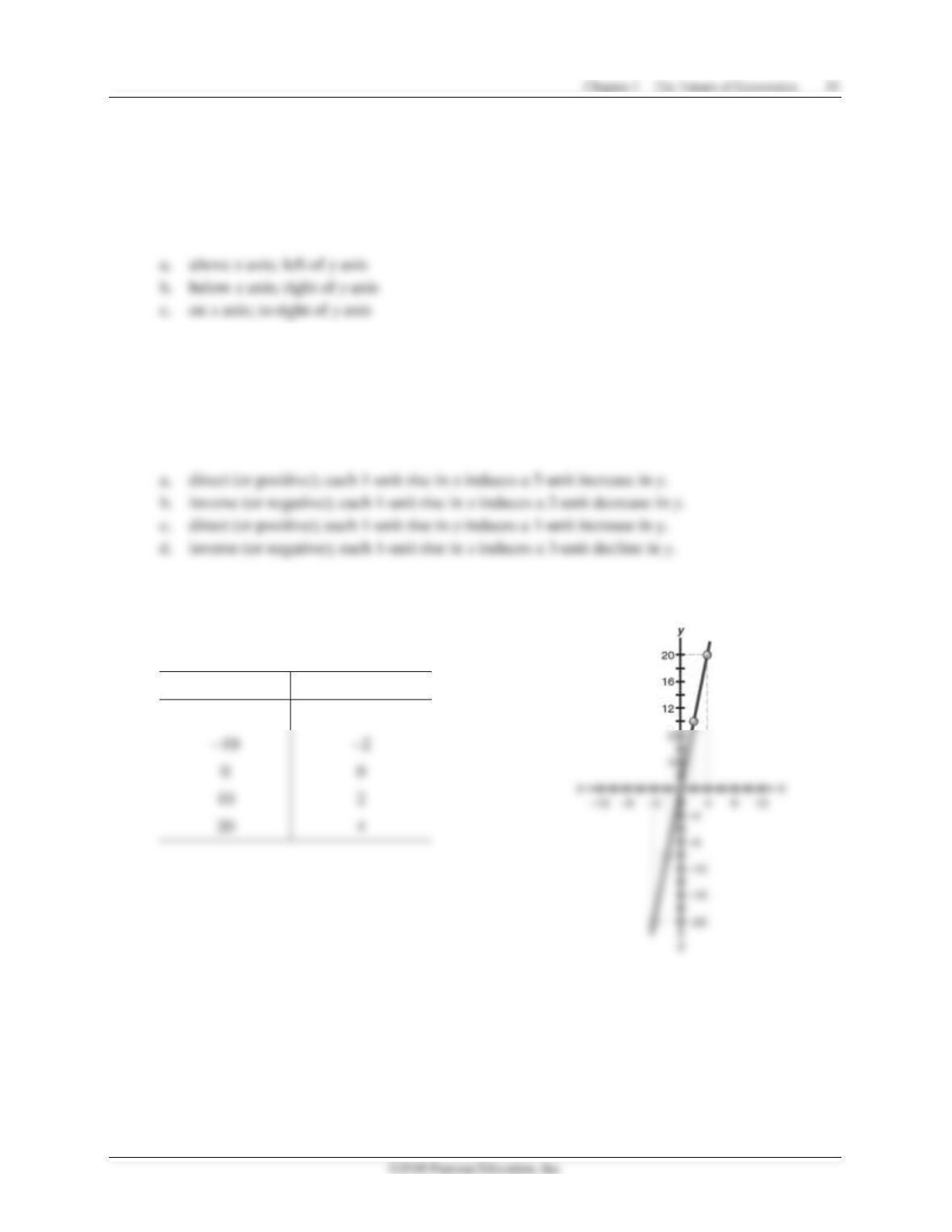
A-5. Given the function y = 5x, complete the following schedule and plot the curve.
y
x
−20
−4
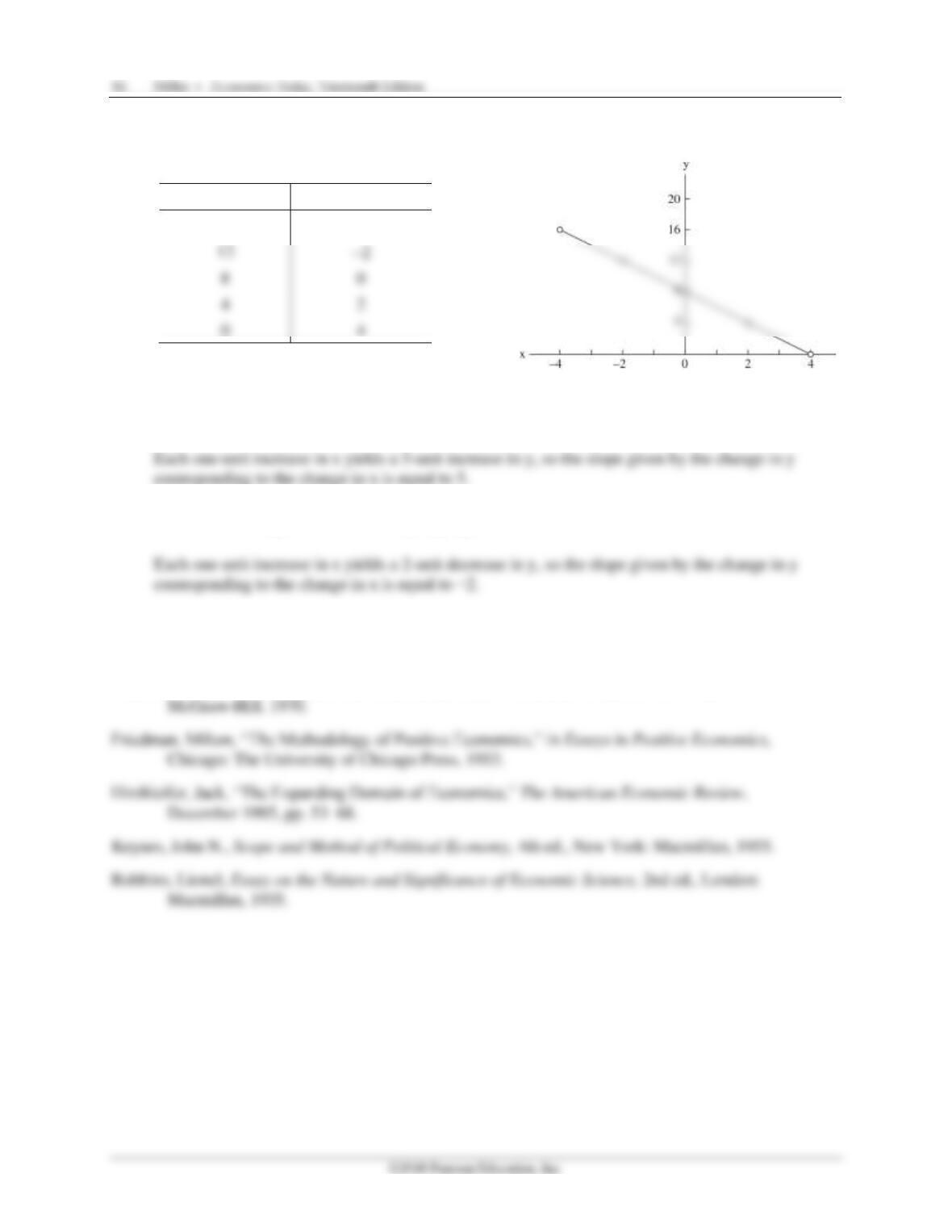
A-6. Given the function y = 8 – 2x, complete the following schedule and plot the curve.
y
x
16
−4
4
2
A-7. Calculate the slope of the function you graphed in Problem A-5.
A-8. Calculate the slope of the function you graphed in Problem A-6.
◼ Selected References
Fellner, William, The Emergence and Content of Modern Economic Analysis, New York: