
Instructor’s Manual
with
Solutions Manual
R. Glenn Hubbard
Anthony Patrick O’Brien
MACROECONOMICS
SIXTH EDITION
R. Glenn Hubbard
Contents
Part 1: Introduction
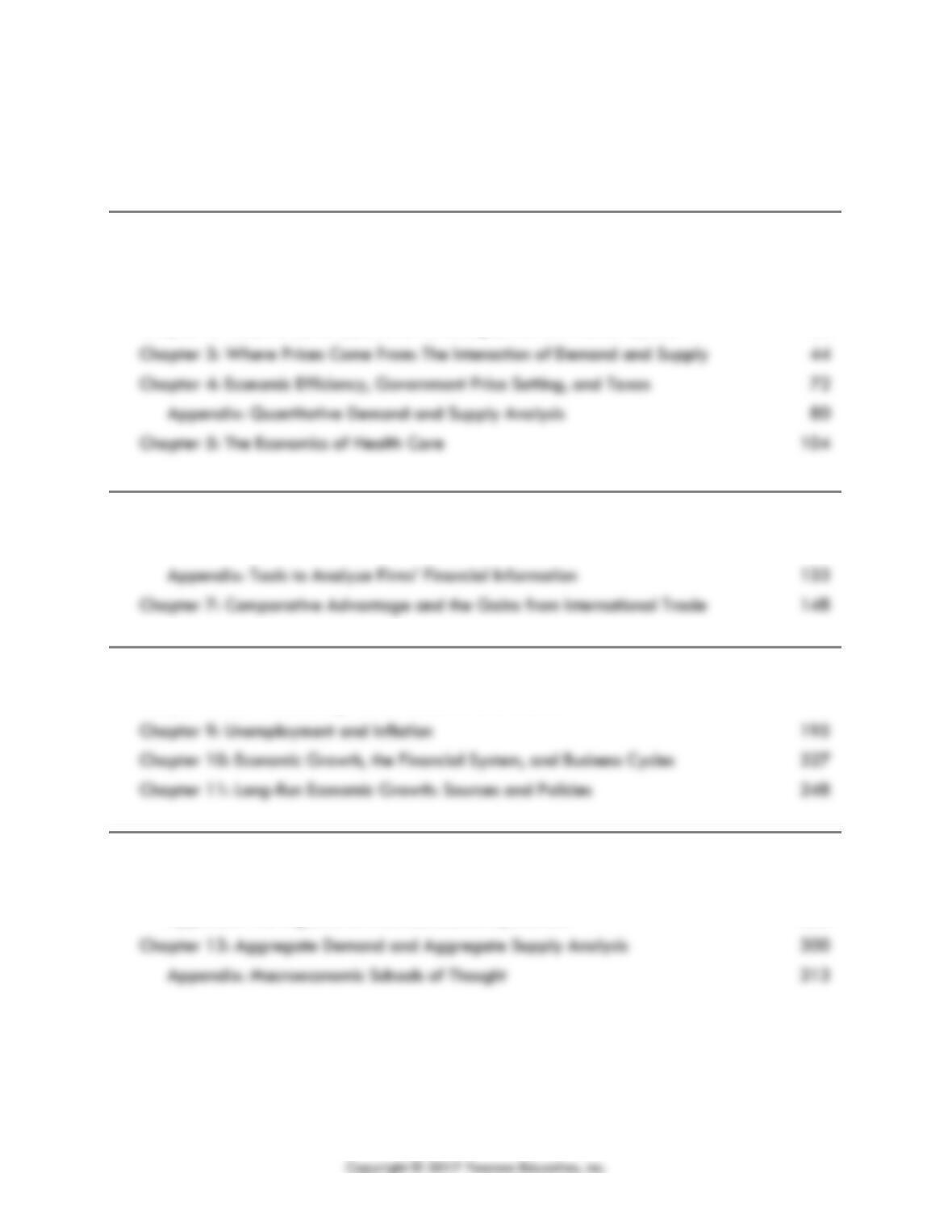
Chapter 1: Economics: Foundations and Models 1
Appendix: Using Graphs and Formulas 12
Chapter 2: Trade-offs, Comparative Advantage, and the Market System 25
Part 2: Firms in the Domestic and International Economies
Chapter 6: Firms, the Stock Market, and Corporate Governance 122
Part 3: Macroeconomic Foundations and Long-Run Growth
Chapter 8: GDP: Measuring Total Production and Income 175
Part 4: Short-Run Fluctuations
Chapter 12: Aggregate Expenditure and Output in the Short Run 271
Appendix: The Algebra of Macroeconomic Equilibrium 286
Contents iii
Part 5: Monetary and Fiscal Policy
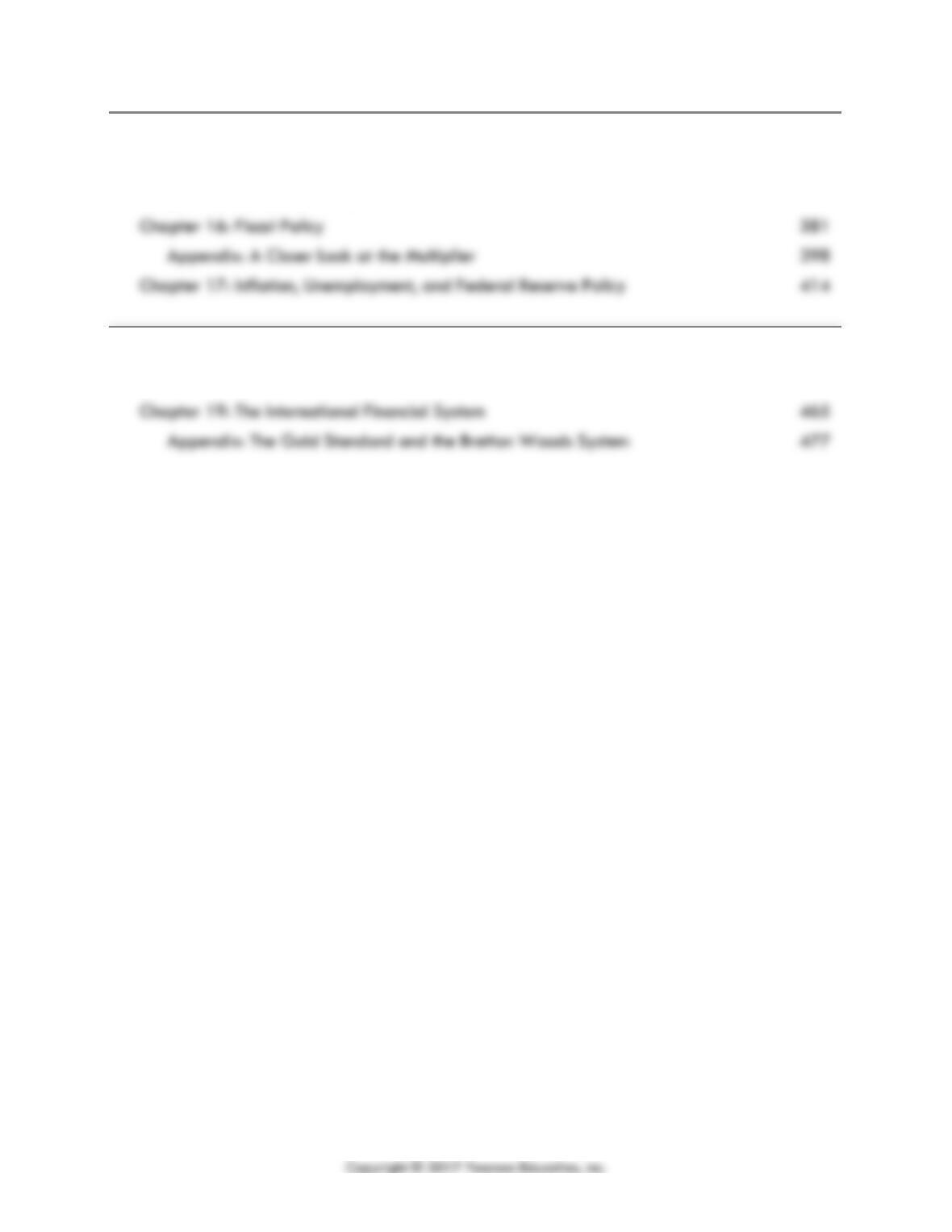
Chapter 14: Money, Banks, and the Federal Reserve System 326
Chapter 15: Monetary Policy 352
Part 6: The International Economy
Chapter 18: Macroeconomics in an Open Economy 438
Preface
Features of this Instructor’s Manual
Each chapter of this Instructor’s Manual contains the following elements:
Chapter Summary: An overview of the main economic concepts covered.
Extra Economics in Your Life: Each chapter of the book opens and closes with a special feature entitled
Economics in Your Life that emphasizes the connection between the material and the students’ personal
experiences and questions. This Instructor’s Manual includes an extra Economics in Your Life for each
chapter to present in class.
Extra Making the Connection: Each chapter of the main text has two or more Making the Connection
Digital Features Located in MyEconLab
MyEconLab is a unique online course management, testing, and tutorial resource. It is included with the
eText version of the book or as a supplement to the print book. Students and instructors will find the
following online resources to accompany the sixth edition:
• Videos. There are 58 Making the Connection features in the book that provide real-world

Preface v
• Concept Checks. Each section of each learning objective concludes with an online Concept Check
that contains one or two multiple-choice, true/false, or fill-in questions. These checks act as “speed
• Animations of Figures. Graphs are the backbone of introductory economics, but many students
struggle to understand and work with them. Each of the 166 numbered figures in the text has a
supporting animated version online. The goal of this digital resource is to help students understand
• Interactive Solved Problems. Many students have difficulty applying economic concepts to solving
problems. The goal of this digital resource is to help students overcome this hurdle by giving them a
model of how to solve an economic problem by breaking it down step by step. Each of the 35 Solved
• Graphs Updated with Real-Time Data from FRED. Approximately 25 graphs are continuously
updated online with the latest available data from FRED (Federal Reserve Economic Data), which is
a comprehensive, up-to-date data set maintained by the Federal Reserve Bank of St. Louis. Students
• Interactive Problems and Exercises Updated with Real-Time Data from FRED. The end-of-
chapter problems in select chapters include Real-Time Data Exercises that use the latest data from

vi Preface
Copyright © 2017 Pearson Education, Inc.
Organizing Your Syllabus
The Instructor’s Manual can be a valuable resource for both experienced and first-time instructors. Both
the textbook and Instructor’s Manual provide comprehensive coverage of economic theory, monetary
policy, fiscal policy, and real-world applications.
Chapter 8, “GDP: Measuring Total Production and Income,” and Chapter 9, “Unemployment and
Inflation” carefully provide definitions of macroeconomic statistics such as GDP, CPI, and payroll
employment, that dominate news headlines.
The comprehensive coverage of macroeconomic models and policy issues allows instructors with
Chapter 12, “Aggregate Expenditure and Output in the Short Run,” contains a thorough discussion of the
traditional Keynesian 45º-line aggregate expenditure model. Many instructors find this model useful in
introducing students to the short-run relationship between spending and production. However, instructors
may also safely omit Chapter 12 and proceed directly to Chapter 13, “Aggregate Demand and Aggregate
Supply Analysis.”
Chapter 13 carefully develops the AD–AS model and then makes the model dynamic in an optional
section to account better for actual movements in real GDP and the price level. Chapter 13 includes a

Preface vii
The following chart helps you organize your syllabus based on your teaching preferences and objectives:
CORE
POLICY
OPTIONAL
Chapter 1: Economics: Foundations
and Models
Chapter 2: Trade-offs, Comparative
Advantage, and the Market
System
Chapter 8: GDP: Measuring
Total Production and Income
Chapter 9: Unemployment and
Inflation
Chapter 10: Economic Growth, the
Financial System, and Business
Cycles
Chapter 4: Economic Efficiency,
Government Price Setting, and
Taxes
Chapter 5: The Economics of
Health Care
Chapter 1 Appendix: Using Graphs
and Formulas
Chapter 4 Appendix: Quantitative
Demand and Supply Analysis
Chapter 12 Appendix: The Algebra
of Macroeconomic Equilibrium
Chapter 13 Appendix:
Macroeconomic Schools of
Thought
Chapter 16 Appendix: A Closer
Look at the Multiplier
viii Preface
Copyright © 2017 Pearson Education, Inc.
MyEconLab for Instructors & Students
MyEconLab is a unique online course management, testing, and tutorial resource.
MyEconLab for the Professor
Instructors can choose how much or how little time to spend setting up and using MyEconLab. Each
chapter contains two preloaded exercise sets that can be used to build an individualized study plan for
• Preloaded exercise assignments sets for each chapter include the student tutorial resources mentioned
earlier.
• Preloaded quizzes for each chapter are unique to the text and not repeated in the study plan or
homework exercise sets.
• Study plan problems are similar to the end-of-chapter problems and numbered exactly as in the book
• Experiments in MyEconLab provide a fun and engaging way to promote active learning and mastery
of important economic concepts. Pearson’s Experiments program is flexible, easy–to-assign, auto-
graded, and available in Single and Multiplayer versions. Single-player experiments allow your
students to play against virtual players from anywhere at any time, as long as they have an Internet
connection. Multiplayer experiments allow you to assign and manage a real-time experiment with
your class. Pre- and post-questions for each experiment are available for assignment in MyEconLab.
For a complete list of available experiments, visit www.myeconlab.com.
Preface ix
Customization and Communication
MyEconLab in MyLab/Mastering provides additional optional customization and communication tools.
MyEconLab for the Student
MyEconLab puts students in control of their learning through a collection of testing, practice, and study
tools tied to the online, interactive version of the textbook and other media resources. Students can study
on their own or can complete assignments created by their instructor. In MyEconLab’s structured
environment, students practice what they learn, test their understanding, and pursue a personalized study
plan generated from their performance on sample tests and from quizzes created by their instructors. In
Homework or Study Plan mode, students have access to a wealth of tutorial features, including:
• Instant feedback on exercises that helps students understand and apply the concepts
Additional MyEconLab Tools
MyEconLab includes the following additional features:
• Enhanced eText. Students actively read and learn, and with more engagement than ever before,
through embedded and auto-graded practice, real-time data-graph updates, animations, author videos,

x Preface
Other Supplements for Instructors
▪ Test Item File
▪ TestGen Computerized Test Program
▪ PowerPoint Lecture Presentation
Test Item File (in electronic TestGen format)
The Test Item File includes more than 4,000 multiple-choice, short answer, and graphing questions.
Test questions are annotated with the following information:
Difficulty: 1 for straight recall, 2 for some analysis, 3 for complex analysis
The Association to Advance Collegiate Schools of Business (AACSB)
The test bank authors have connected select test bank questions to the general knowledge and skill
guidelines found in the AACSB standards.
What Is the AACSB?
AACSB is a not-for-profit corporation of educational institutions, corporations, and other organizations
What Are AACSB Learning Standards?
One of the criteria for AACSB accreditation is the quality of the curricula. Although no specific courses
are required, the AACSB expects a curriculum to include learning experiences in such areas as:
• Written and Oral Communication
• Ethical Understanding and Reasoning
Preface xi
These categories are AACSB Learning Standards. Questions that test skills relevant to these standards
are tagged with the appropriate standard. For example, a question testing the moral questions associated
with externalities would receive the Ethical Reasoning tag.
How Can Instructors Use the AACSB Tags?
Tagged questions help you measure whether students are grasping the course content that aligns with the
TestGen
The computerized TestGen package allows instructors to customize, save, and generate classroom tests.
The test program permits instructors to edit, add, or delete questions from the test banks; edit existing
PowerPoint Slides (Three Sets)
Three sets of PowerPoint slides are available:
1. A comprehensive set of PowerPoint slides can be used by instructors for class presentations or by
students for lecture preview or review. These slides include all the graphs, tables, and equations in
the textbook. Two versions are available—step-by-step mode, in which you can build graphs as you
Learning Catalytics
Learning Catalytics is a “bring your own device” Web-based student engagement, assessment, and
classroom intelligence system. This system generates classroom discussion, guides lectures, and promotes
Digital Interactives
Focused on a single core topic and organized in progressive levels, each interactive immerses students in

xii Preface
Other Supplements for Students
In addition to MyEconLab, Pearson provides the following resources.
Dynamic Study Modules
With a focus on key topics, these modules work by continuously assessing student performance and
PowerPoint Slides
For student use as a study aide or note-taking guide, PowerPoint slides may be downloaded from the