CHAPTER 1 | Economics: Foundations and Models 13
D. Determining Cause and Effect
Inferring cause and effect relationships by observing graphs can lead to incorrect conclusions. One reason
E. Are Graphs of Economic Relationships Always Straight Lines?
The relationship between two variables is linear when it can be represented by a straight line. Few
F. Slopes of Nonlinear Curves
To measure the slope of a nonlinear curve at a particular point, we must measure the slope of a tangent to
the curve at that point. A tangent line touches the curve at only one point. The slope of a tangent is
measured in the same way as the slope of any straight line.
Formulas
This section reviews several useful formulas and shows how to use them.
A. Formula for a Percentage Change
The formula for a percentage change between two variables for any two periods is:
C. Summary of Using Formulas
Follow these steps when using a formula:
1. Make sure you understand the economic concept the formula represents.
2. Make sure you are using the correct formula for the problem you are solving.
14 CHAPTER 1 | Economics: Foundations and Models
Solutions to End-of-Chapter Exercises
Answers to Thinking Critically Questions
1. Technological progress has lowered the cost of producing the types of medical devices likely to
result from partnerships between technology firms like Google and health care firms like
2. In developing an economic model, economists generally follow these 5 steps:
1. Decide on the assumptions to use in developing the model.
2. Formulate a testable hypothesis
5. Retain the revised model to help answer similar economic questions in the future.
Step 1: The primary assumption you could make is that because it is more convenient and less
painful, using contact lenses to monitor blood sugar levels will have a greater effect on reducing
the number of diabetes-related deaths than using the traditional finger-prick method.
Step 2: The article states that Google is trying to use technology to improve people’s quality of life,
a. Collect data on the levels of blood sugar from both users of the contact lenses and users of the
finger prick method, as well as data on the frequency of monitoring blood sugar using both
methods.
b. Collect data on the number of diabetes-related deaths that have occurred for people who had
used the contact lenses and for those who had used the finger-prick method.
CHAPTER 1 | Economics: Foundations and Models 15
1.1
Three Key Economic Ideas
Learning Objective: Explain these three key economic ideas: People are rational;
people respond to incentives; and optimal decisions are made at the margin.
Review Questions
1.1 “People are rational” is the assumption that decision makers explicitly or implicitly weigh the
benefits and costs of each action and then choose an action only if the benefits are expected to
1.2 Scarcity is the situation in which unlimited wants exceed the limited resources available to fulfill
those wants. Economics is the study of the choices consumers, business managers, and
Problems and Applications
1.3 Economists assume that people are rational in the sense that they use all available information as
they act to achieve their goals. Rational individuals weigh the benefits and costs of each action,
1.4 As noted in the chapter, the economic incentive to banks is clear—it is less costly to put up with
1.5 a. Students face a scarcity of time, like everyone else, and respond to the incentives of the
teacher’s grading system. Students have more incentive to put their efforts into the parts of
the course that have the most weight in the grading system.
16 CHAPTER 1 | Economics: Foundations and Models
1.6 a. As a result of changes in the federal student loan programs the total amount students borrow
should increase. The changes increase the incentive students have to borrow money under the
programs because they limit the amount of the loans that must be repaid.
b. If in 2016 President Obama was recommending further changes to the student loan program,
1.7 a. Employees who have health problems incur higher medical costs than healthier employees.
The higher medical costs increase the health insurance premiums that firms must pay
for employer-provided health insurance, which raises the firms’ costs. These higher costs
1.8 a. Obese workers tend to suffer more medical problems than do people who are not overweight
and so incur higher medical costs. The higher medical costs increase the health insurance
premiums that firms must pay for employer-provided health insurance, which raises the
1.9 You would want to compare the expected additional revenue with the expected additional cost of
serving breakfast all day. Your revenue calculations should include the effect of some customers
CHAPTER 1 | Economics: Foundations and Models 17
1.10 Your friend is failing to think at the margin. It doesn’t matter how much time your friend has
already spent studying psychology. What matters is the marginal benefit to be received from
1.11 A complete explanation for the connection between majoring in economics and success in
business would involve many factors. But we can say that economics teaches us how to look at
1.2
The Economic Problem That Every Society Must Solve
Learning Objective: Discuss how an economy answers these questions: What goods and
services will be produced? How will the goods and services be produced? Who will
receive the goods and services produced?
Review Questions
2.1 Scarcity implies that every society and every individual faces trade-offs because wants are
2.2 The three economic questions that every society must answer are: (1) What goods and services
will be produced? (2) How will the goods and services be produced? (3) Who will receive the
goods and services? In a centrally planned economy, the government makes most of these
2.3 Productive efficiency occurs when a good or service is produced at the lowest possible cost.
2.4 Efficiency is concerned with producing the goods and services that people want at the lowest
cost. Equity is “fairness,” a concept that can differ from person to person. Government
18 CHAPTER 1 | Economics: Foundations and Models
Problems and Applications
2.5 Yes, even Bill Gates faces scarcity because his wants exceed his resources. Gates has established
a foundation with billions of dollars to spend on worthy causes like eradicating malaria and
2.6 Spending resources in a way that helps only one poor person is likely to be an ineffective way of
helping poor people. How many poor people could be helped by using another method of helping
the poor? The opportunity cost of using one method is the number of poor people that could be
helped by using the best available alternative method.
2.7 Even if the ticket prices for college football games did not change, if the games were re–
scheduled from late morning to the afternoon or evening, the opportunity cost – the best foregone
2.8 The incentive for a firm in a market economy to be allocatively efficient—producing goods and
2.9 Productive efficiency refers to a situation in which a good or service is produced at the lowest
possible cost. Allocative efficiency is a state in which production is in accordance with consumer
preferences: Every good or service is produced up to the point where the last unit provides a
2.10 Although federal government approval (by the FDA) is required for the sale of drugs and medical
devices, privately owned firms produce and sell these products. It would be more accurate to
2.11 Answers can vary, but it seems that it would be harder for the centrally planned economy to
determine the various goods and services that consumers desire than to determine the cost–
minimizing production process. Productive efficiency refers to a situation in which a good or
CHAPTER 1 | Economics: Foundations and Models 19
2.12 If all of an economic system’s resources were devoted to providing health care, there would be
other important goods and services, such as food, housing, clothing, and education that would not
be provided. An economic system that provided its citizens state-of-the-art health care but so little
2.13 a. The groups of students most likely to get the tickets will be those for whom the expected
marginal benefit of going to the athletic department office on Monday morning is greater than
the expected marginal cost. These would include students who have a relatively low
opportunity cost of their time, such as those who have no Monday morning classes. Other
c. This isn’t an efficient way to distribute the tickets because it wastes so much time. It would
be more efficient to sell the tickets to those willing to pay the highest prices to buy the tickets.
d. Equity is hard to define. Some people will see this way of distributing tickets as equitable
because students with low incomes can still get tickets provided they are willing to pay the
opportunity cost of waiting in line. Some people will see this way of distributing the tickets as
1.3
Economic Models
Learning Objective: Understand the role of models in economic analysis.
Review Questions
3.1 Economists use models for the same reason that other scientists do—to make a complicated world
simple enough that problems can be understood and analyzed, and questions can be accurately
20 CHAPTER 1 | Economics: Foundations and Models
3.2 In arriving at a useful economic model, these five steps are followed: (1) decide the assumptions
3.3 Positive economic analysis concerns what is; that is, it deals with how the economy actually
behaves. Normative economic analysis concerns what ought to be. Economics is mainly
Problems and Applications
3.4 The economist should revise the model in light of its failure to explain or predict real world
events.
3.5 The problem with Dr. Strangelove’s theory is that it cannot be tested unless we can devise a way
3.6 a. This statement represents positive analysis, analysis concerned with “what is.” Positive
analysis would use an economic model to measure the effect a tax on cigarettes has on
teenagers’ purchases of cigarettes.
3.7 Mr. Buffet made a normative judgment regarding the policy that he believed would be best in
reducing poverty and helping people achieve a decent lifestyle. Normative analysis concerns what
one person believes ought to be. One can agree or disagree with his opinion.
3.8 It would be helpful to know what role tuition plays in a student’s decision about whether to attend
medical school. Have tuition increases had a large effect or a small effect on the number of
CHAPTER 1 | Economics: Foundations and Models 21
3.9 An economic incentive for doctors to accept information supplied by their patients is that it would
reduce the amount of time spent testing and evaluating the patients’ condition in the office or
3.10 An economic model used to forecast the number of physicians and physician assistants should
take account of the growth of the home medical device industry. The greater the growth in the use
of home medical devices, the less patients will require the services of physicians and physicians’
3.11 a. The system helps protect consumers by providing high-quality training for physicians.
b. This system allows physicians in a specialty to limit the number of physicians in that
specialty. Increasing the number of physicians in a specialty is likely to reduce the incomes
1.4
Microeconomics and Macroeconomics
Learning Objective: Distinguish between microeconomics and macroeconomics.
Review Question
4.1 Microeconomics is the study of how households and firms make choices, how they interact in
specific markets, and how the government influences their choices. “Micro” means small, and
4.2 No, because many economic situations have both a microeconomic and a macroeconomic aspect.
For example, the level of total consumption spending by households helps to determine how fast
22 CHAPTER 1 | Economics: Foundations and Models
Problems and Applications
4.3 a. and d. are microeconomic questions because they relate to specific industries; b. and c. are
macroeconomic questions because they relate to economy-wide issues.
4.4 You should disagree with the assertion. Microeconomics deals with individual decision makers;
Solutions to Chapter 1 Appendix
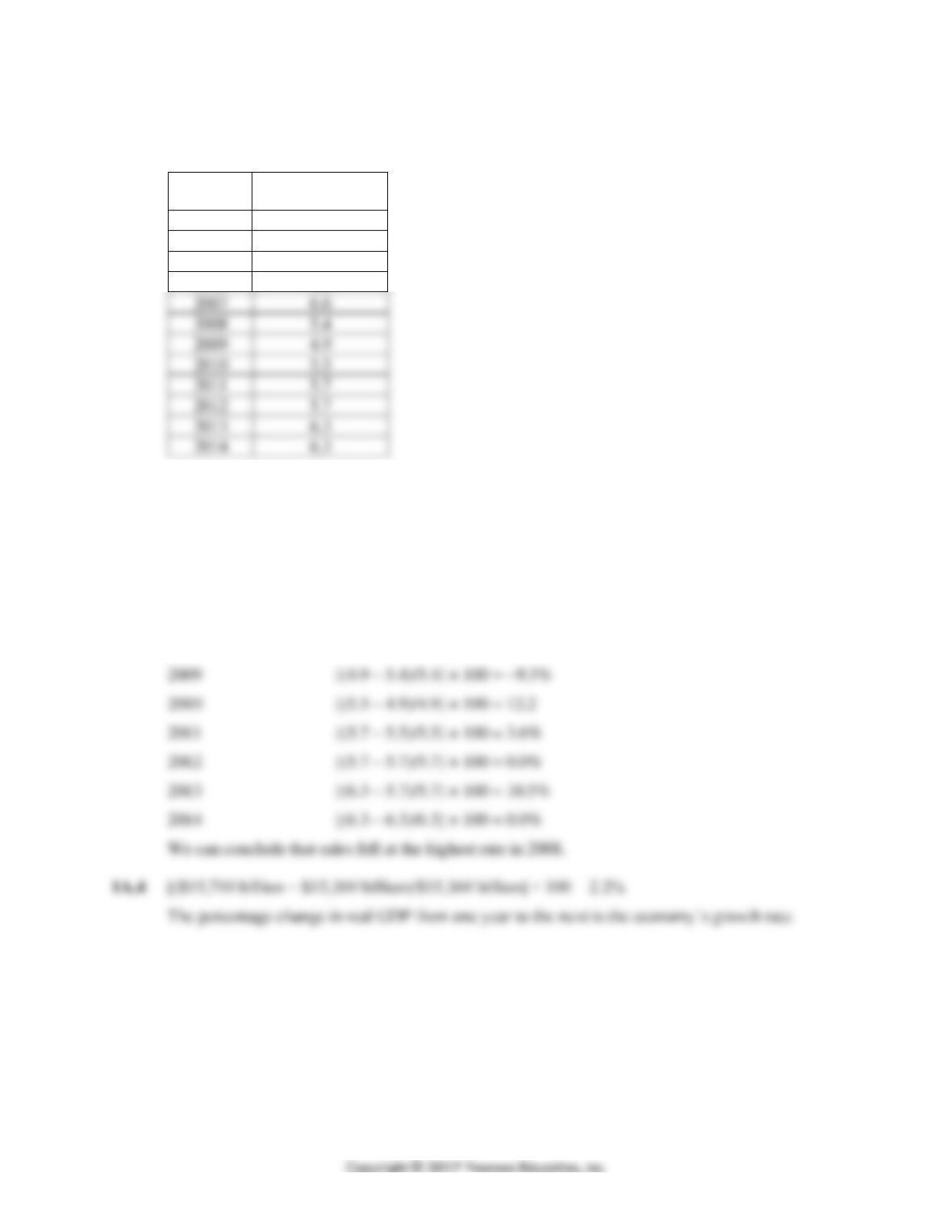
1A.1 a. The relationship is negative because as price decreases, the quantity of pies purchased
increases.
b.
1A. 2
CHAPTER 1 | Economics: Foundations and Models 23
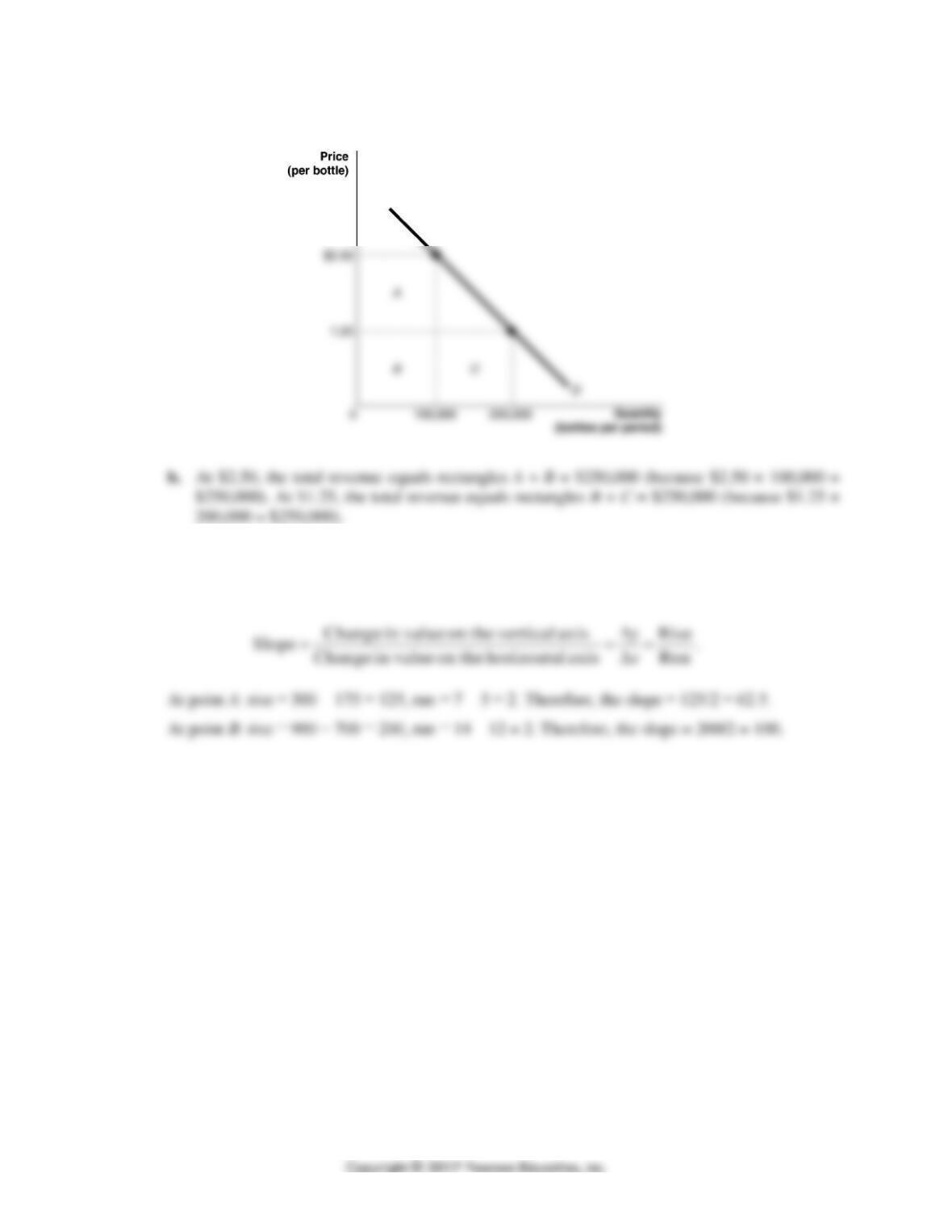
1A.3 Answers will vary somewhat depending on the values determined from the time-series graph. The
calculations below use Ford sales rounded to the nearest millions as shown in the table below.
Year
Ford’s Auto
Sales
2003
6.7
2004
6.8
2005
6.8
2006
6.6
2007
6.6
2008
5.4
2009
4.9
2010
5.5
2011
5.7
2012
5.7
2013
6.3
2014
6.3
Year Percentage Change
2004 [(6.8 – 6.7)/6.7] × 100 = 1.5%
2005 [(6.8 – 6.8)/6.8] × 100 = 0.0%
2006 [(6.6 – 6.8)/6.8] × 100 = −2.9%
2007 [(6.6 – 6.6)/6.6] × 100 = 0.0%
2008 [(5.4 – 6.6)/6.6] × 100 = −18.2%
24 CHAPTER 1 | Economics: Foundations and Models
1A.5 a.
1A.6 The triangle’s area = (0.5) × (175,000 – 115,000) × ($2.25 − $1.50) = 0.5 × 60,000 × $0.75 = $22,500.
1A.7 The slope is calculated using the formula: