Appendix 7C Bankruptcy and Reorganization
Answers and Solutions
7C-1
Web Appendix 7C
Bankruptcy and Reorganization
Answers to Questions
7C-1 The following central issues arise in bankruptcy proceedings:
1. Does the firm’s inability to meet scheduled payments result from a temporary cash flow
problem, or does it represent a permanent problem caused by asset values having fallen below
debt obligations?
2. If the problem is a temporary one, then an agreement that stretches out payments may be worked
out to give the firm time to recover and to satisfy everyone. However, if basic long-run asset values
have truly declined, economic losses will have occurred. In this event, who should bear the losses?
7C-2 Chapters 11 and 7 are the most important ones for financial management purposes. Chapter 11 is
the business reorganization chapter—this means that the company is bankrupt and is trying to
7C-3 a. False; Chapter 7 provides safeguards against the withdrawal of assets by the owners of the
bankrupt firm.
b. False; Chapter 11 establishes the rules of reorganization for firms with projected cash flows that
eventually will be sufficient to meet debt payments.
c. False; Chapter 7 allows insolvent debtors to discharge all their obligations and to start over
unhampered by a burden of prior debt.
Appendix 7C Bankruptcy and Reorganization
Answers and Solutions
7C-3
Solutions to Problems
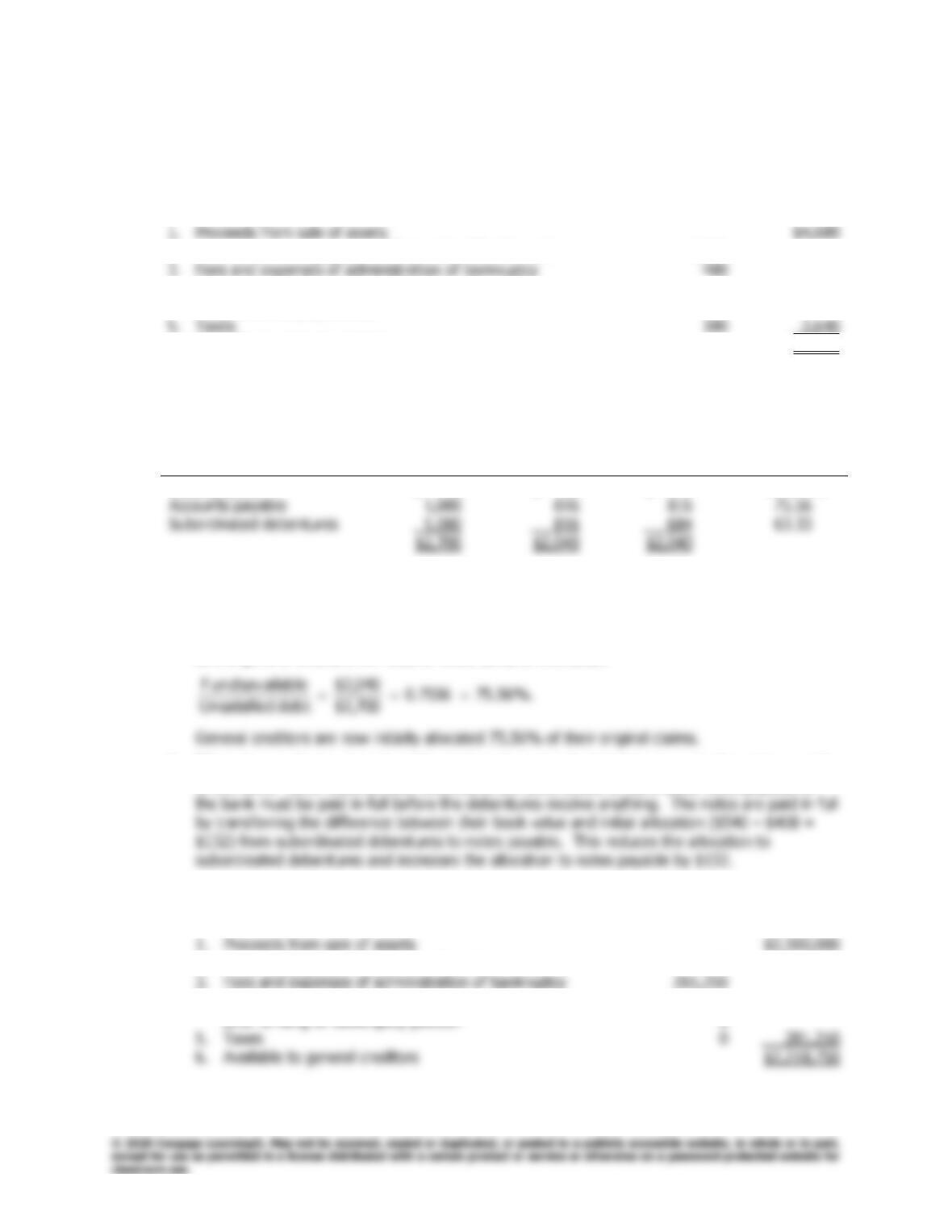
7C-1 Distribution of proceeds on liquidation:
2. 1st and 2nd mortgages, paid from sale of fixed assets 1,800
4. Wages due workers earned within 6 months prior to
filing of bankruptcy petition 180
6. Available to general creditors $2,040
Distribution to general creditors:
Claim
Application of
75.56%
Distribution
After
Subordination
Adjustment
Percentage of
Original Claims
Received
Claims of General Creditors
(1)
(2)
(3)
(4)
Notes payable
$ 540
$ 408
$ 540
100.00%
Accounts payable
1,080
75.56
Subordinated debentures
816
684
63.33
$2,700
$2,040
$2,040
Explanation of the columns:
1. Values taken from the balance sheet (except trustee’s costs).
2. After the distribution of proceeds to priority claimants, $2,040 remains and claims total $2,700,
so the general creditors will receive 75.56 cents on the dollar:
3. This column reflects a transfer of funds from the subordinated debentures to the notes payable
to the bank. Since subordinated debentures are subordinate to bank debt, notes payable to
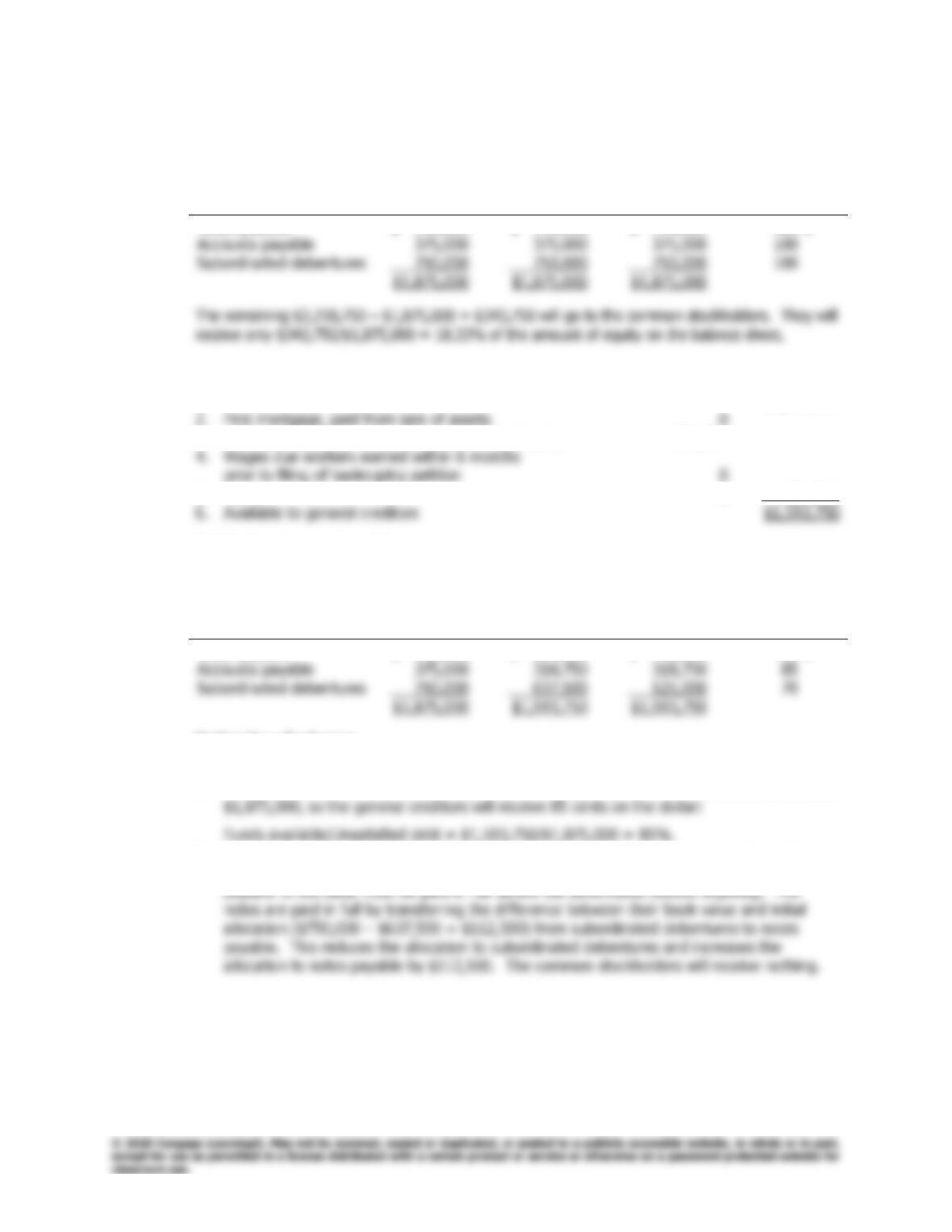
7C-2 a. Distribution of proceeds on liquidation:
2. First mortgage, paid from sale of assets 0
4. Wages due workers earned within 6 months
prior to filing of bankruptcy petition 0
7C-4
Answers and Solutions
Appendix 7C Bankruptcy and Reorganization
Distribution to general creditors:
Claim
Application of
100%
Distribution
After
Subordination
Adjustment
Percentage of
Original Claims
Received
Claims of General Creditors
(1)
(2)
(3)
(4)
Notes payable
$ 750,000
$ 750,000
$ 750,000
100%
Accounts payable
375,000
375,000
Subordinated debentures
750,000
750,000
750,000
$1,875,000
$1,875,000
$1,875,000
b. Distribution of proceeds on liquidation:
1. Proceeds from sale of assets $1,875,000
3. Fees and expenses of administration of bankruptcy 281,250
5. Taxes 0 281,250
Distribution to general creditors:
Claim
Application of
85%
Distribution
After
Subordination
Adjustment
Percentage of
Original Claims
Received
Claims of General Creditors
(1)
(2)
(3)
(4)
Notes payable
$ 750,000
$ 637,500
$ 750,000
100%
Accounts payable
375,000
318,750
318,750
Subordinated debentures
750,000
637,500
525,000
$1,875,000
$1,593,750
$1,593,750
Explanation of columns:
1. Values taken from the balance sheet (except trustee’s costs).
2. After the distribution of proceeds to priority claimants, $1,593,750 remains and claims total
3. This column reflects a transfer of funds from the subordinated debentures to the notes
payable to the bank. Since subordinated debentures are subordinate to bank debt, notes