
Appendix 12B Refunding Operations
Answers and Solutions
12B–1
Web Appendix 12B
Refunding Operations
Answers to Questions
12B-1 The decision to refund a security is analyzed in much the same way as a capital budgeting
expenditure. The costs of refunding (the investment outlays) are (1) the call premium paid for the
privilege of calling the old issue, (2) the costs of selling the new issue, (3) the tax savings from
writing off the unexpensed flotation costs on the old issue, and (4) the net interest that must be
paid while both issues are outstanding (the new issue is often sold prior to the refunding to ensure
that the funds will be available). The annual cash flows, in a capital budgeting sense, are the
12B-2 In the discounting process, the after-tax cost of the new debt, rd(1 – T), should be used as the
discount rate. The reason is that there is relatively little risk to the savings—cash flows in a
refunding decision are known with relative certainty, which is quite unlike the situation with cash
flows in most capital budgeting decisions.
12B-3 Although a refunding analysis shows that the refunding would increase the firm’s value, the
question still remains whether refunding at this time would truly maximize the firm’s expected
12B-2
Answers and Solutions
Appendix 12B Refunding Operations
Solutions to Problems
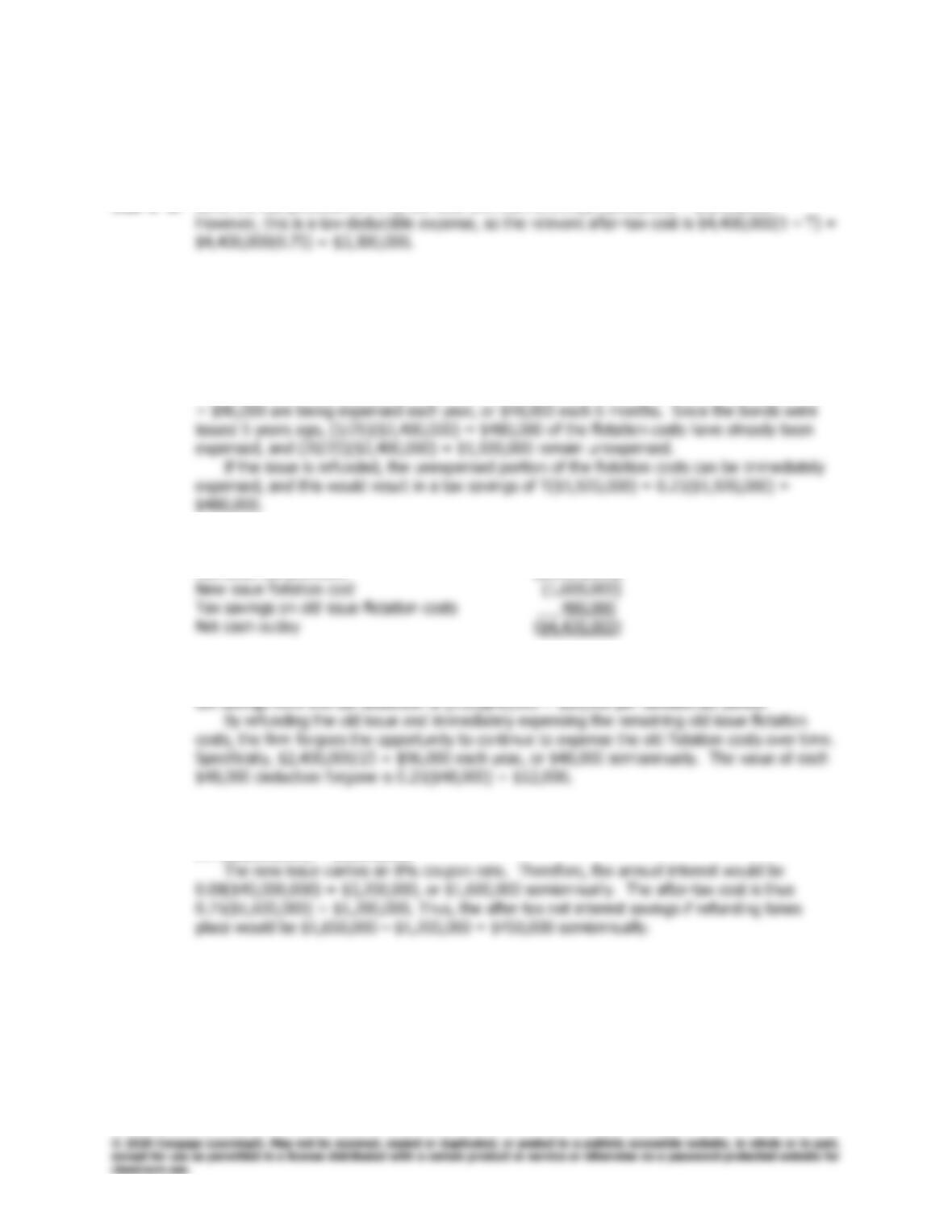
12B-1 a. Since the call premium is 11%, the total premium is 0.11($40,000,000) = $4,400,000.
b. The dollar flotation cost on the new issue is 0.04($40,000,000) = $1,600,000. This cost is not
immediately tax deductible, and hence the after–tax cost is also $1,600,000. (Note that the
flotation cost can be amortized and expensed over the life of the issue. The value of this tax
savings will be calculated in Part e.)
c. The flotation costs on the old issue were 0.06($40,000,000) = $2,400,000. These costs were
deferred and are being amortized over the 25-year life of the issue, and hence $2,400,000/25
d. The net after-tax cash outlay is $4,420,000, as shown below:
Old issue call premium ($3,300,000)
e. The new issue flotation costs of $1,600,000 would be amortized over the 20-year life of the issue.
Thus, $1,600,000/20 = $80,000 would be expensed each year, or $40,000 each 6 months. The
f. The interest on the old issue is 0.11($40,000,000) = $4,400,000 annually, or $2,200,000
semiannually. Since interest payments are tax deductible, the after-tax semiannual amount is
0.75($2,200,000) = $1,650,000.
Appendix 12B Refunding Operations
Answers and Solutions
12B–3
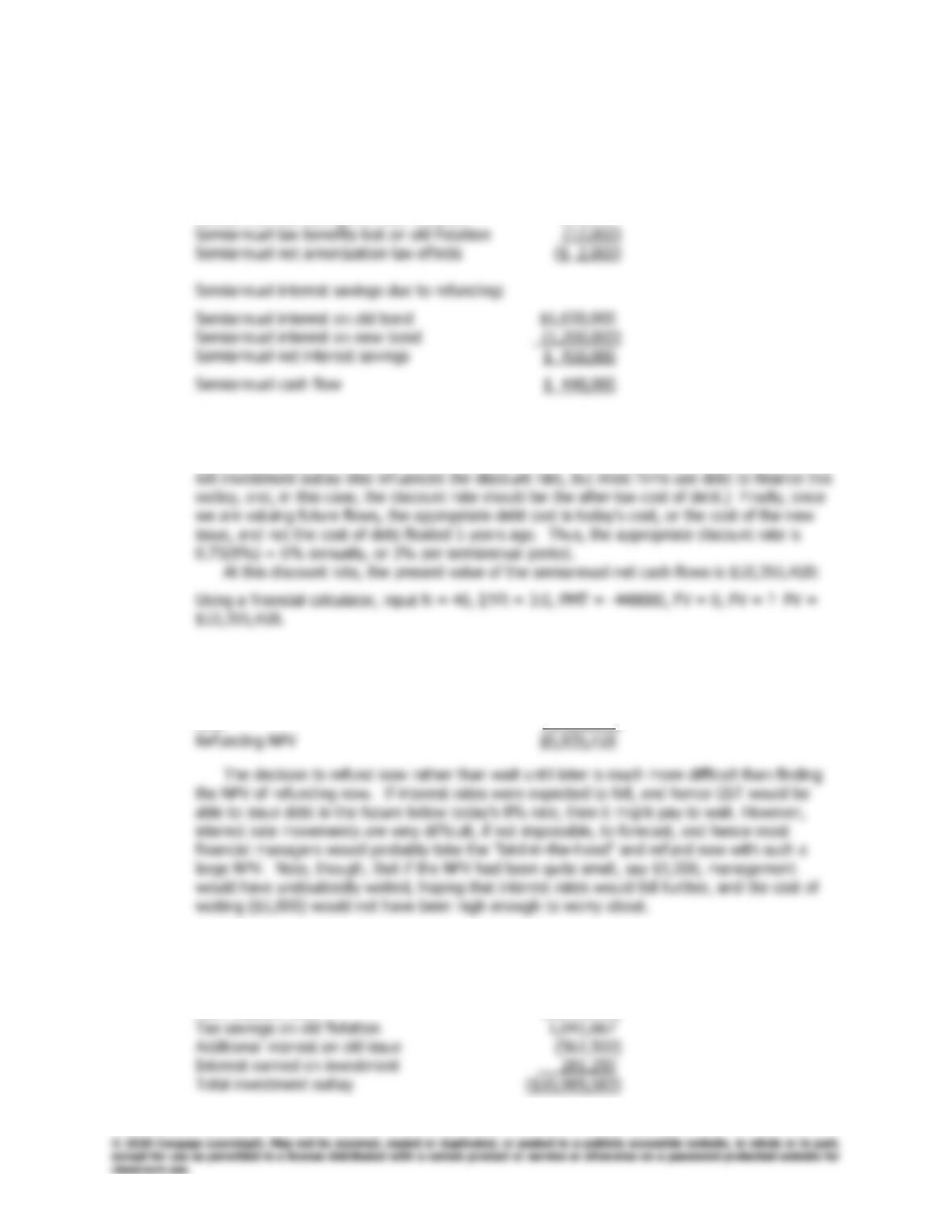
g. The net amortization tax effects are -$2,000 semiannually for 20 years, while the net interest
savings are $450,000 semiannually for 20 years. Thus, the net semiannual cash flow is
$448,000, as shown below.
Semiannual flotation cost tax effects:
Semiannual tax savings on new flotation $10,000
The cash flows are based on contractual obligations, and hence have about the same amount
of risk as the firm’s debt. Further, the cash flows are already net of taxes. Thus, the
appropriate interest rate is GST’s after-tax cost of debt. (The source of the cash to fund the
h. The bond refunding would require a $4,420,000 net cash outlay, but it would produce
$10,355,418 in net savings on a present value basis. Thus, the NPV of refunding is $5,935,418:
PV of net benefits $10,355,418
Cost (4,420,000)
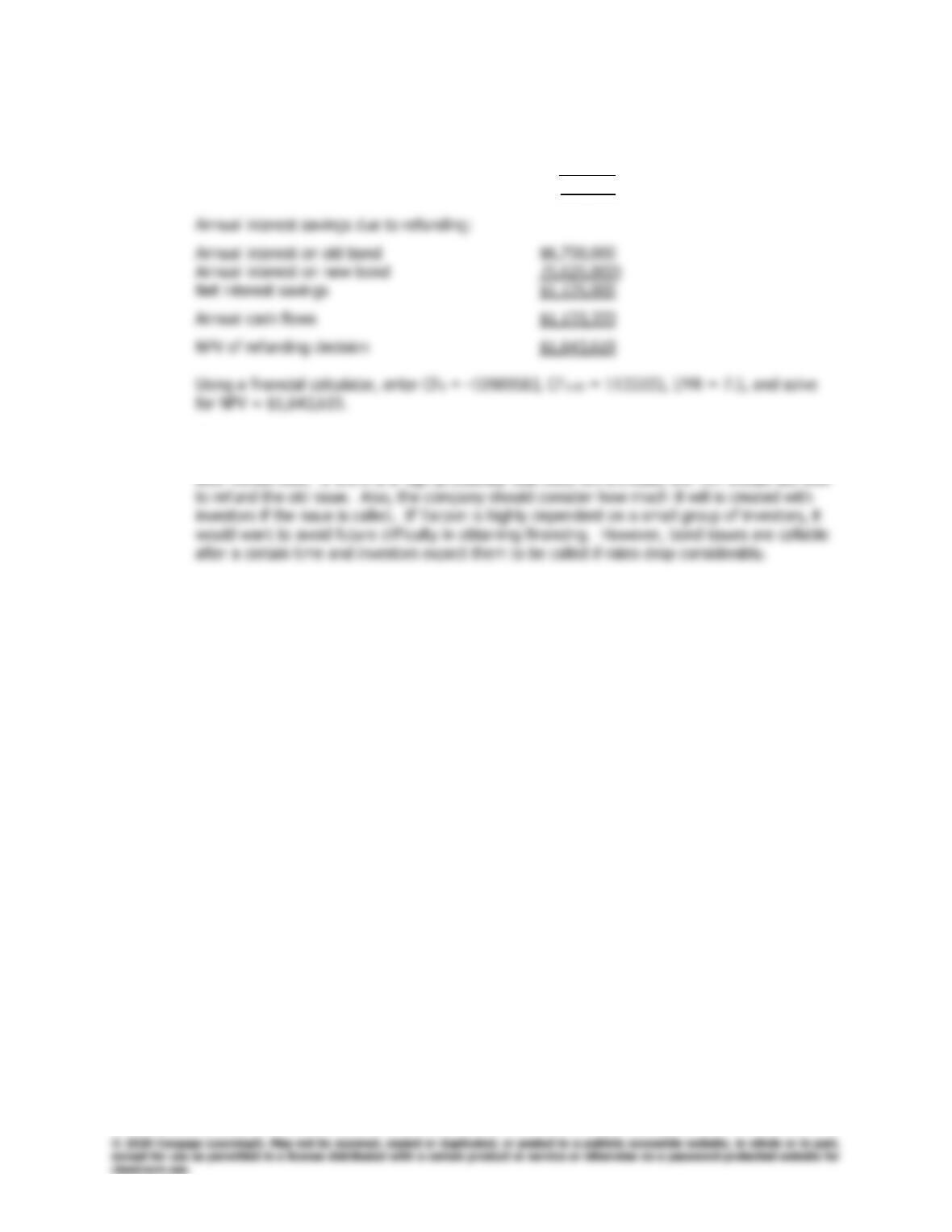
12B-2 a. Investment outlay required to refund the issue:
Call premium on old issue ($6,750,000)
New flotation cost (5,000,000)
12B-4
Answers and Solutions
Appendix 12B Refunding Operations
Annual flotation cost tax effects:
Annual tax savings on new flotation $50,000
Tax benefits lost on old flotation (41,667)
Amortization tax effects $ 8,333
b. The company should consider what interest rates might be next year. If there is a high
probability that rates will drop below the current rate, it may be more advantageous to refund