269
APPENDIX D
SOLUTIONS TO PROBLEMS
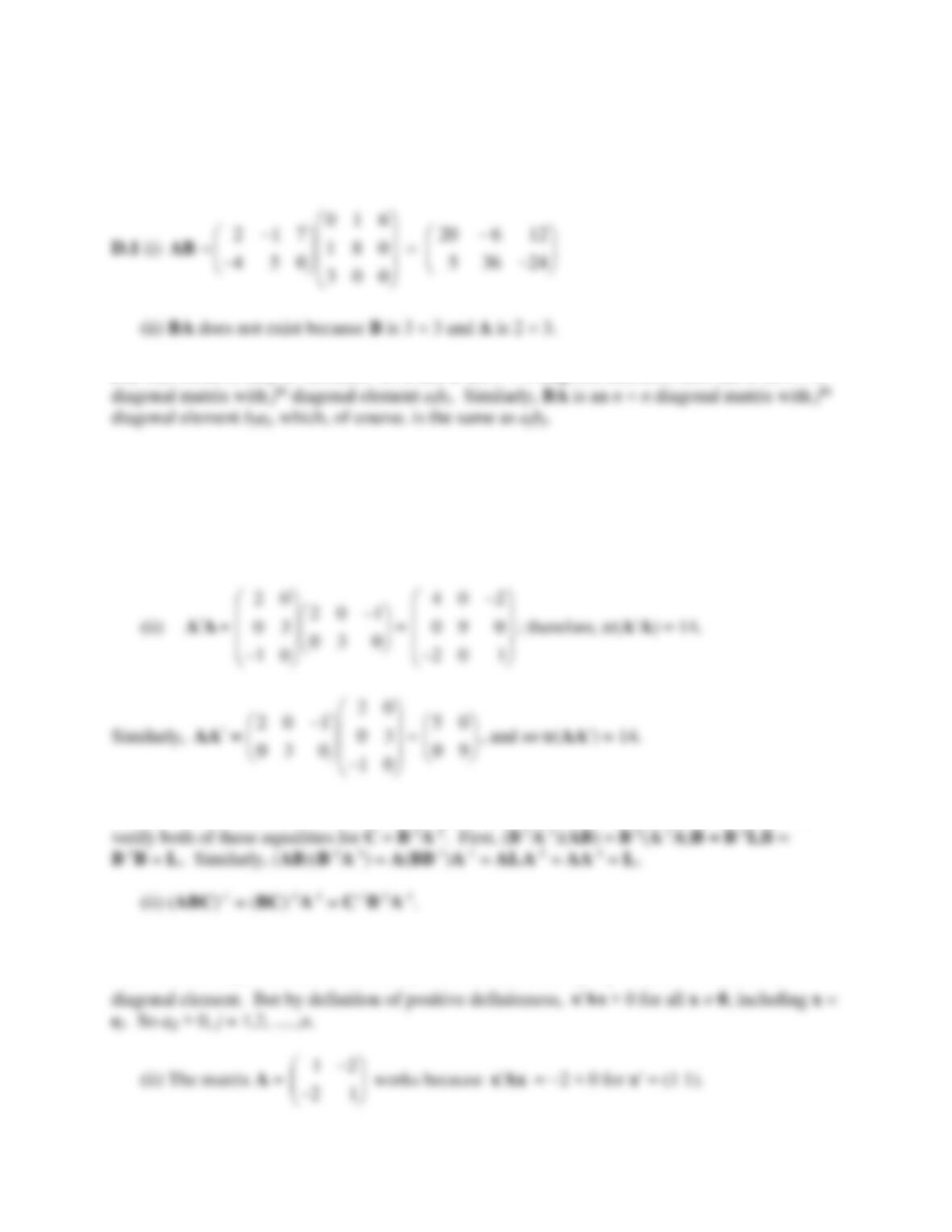
D.2 This result is easy to visualize. If A and B are n n diagonal matrices, then AB is an n n
D.3 Using the basic rules for transpose,
( ) ( )( )
==X X X X X X
, which is what we wanted to
show.
D.4 (i) This follows from tr(BC) = tr(CB), when B is n m and C is m n. Take B =
A
and
C = A.
D.5 (i) The n n matrix C is the inverse of AB if and only if C(AB) = In and (AB)C = In. We
D.6 (i) Let ej be the n 1 vector with jth element equal to one and all other elements equal to
zero. Then straightforward matrix multiplication shows that
jj
e Ae
= ajj, where ajj is the jth
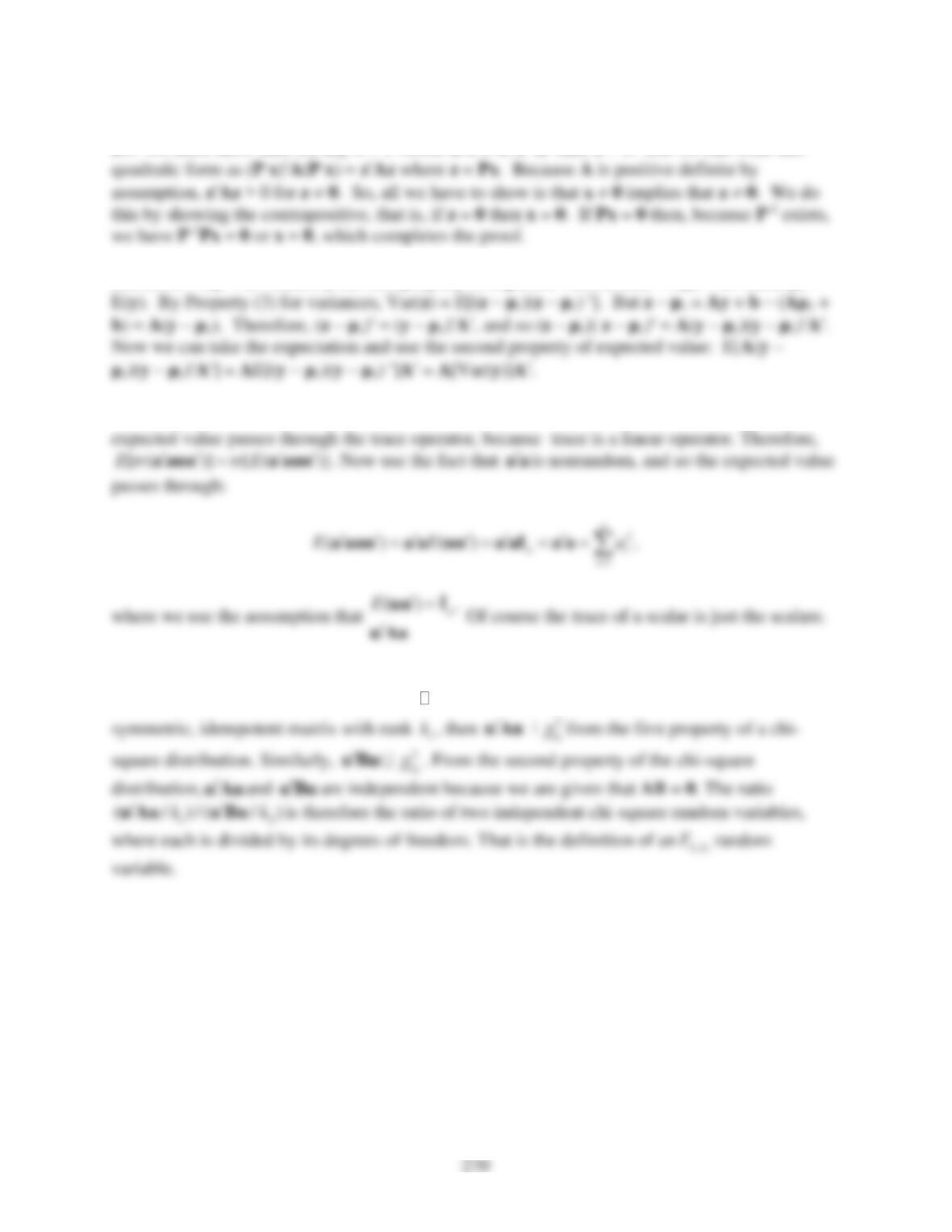
D.7 We must show that, for any n 1 vector x, x 0, x (PAB) x > 0. But we can write this
D.8 Let z = Ay + b. Then, by the first property of expected values, E(z) = Aµy + b, where µy =
D.9 To obtain the stated conclusion, first use the fact that
( ) ( )tr tr
=auu a a auu
. Next, the
D.10 There is not much to prove here; it is a matter of talking through the definitions and
previous claims. First, we know that if
Normal( , )
n
u 0 I
and A is a nonrandom, n
nn