Appendix A
Matrix Algebra
◼ Exercises
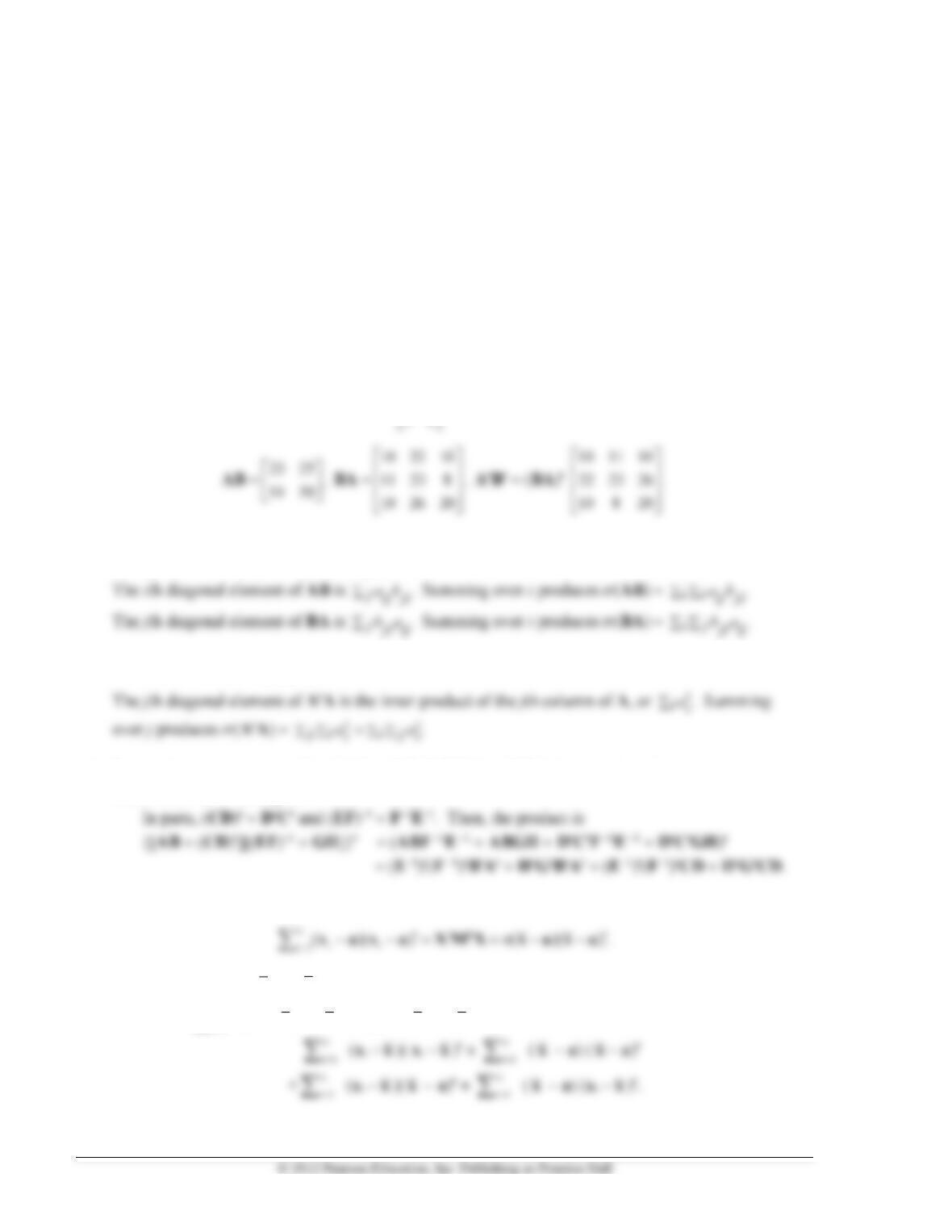
1. For the matrices A =
1 3 3
2 4 1
and B =
24
15
62
compute AB, AB, and BA.
2. Prove that tr(AB) = tr(BA) where A and B are any two matrices that are conformable for both
multiplications. They need not be square.
3. Prove that tr(AA) =
2.
ij
a
ij
4. Expand the matrix product X = {[AB + (CD)][(EF)−1 + GH]}. Assume that all matrices are square
and E and F are nonsingular.
5. Prove that for K 1 column vectors, xi i = 1,...,n, and some nonzero vector, a,
Write xi − a as [(
i
x
−
x
) + (
x
− a)]. Then, the sum is
1
n
i=
[( xi −
x
) + (
x
− a)] [(xi −
x
) + (
x
x
x
x
− a)] =
Appendix A Matrix Algebra 167
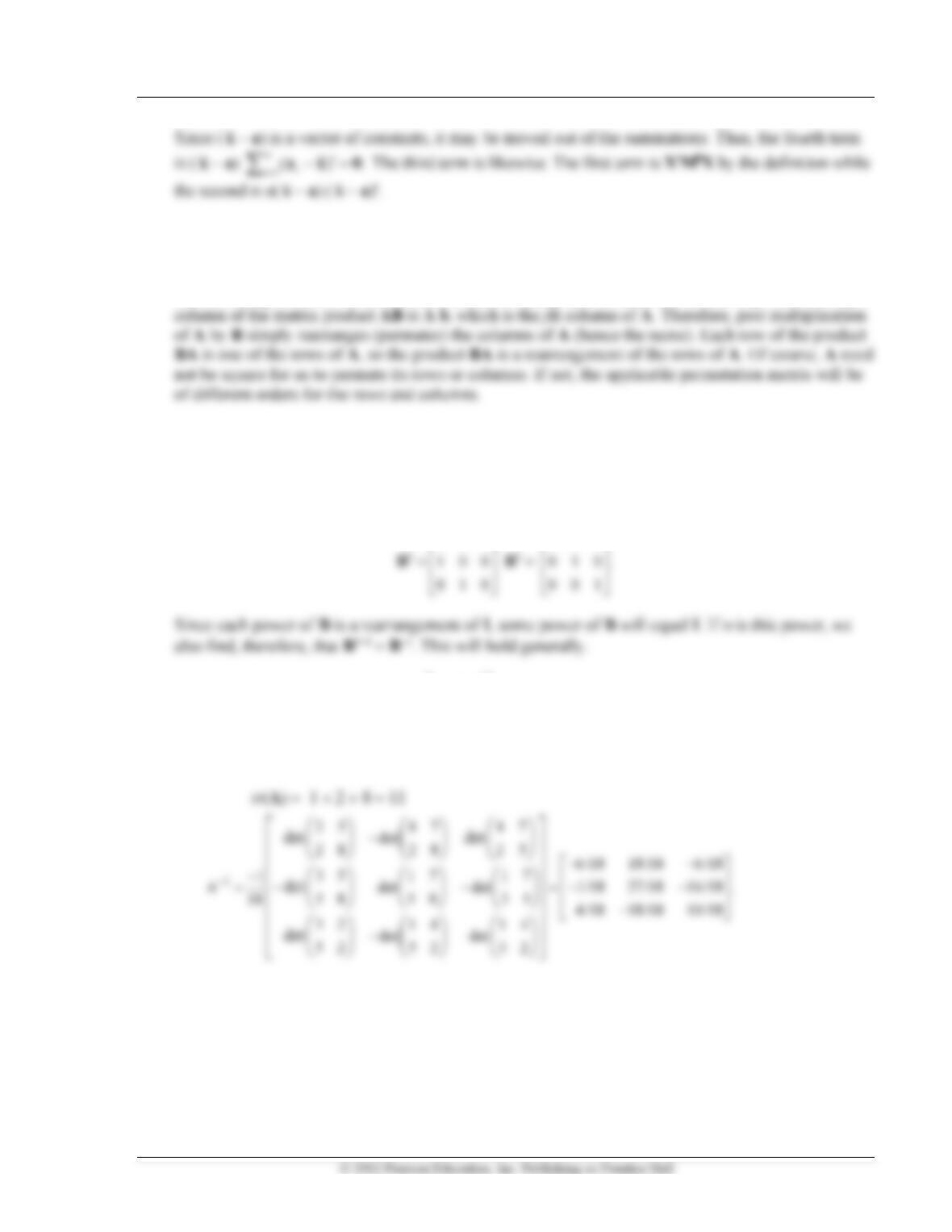
6. Let A be any square matrix whose columns are [a1,a2,…,aM] and let B be any rearrangement of the
columns of the M M identity matrix. What operation is performed by the multiplication AB?
What about BA?
B is called a permutation matrix. Each column of B, say, bi, is a column of an identity matrix. The jth
7. Consider the 3 3 case of the matrix B in Exercise 6. For example, B =
.
001
010
100
Compute B2 and B3.
Repeat for a 4 4 matrix. Can you generalize your finding?
001
100
8. Calculate |A|, tr(A) and A−1 for A =
.
147
3 2 5
5 2 8
|A| = 1(2)(8) + 4(5)(5) + 3(2)(7) −5(2)(7) −1(5)(2) −3(4)(8) = −18,
168 Greene • Econometric Analysis, Seventh Edition
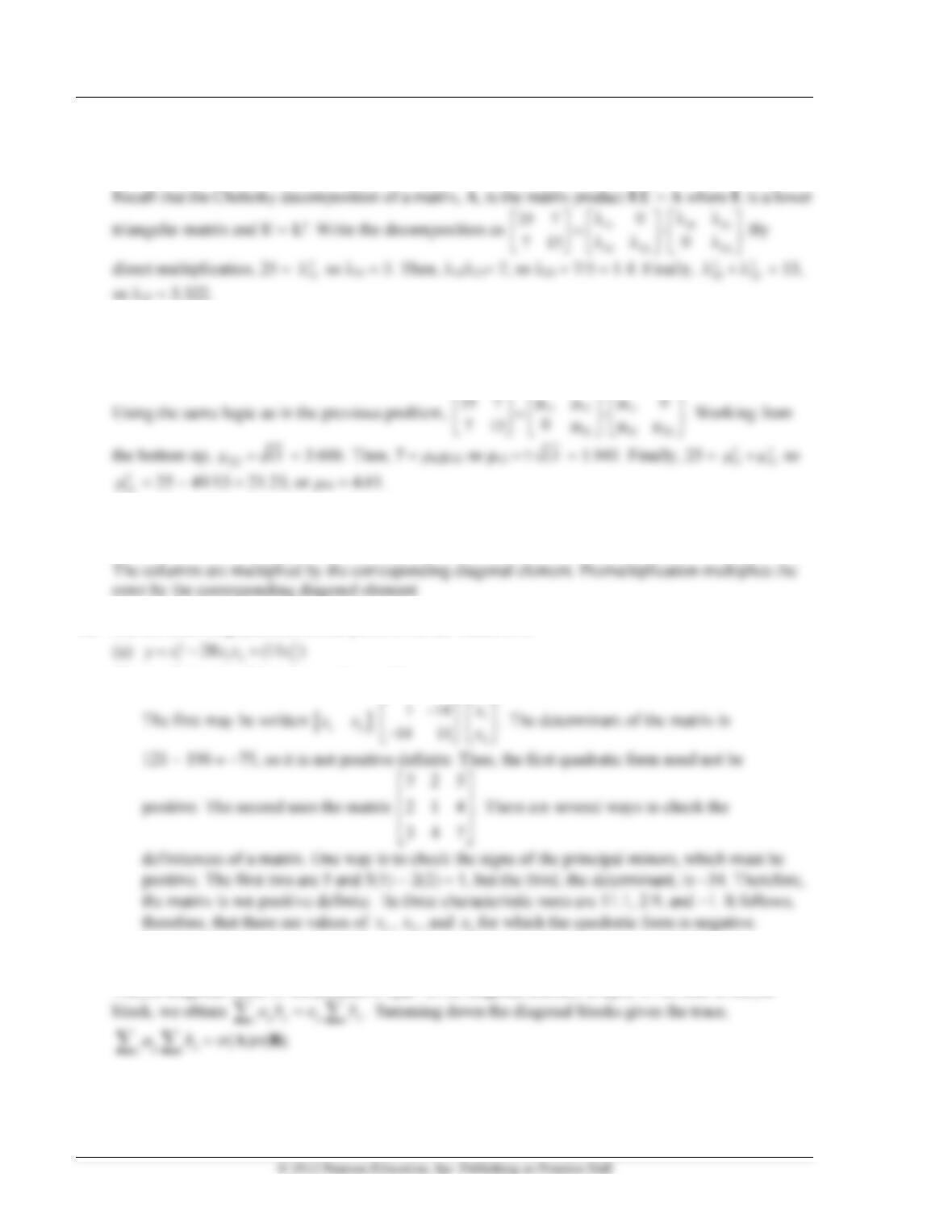
9. Obtain the Cholesky decomposition of the matrix A =
25 7
7 13 .
10. A symmetric positive definite matrix, A, can also be written as A = UL, where U is an upper
triangular matrix and L = U. This is not the Cholesky decomposition, however. Obtain this
decomposition of the matrix in Exercise 9.
11. What operation is performed by postmultiplying a matrix by a diagonal matrix? What about
premultiplication?
12. Are the following quadratic forms positive for all values of x?
(b)
2 2 2
1 2 3 1 2 1 3 2 3
5 7 4 6 8y x x x x x x x x x= + + + + +
1
2
3
13. Prove that tr(AB) = tr(A)tr(B).
The jth diagonal block of the product is ajjB. Its ith diagonal element is ajjbii. If we sum in the jth
14. A matrix, A, is nilpotent if
lim k
k→ A
= 0. Prove that a necessary and sufficient condition for a symmetric
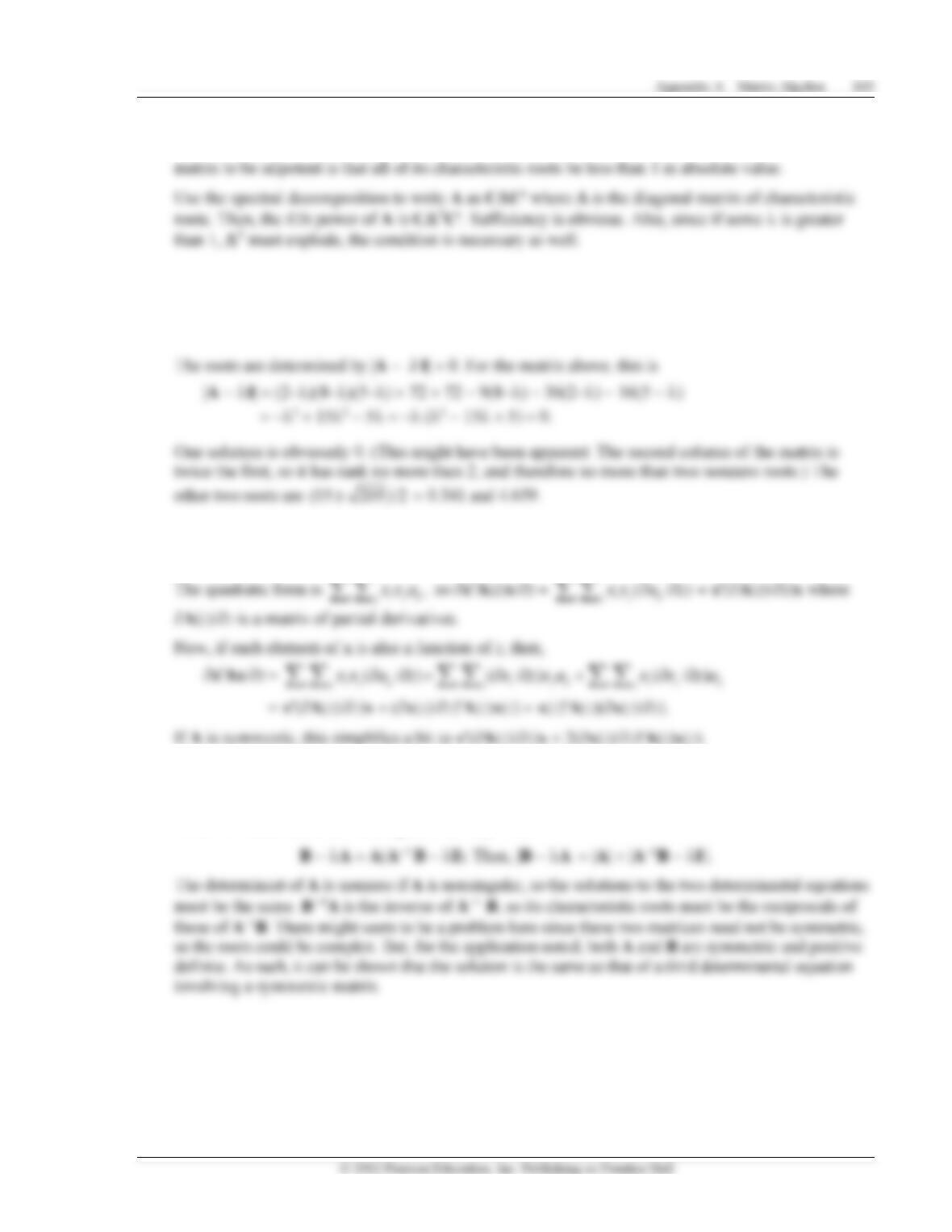
15. Compute the characteristic roots of A =
2 4 3
4 8 6 .
3 6 5
16. Suppose A = A(z) where z is a scalar. What is xAx/z? Now, suppose each element of x is also a
function of z. Once again, what is xAx/z?
17. Show that the solutions to the determinantal equations |B − A| = 0 and |A−1B − I| = 0 are the same.
How do the solutions to this equation relate to those of the equation |B−1A − I| = 0?
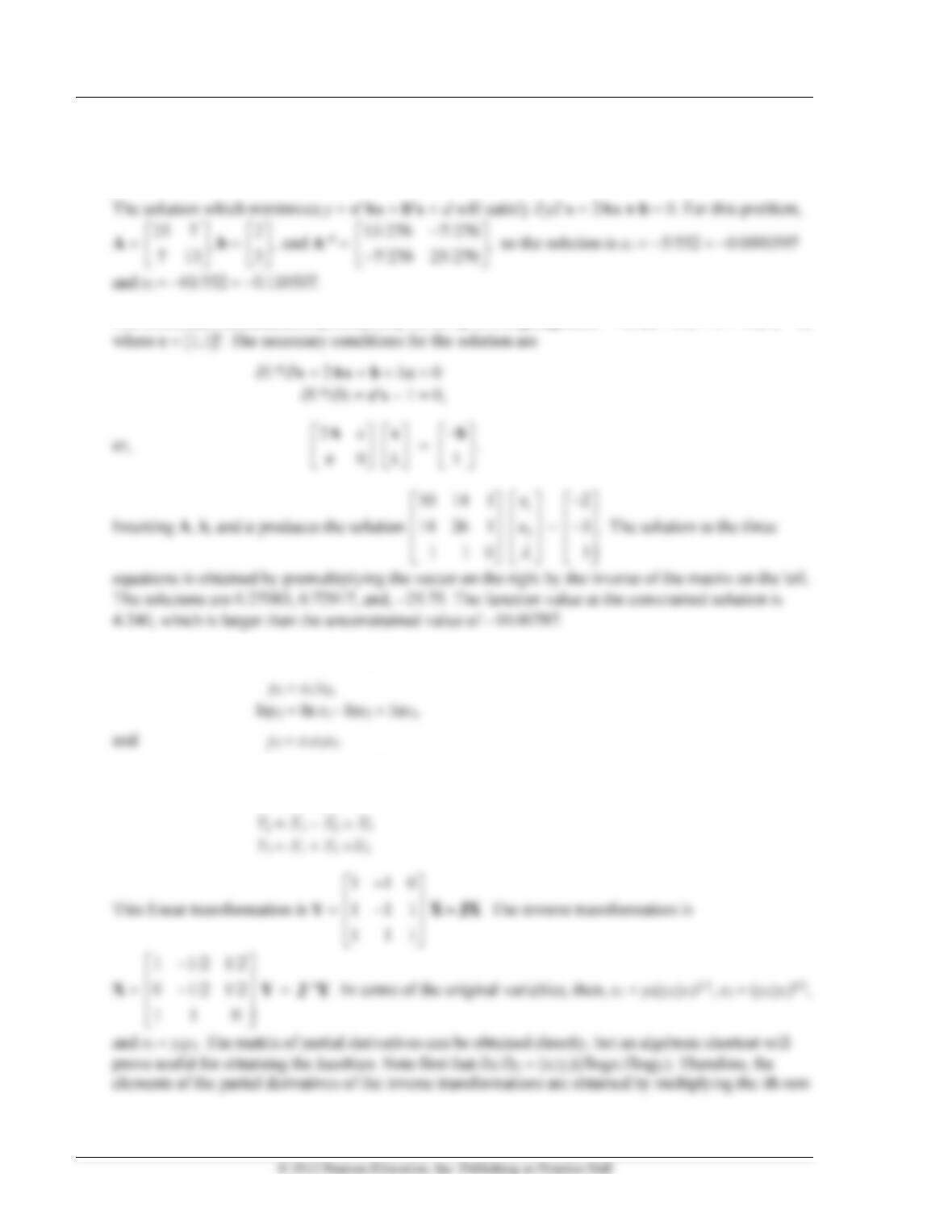
Since A is assumed to be nonsingular, we may write
170 Greene • Econometric Analysis, Seventh Edition
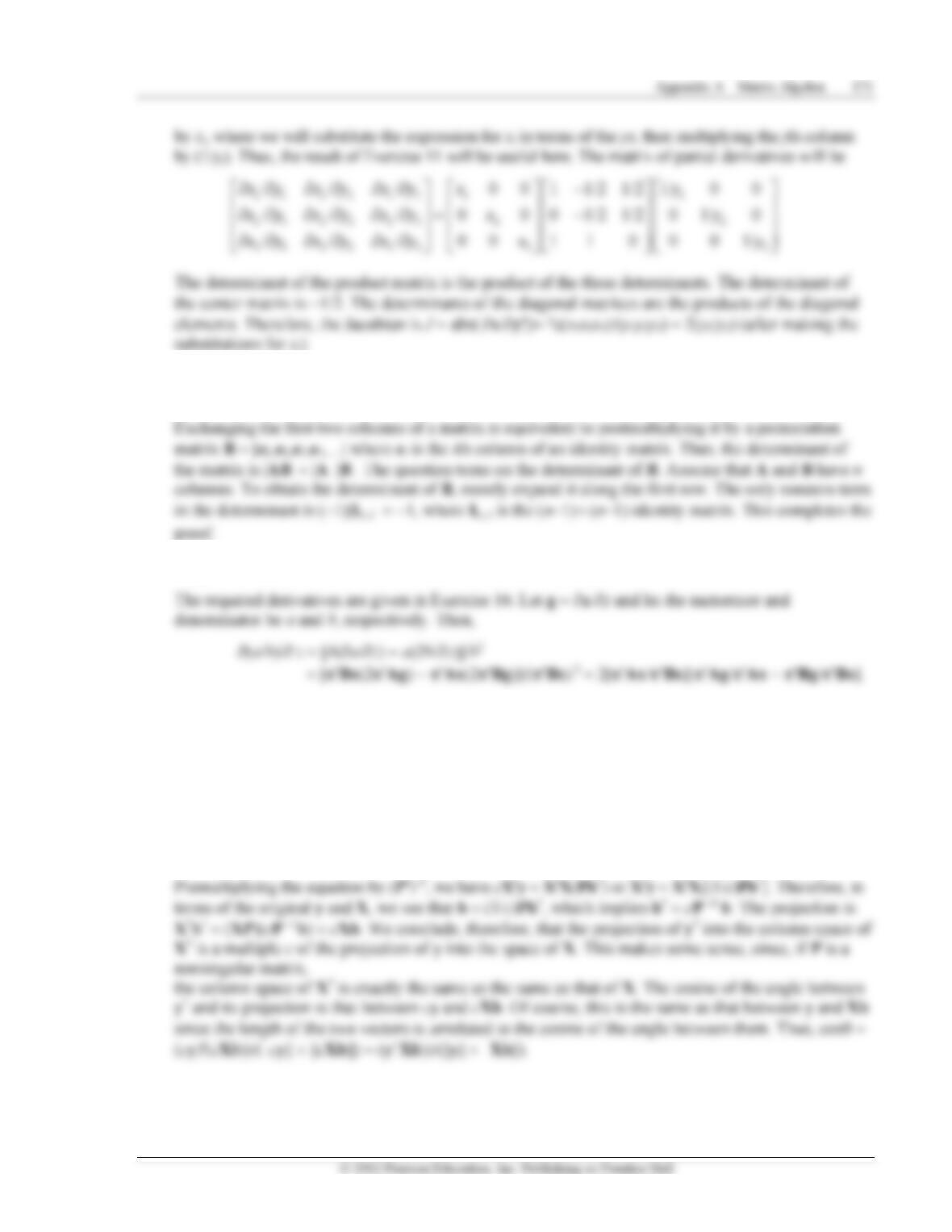
18. Using the matrix A in Exercise 9, find the vector x that minimizes y = xAx + 2x1 + 3x2 − 10. What is
the value of y at the minimum? Now, minimize y subject to the constraint x1 + x2 = 1. Compare the
two solutions.
The constrained maximization problem may be set up as a Lagrangean, L* = xAx + bx + d +
(cx − 1)
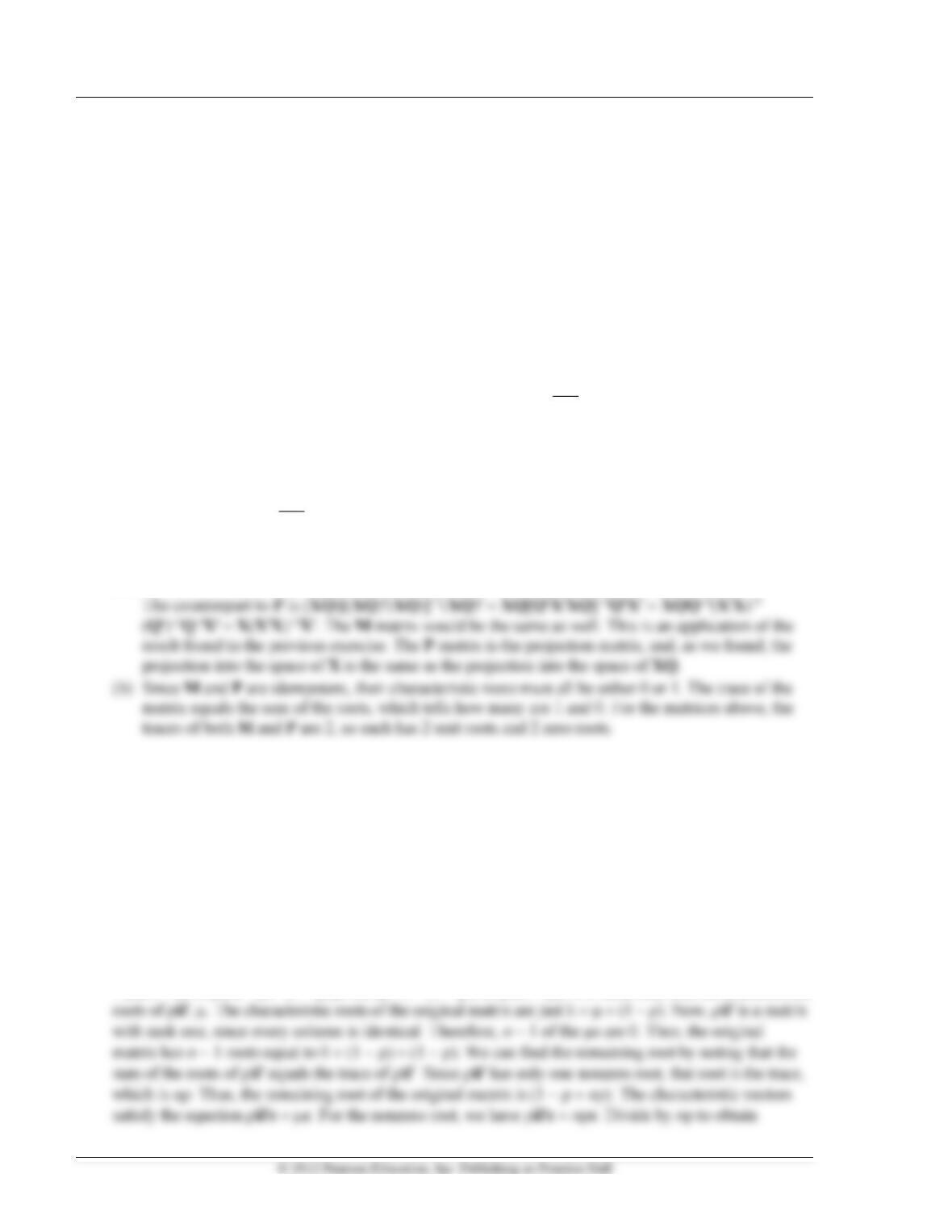
19. What is the Jacobian for the following transformations?
Let capital letters denote logarithms. Then, the three transformations can be written as
Y1 = X1 − X2
20. Prove that exchanging two columns of a square matrix reverses the sign of its determinant.
(Hint: Use a permutation matrix. See Exercise 6.)
21. Suppose x = x(z) where z is a scalar. What is [(xAx)/(xBx)]/z?
22. Suppose y is an n 1 vector and X is an n K matrix. The projection of y into the column space of X
is defined in the text after Equation (2-55),
ˆ
y
= Xb. Now, consider the projection of y* = cy into the
column space of X* = XP where c is a scalar and P is a nonsingular K K matrix. Find the projection
of y* into the column space of X*. Prove that the cosine of the angle between y* and its projection into
the column space of X* is the same as that between y and its projection into the column space of X.
How do you interpret this result?
The projection of y* into the column space of X* is X*b* where b* is the solution to the set of
equations X*y* = X*X*b* or PX(cy) = PXXPb*. Since P is nonsingular, P has an inverse.
172 Greene • Econometric Analysis, Seventh Edition
23. For the matrix X =
1 1 1 1 ,
4 2 3 5
−−
compute P = X(XX)−1X and M = (I − P). Verify that MP =
0. Let Q =
13
.
28
(Hint: Show that M and P are idempotent.)
(a) Compute the P and M based on XQ instead of X.
(b) What are the characteristic roots of M and P?
First, XX =
40
,
0 54
(X X)−1 =
1/4 0 ,
0 1/54
X(XX)−1X =
1 4 59 11 51 13
1 2 1/4 0 1 1 1 1 11 35 15 47
1
1 3 0 1/54 4 2 3 5 51 15 45 3
108
1 5 13 47 3 77
−
−
=
− − −
− − −
= P
M = I − P =
49 11 51 13
11 73 15 47
1.
51 15 63 3
108
13 47 3 31
−−
− − −
−−
−
(a) There is no need to recompute the matrices M and P for XQ, they are the same. Proof:
24. Suppose that A is an n n matrix of the form A = (1 − I) + ii, where i is a column of 1s and 0 < < 1.
Write out the format of A explicitly for n = 4. Find all of the characteristic roots and vectors of A.
(Hint: There are only two distinct characteristic roots, which occur with multiplicity 1 and n − 1.
Every c of a certain type is a characteristic vector of A.) For an application which uses a matrix of
this type, see Section 14.5 on the random effects model.
For n = 4, A =
1
1
1
1
.
There are several ways to analyze this matrix. Here is a simple shortcut.
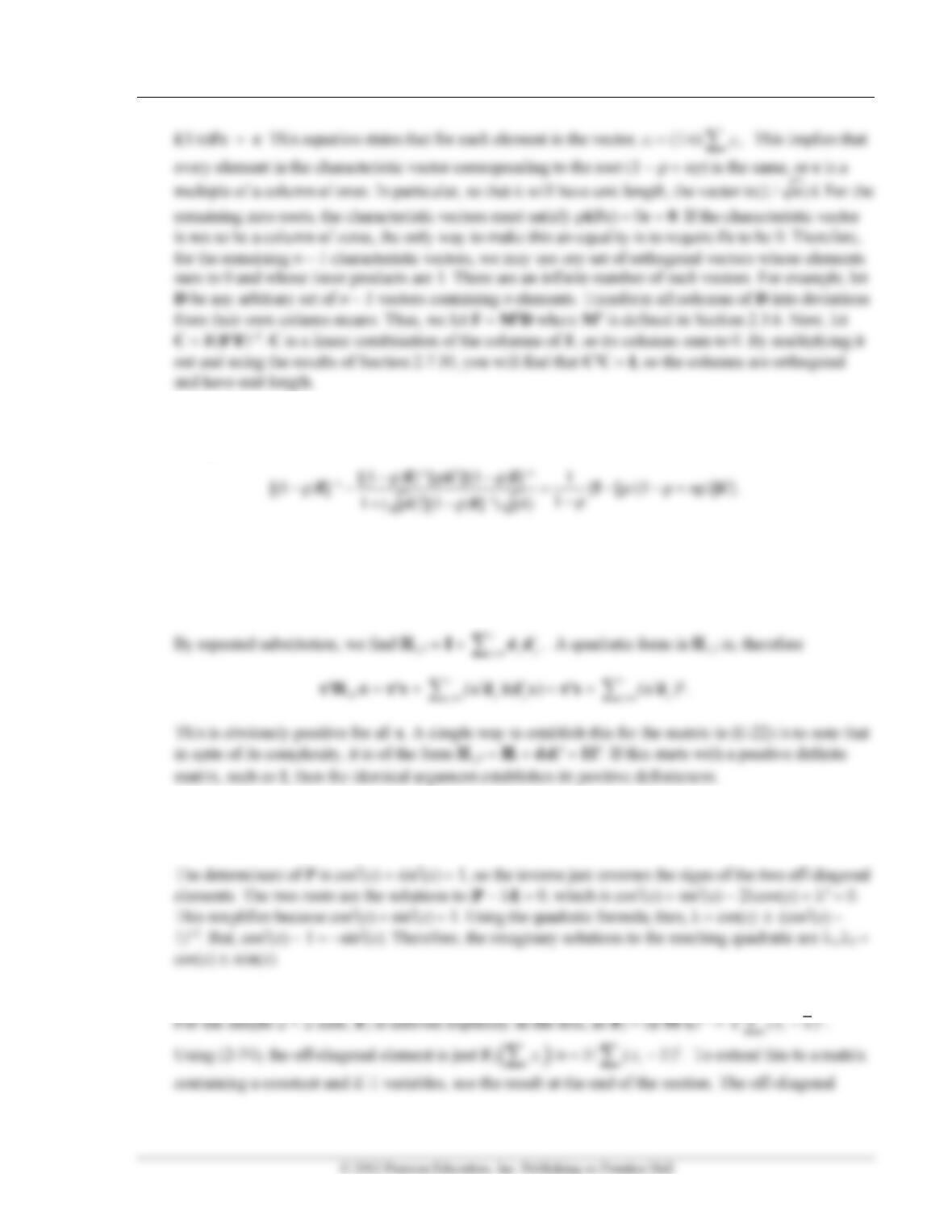
The characteristic roots and vectors satisfy [(1 − )I + ii]c = c. Multiply this out to obtain (1 − )c
+ iic = c or iic = [− (1 − )]c. Let = − (1 − ), so iic = c. We need only find the characteristic
Appendix A Matrix Algebra 173
25. Find the inverse of the matrix in Exercise 24. [Hint: Use (A-66).]
Using the Hint, the inverse is
26. Prove that every matrix in the sequence of matrices Hi+1 = Hi + didi, where H0 = I, is positive
definite. For an extension, prove that every matrix in the sequence of matrices in (E-22) is positive
definite
if H0 = I.
27. What is the inverse matrix of P =
cos( ) sin( ) ?
sin( ) cos( )
xx
xx
−
What are the characteristic roots of P?
28. Derive the off-diagonal block of A−1 in Section B.6.4.
2
174 Greene • Econometric Analysis, Seventh Edition
29. (This requires a computer.) For the XX matrix at the end of Section 2.4.1,
(a) Compute the characteristic roots of XX.
(b) Compute the condition number of XX. (Do not forget to scale the columns of the matrix so that
the diagonal elements are 1.)
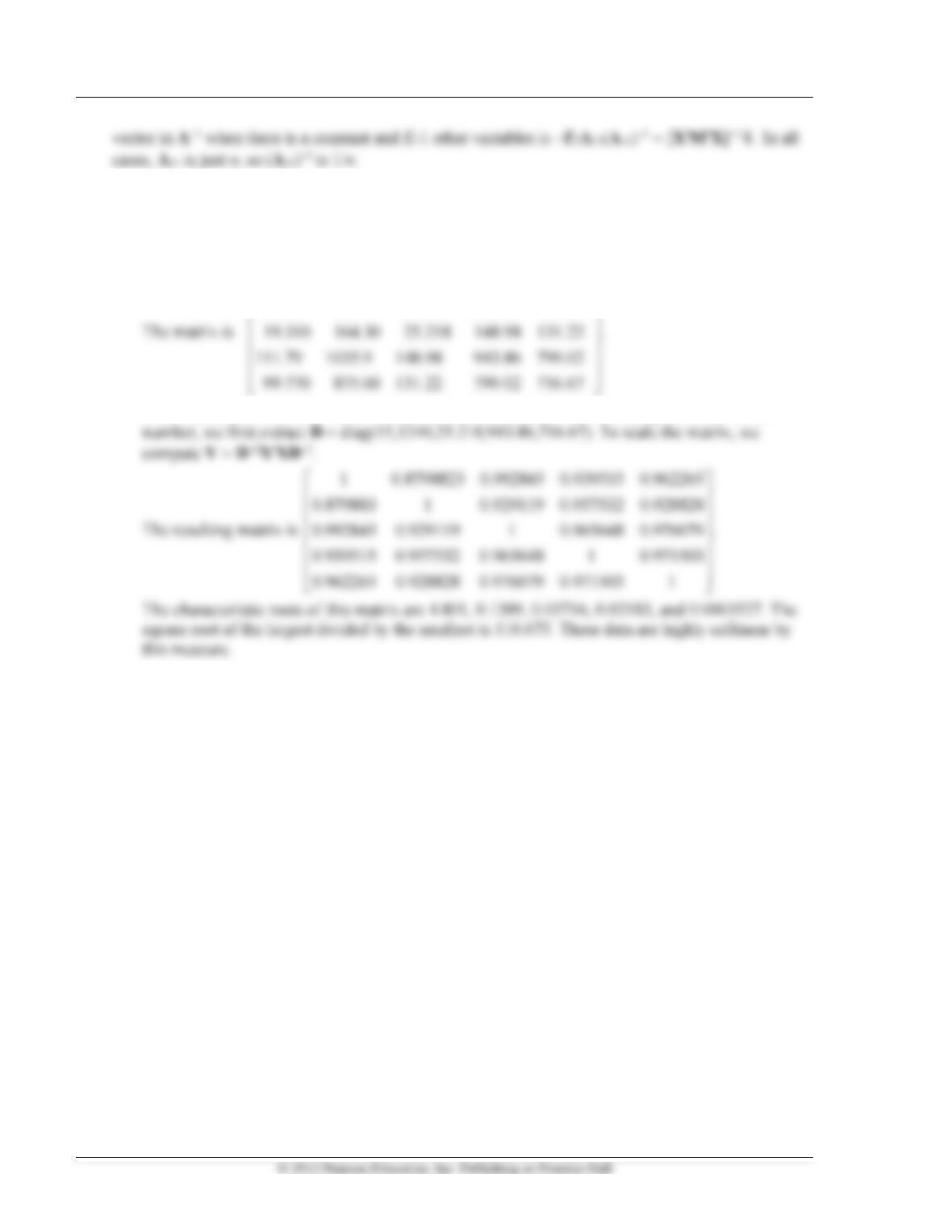
15.000 120.00 19.310 111.79 99.770
120.00 1240.0 164.30 1035.9 875.60
Its characteristic roots are 2486, 72.96, 19.55, 2.027, and .007354. To compute the condition