TEACH Lesson Plan
IANNUCCI AND HOWERTON: Dental Radiography: Principles and Techniques, 5th Edition
24 Imaging of Patients with Special
Needs
CHAPTER LESSON PLAN & OBJECTIVES
Lesson 24.1: Imaging of Patients with Special Needs
1. Define the key terms associated with patients who have special needs.
2. List the areas of the oral cavity that are most likely to elicit the gag reflex when stimulated.
3. List two precipitating factors responsible for initiating the gag reflex.
4. Describe how to control the gag reflex using operator attitude, patient and equipment preparations,
exposure sequencing, and receptor placement and technique.
5. Describe common physical disabilities and what modifications in technique may be necessary during
the imaging examination.
CHAPTER TEACHING FOCUS
• Students will have the opportunity to learn the problems encountered in dealing with patients with
special needs.
Chapter 24: Imaging of Patients with Special Needs 2
TEACH Lesson Plan
CHAPTER PRETEST
Have the students answer these questions prior to covering this chapter to understand where they stand
in relation to the content.
1) The gag reflex is elicited by stimulation of the sensitive tissues of the:
a) pharynx.
b) hard palate. c) larynx.
d) soft palate.
2) What size of film is typically used for the edentulous patient?
a) 4
b) 2 c) 1
d) 0
3) Which receptor placement is most likely to elicit the gag reflex?
a) Maxillary molar
b) Maxillary premolar c) Mandibular premolar
d) Mandibular molar
b) 12 c) 19
d) 18
6) Suggestions to prevent stimulation of the gag reflex include:
a) sliding the receptor along the palate.
b) placing the receptor slowly to avoid
stimulating the patient.
c) distracting the patient.
d) waiting for 30 seconds before exposing
each receptor.
7) When intraoral images are impossible to obtain, the radiographer should:
a) skip imaging.
b) use an injection of local anesthetic on
the patient’s throat and try again.
c) use an intraoral digital sensor rather
than conventional film.
d) use extraoral images to obtain
diagnostic information.
8) To help reduce the gag reflex:
a) do not try to distract the patient.
b) try to reduce tactile stimuli.
c) tell the patient to hold his or her breath.
d) use the term “gagging” with the patient.
9) _________ periapical projections can be used to examine the edentulous arches.
a) Eight
b) Twelve c) Fourteen
d) Sixteen
10) For a periapical examination in an edentulous patient, the receptor should be positioned so that
approximately ________ of it extends beyond the edentulous ridge.
a) one eighth
b) half c) one third
d) one quarter
Chapter 24: Imaging of Patients with Special Needs 3
TEACH Lesson Plan
IANNUCCI AND HOWERTON: Dental Radiography: Principles and Techniques, 5th Edition
CHAPTER PRETEST ANSWERS
1) d
The gag reflex (also called the pharyngeal reflex) can be defined as retching that is elicited by
stimulation of the sensitive tissues of the soft palate region.
p. 277
6) c
Helpful strategies to prevent gagging include avoiding the discussion or suggestion of gagging,
reassuring the patient, suggesting breathing, distracting the patient, reducing tactile stimuli, and using
a topical anesthetic.
p. 279
Chapter 24: Imaging of Patients with Special Needs 4
TEACH Lesson Plan
IANNUCCI AND HOWERTON: Dental Radiography: Principles and Techniques, 5th Edition
Classroom Preparation
Lesson 24.1: Imaging of Patients with Special Needs
INSTRUCTOR PREPARATION
Textbook Objectives Covered
1. Define the key terms associated with patients who have special needs.
2. List the areas of the oral cavity that are most likely to elicit the gag reflex when stimulated.
3. List two precipitating factors responsible for initiating the gag reflex.
4. Describe how to control the gag reflex using operator attitude, patient and equipment preparations,
exposure sequencing, and receptor placement and technique.
5. Describe common physical disabilities and what modifications in technique may be necessary during
the imaging examination.
National Standards Covered
ABHES DAI (Dental Assisting I – Basic)
• Section A: Curriculum, Competencies, Externship and/or Internal Clinical Experience:
• Clinical equipment function and maintenance: Operate dental equipment according to
ABHES DAII (Dental Assisting II – Advanced)
• Section A: Curriculum, Competencies, Externship and/or Internal Clinical Experience:
• Clinical equipment function and maintenance: Operate dental equipment according to
sites. Supervision and evaluation by faculty is essential for safety and proper instruction. (19.c)
CODA Standards for Dental Assisting Programs
• Standard 2: Educational Program:
• The curriculum must include content at the in-depth level in dental radiology. Students must
demonstrate knowledge and skills to produce diagnostic dental image surveys on manikins. Prior to
Chapter 24: Imaging of Patients with Special Needs 5
TEACH Lesson Plan
National Standards Covered (Continued)
CODA Standards for Dental Hygiene Programs
• Standard 2: Educational Program:
• Curriculum content: Dental hygiene science content must include oral health education and
preventive counseling, health promotion, patient management, clinical dental hygiene, provision of
Lesson Preparation Checklist
• Prepare lecture from TEACH lecture slides available on Evolve.
Materials and Supplies
• blindfold
Chapter 24: Imaging of Patients with Special Needs 6
TEACH Lesson Plan
IANNUCCI AND HOWERTON: Dental Radiography: Principles and Techniques, 5th Edition
Classroom Preparation
Lesson 24.1: Imaging of Patients with Special Needs
STUDENT PREPARATION (7 hrs)
1
READ – Textbook (pp. 277-285)
2
• Quiz Questions: True/False, questions 1, 2 (p. 287)
3
READ – Textbook (p. 277)
ANSWER – Textbook
• Quiz Questions: True/False, question 3 (p. 287)
4
• Quiz Questions: True/False, questions 4-15 (p. 287)
5
READ – Textbook (pp. 279-280)
ANSWER – Textbook
• Quiz Questions: True/False, questions 16, 17 (p. 287)
6
READ – Textbook (p. 280)
ANSWER – Textbook
• Quiz Questions: True/False, question 18 (p. 287)
• Critical Thinking Questions 7, 8 (p. 166)
8
READ – Textbook (pp. 281-284)
ANSWER – Textbook
• Quiz Questions:
• True/False, questions 21, 22 (p. 287)
• Identification, questions 26-28 (p. 288)
ANSWER – Workbook Module 4: Technique Basics
• Identification: Eruption of Permanent Teeth: Maxillary, questions 1-8 (p. 163)
• Identification: Eruption of Permanent Teeth: Mandibular, questions 1-8 (p. 163)
• Identification: Eruption of Permanent Teeth: Permanent Tooth Replaced, questions 1-6 (p. 163)
• Primary Tooth Identification, questions 1-20 (p. 164)
• Age Identification, questions 1-3 (p. 164)
• Quiz Questions: True/False, questions 23, 24 (p. 288)
READ – Textbook (p. 285)
• Quiz Questions: True/False, question 25 (p. 288)
• Case Studies
• Review Questions – Self-Study Examination
Chapter 24: Imaging of Patients with Special Needs 7
TEACH Lesson Plan
IANNUCCI AND HOWERTON: Dental Radiography: Principles and Techniques, 5th Edition
50–Minute Lesson Plan
Lesson 24.1: Imaging of Patients with Special Needs
LECTURE OUTLINE (30 min)
1
&
2
KEY TERMS AND GAG REFLEX AREA OF ORAL CAVITY: SLIDES 6-7 (pp. 277-285)
• Discuss the key terms associated with patients who have special needs.
• Describe the areas of the oral cavity that are most likely to elicit the gag reflex when stimulated.
4
CONTROLLING GAG REFLEX: SLIDES 9-15 (pp. 277-278)
• Describe how to control the gag reflex using operator attitude, patient and equipment
preparations, exposure sequencing, and receptor placement and technique.
5
MODIFICATIONS FOR PHYSICAL DISABILITIES: SLIDES 16–17 (pp. 279-280)
• Describe common physical disabilities and what modifications in technique may be necessary
during the imaging examination.
6
MODIFICATIONS FOR DEVELOPMENTAL DISABILITIES: SLIDE 18 (p. 280)
• Describe common developmental disabilities and what modifications in technique may be
necessary during the imaging examination.
and patient management pertaining to the pediatric dental patient.
LEARNING ACTIVITIES (choose one or more to equal 20 min)
1
&
2
REVIEW (10 min)
• Have the students use the key terms in an appropriate sentence.
• Appropriate Settings: Traditional classroom, flipped classroom
DISCUSS (10 min)
• Lead a class discussion regarding the areas of the oral cavity that are affected by the gag
reflex.
Chapter 24: Imaging of Patients with Special Needs 8
TEACH Lesson Plan
IANNUCCI AND HOWERTON: Dental Radiography: Principles and Techniques, 5th Edition
LEARNING ACTIVITIES (choose one or more to equal 20 min) (Continued)
5
• Appropriate Setting: Online
DISCUSS (15 min)
• Divide the class into small groups, and have each group discuss how to handle patients with
physical disabilities and what adjustments must be made to obtain radiographs in the following
scenarios:
• Vision impairment
• Hearing impairment
6
DISCUSS (15 min)
• Divide the class into small groups, and have each group discuss how to handle patients with
developmental disabilities and what adjustments must be made to obtain radiographs in the
following scenarios:
• Autism
• Cerebral Palsy
7
ROLE PLAY (20 min)
• Provide the students with a wheelchair, blindfold, and earplugs. Divide the students into pairs,
and have each pair take turns role playing a dental radiographer taking care of a patient who is
blind, deaf, and has a mobility impairment. Provide feedback when necessary.
• Appropriate Settings: Traditional classroom, flipped classroom
8
PRACTICE
• See the Simulations activities at the end of this Lesson Plan.
9
DISCUSS (15 min)
• Divide the class into small groups, and have each group discuss why it is necessary to take
several radiographs during a root canal procedure. Have the students share their findings with
the class for further discussion.
• Appropriate Settings: Traditional classroom, flipped classroom
Chapter 24: Imaging of Patients with Special Needs 9
TEACH Lesson Plan
IANNUCCI AND HOWERTON: Dental Radiography: Principles and Techniques, 5th Edition
CRITICAL THINKING QUESTIONS
1. A patient comes into the office for a dental examination. He is hearing-impaired and is in a
wheelchair. Dental images must be taken today, and the dental radiographer is worried about a
communication barrier and how the images can be taken while the patient is in his wheelchair.
The patient has come to the office without a caregiver, but can read lips. How should the dental
radiographer handle this situation?
Discussion Guidelines: The dental radiographer will need to speak clearly and directly to the patient
2. Your next patient is Luke, a boy with Down syndrome. Describe how you will prepare for this
special needs patient, and identify what techniques you can use to make Luke feel more
comfortable and have a positive experience.
Discussion Guidelines: Certain physical and mental disorders can slow or challenge a child’s
psychologic and social growth. When a child has been diagnosed with Down syndrome, parents and
Chapter 24: Imaging of Patients with Special Needs 10
TEACH Lesson Plan
IANNUCCI AND HOWERTON: Dental Radiography: Principles and Techniques, 5th Edition
Assessments
Chapter 24: Imaging of Patients with Special Needs
ASSESSMENTS BY OBJECTIVE
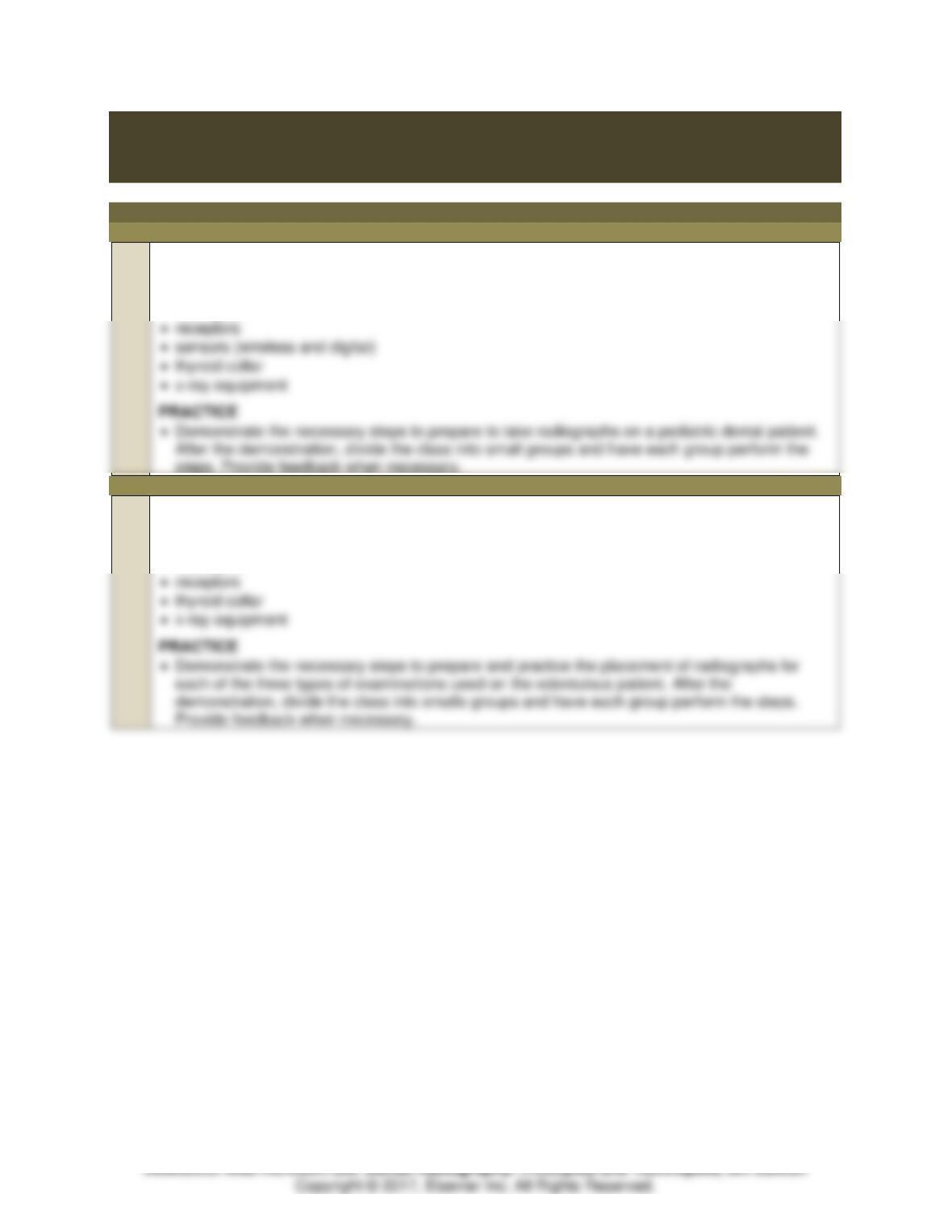
2
Evolve Instructor Resources
• Test Bank: Multiple Choice, question 3
3
Evolve Instructor Resources
• Test Bank: Multiple Choice, questions 1, 2
4
Evolve Instructor Resources
• Test Bank: Multiple Choice, questions 4-9, 19
5
Evolve Instructor Resources
• Test Bank: Multiple Choice, questions 10, 11
• Test Bank: Multiple Choice, question 12
7
• Critical Thinking Questions 7, 8 (p. 166)
8
• Age Identification, questions 1-3 (p. 164)
• Test Bank: Multiple Choice, questions 14–16
Evolve Instructor Resources
• Test Bank: Multiple Choice, questions 17, 18
Evolve Instructor Resources
• Test Bank: Multiple Choice, question 13
Workbook Module 4: Technique Basics
• Identification: Eruption of Permanent Teeth: Maxillary, questions 1-8 (p. 163)
• Identification: Eruption of Permanent Teeth: Mandibular, questions 1-8 (p. 163)
Chapter 24: Imaging of Patients with Special Needs 11
TEACH Lesson Plan
Simulations
Chapter 24: Imaging of Patients with Special Needs
SIMULATIONS BY OBJECTIVE
Pediatric Patient Treatment Preparation (15 min)
8
Equipment Needed
• bite-blocks
• dental treatment chair
• lead apron
Edentulous Patient Examinations (15 min)
11
Equipment Needed
• bite-blocks
• dental treatment chair
• lead apron