TEACH Lesson Plan
IANNUCCI AND HOWERTON: Dental Radiography: Principles and Techniques, 5th Edition
Module 2 Equipment, Film, and
Processing Basics Answer Key
CHAPTER 6: DENTAL X-RAY EQUIPMENT
Basic Terminology Crossword Puzzle
Across
2. exposure button
Down
1. indicator light
Completion and Short Answer
Dental X-Ray Machines
1. List two types of dental x-ray machines: intraoral and extraoral
Multiple Choice
Beam Alignment Devices
1. The anterior RINN device is used on anterior/posterior teeth.
CHAPTER 7: DENTAL X-RAY FILM
Basic Terminology Crossword Puzzle
Across
6. duplicating
15. latent image
Down
2. electromagnetic
Module 2: Equipment, Film, and Processing Basics 2
TEACH Lesson Plan
IANNUCCI AND HOWERTON: Dental Radiography: Principles and Techniques, 5th Edition
Identification and Labeling
Intraoral Film Packet
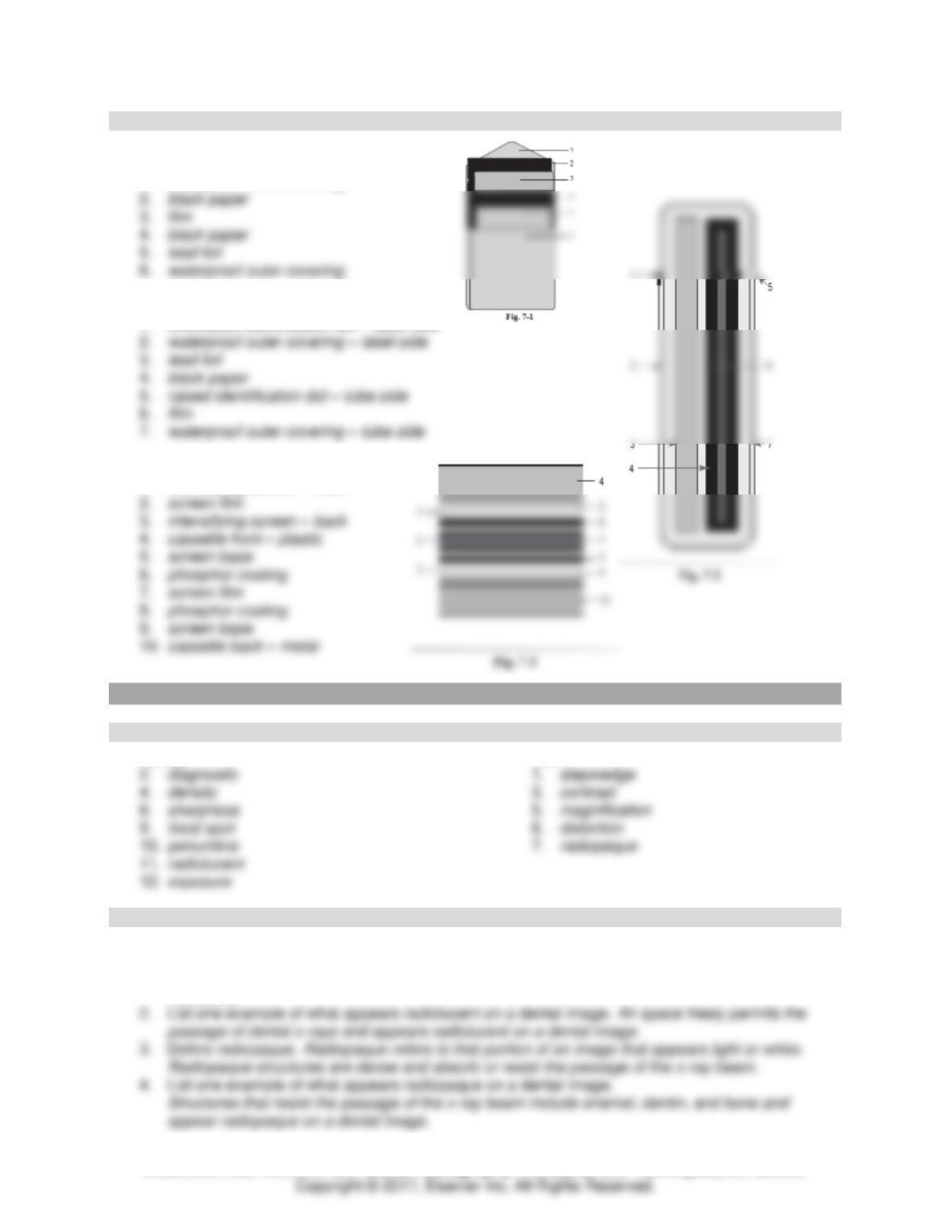
Identify each item in Fig. 7-1.
1. waterproof outer covering
Identify each item in Fig. 7-2.
1. embossed identification dot ‒ label side
Identify each item in Fig. 7-3.
1. intensifying screen ‒ front
CHAPTER 8: DENTAL X-RAY IMAGE CHARACTERISTICS
Basic Terminology Crossword Puzzle
Across
Down
Short Answer and Multiple Choice
Dental X-Ray Image Characteristics
1. Define radiolucent. Radiolucent refers to that portion of an image that is dark or black. A structure
that appears radiolucent lacks density and permits the passage of the x–ray beam with little or no
resistance.
Module 2: Equipment, Film, and Processing Basics 3
TEACH Lesson Plan
IANNUCCI AND HOWERTON: Dental Radiography: Principles and Techniques, 5th Edition
Visual Characteristics
List the two visual characteristics of the radiographic image.
Select the correct answers.
3. HIGH KV electron energy is high / low
4. LOW KV electron energy is high / low
Geometric Characteristics
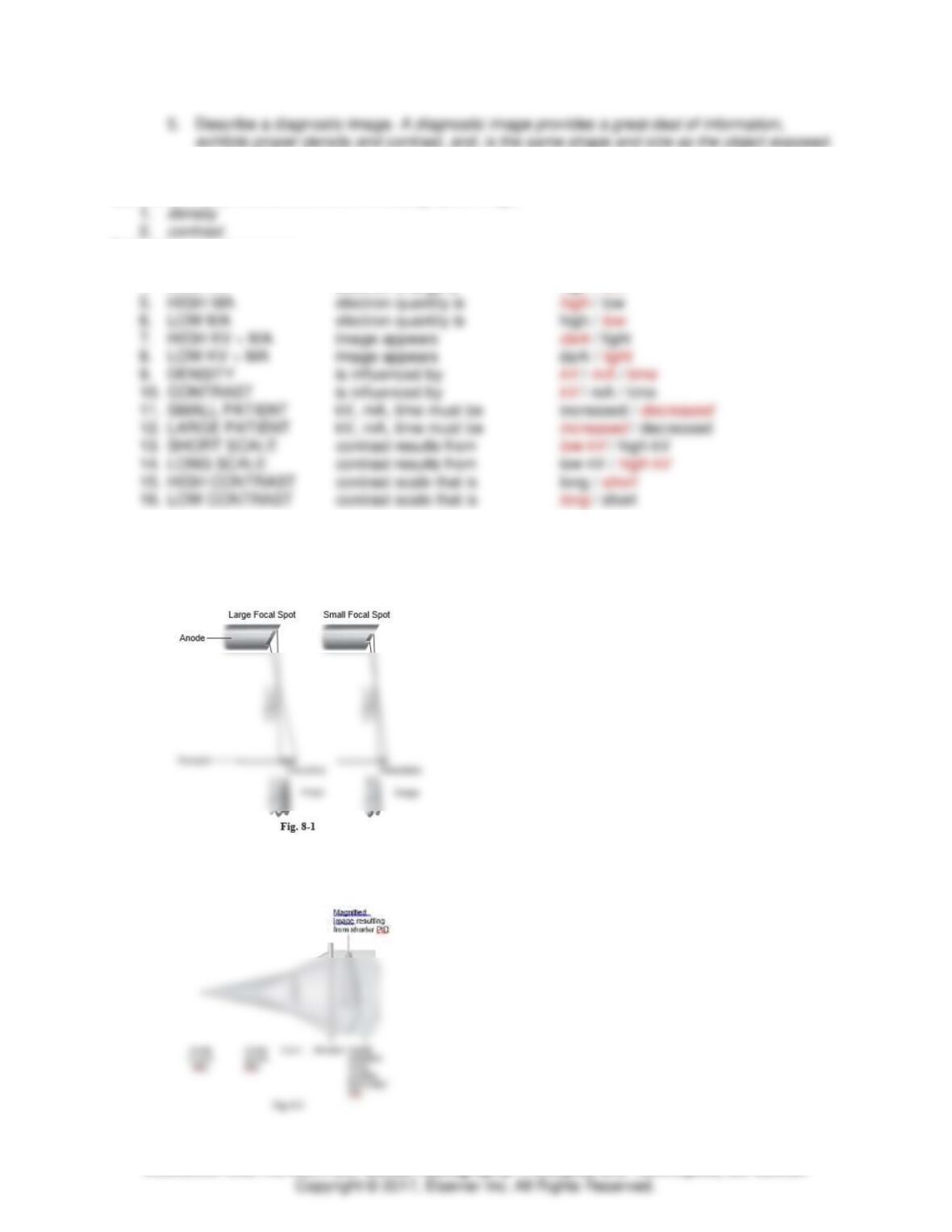
1. Using the diagram in Fig. 8-1, describe how the size of the focal spot affects the sharpness of an
image. The smaller the focal spot area, the sharper the image appears; the larger the focal spot
area, the greater is the amount of penumbra, and the greater is the loss of image sharpness.
2. Using the diagram in Fig. 8-2, describe how the position indicating device (PID) length affects the
magnification of an image. A longer PID (16 inches) and target-receptor distance results in less
image magnification. A shorter PID (8 inches) and target-receptor distance results in more image
magnification.

Module 2: Equipment, Film, and Processing Basics 4
TEACH Lesson Plan
IANNUCCI AND HOWERTON: Dental Radiography: Principles and Techniques, 5th Edition
Influencing Factors and Geometric Characteristics
For items 1 to 8, circle ⇧ (increase) or ⇩ (decrease) for each of the following:
Shadow Casting Activity 2 – Magnification
1. Which distance creates the smallest shadow? flashlight at 16” from the cups
2. How does this relate to PID length and target-receptor distance? LONG PID LENGTH = LESS
IMAGE MAGNIFICATION: A longer target-receptor distance results in less magnification.
smallest shadow is created and less magnification results.
Shadow Casting Activity 4 – Distortion
1. How does the shadow change? When the object is not parallel to the receptor, the shadow
appears distorted (larger or smaller).
Module 2: Equipment, Film, and Processing Basics 5
TEACH Lesson Plan
IANNUCCI AND HOWERTON: Dental Radiography: Principles and Techniques, 5th Edition
Shadow Casting Activity 5 – Distortion
1. What happens when the vertical angulation is steep (+70°)? Is the shadow shorter or longer?
CHAPTER 9: FILM PROCESSING
Basic Terminology Crossword Puzzle
Across
3. manual
Down
1. humidity level
Identification and Labeling
Automatic Processor
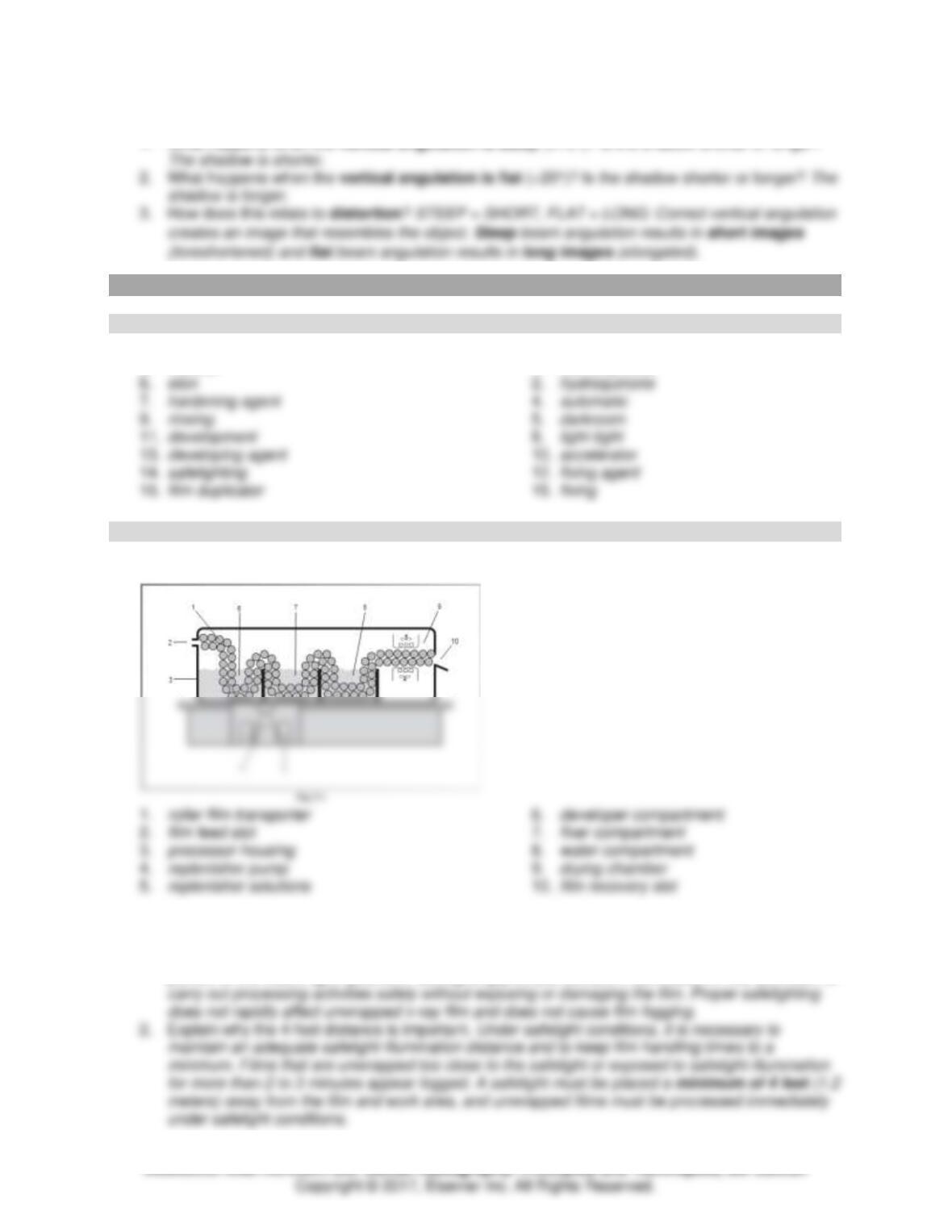
Identify the components in Fig. 9-1.
Safelighting
1. Describe safelighting. The special type of lighting used to provide illumination in the darkroom is
termed safelighting. It is a low-intensity light composed of long wavelengths in the red-orange
portion of the visible light spectrum. Safelighting provides sufficient illumination in the darkroom to

Module 2: Equipment, Film, and Processing Basics 6
TEACH Lesson Plan
IANNUCCI AND HOWERTON: Dental Radiography: Principles and Techniques, 5th Edition
Multiple Choice, Short Answer, and Identification
Time and Temperature Problems
1. Development time is too short / too long.
Chemical Contamination Problems
8. Spots are dark (black) / white (light).
Film-Handling Problems
12. A straight border that is white / black.
13. A straight border that is white / black.
Lighting Problems
20. Describe solution: examine film packets for defects before using; never unwrap films in presence
CHAPTER 10: QUALITY ASSURANCE
Basic Terminology Crossword Puzzle
Down
1. quality administration
Module 2: Equipment, Film, and Processing Basics 7
TEACH Lesson Plan
IANNUCCI AND HOWERTON: Dental Radiography: Principles and Techniques, 5th Edition
Identification and Short Answer
For each test listed, place an X in the box that indicates the suggested frequency of testing; if “other” is
chosen, add notes to clarify how often.
Daily
Weekly
Monthly
Yearly
Other
Special Notes
DENTAL X-RAY MACHINES
1. All quality control tests
X
also: upon installation, inspection by a
qualified expert
DENTAL X-RAY FILM
SCREENS AND CASSETTES
4. Clean
X
PROCESSING EQUIPMENT AND SOLUTIONS
9. Temperature check-solutions
X
10. Quality control tests
X
14. Plexiglas surface
X
15. Light bulbs
X
inspect periodically
DIGITAL IMAGING EQUIPMENT
17. Computer data backup
X
18. Digital sensors
X
frequent inspections needed
19. Imaging plates
X
frequent inspections needed
20. Wired attachments
X
frequent inspections needed

Module 2: Equipment, Film, and Processing Basics 8
TEACH Lesson Plan
IANNUCCI AND HOWERTON: Dental Radiography: Principles and Techniques, 5th Edition
Multiple Choice
Identify the choice that best completes the statement or answers the question.
1. Extraoral intensifying screens that appear visibly scratched should…
a. be cleaned with commercially available cleaner.
b. have antistatic solution applied.
c. be replaced.
d. be polished and then reused.
2. To conduct the film-screen contact test, the PID should have a __-inch target-film distance.
a. 6
b. 12
c. 40
d. 72
3. Which is true concerning the evaluation of the film–screen contact test?
a. Areas of poor film-screen contact appear darker than good contact areas.
b. Areas of poor film-screen contact appear lighter than good contact areas.
c. If the wire mesh image on the film exhibits varying densities, good film-screen contact has
taken place.
d. Both a and c.
4. During the light-leak test for the darkroom…
a. a flashlight should be used to check for light leaks.
b. the overhead lights should be off but the safelight should be on.
c. all lights within the darkroom should be off.
d. light a match within the darkroom and see if any light is visible from the outside.
7. To create a reference radiograph, which of the following must be fresh? I. Film; II. Developer;
III. Fixer
a. I, II, and III
b. I, II
c. II, III
d. I only
8. A reference radiograph is compared with a radiograph taken each day for matched…
a. milliamperage.
b. kV.
c. color.
d. density.
9. When the stepwedge technique is used to evaluate developer strength, if the density on the daily
radiograph differs from that on the standard radiograph by more than _____ steps, the developer
solution is depleted.
a. two
b. three
c. five
d. seven
10. The clearing test is used to monitor…

Module 2: Equipment, Film, and Processing Basics 9
TEACH Lesson Plan
IANNUCCI AND HOWERTON: Dental Radiography: Principles and Techniques, 5th Edition
MODULE 2: CRITICAL THINKING QUESTIONS
1. A patient calls and states that he is moving to another state and needs his dental images before
he moves next week. What should the dental radiographer prepare for the patient? If film is being
2. You are using a stepwedge film to evaluate the quality of the developer solution. You note that
the middle density on the daily film is much lighter than the middle density on the stepwedge film.
is depleted. The developer solution must be changed before proceeding with processing.
3. A new assistant has just been hired and has been instructed to help the dental hygienist with
imaging of two new patients. The dental hygienist exposes the first set of images and instructs
the new assistant to develop the films while the dental hygienist continues with the second
patient. After developing the x-rays, the new assistant presents the x-rays to the dental hygienist.
The x-rays have a yellow-brown color and are unreadable. How should this situation be handled?
4. A new assistant has recently been hired at your office. The automatic processor in your office is
under repair, and the repair company did not issue your office a loaner. During your morning
routine, you are explaining the situation to the new assistant. At this point, she informs you that
she is unfamiliar with processing dental films manually. What should you do to handle this
situation properly? It is the responsibility of the dental radiographer to be familiar with all types of

Module 2: Equipment, Film, and Processing Basics 10
TEACH Lesson Plan
IANNUCCI AND HOWERTON: Dental Radiography: Principles and Techniques, 5th Edition
5. A new assistant has just been hired and has been instructed to take all of the x-rays for new
patients. After she takes her first full-mouth series and develops them, she notices that they all
have a straight white border along the edge that cuts off part of the image. How should this
situation be handled? Should the x-rays be retaken? With manual processing, developer cutoff
6. A dental assistant has just started working at a new office. The staff informs the new assistant
that in the past they have had problems with x-rays having to be retaken. The previous dental
assistant in charge of quality assurance had trouble finding time to follow up on quality control
tests and realized something was wrong only when the staff was busy attending to another
patient. What sort of plan should the new dental assistant implement? How can the dental
assistant ensure that the plan doesn’t interfere with time allocated for patient treatment? Ensuring