Databas – Part V
Part 9 Business Intelligence
Chapter 31 Data Warehousing Concepts
31.1
trend in the 1990s. With the advent of the data warehouse, some basic ideas about data management
phenomenon is causing such interest in the business world.
31.2 -oriented, integrated, time-variant and non-volatile collection of data in
–
characteristics of the data held in a data warehouse.
See Section 31.1.2.
31.3 Discuss the relationship between online transaction processing (OLTP) and data warehousing and identify
the major differences between these systems.
See Section 31.1.4
31.4 Describe the architecture and major components of a data warehouse.
See Section 31.2.
31.5 Discuss the current issues associated with the development and management of a data warehouse.
See Section 31.1.5.
31.6 Discuss the major problems associated with the design, development, and management of a data
warehouse.
31.7 Describe how data marts differ from a data warehouse and identify the major issues associated with the
development and management of data marts.
See Section 31.5.
31.8 Explain why businesses have shown a growing interest in data warehousing in recent years.
Databas – Part V
Since the 1970s, organizations have mostly focused their investment in new computer systems that
automate business processes. In this way, the businesses gained competitive advantage through systems
that offered more efficient and cost-effective services to the customer. Throughout this period,
businesses accumulated growing amounts of data stored in their operational databases. However, in
recent times, where such systems are common place, businesses are focusing on ways to use
operational data to support decision-making, as a means of gaining competitive advantage.
The successful implementation of a data warehouse can bring major benefits to an organization
including:
31.9 Discuss the reasons why an organisation may have one or more Online Transaction Processing
(OLTP) system but only a single data warehouse.
31.10 -oriented, integrated, time-variant, and non-volatile collection of data in support of
–
Discuss what this statement is saying about the data in a data warehouse and contrast the purpose of
such systems with OLTP systems.
Subject-oriented Data
The warehouse is organized around the major subjects of the enterprise (e.g. customers, products, and
Databas – Part V
Time-variance is also shown in the extended time that the data is held, the implicit or explicit
association of time with all data, and the fact that the data represents a series of snapshots.
Non-volatile Data
31.11 Explain why businesses have shown a growing interest in technologies that support their decision
makers.
Since the 1970s, organizations have mostly focused their investment in new computer systems that
automate business processes. In this way, the businesses gained competitive advantage through systems
The successful implementation of a decision support technology can bring major benefits to an
organisation including:
Databas – Part V
Decision maker can access tools that enable interactive querying/reporting/model building using a
31.12 The main characteristics for describing Online Transaction Processing (OLTP) systems and data
warehousing systems are listed below.
– Main purpose
ned in the second and third columns of the
table below.
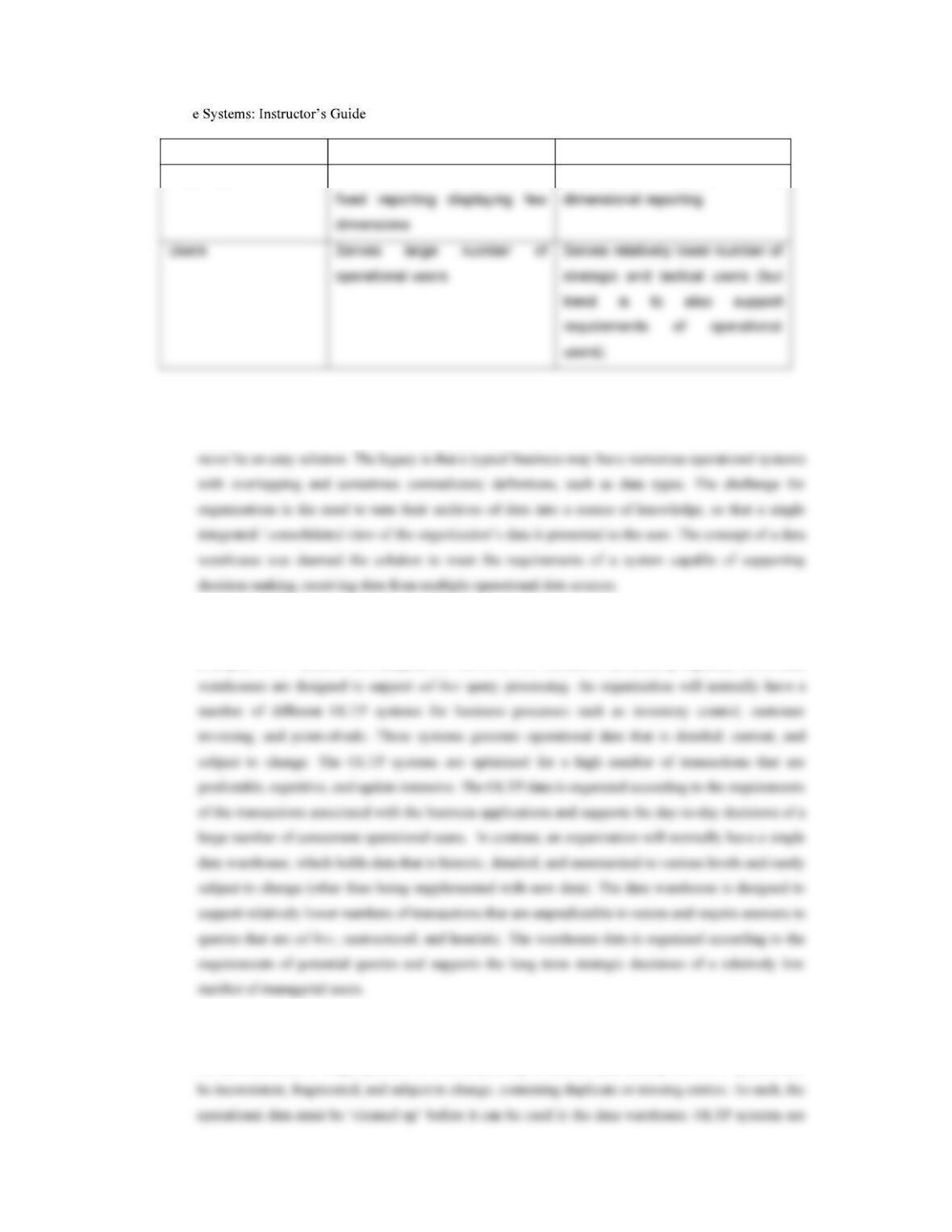
Characteristic OLTP Systems Data Warehouse Systems
Main purpose Supports operational processing Supports analytical processing
Data age Current
Historic (but trend is towards also
supplements to the warehouse
Detailed, lightly and highly
le patterns of data
level of
Less predictable pattern of data
Databas – Part V
transaction throughput
Reporting
Predictable, relatively static
Unpredictable, dynamic multi-
OLTP are the major source of data for the data warehouse. However OLTP systems were never
designed to support such business activities and so tapping into these systems for decision-making may
A DBMS built for Online Transaction Processing (OLTP) is generally regarded as unsuitable for data
warehousing because each system is designed with a differing set of requirements in mind. For
example, OLTP systems are designed to maximize the transaction processing capacity, while data
Although OLTP systems and data warehouses have different characteristics and are built with different
purposes in mind, these systems are closely related, in that the OLTP systems provide the source data
for the warehouse. A major problem of this relationship is that the data held by the OLTP systems can
ing few
Serves large number of
Serves relatively lower number of
trend is to also support
requirements of operational