– Part III
11
Chapter 3 Database Architectures and the Web
Review Questions
3.1 –
approach? Compare the client-server architecture with two other architectures.
The client is a process that requires some resource, and the server provides the resource. Neither
need reside on the same machine. Advantages include:
3.2 Compare and contrast the two-tier client-server architecture for traditional DBMSs with the
three-tier client-server architecture. Why is the latter architecture more appropriate for the Web?
3.3 What is an n-tier architecture?
3.4 What is middleware? Provide a classification service for middleware.
Middleware is a generic term used to describe software that mediates with other software and
middleware, which hides the underlying complexity of distributed systems.
3.5 What is a TP Monitor? What advantages does a TP Monitor bring to an OLTP environment?
A TP Monitor forms the middle tier of a three-tier architecture. TP Monitors provide significant
advantages, including:
– Part III
12
3.6 What is a Web service?
Web services allow applications to integrate with other applications across the Internet and may
3.7 What technologies and standards are used to develop Web services and how do they relate to
each other?
Key to the Web services approach is the use of widely accepted technologies and standards, such
as:
– Part III
13
3.8 What is a service-oriented architecture?
The SOA approach attempts to design loosely coupled and autonomous services that can be
combined to provide flexible composite business processes and applications. SOA principles
provide a unique design approach for building Web services for SOA:
3.9 Provide an example of a service-oriented architecture.
3.10 What is Cloud computing?
Cloud computing: A model for enabling ubiquitous, convenient, on-demand network access
3.11 Discuss the five essential characteristics of cloud computing.
The essential characteristics are:
– Part III
14
On-demand self-service: consumers can obtain, configure and deploy cloud services
themselves using cloud service catalogues, without requiring the assistance of anyone
from the cloud provider.
See Section 3.5.
3.12 Discuss the three main service models of cloud computing.
Software as a Service (SaaS): software and associated data are centrally hosted on the
cloud.
Platform as a Service (PaaS): a computing platform that allows the creation of web
3.13 Compare and contrast the four main deployment models for the cloud.
The four main deployment models for the cloud are:
– Part III
15
Private cloud: cloud infrastructure operated solely for a single organization, whether
3.14 What are the difference between Data as a service (DaaS) and Database as a service
(DBaaS)?
DaaS: offers the ability to define data in the cloud and subsequently query that data on
demand. Unlike traditional database solutions, DaaS does not implement typical DBMS
3.15 Discuss the different architectural models for Database-as-a-service.
Separate servers
Shared Server, Separate Database Server Process
16
3.16 Describe the main components in a DBMS.
The major software components in a DBMS environment are depicted in Figure 3.20. The main
components in a DBMS are:
Query processor. This is a major DBMS component that transforms queries into a series of
low-level instructions directed to the database manager.
3.17 Describe the internal architecture of Oracle.
Oracle is based on the client server architecture. The Oracle server consists of the database (the
Exercises
3.18 Examine the d
identify their support for the following:
(a) client server architecture
(b) Web services
(c) service-oriented architecture
Microsoft SQL Server
Microsoft SQL Server is designed to work effectively in a number of environments:
As a two-tier or multitier client/server database system
As a desktop database system
– Part III
17
In a two-tier client/server system, users run an application on their local computer, known as a
Web services extend the World Wide Web infrastructure to provide the means for software to
connect to other software applications. Applications access Web services via ubiquitous Web
Oracle
In the Oracle database system environment, the database application and the database are
separated into two parts: a front-end or client portion, and a back-end or server portion–hence
the term client/server architecture. The client runs the database application that accesses
database information and interacts with a user through the keyboard, screen, and pointing
device, such as a mouse. The server runs the Oracle software and handles the functions
required for concurrent, shared data access to an Oracle database.
– Part III
18
Comprehensive and Pre-Integrated SOA Platform Complete set of service and
Oracle SOA Suite, which now includes the former BEA AquaLogic Service Bus, is Oracle
Fusion Middleware’s strategic product for SOA. Oracle plans to continue to develop and
DB2
Local and remote application processes can work with the same database. A remote
application is one that initiates a database action from a machine that is remote from the
database machine. Local applications are directly attached to the database at the server
machine.
– Part III
19
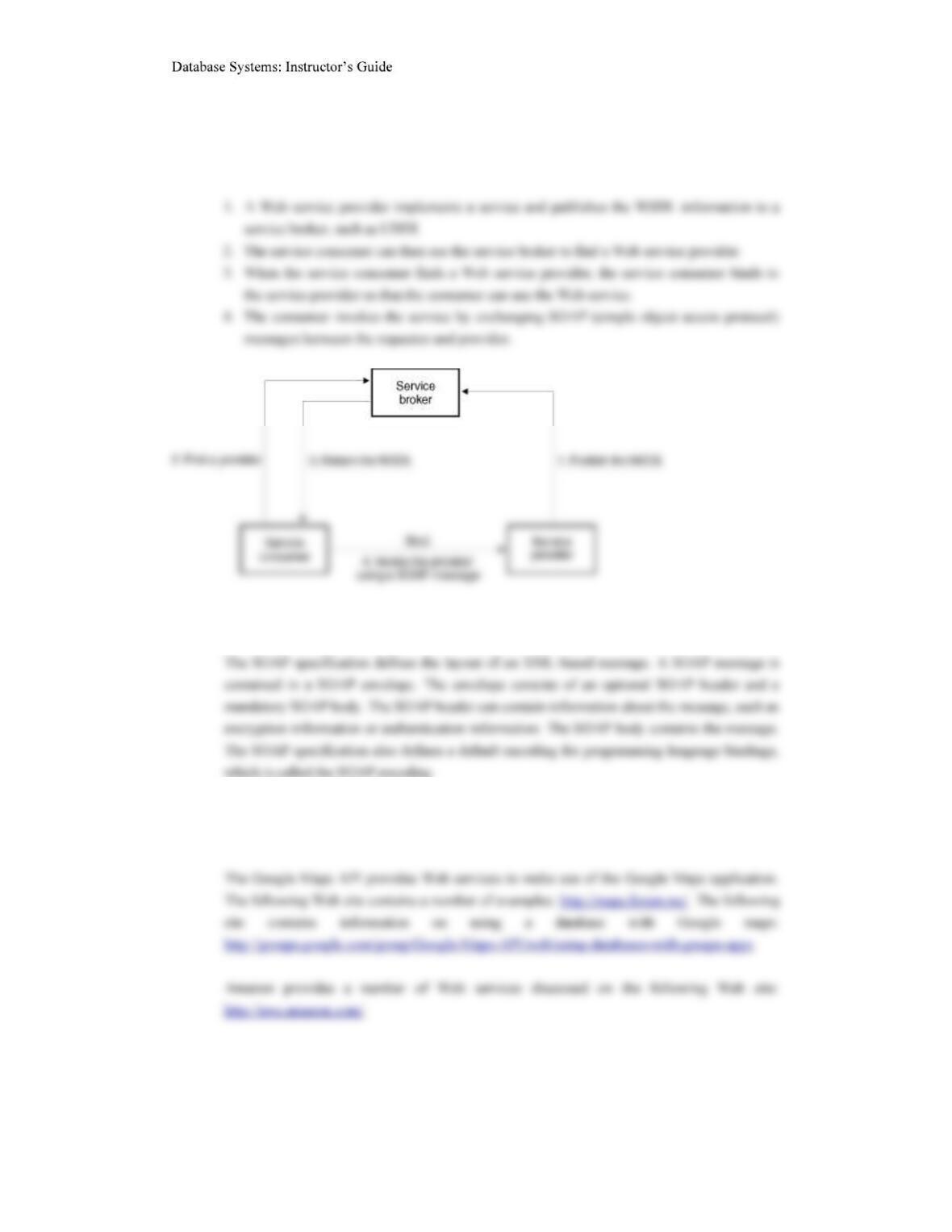
Web service providers are described by Web Services Description Language (WSDL)
documents. You can use the Web services wrapper to access Web service providers. Figure 1
shows the architecture of Web services.
Figure 1. Web services: a service-oriented architecture
3.19 Search the Web for a number of Web services other than the ones discussed in Section 3.2.
What do these services have in common? Identify whether the services access a database.