
Chapter 3 – The Relational Model and Normalization
Page 3-21
c. Transform this table into two or more tables such that each table is in BCNF and in
4NF. State the primary keys, candidate keys, foreign keys, and referential integrity
constraints.
We’ll move the obvious multivalued dependencies into their own tables, and then check for
BCNF. IF we have BCNF and no multivalued dependencies, we also have 4NF:
STEP ONE: MOVE MUTIVALUED DEPENDENCIES INTO SEPARATE TABLES:
STEP TWO: CHECK EACH OF THE RESULTING TABLES FOR BNCF:
STEP TWO (A): CHECK STUDENT
STUDENT_2 FUNCTIONAL DEPENDENCIES:
STUDENT_2 (StudentNumber, StudentName, Dorm, RoomType, DormCost)
Is every determinant a candidate key?
NO, RoomType is NOT a candidate key.
Therefore the relation is NOT in BCNF.

Chapter 3 – The Relational Model and Normalization
Page 3-22
STEP TWO (A) (1): CHECK STUDENT_3:
STUDENT FUNCTIONAL DEPENDENCIES:
STUDENT_3 (StudentNumber, StudentName, Dorm, RoomType)
STUDENT CANDIDATE KEYS:
StudentNumber
Is every determinant a candidate key?
DORM_RATE CANDIDATE KEYS:
RoomType
Is every determinant a candidate key?
YES, Therefore DORM_RATE is in BNCF.
STEP TWO (B): CHECK STUDENT_CLUB_MEMBERSHIP
STUDENT_CLUB_MEMBERSHIP FUNCTIONAL DEPENDENCIES:

Chapter 3 – The Relational Model and Normalization
Page 3-23
Is every determinant a candidate key?
NO, Club is not a candidate key.
STUDENT_CLUB_MEMBERSHIP CANDIDATE KEYS:
(StudentNumber, Club)
Is every determinant a candidate key?
YES, in this case there are NO determinants, but this
STEP TWO (B) (2): CHECK STUDENT_CLUB_COST:
STUDENT_CLUB_COST FUNCTIONAL DEPENDENCIES:
STUDENT_CLUB_COST (Club, ClubCost)
Is every determinant a candidate key?

Chapter 3 – The Relational Model and Normalization
Page 3-24
YES, Therefore STUDENT_CLUB_COST is in BNCF.
STEP TWO (C): CHECK STUDENT_SIBLING
STUDENT_SIBLING FUNCTIONAL DEPENDENCIES:
Is every determinant a candidate key?
YES, in this case there are NO determinants, but this
meets the criteria!
STUDENT_NICKNAME FUNCTIONAL DEPENDENCIES:
STUDENT_NICKNAME (StudentNumber, Nickname)
None StudentNumber does not determine Nickname,
Is every determinant a candidate key?
YES, in this case there are NO determinants, but this
meets the criteria!

Chapter 3 – The Relational Model and Normalization
Page 3-25
ALL TABLES ARE NOW IN BCNF AND 4NF!
STEP THREE: STATE FINAL MODEL SPECIFICATIONS:
Primary Keys are underlined.
Foreign Keys are italicized.
Non-Primary Key Candidate Keys (Alternate Primary Keys) are stated following
each relation as Alternate Keys [NOTE: None exist].
Referential Integrity Constraints are stated following each relation.
❖ REGIONAL LABS CASE QUESTIONS
Regional Labs is a company that conducts research and development work on a contract basis
for other companies and organizations. Figure 3-32 shows data that Regional Labs collects
about projects and the employees assigned to them. This data is stored in a relation (table)
named PROJECT:

Chapter 3 – The Relational Model and Normalization
Page 3-26
A. Assuming that all functional dependencies are apparent in this data, which of the
following are true?
1. ProjectID → EmployeeName FALSE
B. What is the primary key of PROJECT?
(ProjectID, EmployeeName)
C. Are all the non-key attributes (if any) dependent on the primary key?
D. In what normal form is PROJECT?
1NF ONLY
E. Describe two modification anomalies that affect PROJECT.
The two modification anomalies that affect PROJECT are:
F. Is ProjectID a determinant? If so, based on which functional dependencies in part A?

Chapter 3 – The Relational Model and Normalization
Page 3-27
G. Is EmployeeName a determinant? If so, based on which functional dependencies
in part A?
H. Is (ProjectID, EmployeeName) a determinant? If so, based on which functional
dependencies in part A?
I. Is EmployeeSalary a determinant? If so, based on which functional dependencies in part
A?
J. Does this relation contain a transitive dependency? If so, what is it?
K. Redesign the relation to eliminate modification anomalies.
Chapter 3 – The Relational Model and Normalization
Page 3-28
❖ THE QUEEN ANNE CURIOSITY SHOP PROJECT QUESTIONS
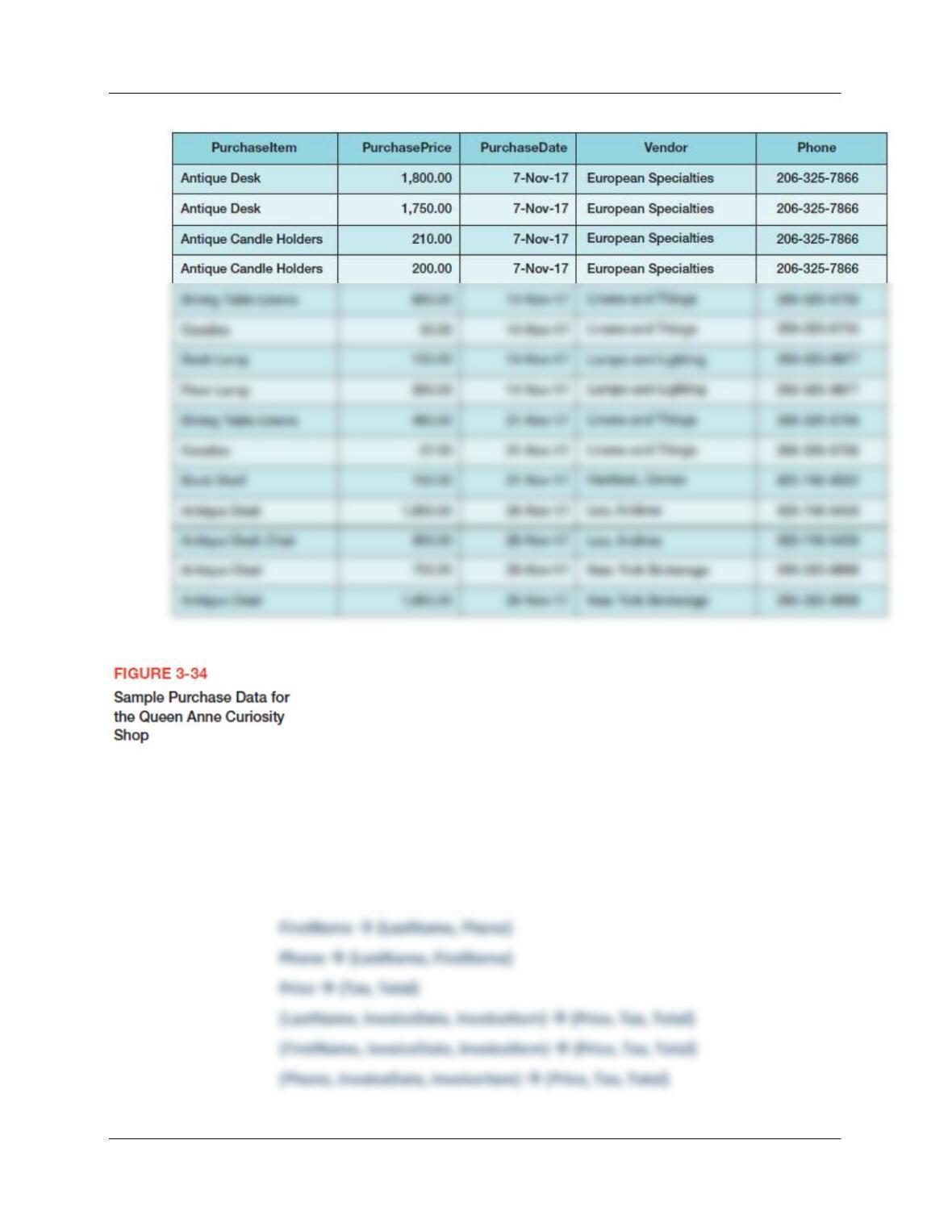
Figure 3-33 shows typical sales data for the Queen Anne Curiosity Shop, and Figure 3-34
shows typical purchase data.
Chapter 3 – The Relational Model and Normalization
Page 3-29
A. Using these data, state assumptions about functional dependencies among the columns
of data. Justify your assumptions on the basis of these sample data and also on the
basis of what you know about retail sales.
From the sample sales data it would appear:
LastName → (FirstName, Phone)
Chapter 3 – The Relational Model and Normalization
Page 3-30
However, these are based on a very limited dataset and cannot be trusted. For example, name is
not a good determinant in a retail application; there may be many customers with the same name.
It’s also possible that some customers could have the same phone, even though they do not in this
example. The one trustable functional dependency here is:
Price → (Tax, Total)
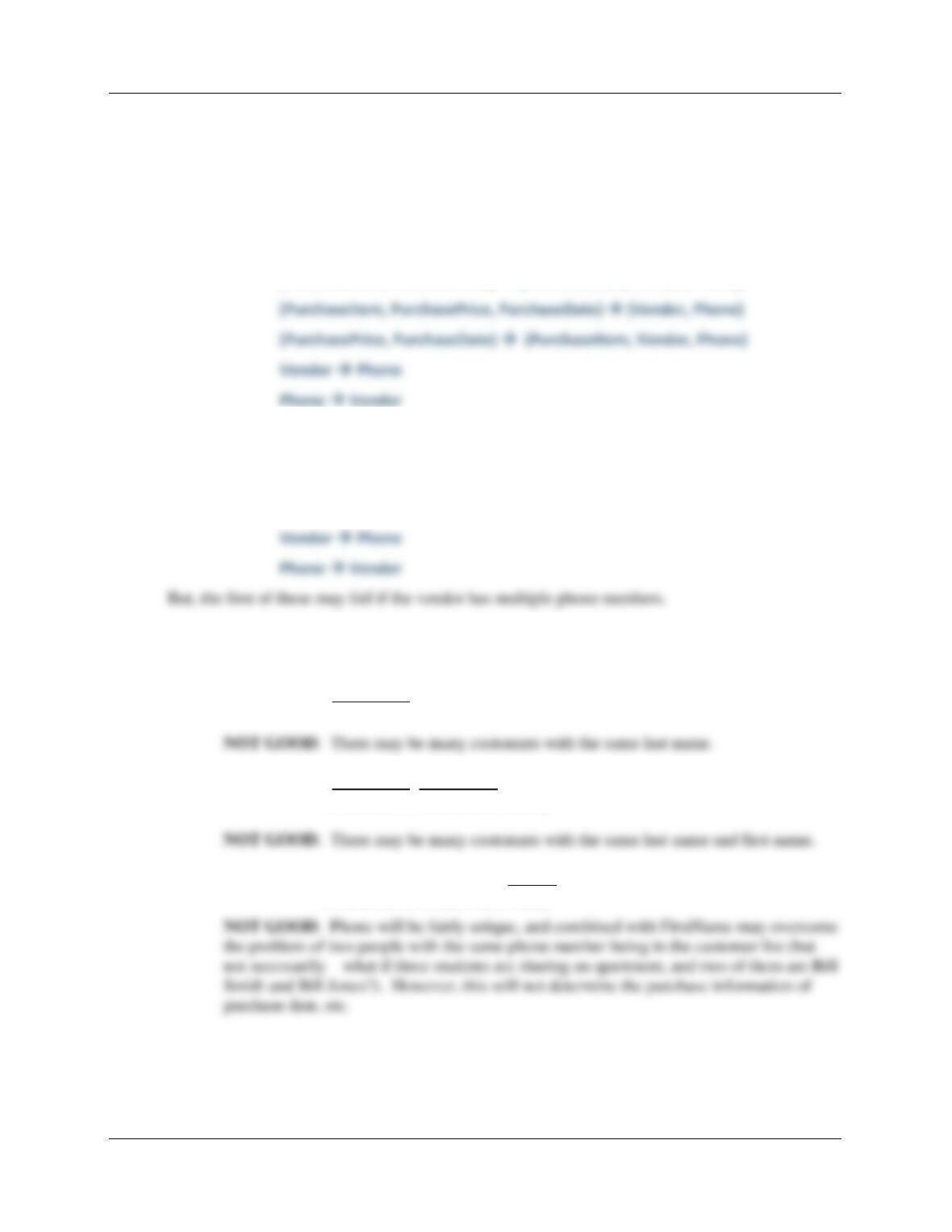
From the sample purchase data it would appear:
(PurchaseItem, PurchasePrice) → (PurchaseDate, Vendor, Phone)
However, these are based on a very limited dataset and cannot be trusted. For example,
PurchaseItem is not a good determinant in a retail application; there may be many PurchaseItems
with the same designator. It’s also possible that multiple purchases on the same purchase date
will be for the same purchase price and not necessarily for the same purchase item. The most
trustworthy functional dependencies here are:
B. Given your assumptions in part A, comment on the appropriateness of the following
designs:
1. CUSTOMER (LastName, FirstName, Phone, EmailAddress, InvoiceDate,
InvoiceItem, Price, Tax, Total)
2. CUSTOMER (LastName, FirstName, Phone, EmailAddress, InvoiceDate,
InvoiceItem, Price, Tax, Total)
3. CUSTOMER (LastName, FirstName, Phone, EmailAddress, InvoiceDate,
InvoiceItem, Price, Tax, Total)
Chapter 3 – The Relational Model and Normalization
Page 3-31
4. CUSTOMER (LastName, FirstName, Phone, EmailAddress, InvoiceDate,
InvoiceItem, Price, Tax, Total)
5. CUSTOMER (LastName, FirstName, Phone, EmailAddress, InvoiceDate,
InvoiceItem, Price, Tax, Total)
6. CUSTOMER (LastName, FirstName, Phone, EmailAddress)
and:
7. CUSTOMER (LastName, FirstName, Phone, EmailAddress, InvoiceDate)
and:
8. CUSTOMER (LastName, FirstName, Phone, EmailAddress, InvoiceDate,
InvoiceItem)
and:
SALE (InvoiceDate, InvoiceItem, Price, Tax, Total)

Chapter 3 – The Relational Model and Normalization
Page 3-32
C. Modify what you consider to be the best design in part B to include surrogate ID columns
called CustomerID and SaleID. How does this improve the design?
The best design in part B was number 8, so we’ll put in the ID columns. These columns
will become the new primary keys, and we’ll need to adjust the foreign key so that it is in
SALE. The result is:
D. Modify the design in part C by breaking SALE into two relations named SALE and
SALE_ITEM. Modify columns and add additional columns as you think necessary. How
does this improve the design?
The main problem with the design in part C is that only one item can be included in each
sale. Moving items into a SALE_ITEM table linked to SALE will allow multiple items
to be purchased as part of one sale. We’ll need to include SaleID as part of a composite
primary key so that the sale items are grouped according to their corresponding SALE.