
– Part III
3
Chapter 27 Object-Oriented DBMSs Concepts and Design
Review Questions
27.1 Describe the three generations of DBMSs.
First generation is the hierarchical and network DBMSs.
27.2 Compare and contrast the different definitions of object-oriented data models.
27.3 Describe the main modeling primitives of the functional data model.
27.4 What is a persistent programming language and how does it differ from an OODBMS?
27.5 Discuss the difference between the two-level storage model used by conventional DBMSs and
the single-level storage model used by OODBMSs.
See Section 27.3.
27.6 How does this single-level storage model affect data access?
See Section 27.3.
27.7 Describe the main strategies that can be used to create persistent objects.
27.8 What is pointer swizzling? Discuss the different approaches to pointer swizzling.
27.9 Describe the types of transaction protocol that can be useful in design applications.
27.10 Discuss why version management may be a useful facility for some applications.
There are many applications that need access to the previous state of an object. For example, the
27.11 Discuss why schema control may be a useful facility for some applications.
Engineering design is an incremental process and evolves with time. To support this process,
27.12 Describe the different architectures for an OODBMS.
See Section 27.4.4.
27.13 List the advantages and disadvantages of an OODBMS.
See Section 27.5.
27.14 Describe how relationships can be modelled in an OODBMS.
27.15 Describe the different modelling notations in the UML.
Expect discussion of the notations for:
Structural diagrams, which describe the static relationships between components, and
include:
– Part III
Exercises
27.16 For the DreamHome case study documented in Appendix A, suggest attributes and methods
that would be appropriate for Branch, Staff, and PropertyForRent classes.
27.17 Produce use case diagrams and a set of associated sequence diagrams for the DreamHome case
study documented in Appendix A.
27.18 Produce use case diagrams and a set of associated sequence diagrams for the University
Accommodation Office case study documented in Appendix B.1.
27.19 Produce use case diagrams and a set of associated sequence diagrams for the Easy Drive
School of Motoring case study documented in Appendix B.2.
27.20 Produce use case diagrams and a set of associated sequence diagrams for the Wellmeadows
Hospital case study documented in Appendix B.3.
6
27.21 You have been asked by the Managing Director of DreamHome to investigate and prepare a
report on the applicability of an OODBMS for your organization. The report should compare
the technology of the RDBMS with that of the OODBMS, and should address the advantages
and disadvantages of implementing an OODBMS within the organization, and any perceived
problem areas. Finally, the report should contain a fully justified set of conclusions on the
applicability of the OODBMS for DreamHome.
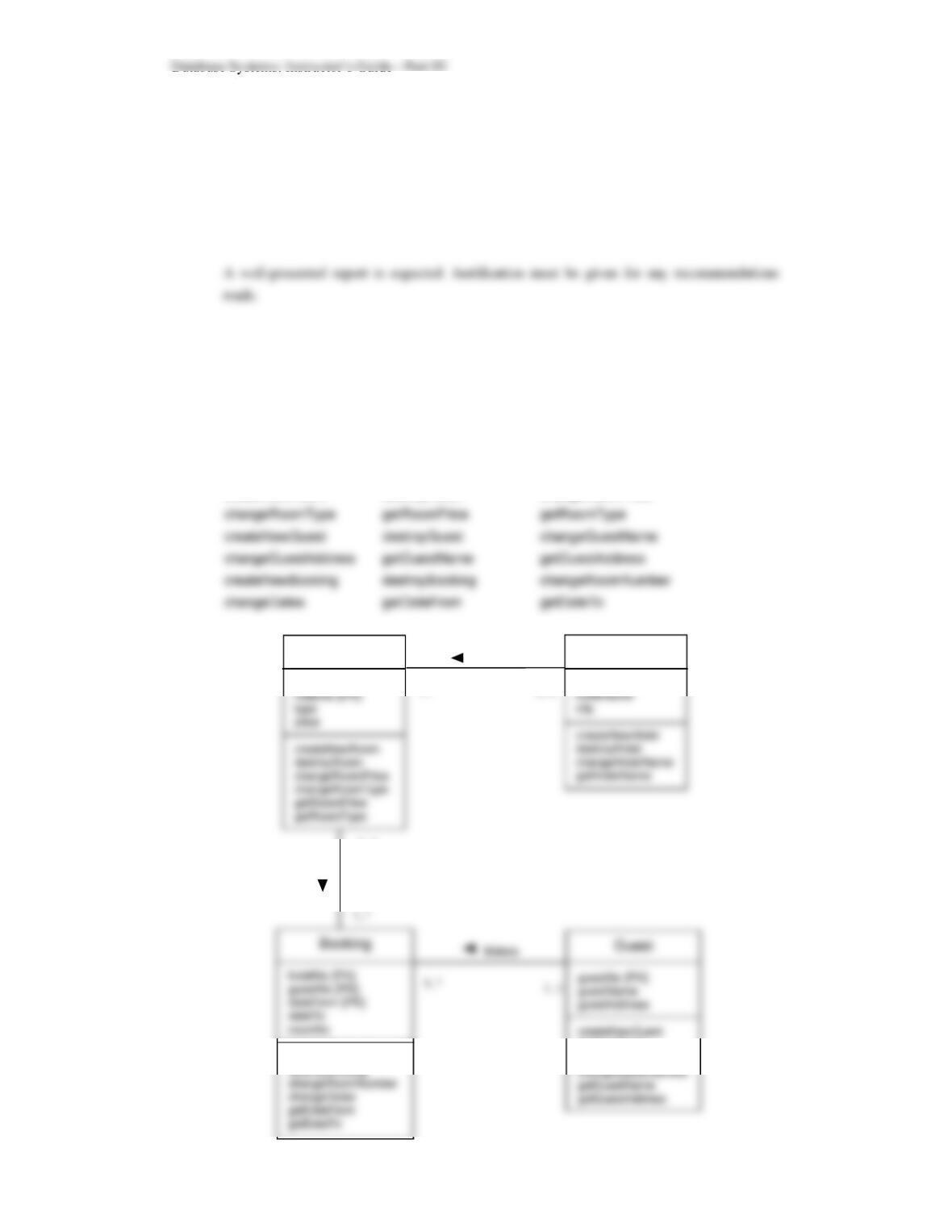
27.22 For the relational Hotel schema in the Exercises at the end of Chapter 4, suggest a number of
methods that would be applicable to the system. Produce an object-oriented schema for the
system.
Some methods might be:
createNewHotel destroyHotel changeHotelName
getHotelName
createNewRoom destroyRoom changeRoomPrice
Room
roomNo {PK}
1..*
Contains
1..1
destroyGuest
changeGuestName
Hotel
hotelNo {PK}
createNewBooking
destroyBooking
Gets
1..1

7
27.23 For the relational Project schema in the Exercises at the end of Chapter 5, suggest a number of
methods that would be applicable to the system. Produce an object-oriented schema for the
system.
27.24 For the relational Library schema in the Exercises at the end of Chapter 5, suggest a number of
27.25 Produce an object-oriented database design for the DreamHome case study documented in
Appendix A. State any assumptions necessary to support your design.
27.26 Produce an object-oriented database design for the University Accommodation Office case study
presented in Appendix B.1. State any assumptions necessary to support your design.
27.27 Produce an object-oriented database design for the EasyDrive School of Motoring case study
presented in Appendix B.2. State any assumptions necessary to support your design.
27.28 Produce an object-oriented database design for the Wellmeadows Hospital case study presented
in Appendix B.3. State any assumptions necessary to support your design.
8
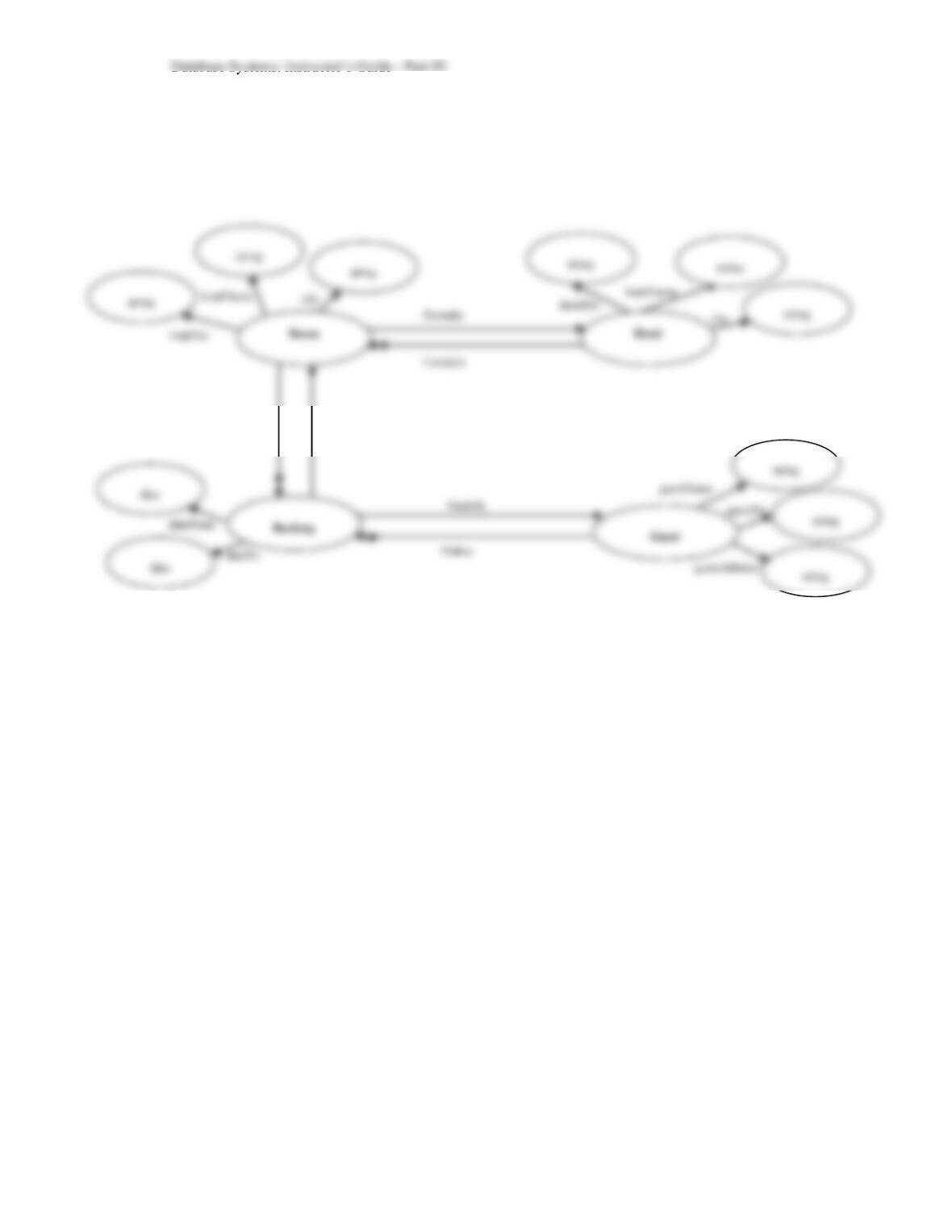
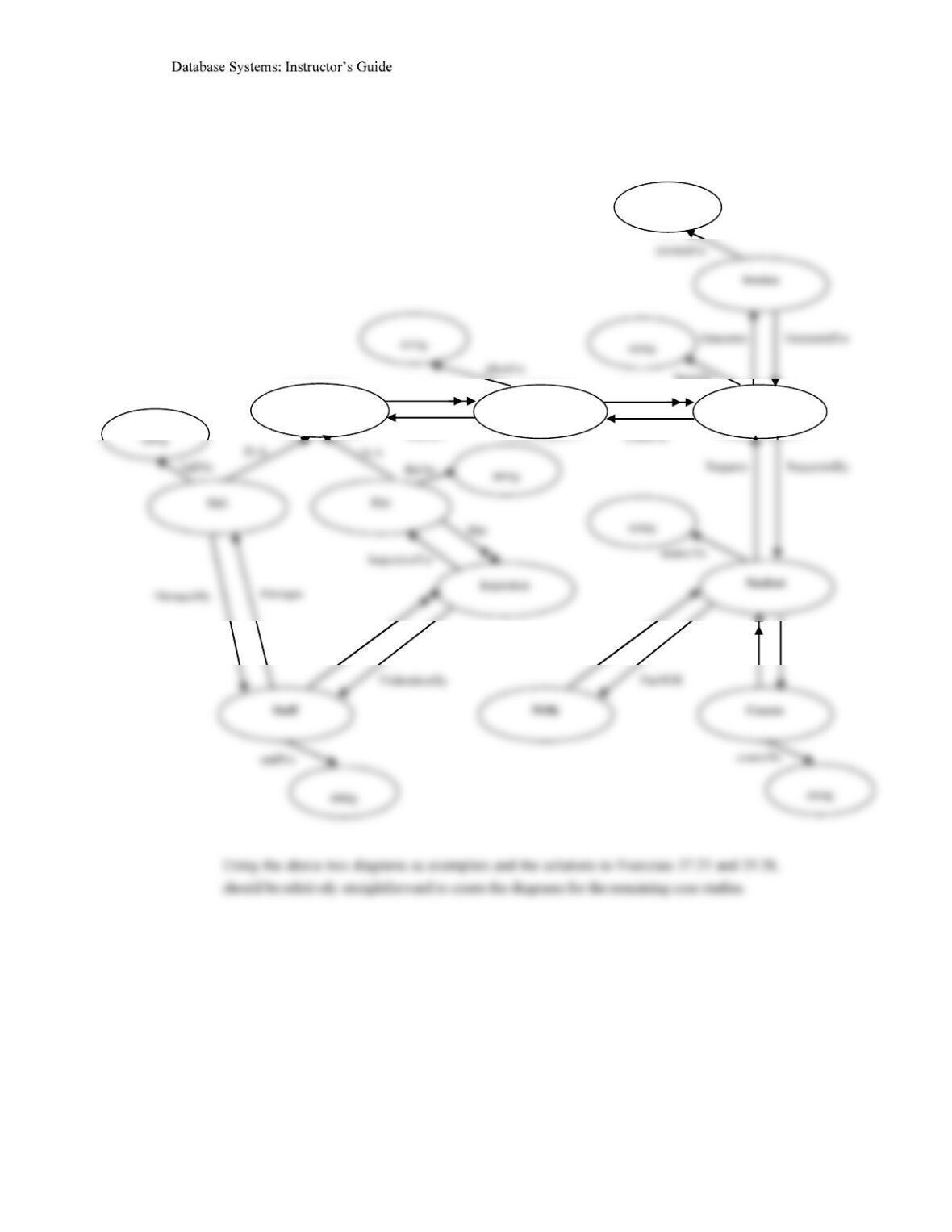
27.29 Repeat Exercises 27.22 to 27.28 but produce a schema using the functional data model.
Diagramatically illustrate each schema.
(a) Hotel case study.
BookingFor
Gets
– Part III
9
(b) University Accommodation Office case study
Sample solution as follows (only primary key shown):
Provides
For
leaseNo
Lease
string
RoomIn
Accommodation Room
AttendedBy Attends
NOKFor
Undertakes
10
27.30 Using the rules for schema consistency given in Section 27.4.3 and the sample schema given
in Figure 27.11, consider each of the following modifications and state what the effect of the
change should be to the schema:
(a) adding an attribute to a class
See Section 27.4.3.