PART IV
Chapter 22 Transaction Management
22.1 (a) Locking-based algorithms for concurrency control can be employed to synchronize the
execution of transactions. Explain what is meant by a serializable schedule and show
that the following locking-based schedule is not serializable:
A schedule S is said to be serializable if all the reads and writes of each transaction can be
(b) Identify the problem with the above schedule, and produce a correct locking-based
serializable schedule.
The problem is that the locking algorithm releases the locks that are held by a transaction as soon
22.2
reliability and availa
(a)
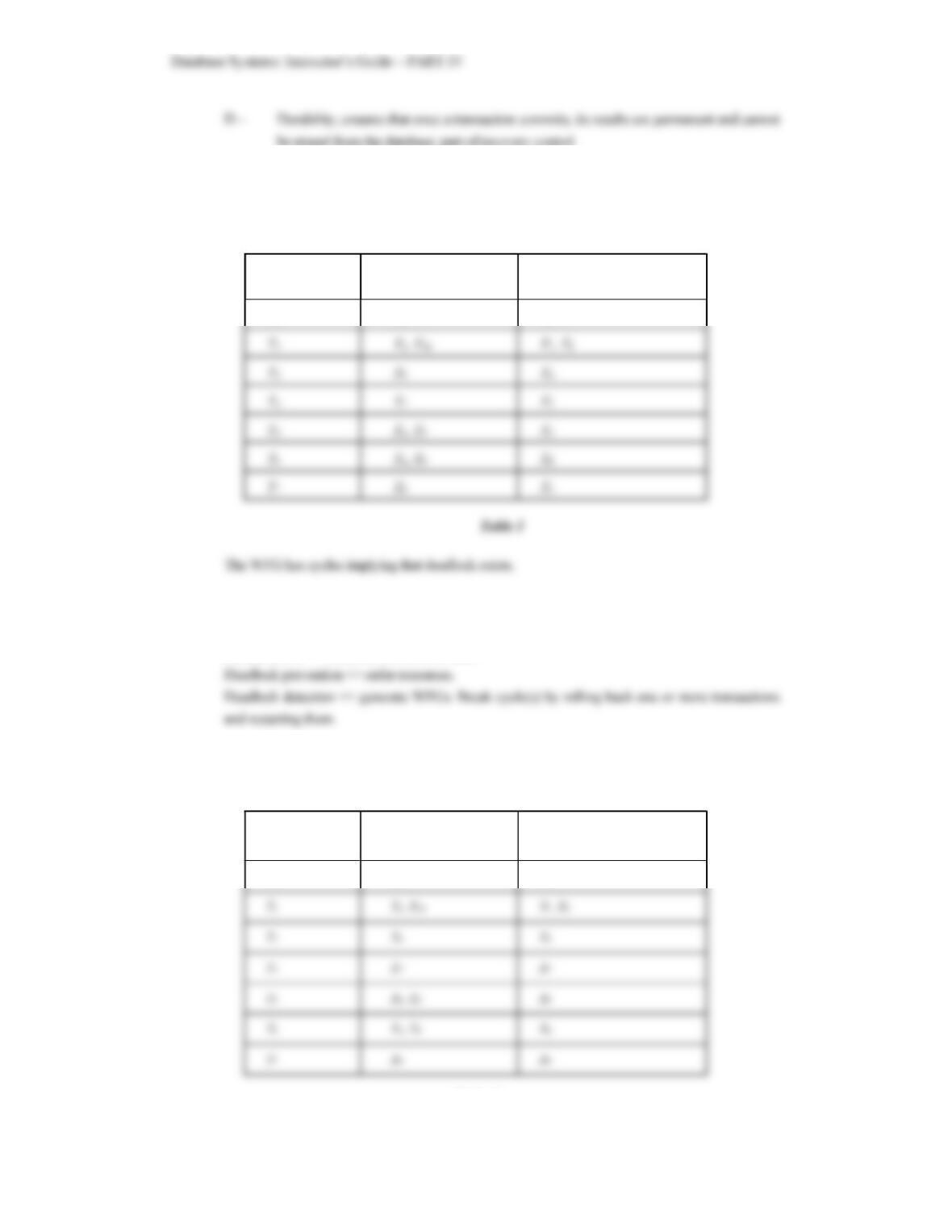
22.3 (a) Produce a wait-for-graph for the transactions with locking information shown in Table
1. What can you conclude for this graph?
Transaction
Data items locked by
transaction
Data items transaction is
waiting for
T1 X2 X1
(b) Compare and contrast the approaches to deadlock management in database systems.
Deadlock free => claim all resources at once.
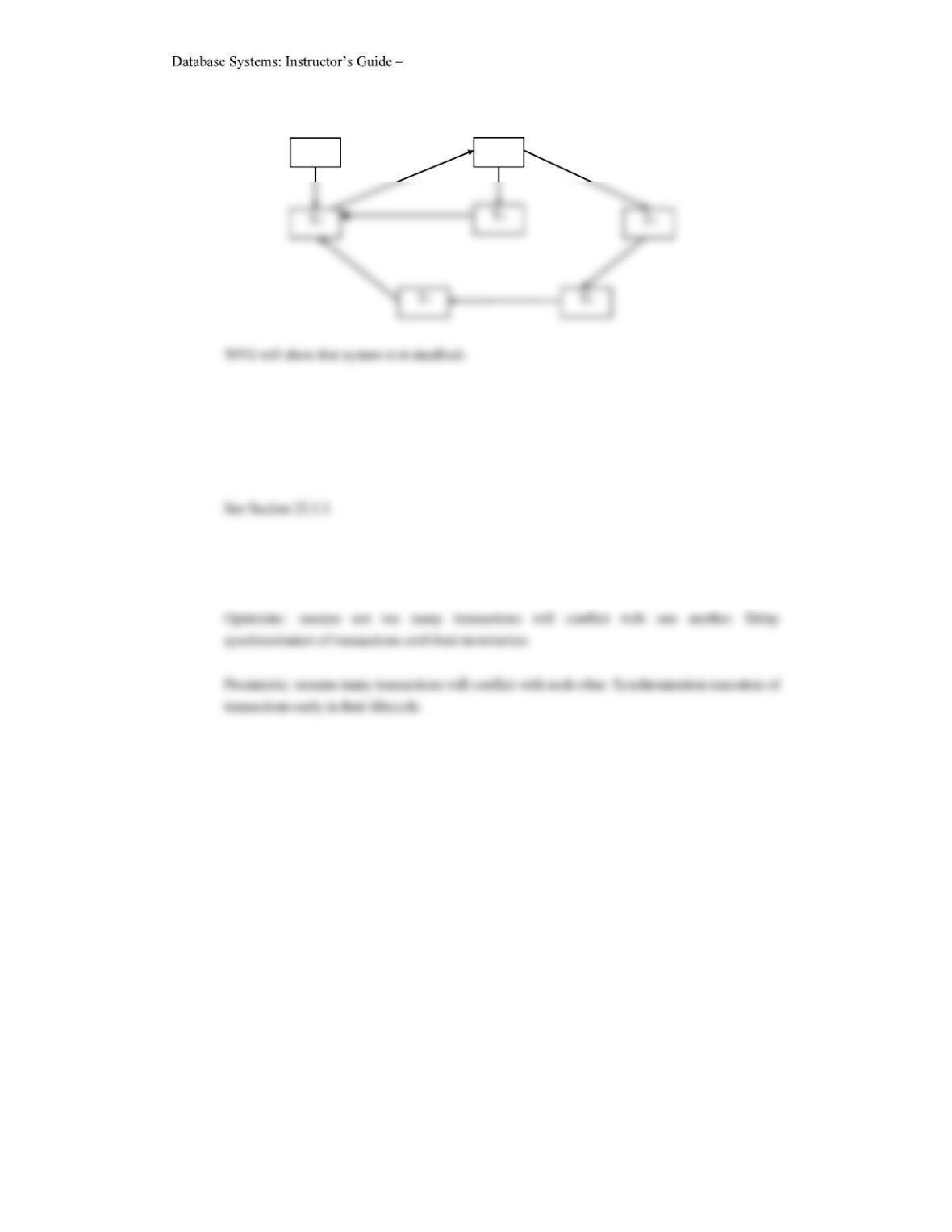
22.4 The locking information for several transactions is shown in Table 2. Produce a wait-for-graph
(WFG) for the transactions and determine whether deadlock exists.
Transaction
Data items locked by
transaction
Data items transaction
is
waiting for
T1 X2 X1
Table 2
PART IV
22.5 Locking-based algorithms for concurrency control can be employed to synchronize the execution
of transactions. Explain the rules for two-phase locking in a centralized Database Management
System and why each of these is necessary to avoid the database becoming inconsistent.
22.6 A taxonomy of concurrency control algorithms can classify algorithms as pessimistic or
optimistic. Compare and contrast these algorithms.
T1
T2
PART IV
Student Project
Assignment Transaction Management Design and Implementation
Introduction
The objective of this project is to design and implement part of a Relational Database Management System.
The work is to be undertaken in groups it will be left to yourselves to split into groups of 2/3.
Specification of Requirements
Design and implement an interface to the proprietary Relational Database Management System, Oracle, on
the SUN workstations, which will provide layers for:
(a) authorization