PART IV
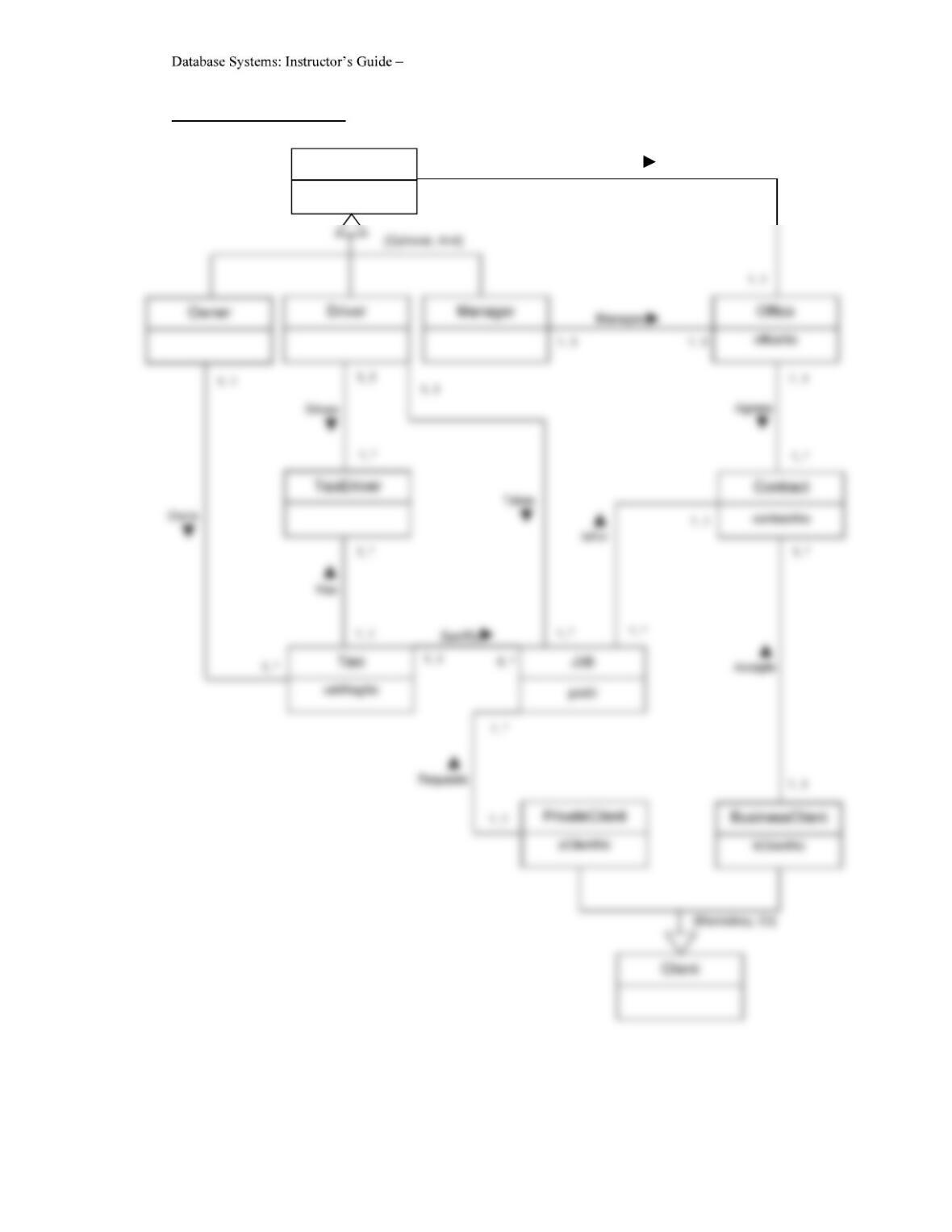
FastCabs Sample ER Model
Staff
staffNo
WorksAt
1..*
Manages
1..1
1..1
1..*
1..1
1..*
1..*
1.
.1
1..1
1..1
1..*
1..1
1..1
1..*
1..1
1..*
1..*
1..1
1..1
1..*
0..*
1..
1
PART IV
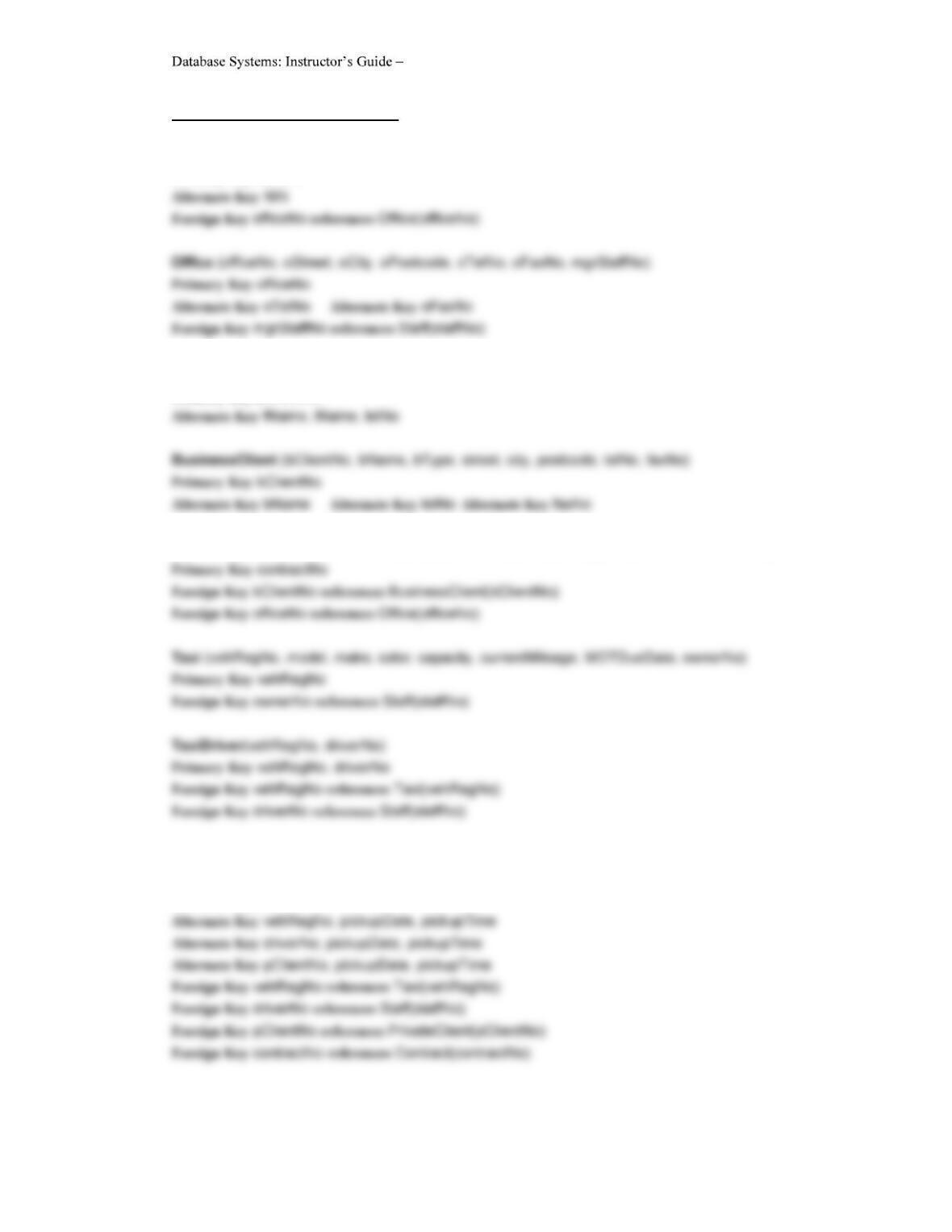
FastCabs Sample Relational Schema
Staff (staffNo, fName, lName, sAddress, jobDescription, salary, NIN, sex, DOB, officeNo)
Primary Key staffNo
PrivateClient (pClientNo, fName, lName, street, city, postcode, telNo)
Primary Key pClientNo
Contract (contractNo, bClientNo, startDate, finishDate, totalCharge, maxNoOfJobs, officeNo)
Job (jobID, vehRegNo, driverNo, pClientNo, contractNo, pickupDate, pickupTime,
pickupAddress, dropOffAddress, mileageUsed, Charge)
Primary Key jobID
PART IV
Database Systems Coursework 2 (Case Study 7 University Database)
DATABASE SYSTEMS
COURSEWORK
GROUP WORK: 2 3 Students
Introduction to Coursework
You have been approached by a University for the design and implementation of a relational database
Coursework Requirements
Each department runs a number of courses. The university provides a set of modules used in different
courses. Each course uses a number of modules but not every module is used. A course is assigned a
unique course code and a module is identified by a unique module code. A module can be used in one
course only, but can be studied by many students. In addition to the module code each module unique
title, start date, end date, texts (books), and assessment scheme (i.e. coursework and exam marks
percentages) are also stored.
Each department is managed by a member of academic staff. The database should record the date
he/she started managing the department. Each department has a name, phone number, fax number, and
location (e.g. E Block). Each department employs many members of academic staff.
Part 1 Design the Database
1. Create an Entity Relationship (ER) model of the data requirements for the University Database
case study using the UML notation. Note: if necessary, use the additional concepts of the
Enhanced Entity Relationship (EER) model. State any assumptions necessary to support your
design.
(Submit hardcopy)
2. Derive relational schema from your ER model that represents the entities and relationships.
Identify primary, alternate and foreign keys. Note: use the following notation to describe your
relational schema, as shown in the example of a Staff relation given below.
Staff (staffNo, fName, lName, address, NIN, sex, DOB, deptNo)
3. Use the technique of normalization to validate the structure of your relational schema.
Demonstrate that each of your relations is in third normal form (3NF) by displaying the functional
dependencies between attributes in each relation. Note, if any of your relations are not in 3NF, this
may indicate that your ER model is structurally incorrect or that you have introduced errors in the
process of deriving relations from your model.
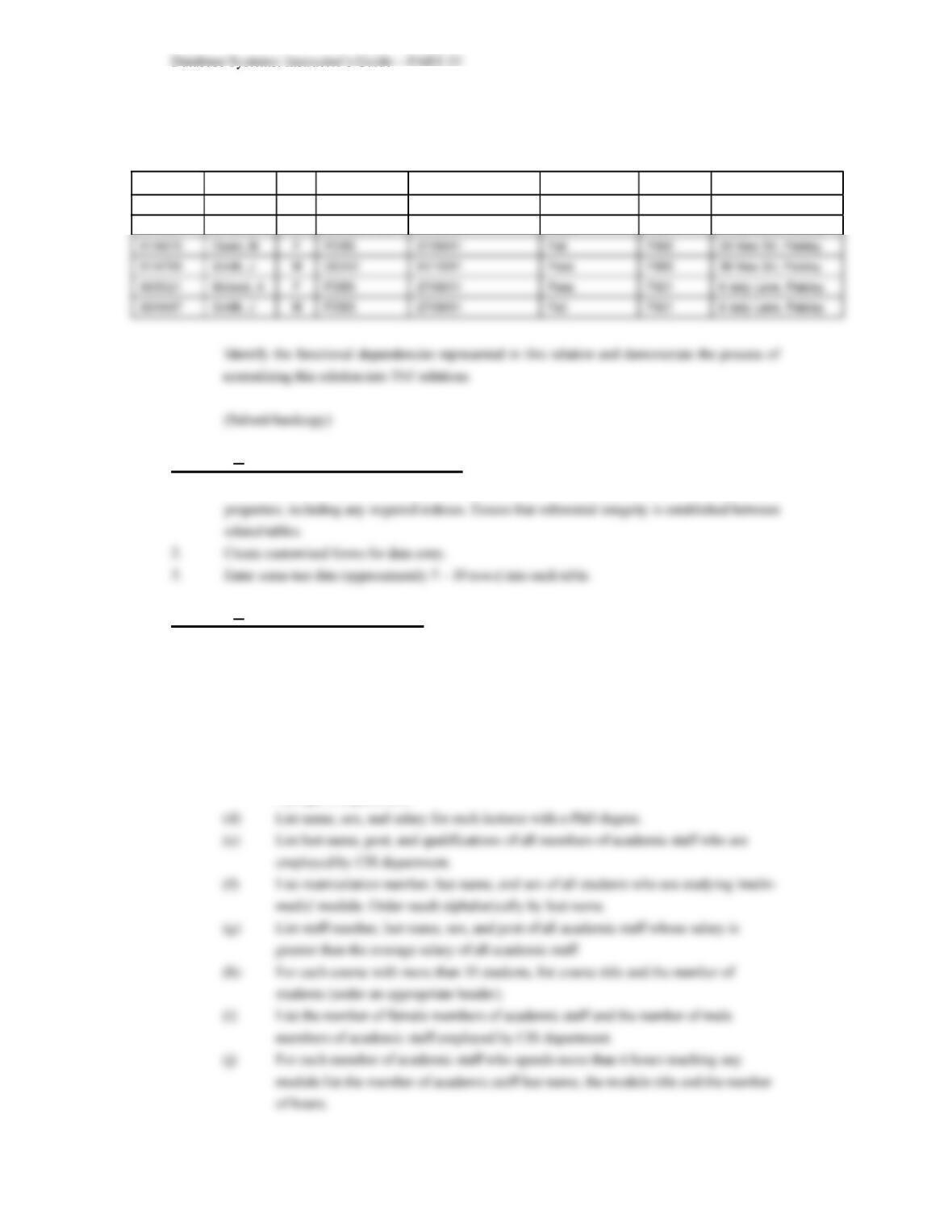
4. To further demonstrate your knowledge of normalization, assume that a proposed (badly
structured) relation for the University Database database has the following structure.
matricNo name sex moduleTitle module startDate performance flatNo address
00/5021 Mcleod, A F BITS 27/09/01 Pass F001 6 lady Lane, Paisley
00/4647 Smith, J M Software Dev. 01/10/01 Pass F001 6 lady Lane, Paisley
Part 2 Implement the Database
1. Create the tables for the University Database database. Where appropriate set field and table
Part 3 Query the Database
Before starting this section, please ensure that your tables contain sufficient data to enable you to test
the query transactions described in the University Database case study.
1. Create and save the following query transactions:
(a) List details of all departments located in E Block.
(b) List title, start and end dates of all modules run in the PgDIT course.
(c) List name, address, and salary for each female member of academic staff who
manages a department.
PART IV
2. Create a customised form or a report for each saved query.
3. Provide 10 additional examples of queries, which retrieve useful data from the University
Database database. State the purpose of each query and attempt to use each example to
demonstrate the breadth of your knowledge of QBE/SQL.
Part 4 Implement Database Application
Implement a prototype database application for the University Database. The purpose of this prototype
is to allow the Director to provide feedback on your proposed design.
Part 5 Document Database Application
1. Create a user manual that describes your prototype for the University Database database
application.
Part 6 Demonstrate Database Application
You and the members of your group are required to demonstrate your database application to your Lab
Tutor during your usual lab time in Week 11.
Part 7 Individual Critical Evaluation
Each student should submit his or her own critical assessment of the coursework. The evaluation
should include a discussion on how the coursework has reinforced (or otherwise) his or her
appreciation of the techniques and processes employed in undertaking a database project. In addition
the evaluation may include a wider discussion on topics such as:
How the Database Systems module relates to the other modules on your course.
PART IV
Marking Scheme
The assessment of this coursework will be carried out on the following components of the work. Please
note that each student should submit his or her own critical evaluation of the coursework and will
receive an individual mark for this component (out of 10%). This individual student mark will be
combined with the mark for the groupwork component (out of 90%) for the coursework.
Part 1 Design the Database (30)
PART IV
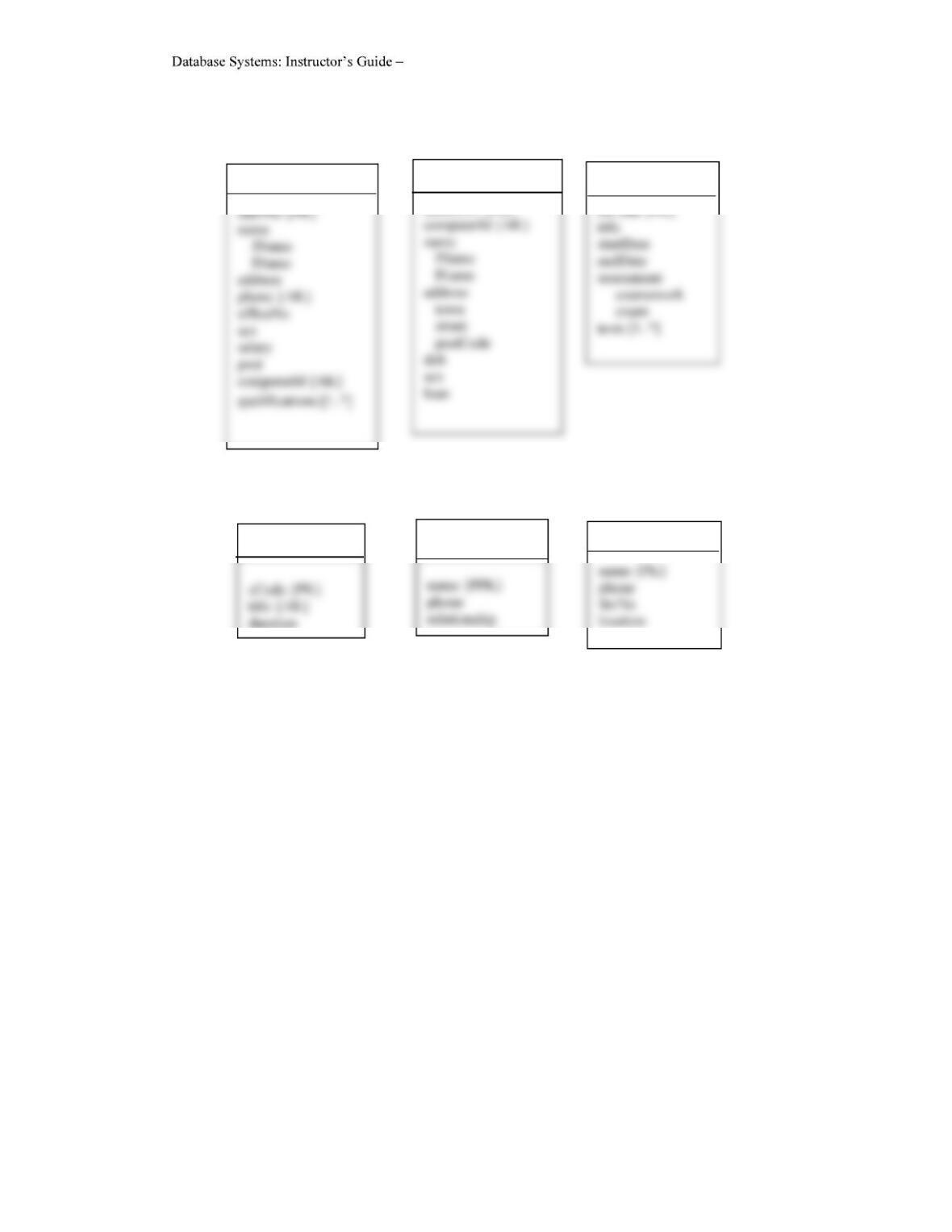
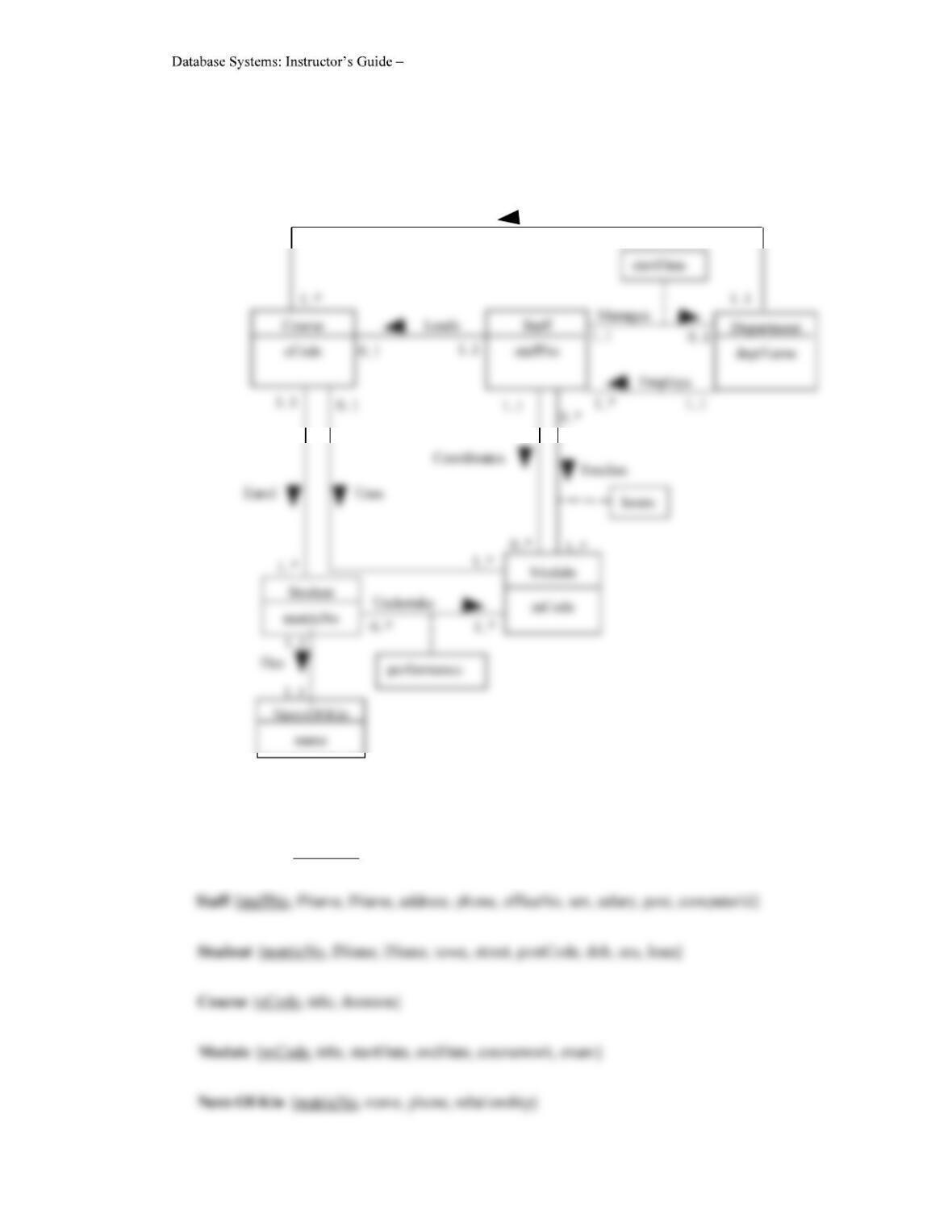
Partial ER diagrams
Staff
Student
matricNo {PK}
Course
Module
Next-Of-Kin
Department
PART IV
‘Global’ EER diagram
3. Logical Design (map ER to Relational)
1. Map entities and their attributes
Department {deptName, phone, faxNo, location}
Runs
Manages
0..1
2. Final relational schema
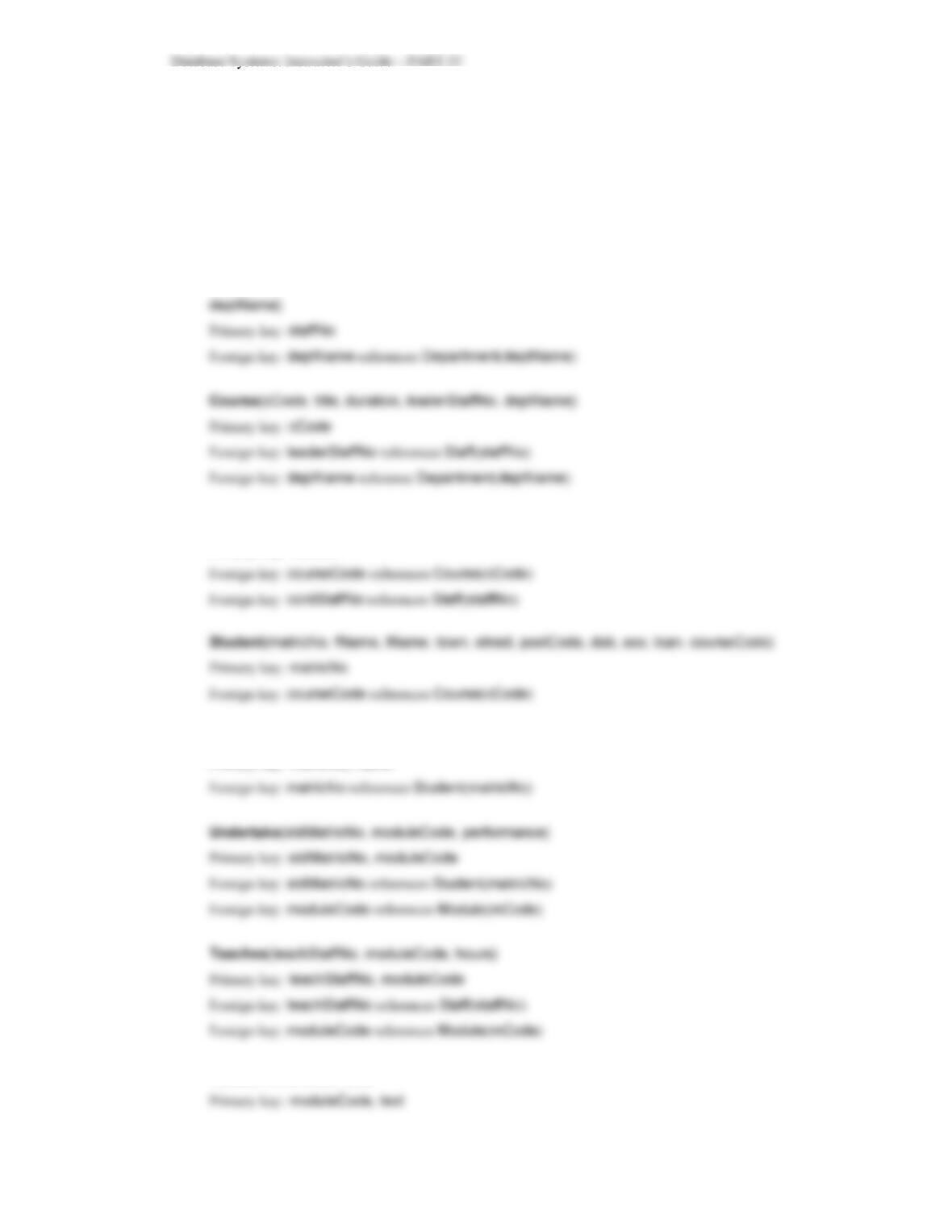
Department(deptName, phone, faxNo, location, mgrStaffNo, mgrStartDate)
Primary key: deptName
Foreign key: mgrStaffNo references Staff(staffNo)
Staff(staffNo, fName, lName, address, phone, officeNo, sex, salary, post, computerId,
Module(mCode, title, startDate, endDate, coursework, exam, courseCode, cordStaffNo)
Primary key: mCode
Next-Of-Kin(matricNo, name, phone, relationship)
Primary key: matricNo, name
Texts(moduleCode, text)
PART IV
Qualifications(qualStaffNo, qualification)
4. Normalisation
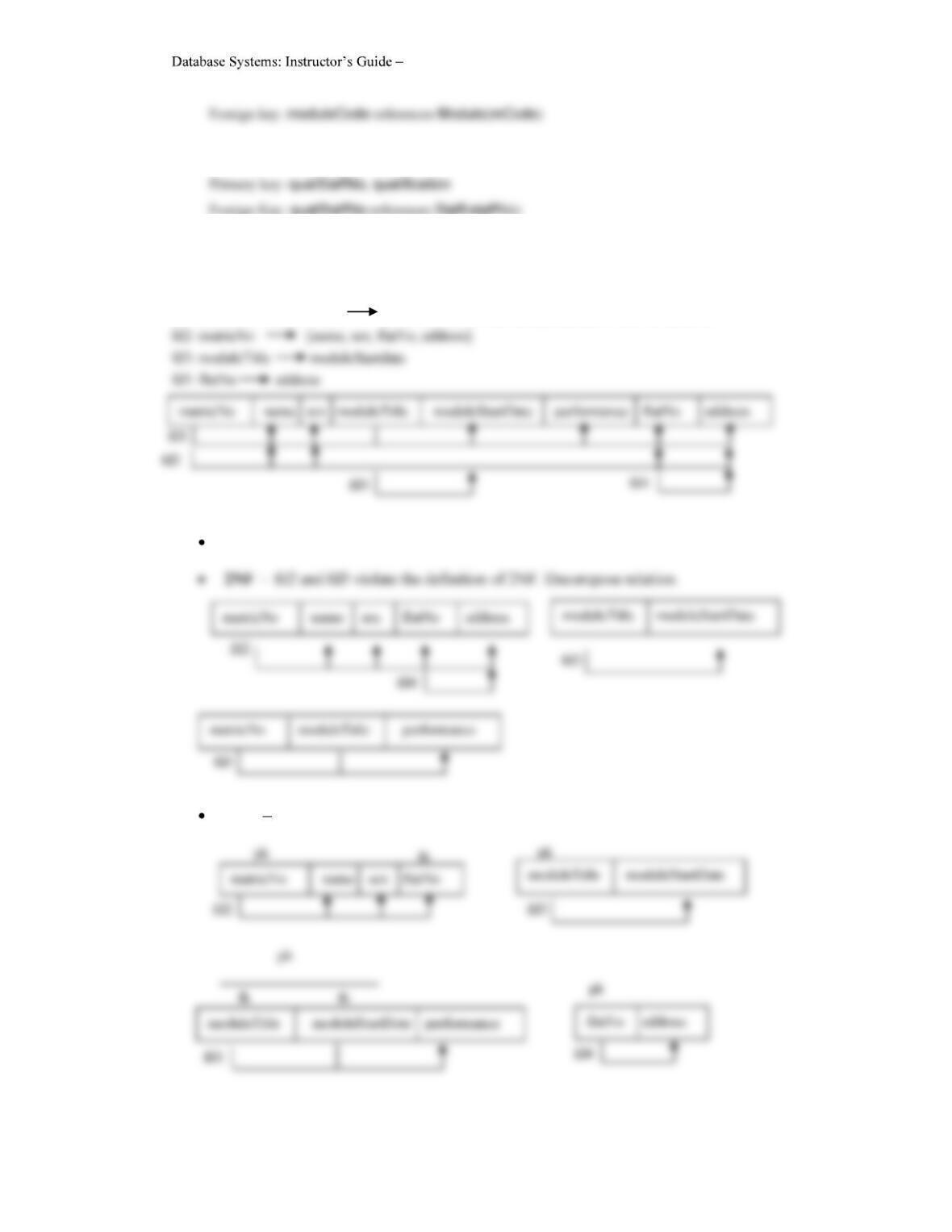
Functional dependencies
fd1: (matricNo, moduleTitle) {name, sex, modSartDate, performance, flatNo, address}
Primary key: (matricNo, moduleTitle)
3NF fd4 violate 3NF definition. Decompose relation.
5. Query the Database
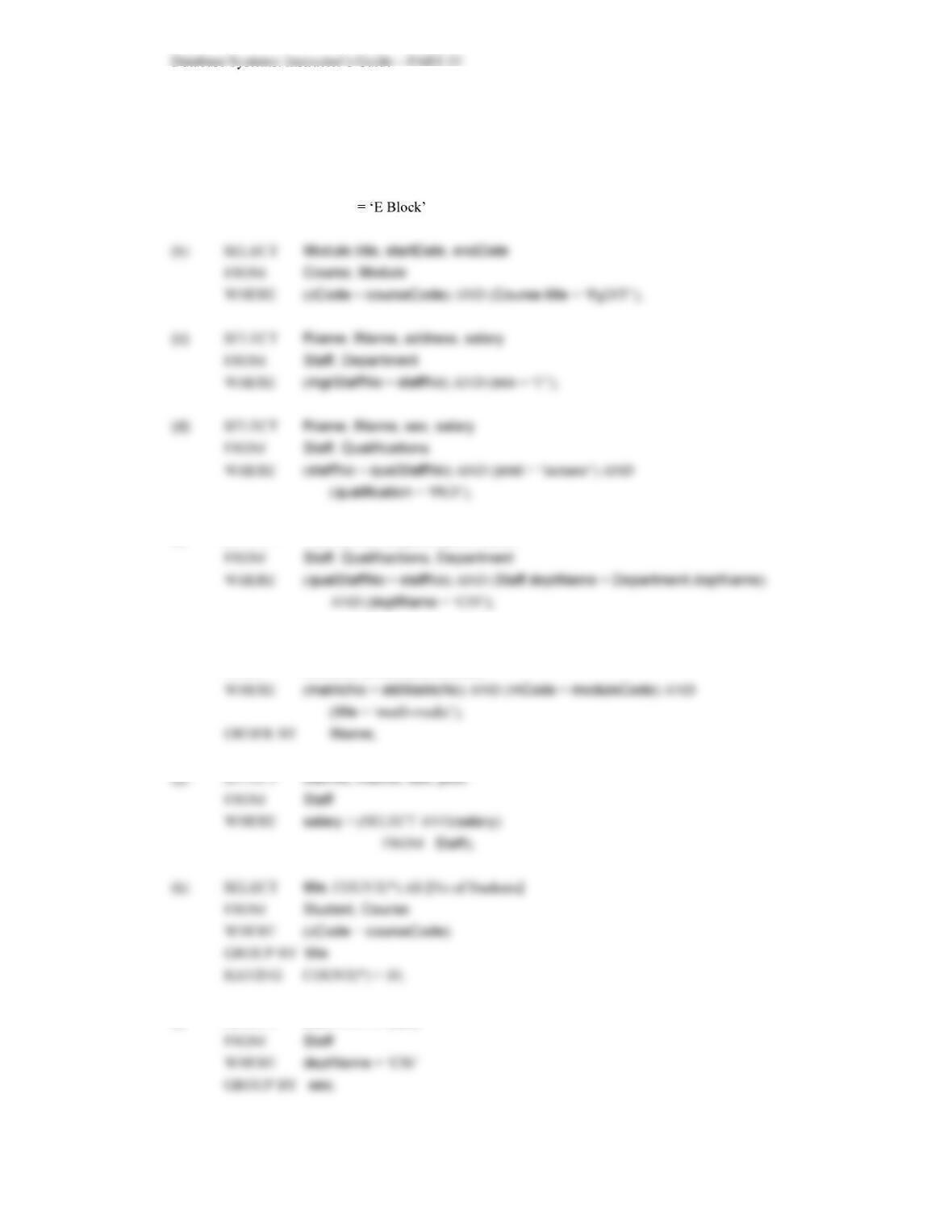
(a) SELECT *
FROM Department
WHERE location ;
(e) SELECT fName, lName, post, qualification
(f) SELECT matricNo, lName, sex
FROM Student, Undertake, Module
(i) SELECT sex, COUNT (sex)

PART IV
(j) SELECT lName, title, hours