PART IV
(f) Approximately 50 new video orders are placed each week. The details of video orders are
destroyed two years after the creation of the record.
The types and average number of record searches
(a) Searching for the details of a branch approximately 10 per day.
(b) Searching for the details of a member of staff at a branch approximately 20 per day.
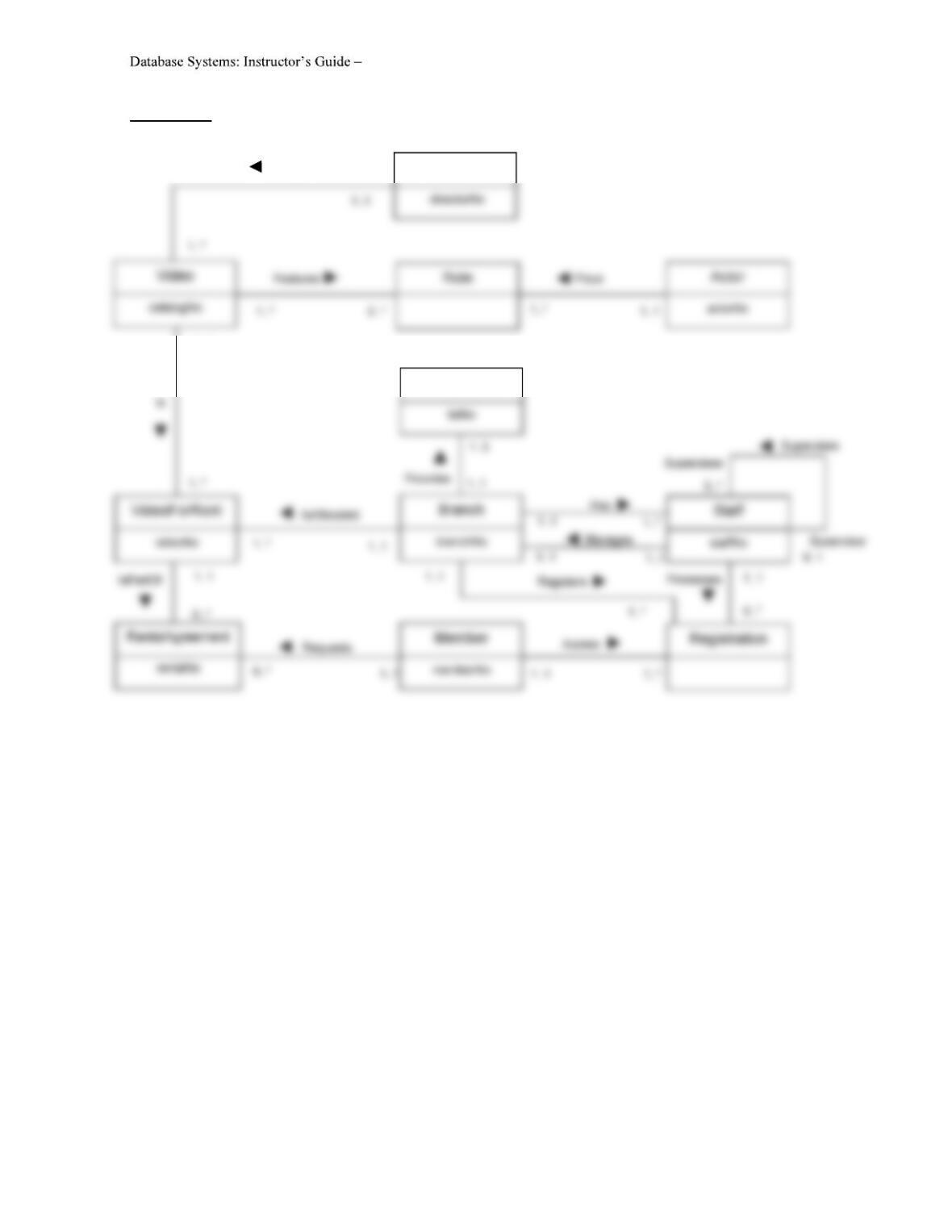
15.7 (a) Create a conceptual schema for each view of StayHome using the concepts of the Enhanced
Entity Relationship (EER) model. To simplify each diagram, only show entities, relationships
and the primary key attributes. Specify the cardinality ratio and participation constraint of
each relationship type. State any assumptions you make when creating the EER model (if
necessary).
(b) Validate the conceptual data model.
(c) Map your high-level local conceptual data models to local logical data models.
Identify primary, alternate, and foreign keys.
PART IV
Branch View
1..1
Registers
1..1
Telephone
Director
Directs
PART IV
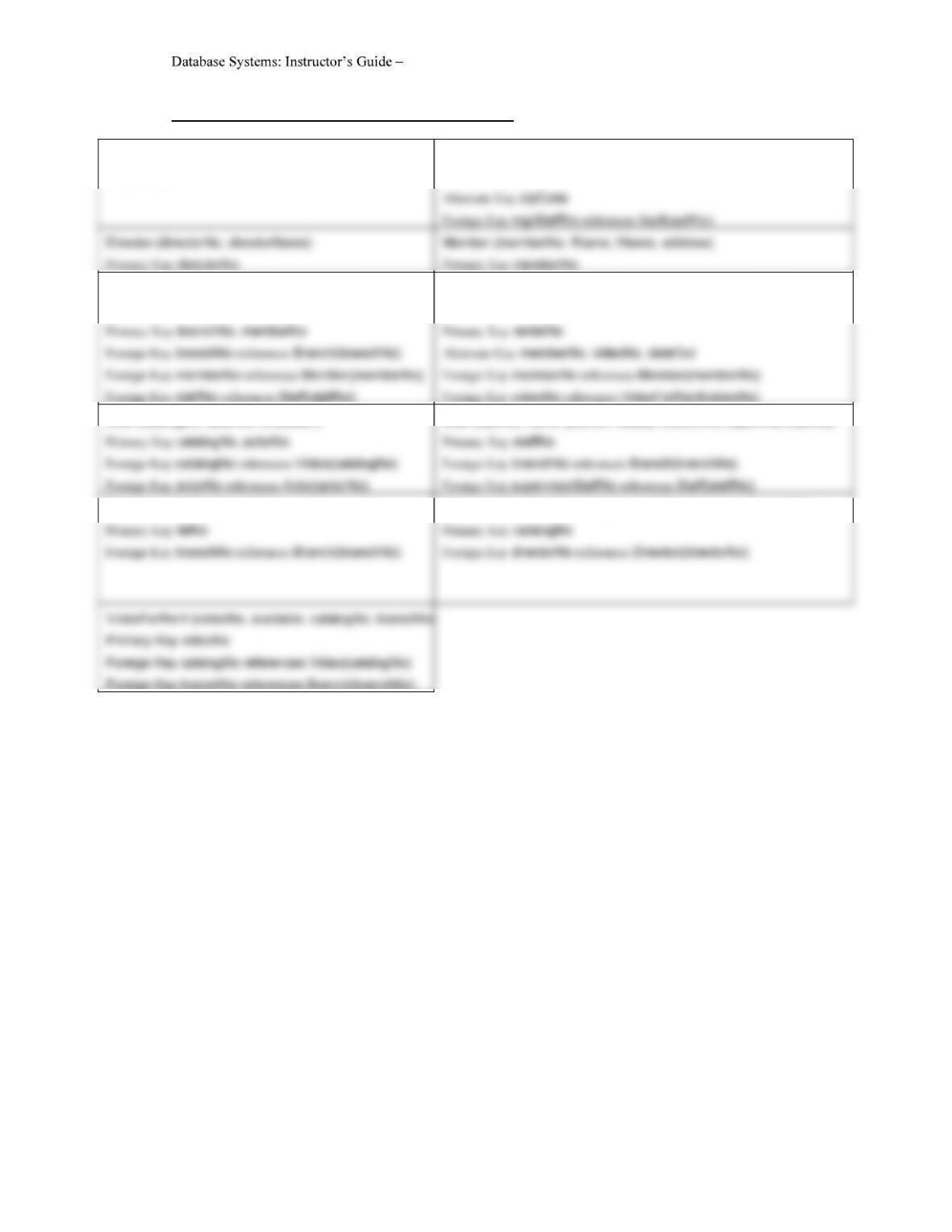
Tables for local logical data model for the Branch view
Actor (actorNo, actorName)
Primary Key actorNo
Branch (branchNo, street, city, state, zipCode, mgrStaffNo)
Primary Key branchNo
Registration (branchNo, memberNo, staffNo,
dateJoined)
RentalAgreement (rentalNo, dateOut, dateReturn, memberNo,
videoNo)
Role (catalogNo, actorNo, character)
Staff (staffNo, name, position, salary, branchNo, supervisorStaffNo)
Telephone (telNo, branchNo)
deoNo, available, catalogNo, branchNo)
Video (catalogNo, title, category, dailyRental, price, directorNo)
PART IV
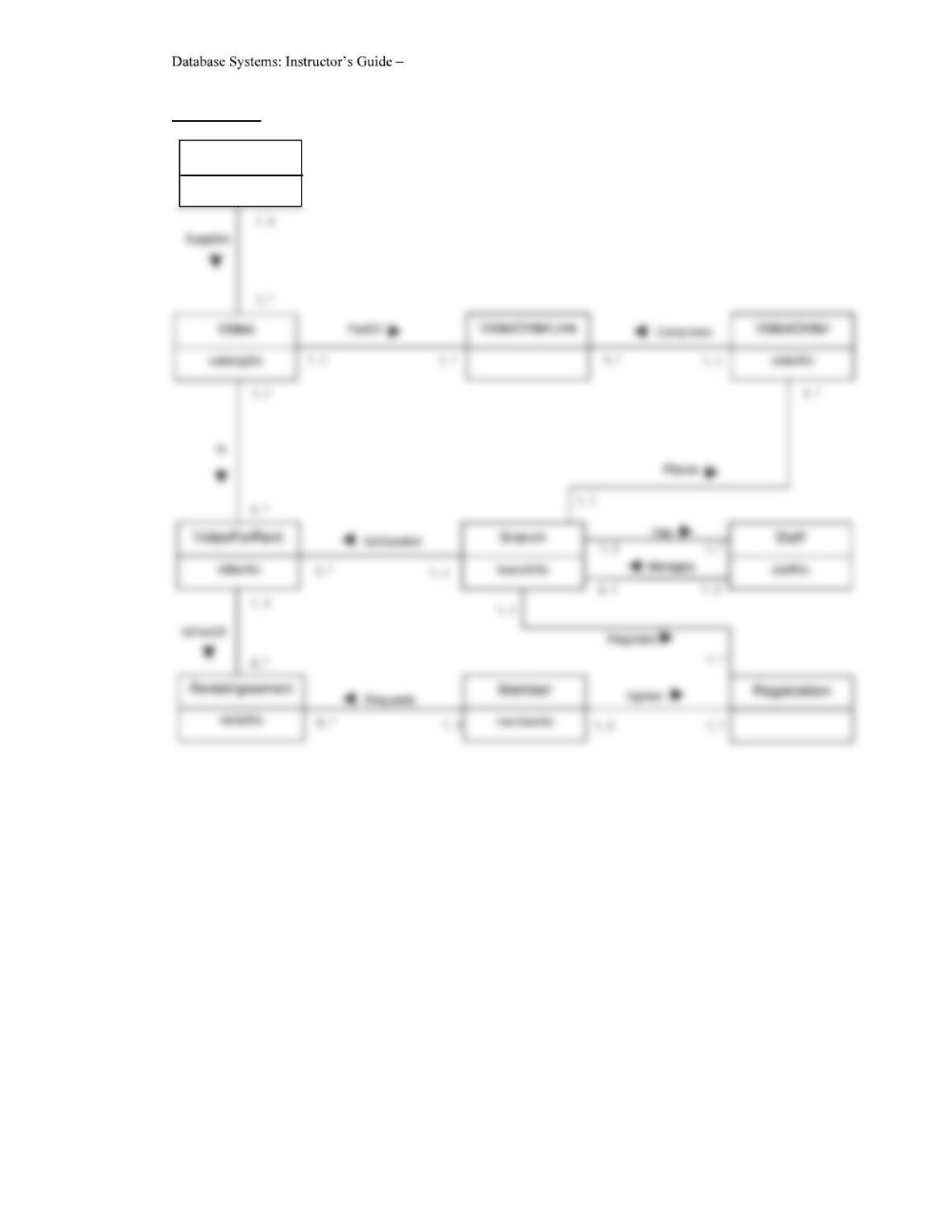
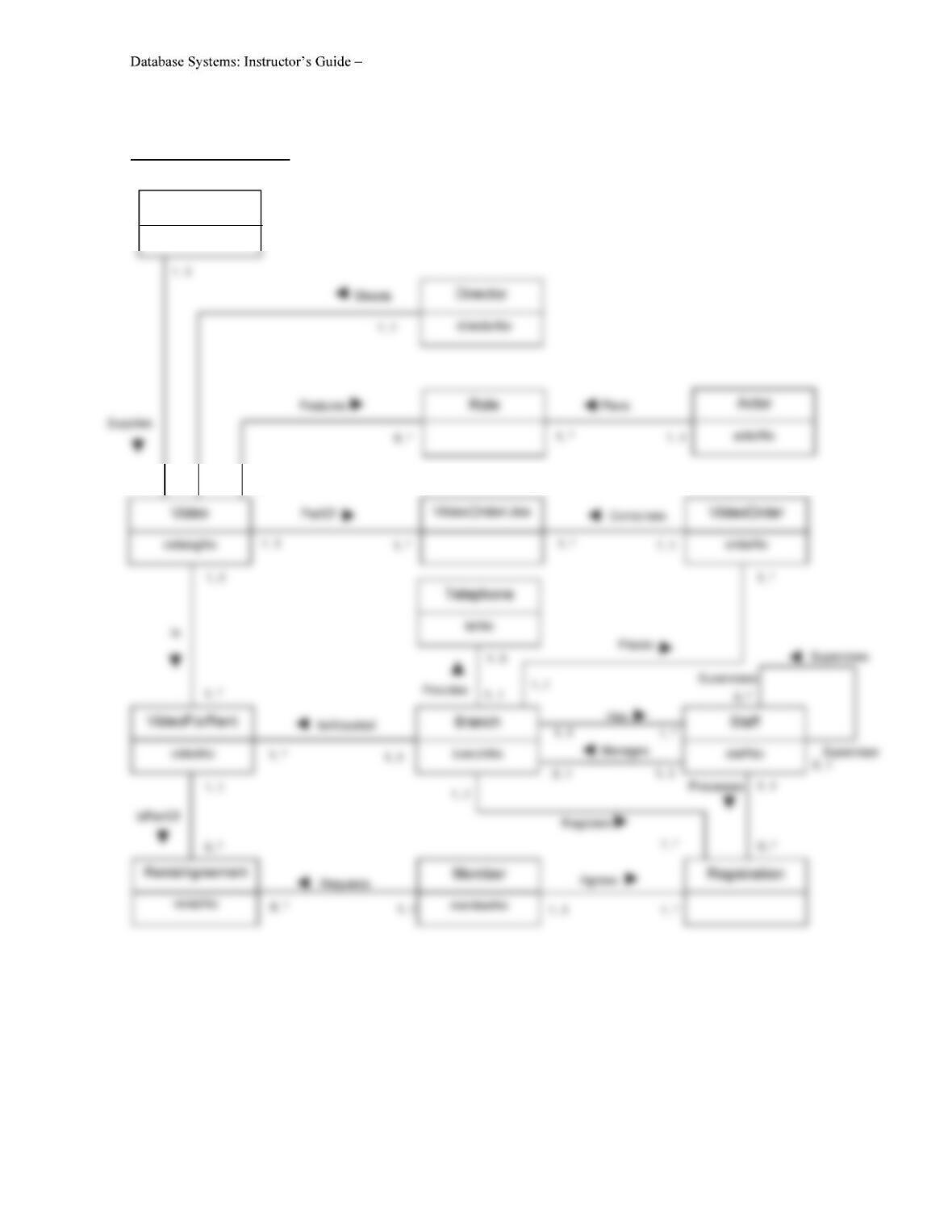
Business View
Supplier
supplierNo
PART IV
Tables for local logical data model for Business view
Branch (branchNo, address, telNo, mgrStaffNo)
Primary Key branchNo
Alternate Key telNo
Foreign Key mgrStaffNo references Staff(staffNo)
Member (memberNo, name, address)
Primary Key memberNo
Registration (branchNo, memberNo, dateJoined)
RentalAgreement (rentalNo, dateOut, dateReturn,
Video (catalogNo, title, category, dailyRental, price,
VideoForRent (videoNo, available, catalogNo, branchNo)
PART IV
(d) Merge the two logical data models together to produce a global logical data model.
Global logical data model
Supplier
supplierNo
1..1
1..*
Directs
1..*
1..* 1..*
Is
0..*
Has
Manages
0..1
1..*
1..1
1..1
1..3
PART IV
Table structures for global logical data model
Actor (actorNo, actorName)
Primary Key actorNo
Branch (branchNo, street, city, state, zipCode, mgrStaffNo)
Primary Key branchNo
Role (catalogNo, actorNo, character)
Primary Key catalogNo, actorNo
Foreign Key catalogNo references Video(catalogNo)
Foreign Key actorNo references Actor(actorNo)
Staff (staffNo, name, posiiton, salary, branchNo, supervisorStaffNo)
Primary Key staffNo
Foreign Key branchNo references Branch(branchNo)
Foreign Key supervisorStaffNo references Staff(staffNo)
Supplier (supplierNo, name, address, telNo, status)
Telephone (telNo, branchNo)
PART IV
18.1 Which of the three basic file organizations (heap, ordered, hash) would you choose for a file
where the most frequent operations were as follows:
(a) Inserts and scans where the order of records does not matter.
(b) Record searches based on a range of field values.
(c) Record searches based on a particular field value.
18.2 Discuss the difference between each of the following types of indexes:
(a) Dense versus sparse indexes.
(b) Primary versus secondary indexes.
(c) Clustered versus unclustered indexes.
(a) A dense index has at least one data entry for every search key value that appears in a

PART IV
Database Systems Coursework 1 (Case Study 6 Fastcabs Cab Company)
DATABASE SYSTEMS
COURSEWORK
GROUP WORK: 2 3 Students
CONTRIBUTION: 50% of Final Mark
SUBMISSION DATE: Week 11
DEMONSTRATION DATE: Lab Time Week 11
Introduction to Coursework
You and your group members are part of a consultancy company that specialises in the provision of
database applications. The Director of FastCabs has recently approached your company to undertake a
project to design and partially implement a database management system for the company.
Notes
1. You are in the initial stages of user requirements collection and analysis and are required to read
Coursework Requirements
Part 1 Design the Database
1. Create an Entity Relationship (ER) model of the data requirements for the FastCabs case study
using the UML notation. Note: if necessary, use the additional concepts of the Enhanced Entity
Relationship (EER) model. State any assumptions necessary to support your design.
2. Derive relational schema from your ER model that represents the entities and relationships.
Identify primary, alternate and foreign keys. Note: use the following notation to describe your
relational schema, as shown in the example of a Staff relation given below.
Staff (staffNo, fName, lName, address, NIN, sex, DOB, deptNo)
PART IV
3. Use the technique of normalization to validate the structure of your relational schema.
Demonstrate that each of your relations is in third normal form (3NF) by displaying the functional
dependencies between attributes in each relation. Note, if any of your relations are not in 3NF, this
may indicate that your ER model is structurally incorrect or that you have introduced errors in the
process of deriving relations from your model.
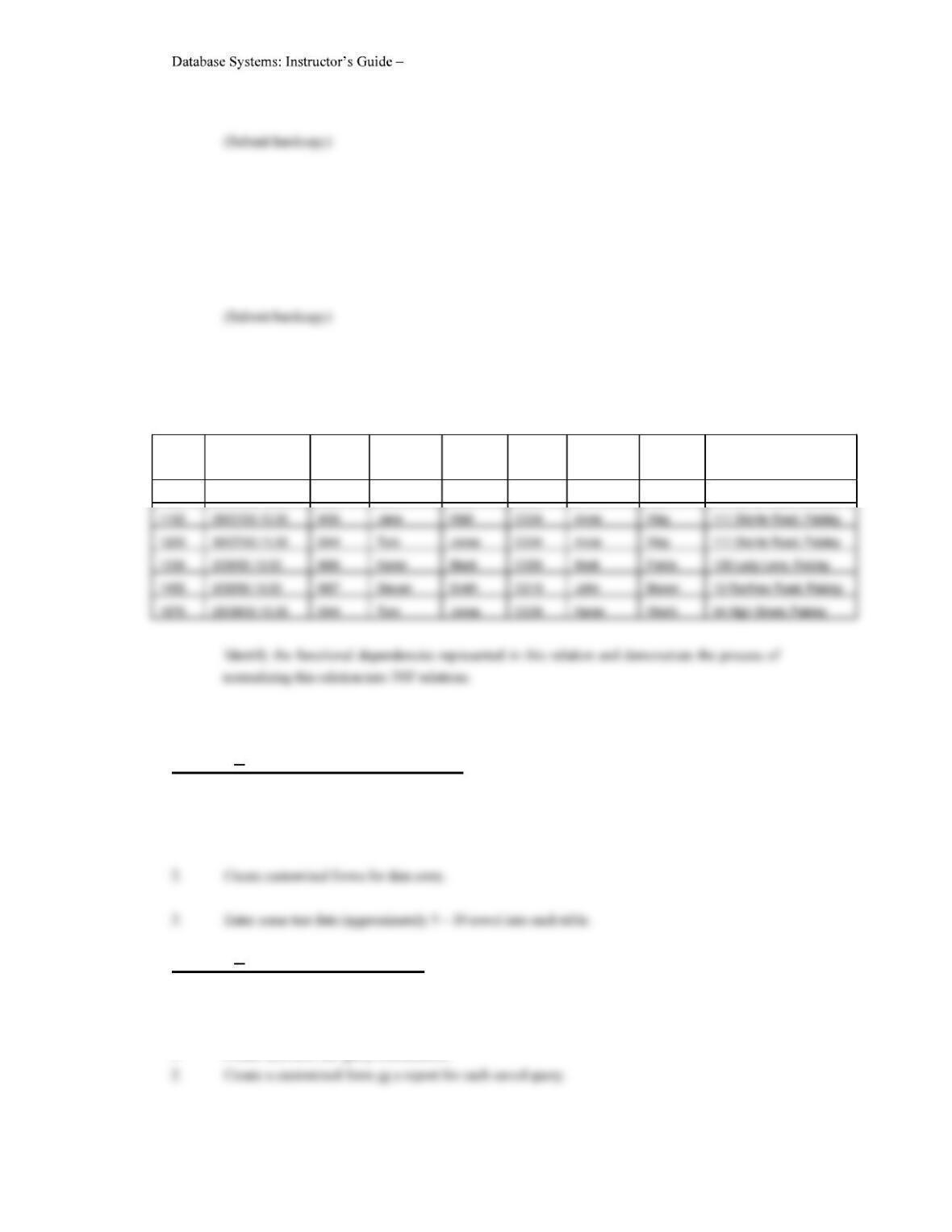
4. To further demonstrate your knowledge of normalization, assume that a proposed (badly structured)
relation for the FastCabs database has the following structure.
jobID pickupDateTime
driverID
dFName dLName clientID cFName cLName cAddress
1001 25/07/00.10.00 I456 Jane Watt C034 Anne Way 111 Storrie Road, Paisley
(Submit hardcopy)
Part 2 Implement the Database
1. Create the tables for the FastCabs database. Where appropriate set field and table properties,
including any required indexes. Ensure that referential integrity is established between related
tables.
Part 3 Query the Database
Before starting this section, please ensure that your tables contain sufficient data to enable you to test
the query transactions described in the FastCabs case study.
1. Create and save the query transactions.

PART IV
3. Provide 10 additional examples of queries, which retrieve useful data from the FastCabs
database. State the purpose of each query and attempt to use each example to demonstrate the
breadth of your knowledge of Access QBE/SQL.
Part 4 Implement Database Application
Implement a prototype database application for the FastCabs. The purpose of this prototype is to allow
the Director to provide feedback on your proposed design.
Part 5 Document Database Application
1. Create a user manual that describes your prototype for the FastCabs database application.
2. The user manual should introduce the database application to the users, describe the functionality
of the database application and clearly demonstrate how to use the application.
Part 6 Demonstrate Database Application
You and the members of your group are required to demonstrate your database application to your Lab
Tutor during your usual lab time in Week 11.
Part 7 Individual Critical Evaluation
Each student should submit his or her own critical assessment of the coursework. The evaluation
should include a discussion on how the coursework has reinforced (or otherwise) his or her
appreciation of the techniques and processes employed in undertaking a database project. In addition
the evaluation may include a wider discussion on topics such as:
How the Database Systems module relates to the other modules on your course.
Marking Scheme
The assessment of this coursework will be carried out on the following components of the work. Please
note that each student should submit his or her own critical evaluation of the coursework and will
PART IV
receive an individual mark for this component (out of 10%). This individual student mark will be
combined with the mark for the groupwork component (out of 90%) for the coursework.
Part 1 Design the Database (30)
The FastCabs Case Study
A private taxi company called FastCabs was established in Glasgow in 1992. Since then, the company
has grown steadily and now has offices in most of the main cities of Scotland. However, the company
is now so large that more and more administrative staff are being employed to cope with the ever–
increasing amount of paperwork. Furthermore, the communication and sharing of information within
the company is poor. The Director of the company, Paddy MacKay feels that too many mistakes are
being made and that the success of his company will be short-lived if he does not do something to
remedy the situation. He knows that a database could help in part to solve the problem and has
approached you and your team to help in creating a database application to support the running of
FastCabs.
The Director has provided the following brief description of how FastCabs operates.
There are two kinds of clients, namely private and business. The business provided by private clients is

PART IV
The Director has provided some examples of typical queries that the database application for FastCabs
must support.
a) The names and phone numbers of the Managers at each office.
b) The names of all female drivers based in the Glasgow office.