– Part III
15
Chapter 13 Enhanced Entity-Relationship Modeling
Review Questions
13.1 Describe what a superclass and a subclass represent.
A superclass is an entity type that includes one or more distinct subgroupings of its
13.2 Describe the relationship between a superclass and its subclass.
13.3 Describe and illustrate using an example the process of attribute inheritance.
13.4 What are the main reasons for introducing the concepts of superclasses and subclasses into an
ER model?
13.5 Describe what a shared subclass represents and how does this concept relate to multiple
inheritance.
13.6 Describe and contrast the process of specialization with the process of generalization.
– Part III
16
13.7 Describe the two main constraints that apply to a specialization/generalization relationship.
13.8 Describe and contrast the concepts of aggregation and composition and provide an example
of each.
Exercises
13.9 Consider whether it is appropriate to introduce the enhanced concepts of
specialization/generalization, aggregation, and/or composition for the case studies described
in Appendix B.
The University Accommodation Office Case Study
The Wellmeadows Hospital Case Study
17
13.10 Consider whether it is appropriate to introduce the enhanced concepts of
specialization/generalization, aggregation, and/or composition into the ER model for the case
study described in Exercise 11.12. If appropriate, redraw the ER diagram as an EER diagram
with the additional enhanced concepts.
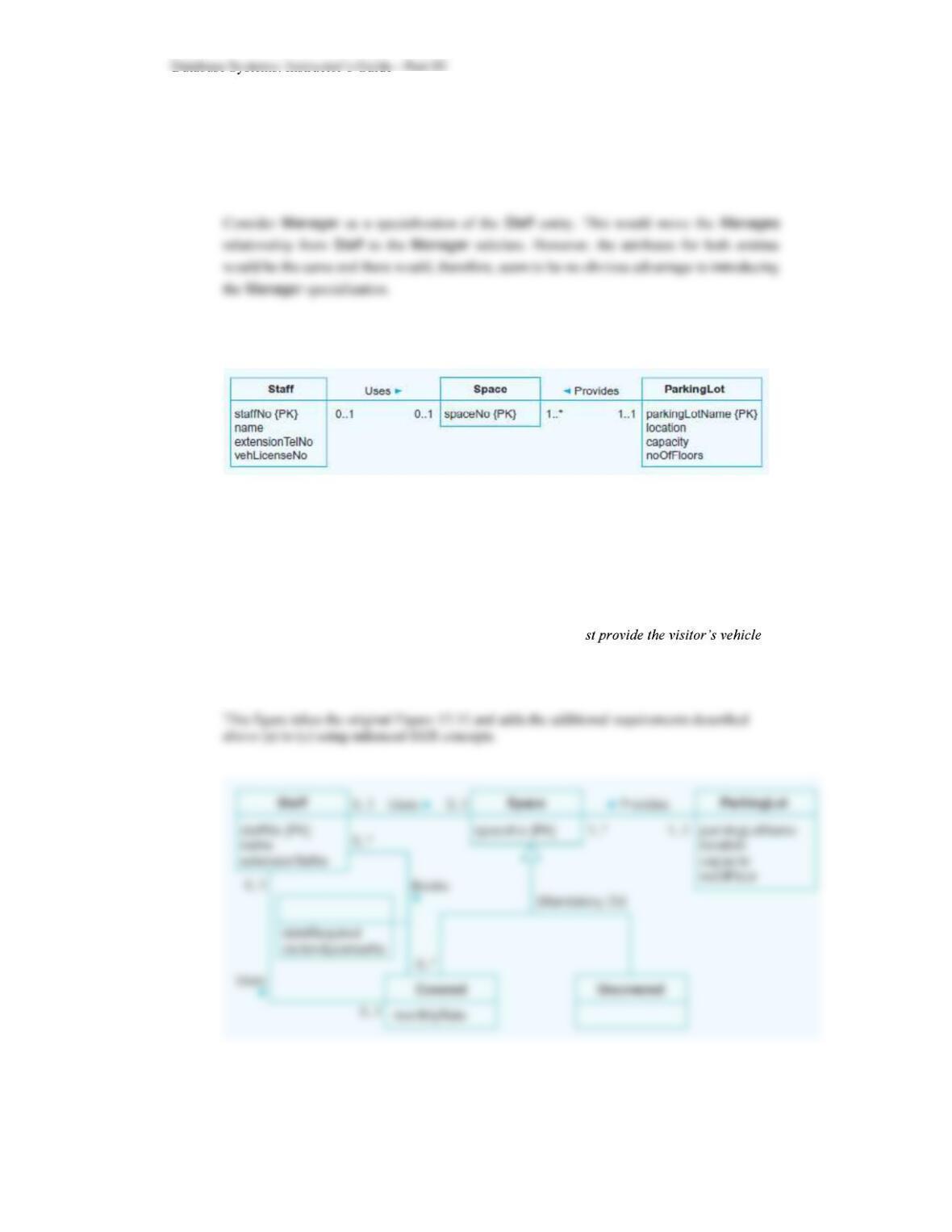
13.11 Introduce specialization/generalization concepts into the ER model shown in Figure 13.11 and
described in Exercise 12.13 to show the following:
Figure 13.11
(a) The majority of parking spaces are under cover and each can be allocated for use by a
member of staff for a monthly rate.
(b) Parking spaces that are not under cover are free to use and each can be allocated for use
by a member of staff.
(c) Up to twenty covered parking spaces are available for use by visitors to the company.
However, only members of staff are able to book out a space for the day of the visit. There is
no charge for this type of booking, but the member of staff mu
license number.
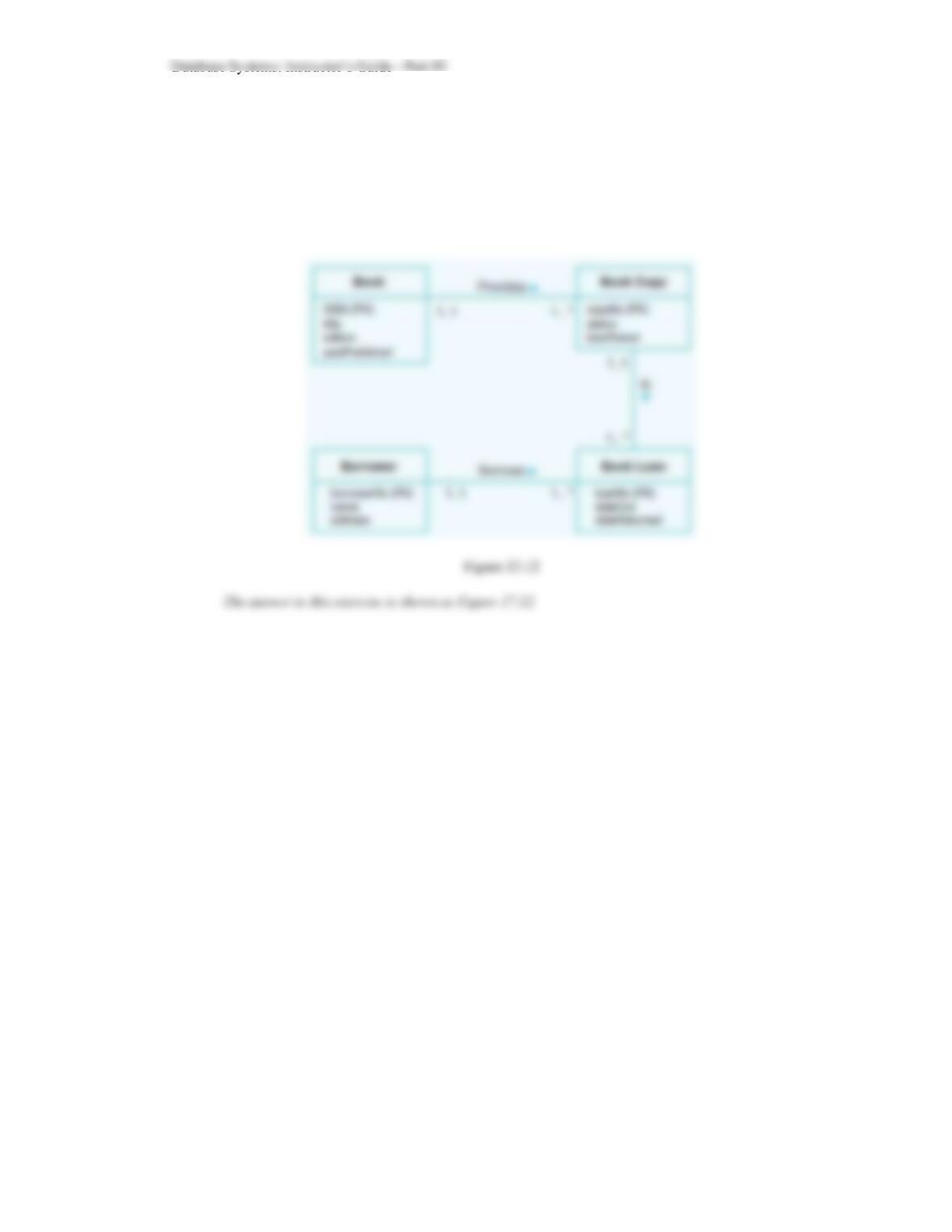
The final answer to this question is shown as Figure 17.11.
Figure 17.11
18
13.12 The library case study described in Exercise 12.14 is extended to include the fact that the
library has a significant stock of books that are no longer suitable for loaning out. These
books can be sold for a fraction of the original cost. However, not all library books are
eventually sold as many are considered too damaged to sell on, or are simply lost or stolen.
Each book copy that is suitable for selling has a price and the date that the book is no longer
to be loaned out. Introduce enhanced concepts into the ER model shown in Figure 13.12 and
described in Exercise 12.14 to accommodate this extension to the original case study.