
INSTRUCTOR’S MANUAL
TO ACCOMPANY
40th Anniversary Edition
DATABASE PROCESSING
Fundamentals, Design, and Implementation
15th Edition
Appendix F
The Semantic Object Model
David M. Kroenke | David J. Auer | Scott L. Vandenberg | Robert C. Yoder

Appendix F – The Semantic Object Model
Page F-2
❖ CHAPTER OBJECTIVES
• To define the term semantic object
• To define and illustrate the use of simple, group, and object link attributes
• To demonstrate the use of semantic object diagrams to build a data model
• To define and illustrate the seven basic types of semantic objects
• To compare the semantic object model to the entity-relationship model
❖ ERRATA
❖ TEACHING SUGGESTIONS
• The semantic object data model is straightforward and useful. However, it is new
and requires an adjustment in one’s mental model. It may, however, be much
easier to teach data modeling, database design, and applications design using
this model. Also, users normally have little difficulty interpreting semantic
objects.
Appendix F – The Semantic Object Model
• Use the same class-developed semantic object instance to discuss property
domains. The physical description is, of course, very computer-oriented (data
type, length, position of decimal point, value range and restrictions). But the
semantic description of a property is more difficult to define, although it is an
important aspect of requirements definition.
❖ ANSWERS TO REVIEW QUESTIONS
F.1. Explain why the E-R model and the semantic object model are like lenses.
These models are tools for representing and expressing the views of users’ data structures. They
F.2. Define semantic object.
F.3. Explain the difference between an object class name and an object instance name. Give
an example of each.
An object class name and an object instance name are different because the object instance name
F.4. What is required for a set of attributes to be a sufficient description?
F.5. Explain the words distinct identity as they pertain to the definition of a semantic object.
They mean something that users recognize as independent and separate. That thing stands on its
F.6. Explain why a line item of an order is not a semantic object.
Line items are not distinct entities that stand on their own. They are a piece of something that
Appendix F – The Semantic Object Model
Page F-4
F.7. List the three types of attributes.
F.8. Give an example of each of the following:
In the semantic object APARTMENT:
a. a simple, single-value attribute:
NumberOfBedrooms
d. a group, multivalue attribute
Occupant (FirstName, LastName), where more than one person can live in an apartment
REPAIR
F.9. What is minimum cardinality? How is it used? Which types of attributes have minimum
cardinality?
F.10. What is maximum cardinality? How is it used? Which types of attributes have maximum
cardinality?
The maximum number of values an attribute can have in a semantic object. No object will be
F.11. What are paired attributes? Why are they needed?
Semantic object attributes are always paired. If OBJECT1 contains an attribute OBJECT2, then
Appendix F – The Semantic Object Model
Page F-5
F.12. What is an object identifier? Give an example of a simple attribute object identifier and
an example of a group attribute object identifier.
An attribute that identifies instances of an object. Identifiers can be unique or nonunique. In
F.13. Define attribute domain. What are the types of attribute domains? Why is a semantic
description necessary?
The attribute domain is a description of the possible values of an attribute. An attribute domain
F.14. What is a semantic object view? Give an example of an object and two views other than
those in this text.
A semantic object view is a subset of a semantic object. Consider the object APARTMENT with
F.15. Give an example of a simple object other than one in this text. Show how to represent
this object by means of a relation.
A screenshot of the Tabledesigner solution from Database Processing (12th Edition) is shown
Page F-6
F.16. Give an example of a composite object, other than one in this text. Show how to
represent this object by means of relations.
A screenshot of the Tabledesigner solution from Database Processing (12th Edition) is shown
below.
Appendix F – The Semantic Object Model
Page F-7
F.17. Give an example of a 1:1 compound object, other than one in this text. Show two ways
to represent it by means of relations.
A screenshot of the Tabledesigner solution from Database Processing (12th Edition) is shown
below.
Referential Integrity Constraints:
SerialNumber in EMPLOYEE must exist in SerialNumber in COMPUTER
EMPLOYEE (EmpNumber, Phone)
COMPUTER (SerialNumber, Brand, Model, Processor, Memory, Cost, EmpNumber)
Appendix F – The Semantic Object Model
F.18. Give an example of a 1:N compound object, other than one in this text. Show how to
represent it by means of relations.
A screenshot of the Tabledesigner solution from Database Processing (12th Edition) is shown
below.
F.19. Give an example of an M:1 compound object, other than one in this text. Show how to
represent it by means of relations.
Appendix F – The Semantic Object Model
Page F-9
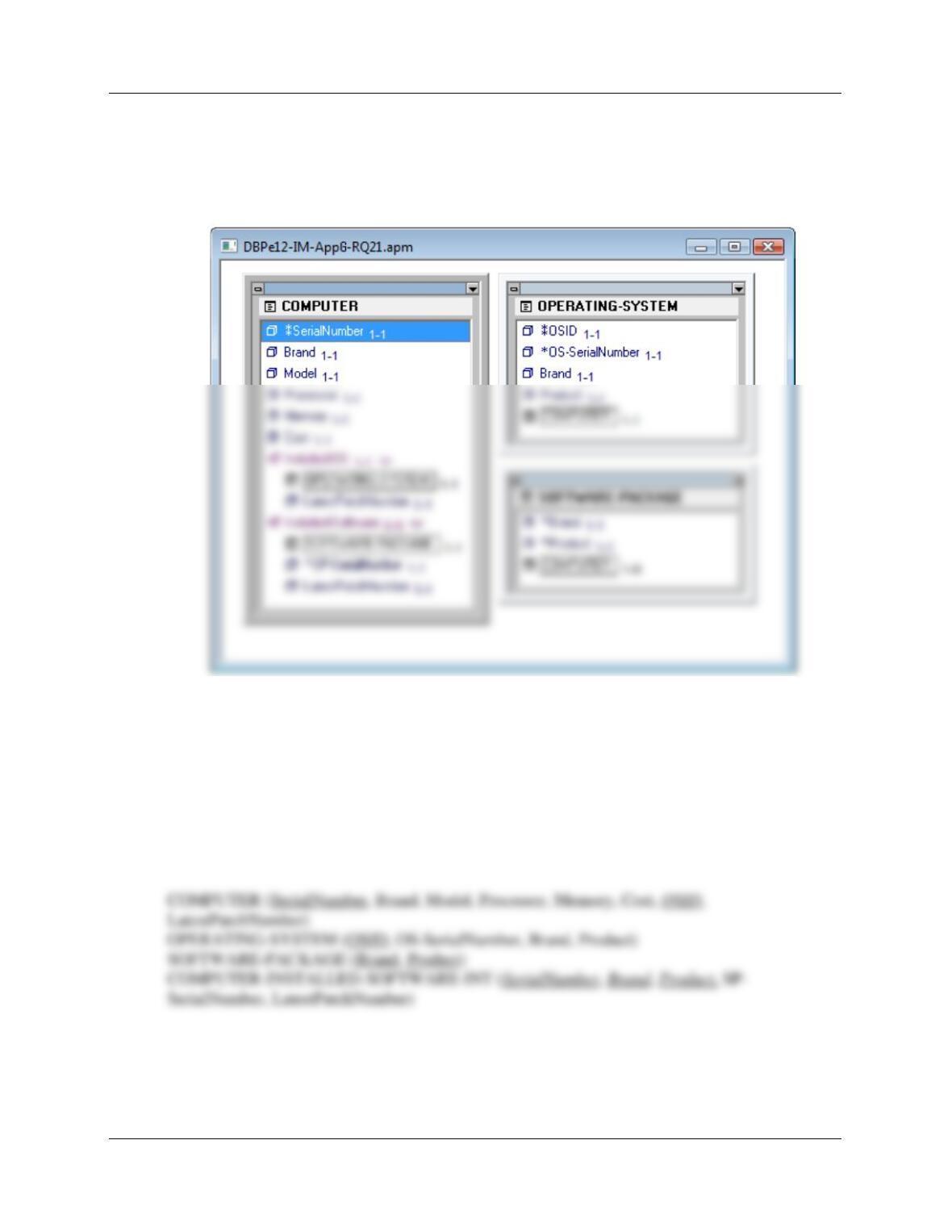
F.20. Give an example of an M:N compound object, other than one in this text. Show how to
represent it by means of relations.
A screenshot of the Tabledesigner solution from Database Processing (12th Edition) is shown
below.
Appendix F – The Semantic Object Model
Page F-10
F.21. Give an example of a case 1 (see Figure F.22) hybrid object. Show how to represent it
by means of relations.
A screenshot of the Tabledesigner solution from Database Processing (12th Edition) is shown
below.
Case 1: Each instance of OPERATING-SYSTEM relates to only one COMPUTER (since
OPERATING-SYSTEM contains a unique ID number) and only appears once within the
Installed-OS Group (the computers in the company have only one operating system per
computer).
[Case 4: Each instance of SOFTWARE-PACKAGE relates to many COMPUTERS (since the
Installed-Software Group contains the serial number) and can appear many times within the
Installed-Software Group (the computers in the company can have several applications per
computer)].
Appendix F – The Semantic Object Model
Page F-11
F.22. Give an example of a case 2 (see Figure F.22) hybrid object. Show how to represent it
by means of relations.
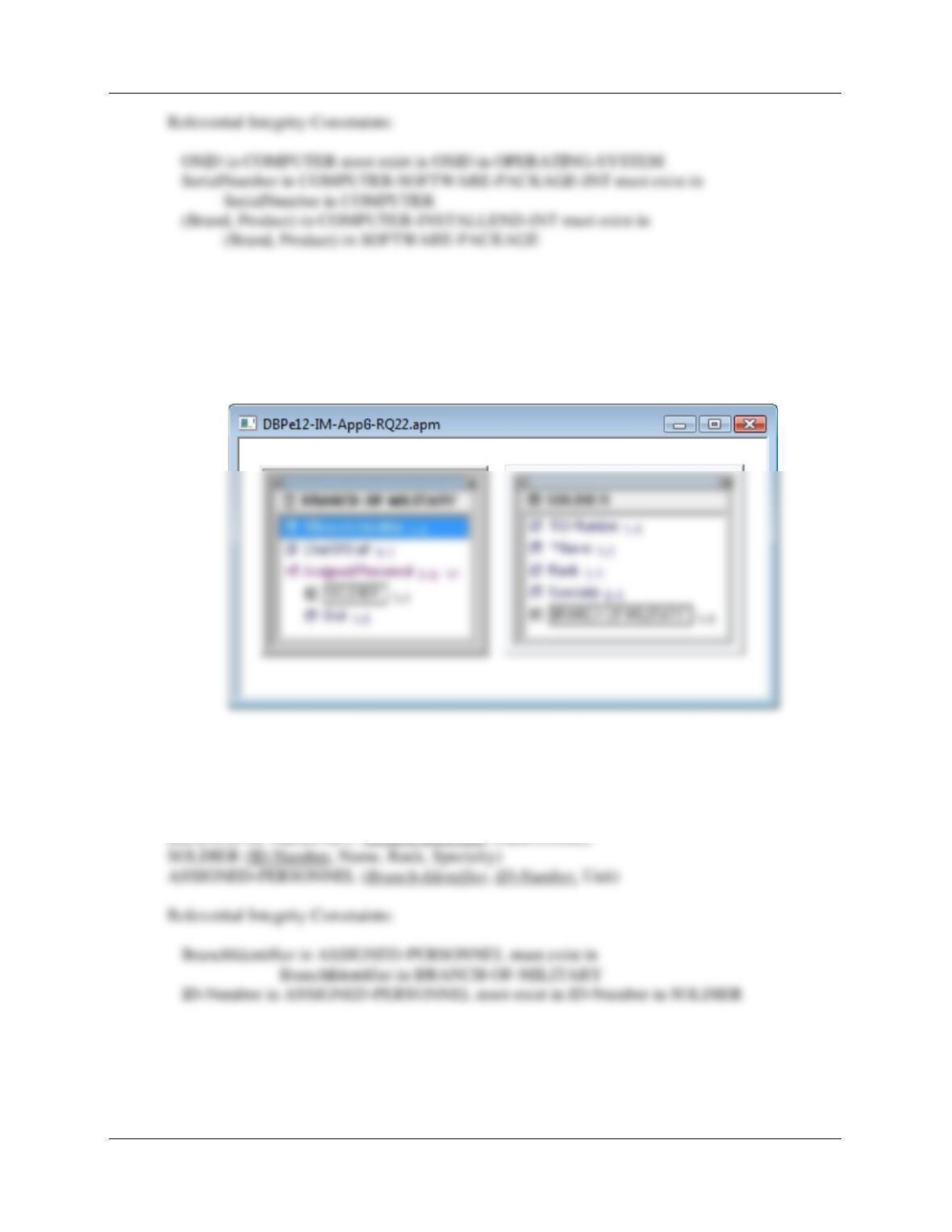
A screenshot of the Tabledesigner solution from Database Processing (12th Edition) is shown
below.
Case 2: Since a SOLDIER can only be assigned to one BRANCH–OF-MILITARY (the Army),
each instance of SOLDIER relates to only one BRANCH-OF-MILITARY, but there are many
soldiers in the Army, so SOLDIER appears many times within that one instance of BRANCH-
OF-MILITARY.
BRANCH–OF-MILITARY (Branch-Identifier, ChiefOfStaff,)
Appendix F – The Semantic Object Model
Page F-12
F.23. Give an example of an association and related objects, other than one in this text. Show
how to represent these objects by means of relations. Assume that the association
object has an identifier of its own.
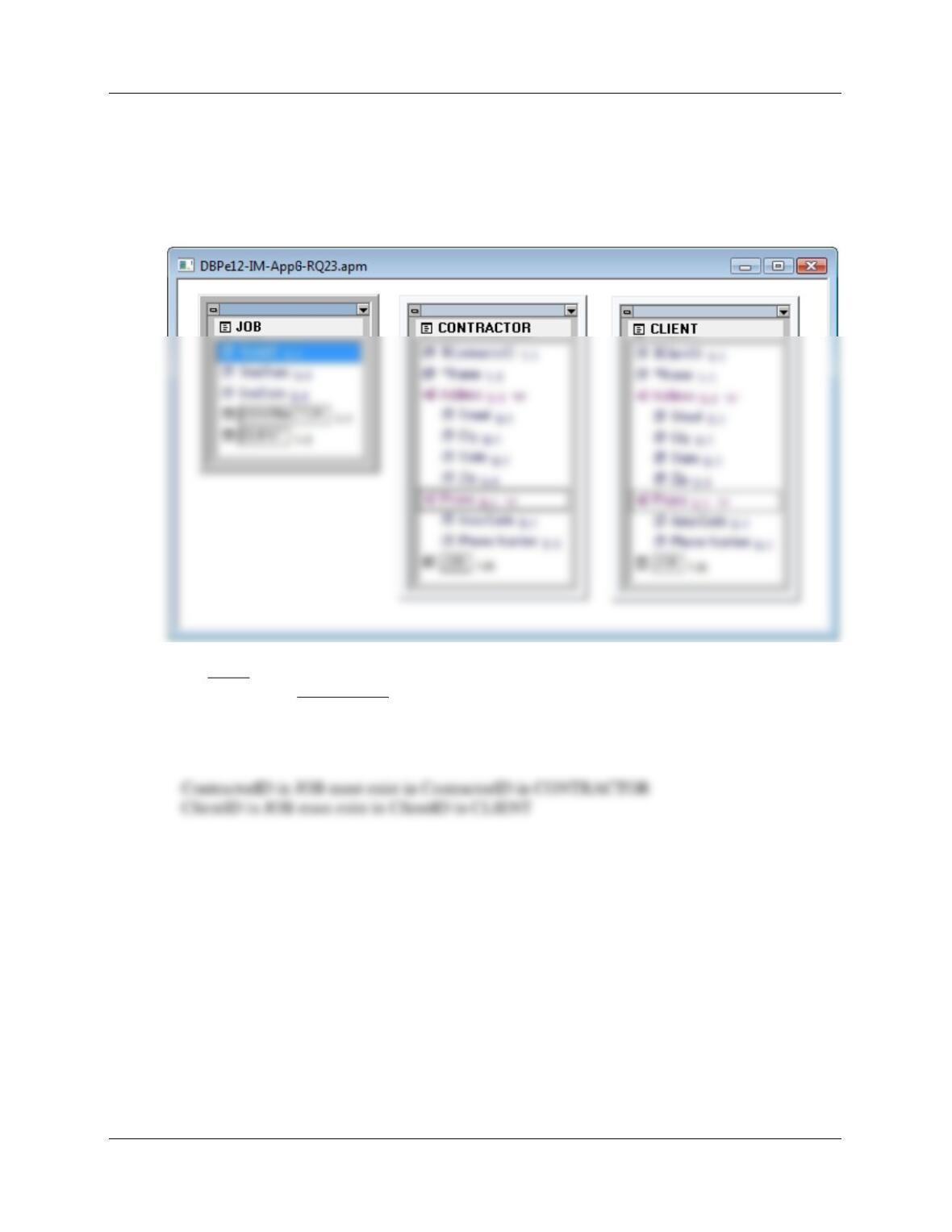
A screenshot of the Tabledesigner solution from Database Processing (12th Edition) is shown
below.
JOB (JobID, ContractorID, ClientID, StartDate, EndDate)
CONTRACTOR, (ContractorID, Name, Street, City, State, Zip, Area Code, Phone Number)
CLIENT (ClientID, Name, Street, City, State, Zip, Area Code, Phone Number)
Referential Integrity Constraints: