Appendix F – The Semantic Object Model
Page F-13
F.24. Do the same as for question F.23, but assume that the association object does not have
an identifier of its own.
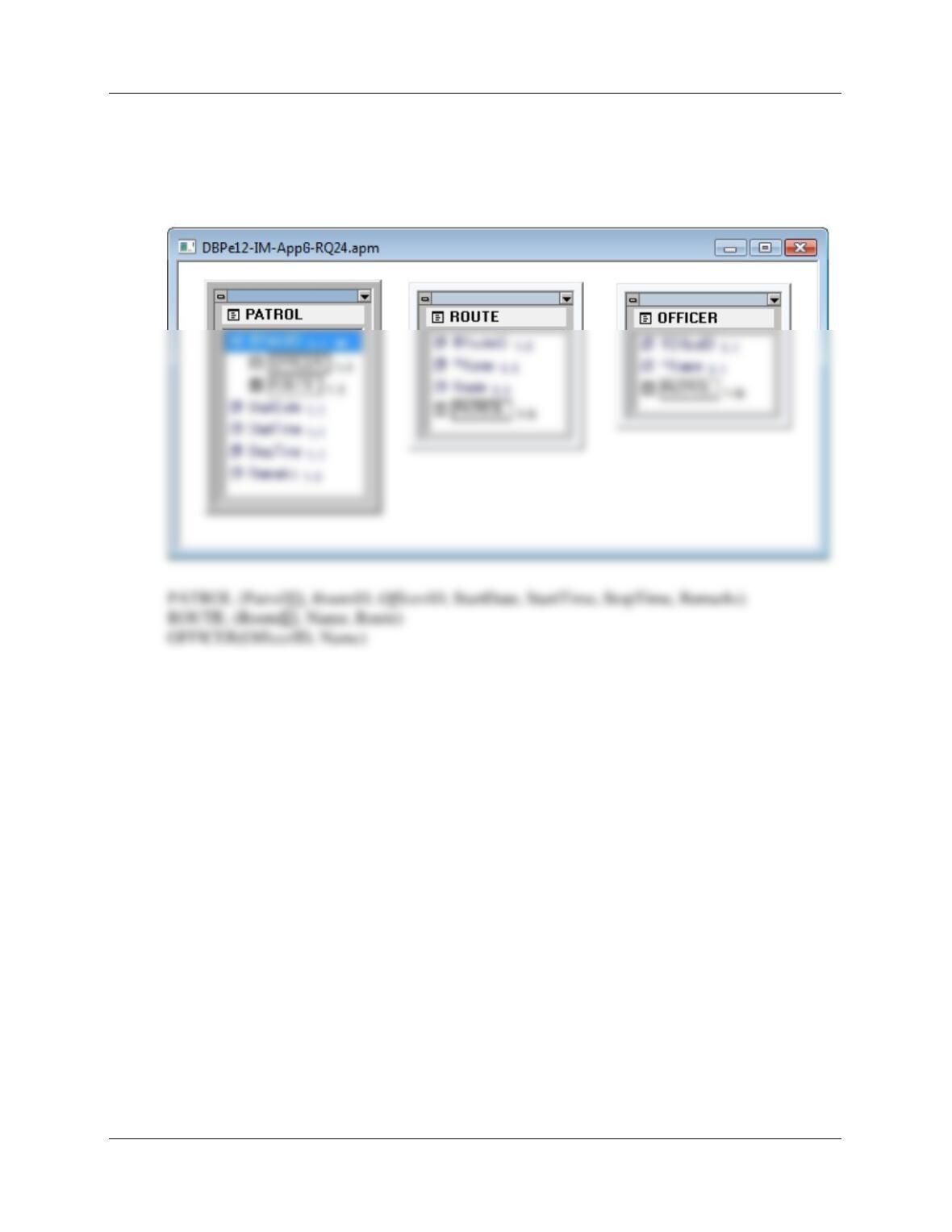
A screenshot of the Tabledesigner solution from Database Processing (12th Edition) is shown
below.
Referential Integrity Constraints:
RouteID in PATROL must exist in RouteID in ROUTE
OfficerID in PATROL must exist in OfficerID in OFFICER
Appendix F – The Semantic Object Model
Page F-14
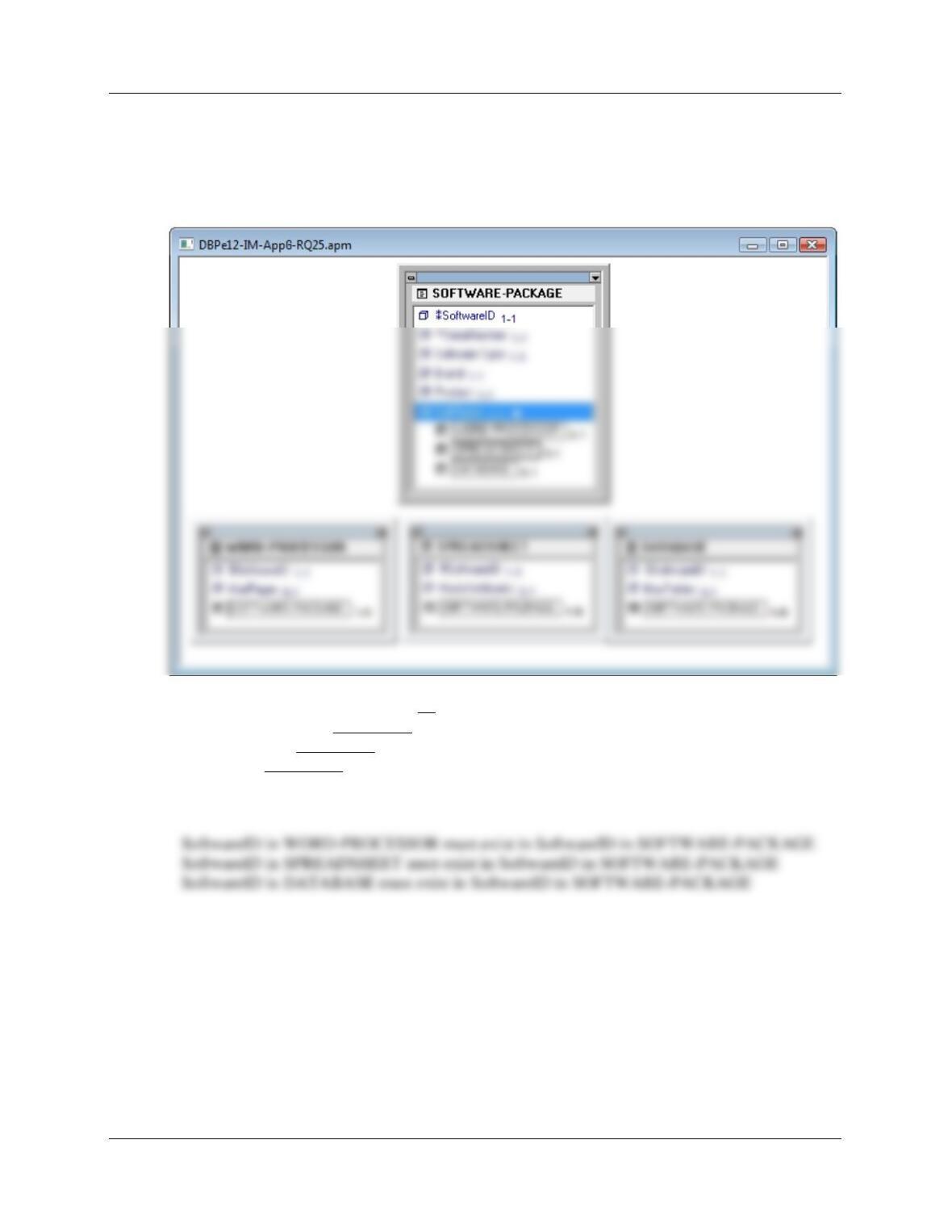
F.25. Give an example of a parent object with at least two exclusive subtypes. Show how to
represent these objects by means of relations.
A screenshot of the Tabledesigner solution from Database Processing (12th Edition) is shown
below.
SOFTWARE-PACKAGE (SoftwareID, SerialNumber, Software-Type, Brand, Product)
WORD-PROCESSOR (SoftwareID, MaxPages)
SPREADSHEET (SoftwareID, MaxWorkbooks)
DATABASE(SoftwareID, MaxTables)
Referential Integrity Constraints:
Appendix F – The Semantic Object Model
Page F-15
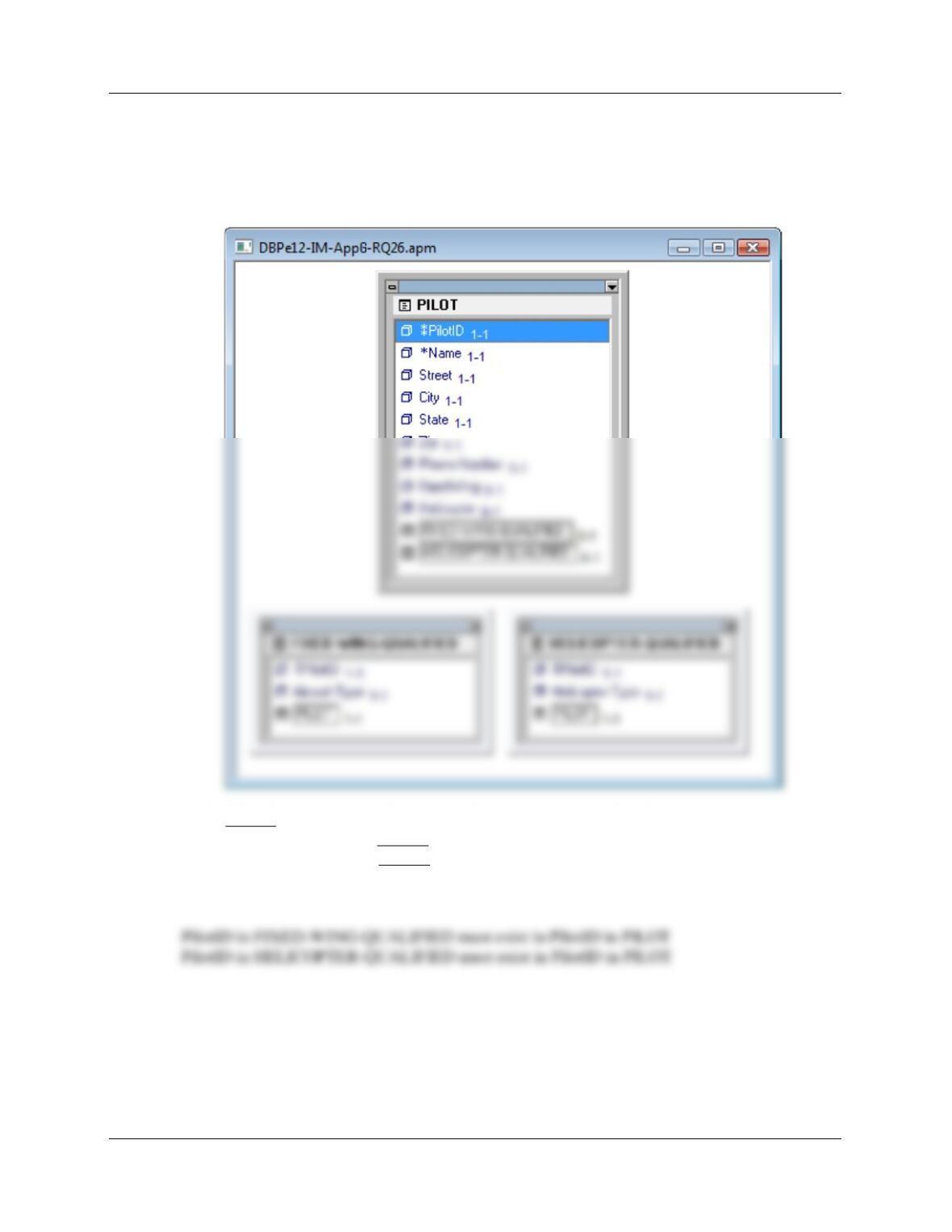
F.26. Give an example of a parent object with at least two nonexclusive subtypes. Show how
to represent these objects by means of relations.
A screenshot of the Tabledesigner solution from Database Processing (12th Edition) is shown
below.
PILOT (PilotID, Name, Street, City, State, Zip, Phone Number, FixedWing, Helicopter)
FIXED-WING-QUALIFIED (PilotID, Aircraft-Type)
HELICOPTER-QUALIFIED (PilotID, Helicopter-Type)
Referential Integrity Constraints:

Page F-16
F.27. Find an example of a form on your campus that would be appropriately modeled with a
simple object. Show how to represent this object by means of a relation.
NOTE: The question asks for the student to find an actual campus form, create a Semantic Object
model, and the equivalent relation. Since forms will vary from campus to campus, a generic
solution to the problem is presented here.
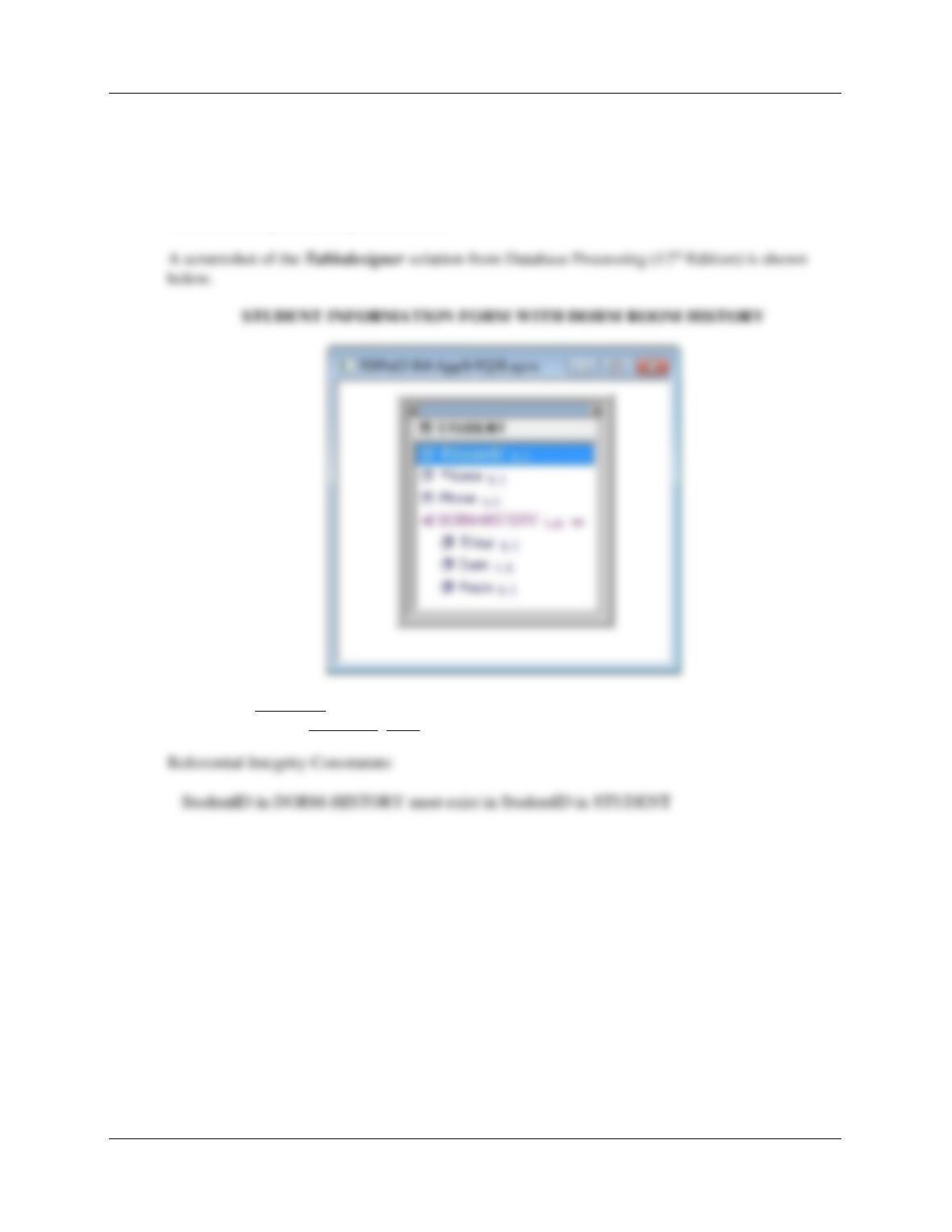
A screenshot of the Tabledesigner solution from Database Processing (12th Edition) is shown
below.
Appendix F – The Semantic Object Model
Page F-17
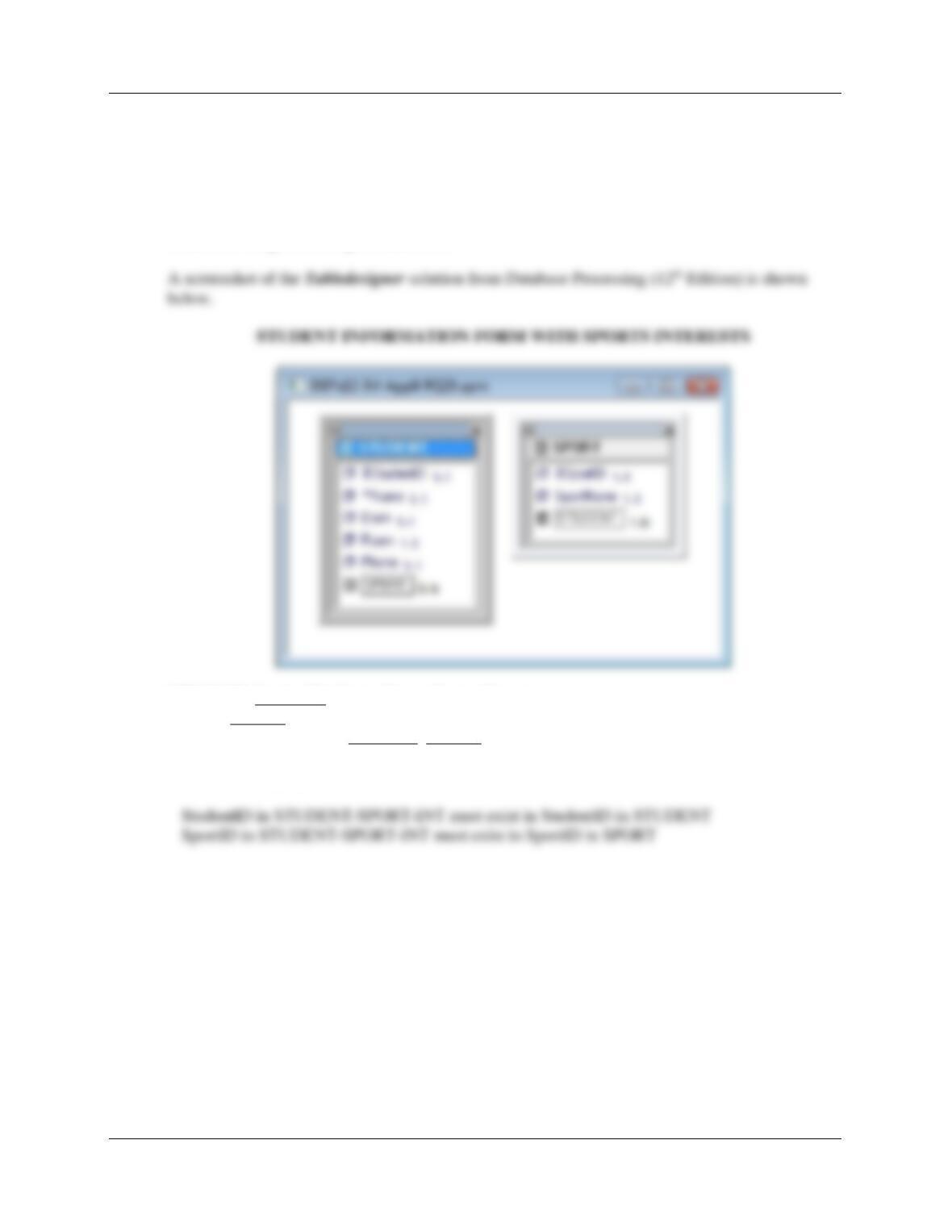
F.28. Find an example of a form on your campus that would be appropriately modeled with a
composite object. Show how to represent this object by means of relations.
NOTE: The question asks for the student to find an actual campus form, create a Semantic Object
model, and the equivalent relations. Since forms will vary from campus to campus, a generic
solution to the problem is presented here.
STUDENT (StudentID, Name, Phone)
DORM-HISTORY (StudentID, Year, Dorm, Room)
Appendix F – The Semantic Object Model
Page F-18
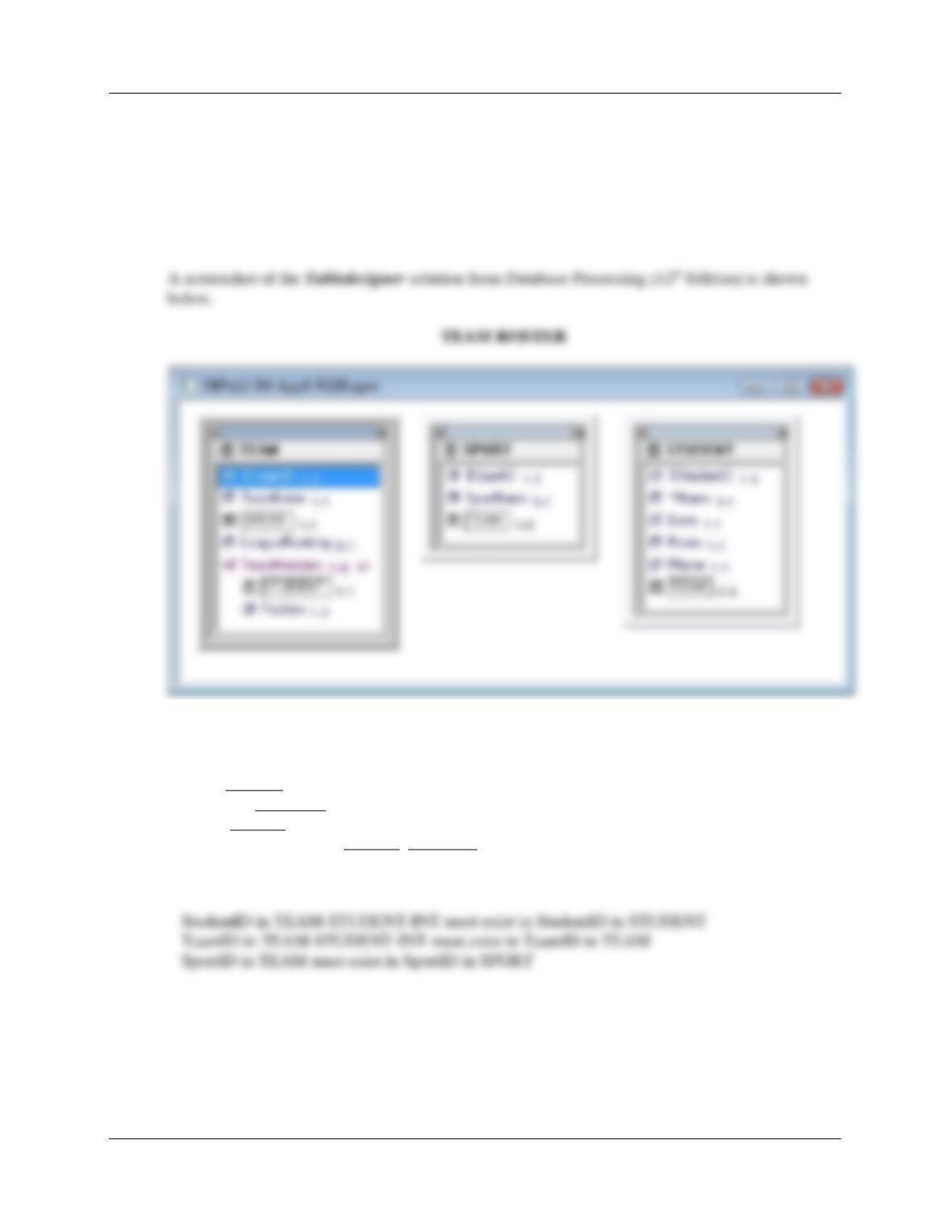
F.29. Find an example of a form on your campus that would be appropriately modeled with
one of the types of a compound object. Show how to represent these objects by means
of relations.
NOTE: The question asks for the student to find an actual campus form, create a Semantic Object
model, and the equivalent relations. Since forms will vary from campus to campus, a generic
solution to the problem is presented here.
STUDENT (StudentID, Name, Dorm, Room, Phone)
SPORT (SportID, SportName)
STUDENT-SPORT-INT (StudentID, SportID)
Referential Integrity Constraints:
Appendix F – The Semantic Object Model
Page F-19
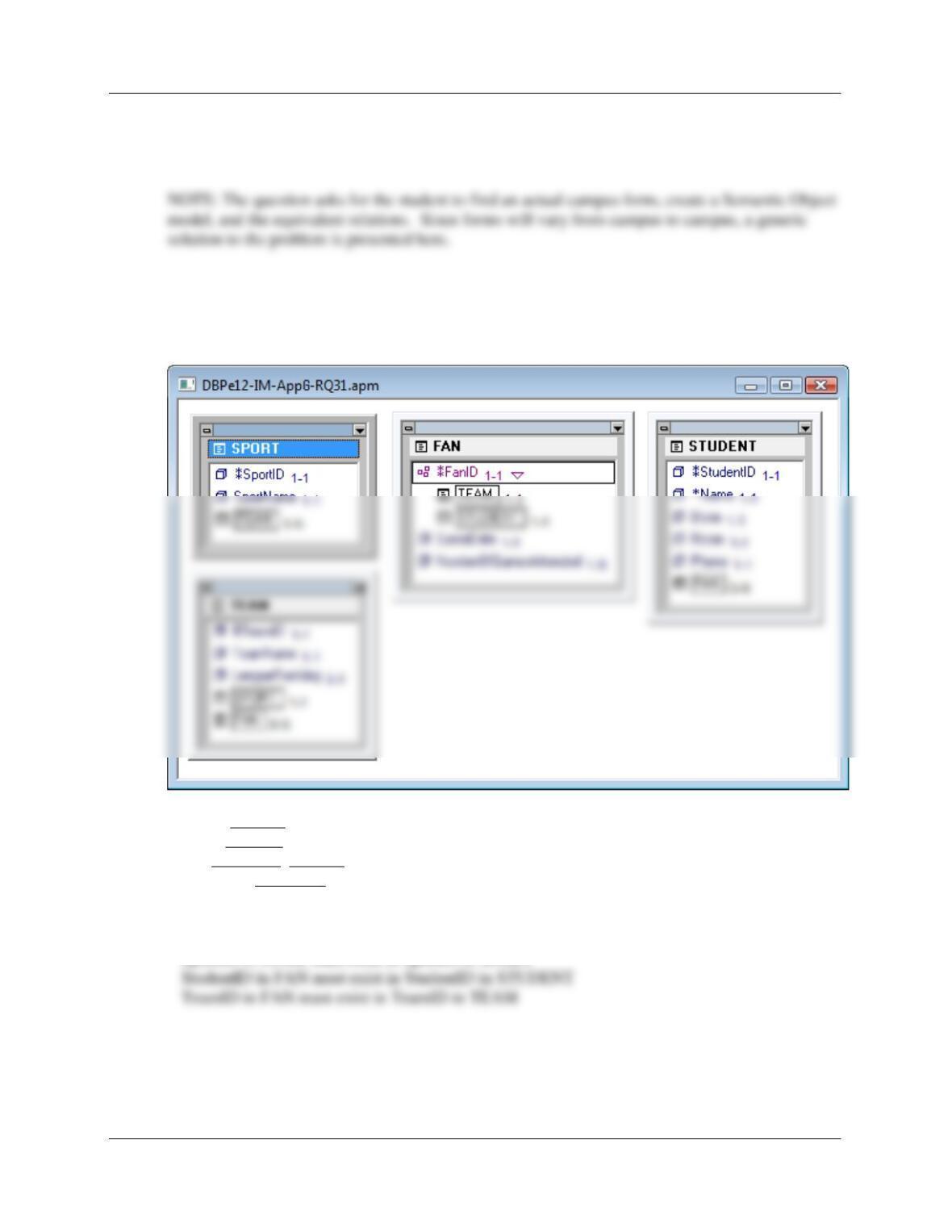
F.30. Find an example of a form on your campus that would be appropriately modeled with a
hybrid object. Classify the object according to Figure F-22. Show how to represent these
objects by means of relations.
NOTE: The question asks for the student to find an actual campus form, create a Semantic Object
model, and the equivalent relations. Since forms will vary from campus to campus, a generic
solution to the problem is presented here.
TEAM is a Case 3 Object—STUDENT can appear in many instances of TEAM, but only once in
each instance.
TEAM (TeamID, TeamName, LeagueRanking, SportID)
STUDENT (StudentID, Name, Dorm, Room, Phone)
SPORT (SportID, SportName)
TEAM-STUDENT-INT (TeamID, StudentID, Position)
Referential Integrity Constraints:
Appendix F – The Semantic Object Model
Page F-20
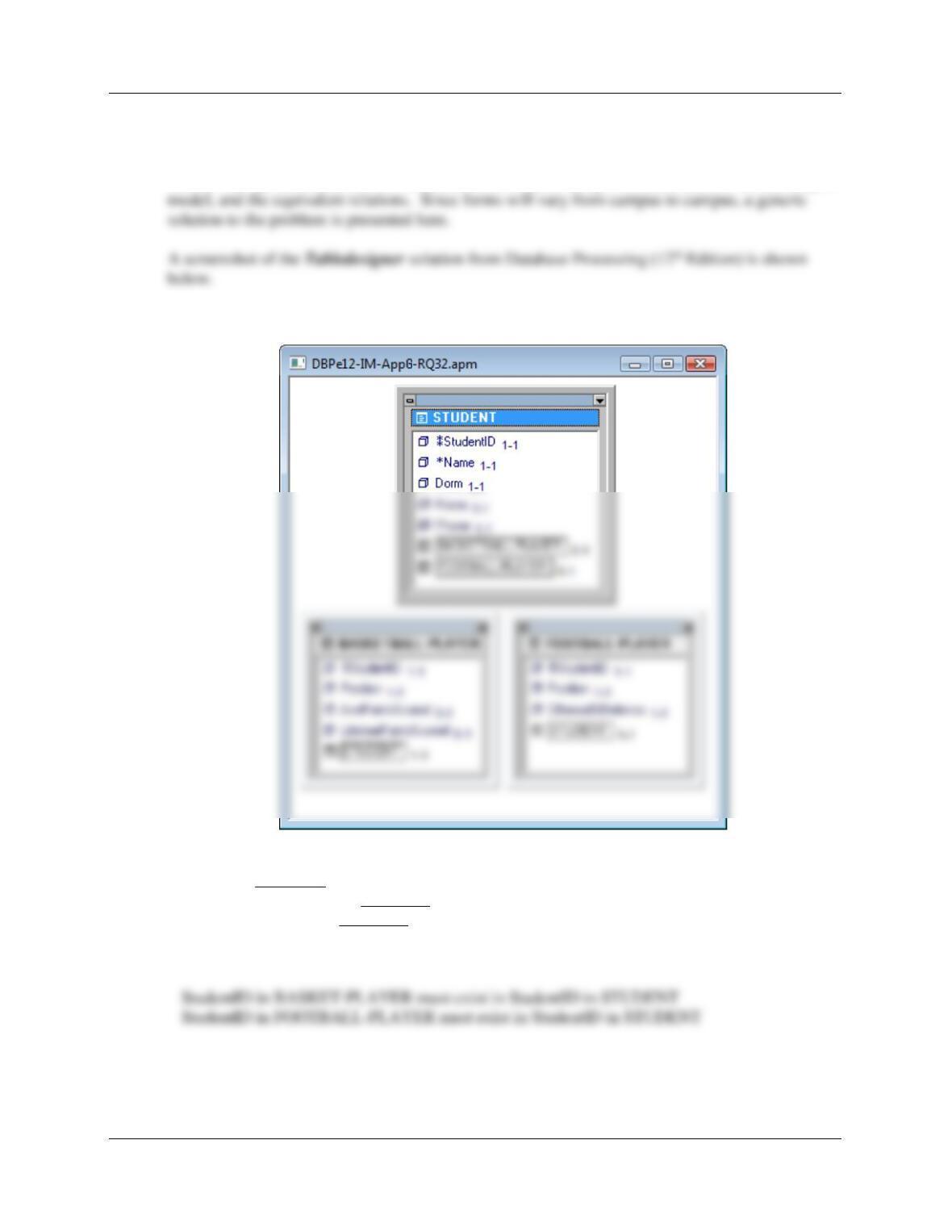
F.31. Find an example of a form on your campus that would be appropriately modeled with an
association and related objects. Show how to represent these objects by means of
relations.
A screenshot of the Tabledesigner solution from Database Processing (12th Edition) is shown
below.
TEAM FAN SIGNUP SHEET FROM A SINGLE GAME
SPORT (SportID, SportName)
TEAM (TeamID, TeamName, LeagueRanking, SportID)
FAN (StudentID, SportID, GameDate, NumberOfGamesAttended)
STUDENT (StudentID, Name, Dorm, Room, Phone)
Referential Integrity Constraints:
SportID in TEAM must exist in SportID in SPORT
Appendix F – The Semantic Object Model
Page F-21
F.32. Find an example of a form on your campus that would be appropriately modeled with
parent/subtypes objects. Show how to represent these objects by means of relations.
NOTE: The question asks for the student to find an actual campus form, create a Semantic Object
STUDENT INFORMATION FORM WITH DETAILED SPORTS INFORMATION
STUDENT (StudentID, Name, Dorm, Room, Phone)
BASKETBALL-PLAYER (StudentID, Position, AvePointsScored, LifetimePointsScored)
FOOTBALL-PLAYER (StudentID, Position, OffenseOrDefense)
Referential Integrity Constraints:
Page F-22
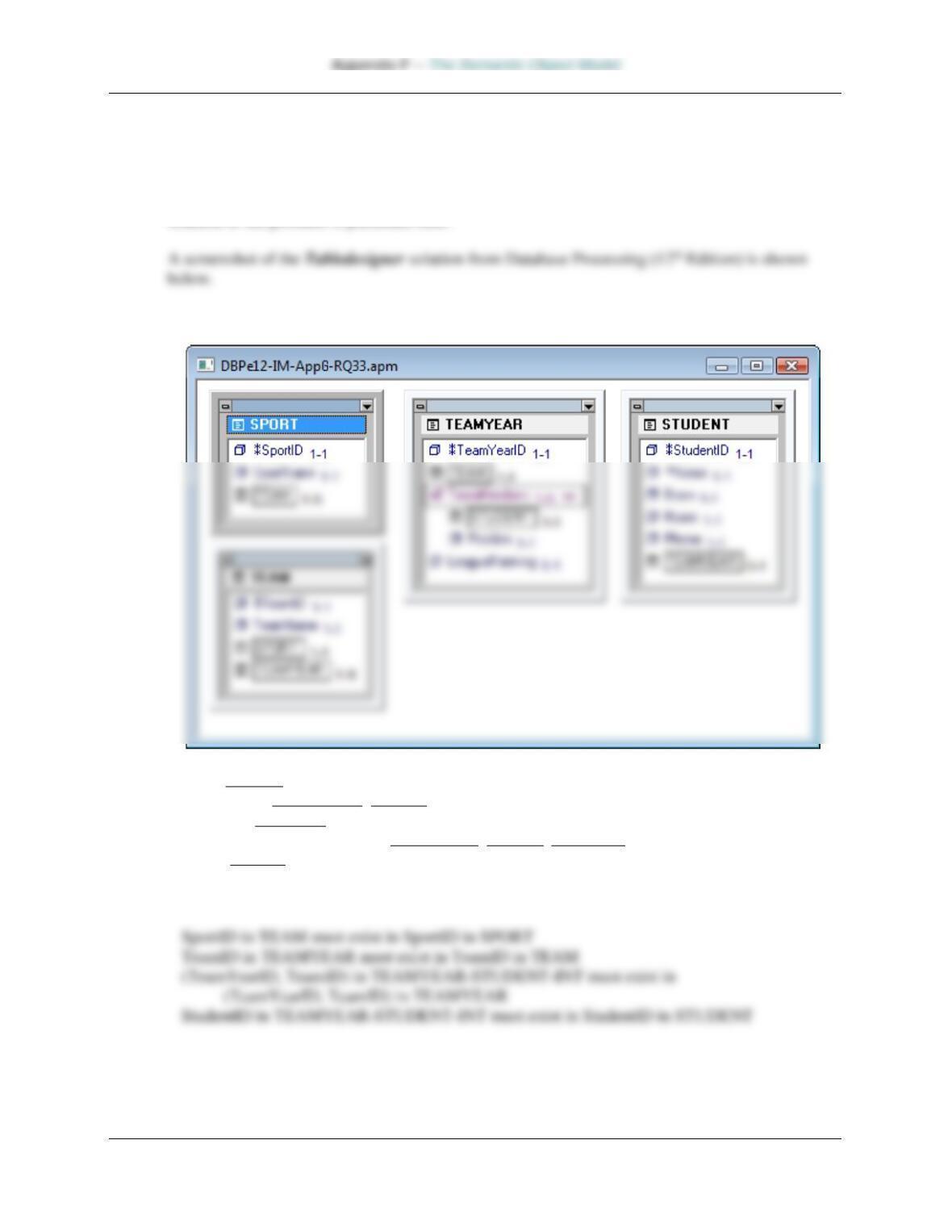
F.33. Find an example of a form on your campus that would be appropriately modeled with
archetype/version objects. Show how to represent these objects by means of relations.
NOTE: The question asks for the student to find an actual campus form, create a Semantic Object
model, and the equivalent relations. Since forms will vary from campus to campus, a generic
solution to the problem is presented here.
TEAM ROSTER AND RESULTS FOR A SPECIFC SCHOOL YEAR
TEAM (TeamID, TeamName, SportID)
TEAMYEAR (TeamYearID, TeamID, LeagueRanking)
STUDENT (StudentID, Name, Dorm, Room, Phone)
TEAMYEAR-STUDENT-INT (TeamYearID, TeamID, StudentID, Position)
SPORT (SportID, SportName)
Referential Integrity Constraints:

Appendix F – The Semantic Object Model
Page F-23
F.34. Explain the similarities between the E-R model and the semantic object model.
Both are tools for understanding and documenting users’ data models. Both are concerned with
F.35. Explain the major differences between the E-R model and the semantic object model.
E-R model takes entity as the basic element of interest to the user. Semantic object model takes
F.36. Explain the reasoning that entities, as defined in the E-R model, do not truly exist.
An entity is a piece of an object. In Figure 5.33, the entity SALES-ORDER is an artifact of
F.37. Show how both the E-R model and the semantic object model would represent the data
underlying the SALES-ORDER form shown in Figure H-20(a), and explain the main
differences.
See Figures H-34 and H-35 in the text. The main difference is that semantic objects contain more
metadata than entities. Specific instances of this are:
(1) The semantic model records that users consider CustomerNumber to be a unique identifier.