
INSTRUCTOR’S MANUAL
TO ACCOMPANY
40th Anniversary Edition
DATABASE PROCESSING
Fundamentals, Design, and Implementation
15th Edition
Appendix B
Getting Started with Systems Analysis and Design
David M. Kroenke | David J. Auer | Scott L. Vandenberg | Robert C. Yoder
Appendix B – Getting Started with Systems Analysis and Design
Page B-2
❖ CHAPTER OBJECTIVES
• To understand information systems
• To understand business processes
• To understand and be able to apply the systems development life cycle (SDLC)
model
❖ ERRATA
There are no known errors at this time. Any errors that are discovered in the future will
❖ TEACHING SUGGESTIONS
• The general purpose of this appendix is to provide a context for the study of data
models in Chapter 5 and database designs in Chapter 6. It can be used as an
introduction to or in conjunction with DBP Part II – Database Design, and you should
assign it as a reading before your students read Chapter 5 or Chapter 6 depending
on how it fits into your presentation of this material.
Appendix B – Getting Started with Systems Analysis and Design
Page B-3
❖ ANSWERS TO REVIEW QUESTIONS
B.1 What is a decision?
B.2 What is data?
B.3 What is information?
We can now define information as:
B.4 What is a system? What is an information system?
A system is a set of components that interact to achieve some purpose or goal.
B.5 What is a computer-based information system? Describe the five components of a
computer based information system.
A computer-based information system is an information system comprised of five components:
B.6 What is a competitive strategy?
A competitive strategy is a company’s organized response to the industry structure of the
B.7 Describe Michael Porter’s five forces model.
According to Porter’s five forces model, the structure of an industry is determined by relative
strength or weakness within the industry of:
Appendix B – Getting Started with Systems Analysis and Design
Page B-4
B.8 Describe Michael Porter’s primary activities.
Michael Porter defines the primary activities or operational activities of a business as:
• Inbound logistics: receiving, storing, and distributing product inputs
B.9 Describe Michael Porter’s support activities.
Michael Porter defines the support activities, which, as the name implies, support the operational
activities, as:
B.10 What is a business process?
A business process is a set of activities that transform inputs into outputs.
B.11 How do information systems support business processes?
Information systems support business processes by providing applications that help the process
B.12 Describe how information systems include processes.
A generalized conceptual process is input
→
process
→
output. Information systems include
such processes. For example, an inventory control application may include these steps as:
Appendix B – Getting Started with Systems Analysis and Design
Page B-5
B.13 What is business process modeling?
Business process modeling is a technique to help us understand a business process before we
B.14 What is systems analysis and design?
Systems analysis and design is the process of creating and maintaining information systems.
B.15 Describe the systems development life cycle (SDLC) model.
There are different interpretations or conceptualizations of the SDLC, each of which uses a
different number of steps. This book uses the same set of steps discussed by David Kroenke, and
includes five steps or stages:
1. System definition
Each step should result in one or more deliverables, such as documents, designs, prototypes, data
models, database designs, Web screens, and so on.
The system definition step is a process that starts with the need for an information system to
support a business process as its input, and produces a project plan as its output. During this
process, we will need to:
• Define the information system project goals and scope
Appendix B – Getting Started with Systems Analysis and Design
Page B-6
The requirements analysis step is a process that starts with the project plan as its input, and
produces a set of approved user requirements as its output. During this process, we will need
to:
• Conduct user interviews
The component design step is a process that starts with the approved user requirements as its
input, and produces a final system design as its output. During this process, we will need to:
• Determine hardware specifications
The implementation step is a process that starts with the final system design as its input, and
produces a final system as its output. During this process, we will need to:
• Build system components
The system maintenance step is a process that starts with the implemented system as its input,
and produces an updated system or a request for system modification using the SDLC as its
output. During this process, we will need to:
• Update the system with patches, service packs, and new software releases
• Record and prioritize requests for system changes or enhancements.
B.16 Define project scope.
Project scope is the work that needs to be done to deliver a product, service, or result with the
required functions and features.
B.17 What is a use case? How well does Microsoft Visio 2016 support modeling use cases?
Use cases are descriptions of the ways users will employ the features and functions of the new
Appendix B – Getting Started with Systems Analysis and Design
Page B-7
B.18 What are business rules?
Business rules are constraints on database activities. Generally, such rules arise from business
B.19 What is a user requirements document (URD)? What purpose does it serve?
A user requirements document (URD) is a requirements analysis deliverable that provides an
approved set of user requirements. There is no set format for a URD.
Typically a URD may contain:
• a table of contents
The purpose of a URD is to formalize the project team’s understanding of the users’ requirements
so that the users can review the document. Note that the data model for the database is presented
as part of the URD.
B.20 What is a statement of work (SOW)? What purpose does it serve?
A statement of work (SOW) is a possible deliverable for the requirements analysis step of the
SDLC. There is no set format for a SOW, and a SOW for an in-company project may be very
different from a SOW between a consultant and client.
Typically a SOW may contain:
• A history of the problem or need that generated the project
• An identification of the client for the work
Appendix B – Getting Started with Systems Analysis and Design
Page B-8
❖ ANSWERS TO PROJECT QUESTIONS
B.21 Review the information about Wedgewood Pacific (WP) and the WP database that has
been presented in the Project Questions in Chapters 1 and 2.
A. The database is part of an information system to support business operations at
Wedgewood Pacific. What specific business process at Wedgewood Pacific
Corporation do you think this information system is being developed to support?
How does the WP database support the business process?
The WP database is part of an information system being created to support project
Appendix B – Getting Started with Systems Analysis and Design
Page B-9
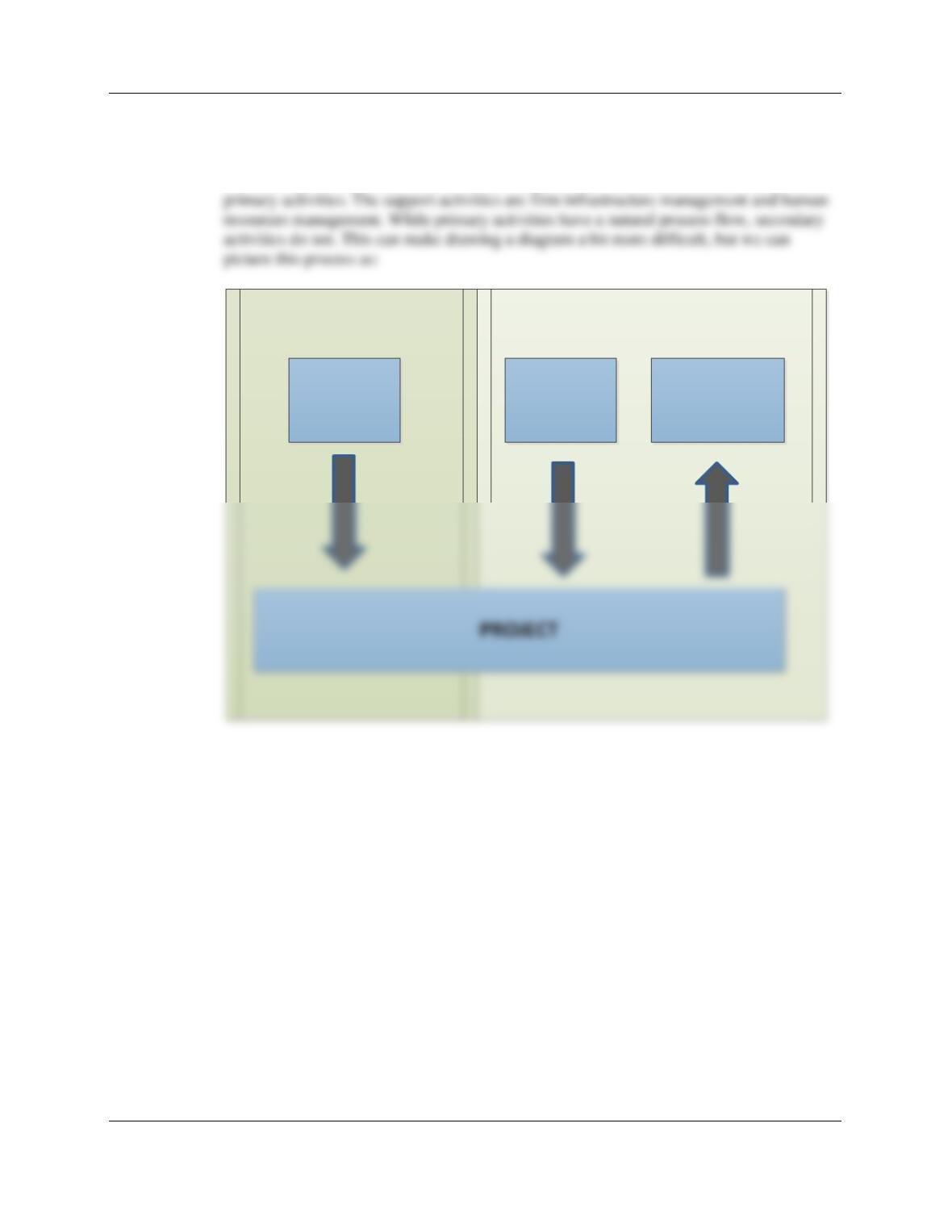
B. How does this business process overlay Michael Porter’s set of primary and
support business activities? Draw a diagram to illustrate this overlap.
The Sales process overlays two of Porter’s support activities, but none of Porter’s
Human Resources Management Firm Infrastructure Management
EMPLOYEES RESOURCES PROJECT
TRACKING AND
ACCOUNTING
Appendix B – Getting Started with Systems Analysis and Design
Page B-10
C. Based on the actual Wedgewood Pacific database as it has been created
through the Chapter 2 Exercises, what do you think are the approved
requirements for the project? What are the business rules (either stated or
implied)?
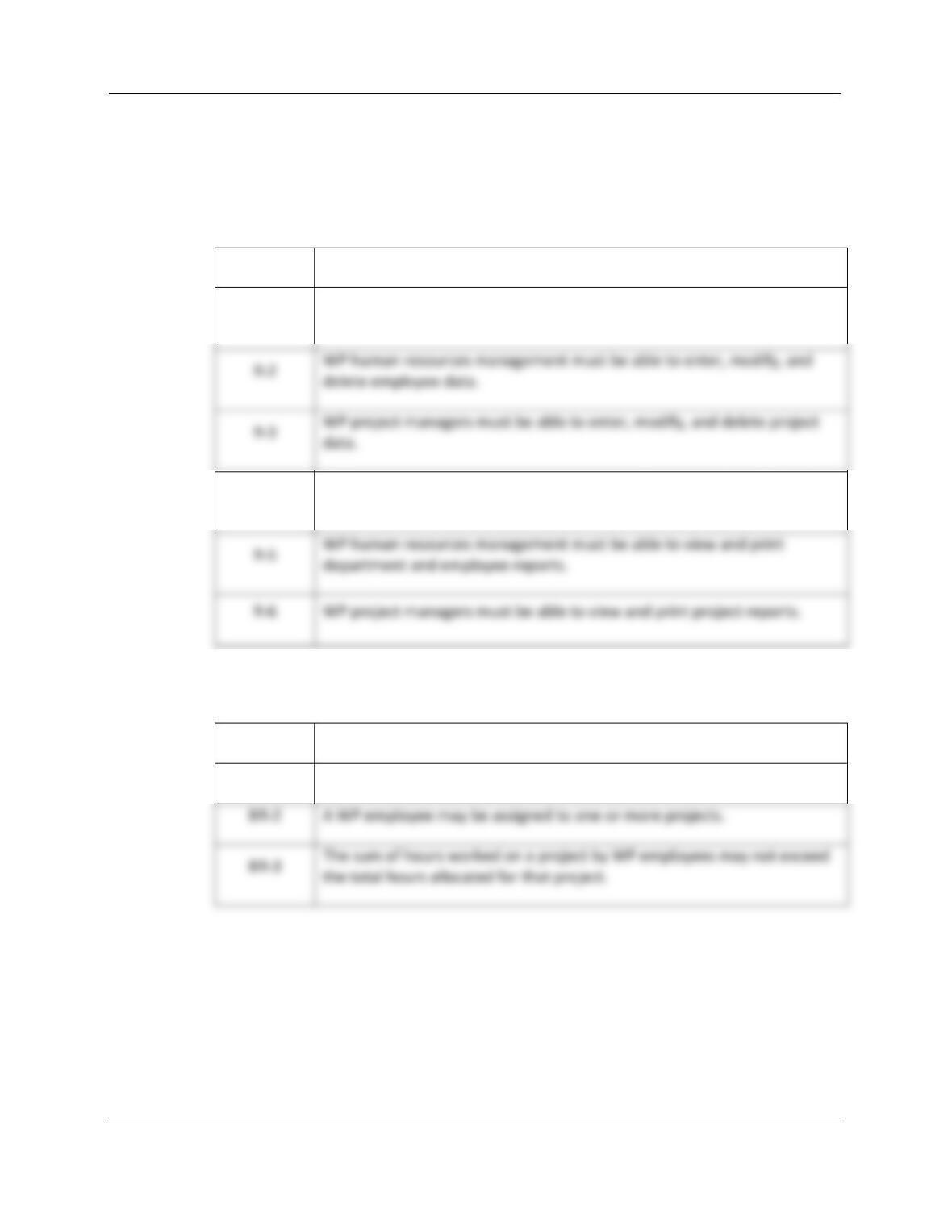
Approved requirements would include:
Functional Requirements
R-1
WP human resources management must be able to enter, modify, and
delete department data.
R-4
WP human resources management must be able to enter, modify, and
delete employee assignment data.
R-5
WP human resources management must be able to view and print
department and employee reports.
Business rules would include:
Business Rules
BR-1
A WP project must be sponsored by a WP department.
A WP employee may be assigned to one or more projects.
The sum of hours worked on a project by WP employees may not exceed
the total hours allocated for that project.
R-3
WP project managers must be able to enter, modify, and delete project
data.