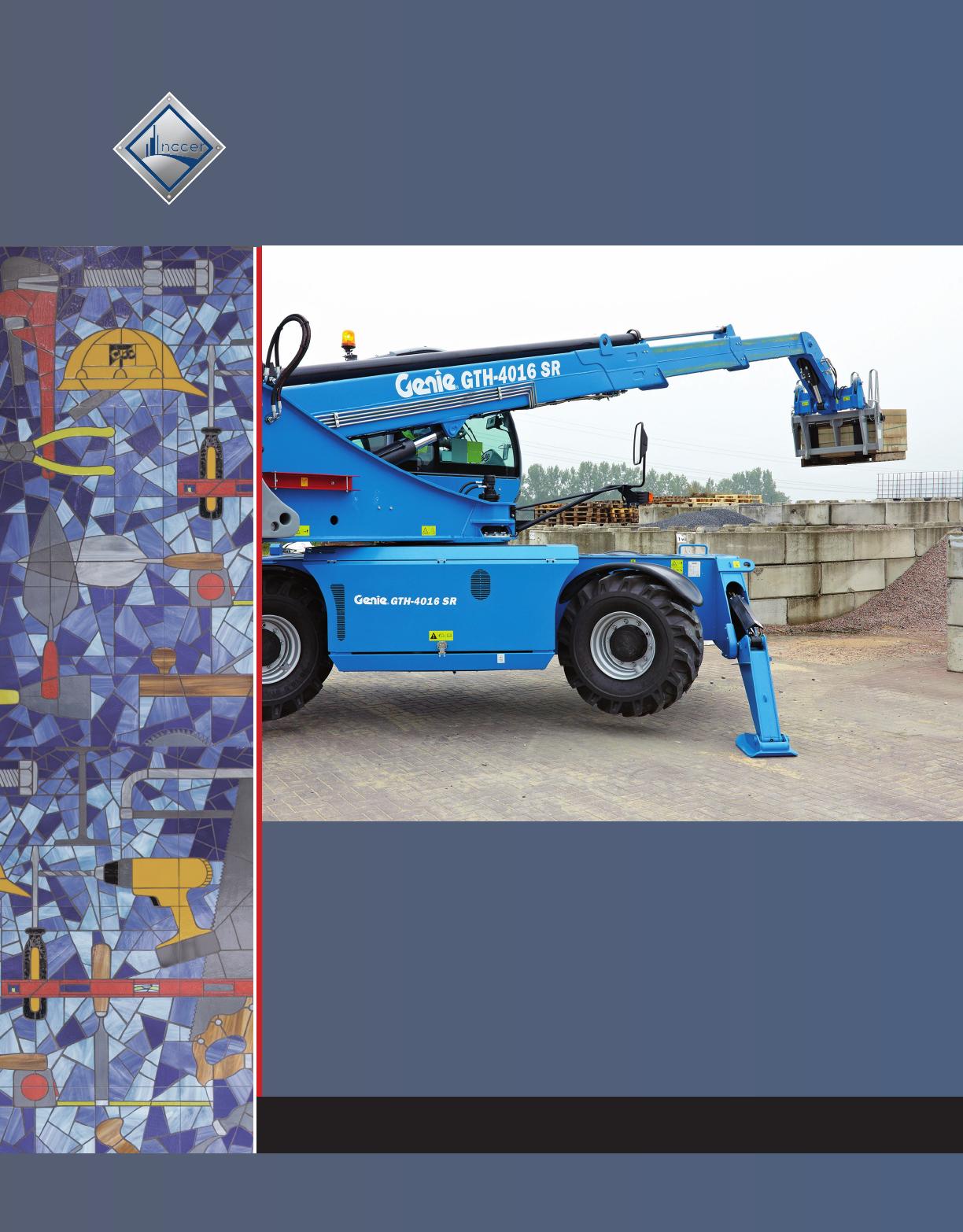
Module Nine
Core CurriCulum
Lesson Plans for Instructors
Introduction to
Material Handling
00109-15
00109-15 Introduction to Material Handling Module Nine i
Lesson Plans for Module 00109–15
IntroductIon to MaterIal HandlIng
Module Nine (00109–15) provides safety guidelines for workers handling materials on the job site. It covers
proper procedures and techniques to use when lifting, stacking, transporting, and unloading materials. It also
introduces basic motorized and non–motorized material–handling equipment commonly found in the construc–
tion environment.
Teaching Time: 5 hours
(Two 2.5–Hour Classroom Sessions)
Session time may be adjusted to accommodate your class size, schedule, and teaching style.
Before You Begin
As you prepare for each session, allow sufficient time to review the course objectives, content, visual aids
(including the PowerPoint® presentation), and these lesson plans, and to gather the required equipment and
Objectives
Learning Objective 1
• Describe the basic concepts of material han–
dling and common safety precautions.
a. Describe the basic concepts of material
Performance Tasks
Performance Task 1 (Learning Objective 1)
• Demonstrate safe manual lifting techniques.
Performance Task 2 (Learning Objective 1)
• Demonstrate how to tie two of the following
ii NCCER – Core Curriculum 0010 9 -15
Classroom Equipment
and Materials
Whiteboard/chalkboard
Markers/chalk
Pencils and paper
Core Curriculum PowerPoint®
Presentations
DVD player
Safety Considerations
During the course of this module, trainees may be in the vicinity of electrical energy sources and potentially
hazardous tools, equipment, and materials. In those instances, trainees should be carefully observed to
ensure that they wear the proper PPE, follow safe practices, and give due respect to the hazards associated
with the energy sources, tools, equipment, and materials.
Additional Resources
This module presents thorough resources for task training. The following resource material is suggested for
further study.
Materials Handling Handbook, The American Society of Mechanical Engineers (ASME) and The International
Material Management Society (IMMS), Raymond A. Kulwiec, Editor-in–Chief. 1985. New York, NY: Wiley–
Interscience.
Manufacturing Facilities Design & Material Handling, Matthew P. Stevens, Fred E. Meyers. 2013. West Lafay-
ette, IN: Purdue University Press.
Knots: The Complete Visual Guide, Des Pawson. 2012. New York, NY: DK Publishing.
Simple Solutions Ergonomics for Construction Workers. US Centers for Disease Control, National Institute
for Occupational Safety and Health. Last modified August 2007. http://www.cdc.gov/niosh/docs/2007–122/
Appropriate PPE:
Standard eye protection
Work gloves
Objects for manual lifting
Several pairs of rope sections of
suitable length and equal diameter
Common objects (rings, bars, posts,
poles, etc.) around which knots can
be tied
Equipment and Materials for Laboratories and
Performance Testing
00109-15 Introduction to Material Handling Module Nine iii
The Lesson Plan for this module is divided into two 2.5–hour sessions.
This time includes 10 minutes for administrative tasks and a 10-minute break per session.
SeSSion one
Session One discusses basic material handling
concepts and safety precautions. It reviews
various types of motorized and non-motorized
material handling equipment and describes how
the equipment is used.
1. Show the Session One PowerPoint®
presentation.
2. Use the Kickoff Activity to introduce the
subjects that will be covered in this module
and stimulate trainee interest in the topic.
SeSSion Two
Session Two begins with a laboratory devoted
to practice and completion of Performance
Tasks 1 and 2. The laboratory is followed by
a comprehensive module review and written
examination.
1. Note that there is no PowerPoint®
presentation associated with this session.
2. Have trainees practice and/or complete the
tasks associated with Performance Tasks 1
and 2.
IntroductIon to MaterIal HandlIng
Session Outline for 00109–15
iv NCCER – Core Curriculum 0010 9 -15
Materials Checklist for Module 00109-15, Introduction to Material Handling
Equipment and Materials
Personal protective equipment: Objects for manual lifting
Pencils and paper
Core Curriculum PowerPoint®
Presentation Slides
DVD player
LCD projector and screen
Computer
Internet access during class
(optional)
Copies of the Module
Examination and Performance
Profile sheets
The following items are
optional:
Video resource(s) on
proper lifting techniques
A safety harness and
positioning belt with
lanyard
Video resource(s)
demonstrating how to tie
common knots
00109-15 Introduction to Material Handling Module Nine 1
MaterIal HandlIng; MaterIal HandlIng equIpMent
Classroom Session 1 for 00109–15
Safety Considerations
The following safety consideration should be emphasized when introducing trainees to the
construction environment:
Remind trainees that some forms of PPE may be required any time they are in the shop or on a job site.
Safety Equipment
The use of specific safety equipment is not anticipated during this session.
Classroom and/or Lab Equipment
The following items are optional:
Resources
No specific resources are required for this session.
Kickoff Activity
Ask trainees to identify basic aspects of material handling that have changed relatively little over time
as well as those that have changed a great deal. Record their answers on a whiteboard/chalkboard.
Retain the list and refer back to it to check off items as they are covered during the classroom session.
Possible answers for relatively unchanged aspects include the following:
Equipment powered by the human body
Use of knots to secure materials
Importance of safe lifting techniques
2 NCCER – Core Curriculum 0 010 9 -15
MaterIal HandlIng; MaterIal HandlIng equIpMent
Classroom Session 1 for 00109–15
Session Objectives
When trainees have completed this session, they should be able to do the following:
1. Describe the basic concepts of material handling and common safety precautions.
a. Describe the basic concepts of material handling and manual lifting.
Session Performance Requirements
Trainees will not complete a Performance Task during this session.
Instructional Outline
Research has shown that varying instructional methods periodically throughout class sessions helps to
engage and hold trainees’ attention. The Core Curriculum PowerPoint® presentation that you received
with this lesson plan is keyed to the sections of the Trainee Guide indicated below and has been
designed for use with this lesson plan.
Classroom: Sections 1.0.0–1.1.0
Explain what a load is and talk about why proper material handling on a job site is important.
Identify the four basic aspects of material handling that will be covered in the following sections.
Classroom: Sections 1.1.1–1.1.3
Talk about why mentally planning a material-handling task is important. Review the bulleted list of
steps for assessing the situation before attempting to lift any material.
Teaching Tip
Show a brief video on proper lifting techniques.
00109-15 Introduction to Material Handling Module Nine 3
MaterIal HandlIng; MaterIal HandlIng equIpMent
Classroom Session 1 for 00109–15
Classroom: Sections 1.2.0–1.2.2
Introduce the importance of making sure that the workers, materials, and equipment on a job site are
safe from unexpected movement.
Teaching Tip
Have a safety harness and a positioning belt with lanyard available for trainees to examine or try on.
Classroom: Section 1.3.0
Explain the difference between knots and hitches. Identify the four types of knots that will be covered
in the sections that follow. Define the following knot tying terms: standing end, working end, standing
part, and capsize. Point out the need to be aware of differences in knot-tying techniques.
Classroom: Section 1.3.1
Teaching Tip
Show a video of how to tie a square knot.
Classroom: Section 1.3.2
Describe a bowline, applications for which it is suitable, and applications for which it is not suitable.
Explain how to tie a bowline.
Teaching Tip
Classroom: Section 1.3.3
Describe a half hitch, applications for which it is suitable, and applications for which it is not suitable.
Explain how to tie a half hitch.
Teaching Tip
4 NCCER – Core Curriculum 0 010 9 -15
Classroom Session 1 for 00109–15
MaterIal HandlIng; MaterIal HandlIng equIpMent
Classroom: Section 1.3.4
Describe a clove hitch, applications for which it is suitable, and applications for which it is not suitable.
Explain how to tie a clove hitch using the threading the end technique, the stacked loops technique,
and the two half hitches technique.
Teaching Tip
Classroom: Sections 2.0.0–2.1.0
Identify the two types of material-handling equipment and talk about why they are used.
Review the bulleted list of the types of manual material-handling equipment that will be covered in the
sections that follow.
Classroom: Sections 2.1.1–2.1.3
Describe the basic features and uses of material carts. Review the bulleted list of safety guidelines for
using material carts.
Classroom: Sections 2.1.4–2.1.6
Describe the basic features and uses of drum dollies and drum carts. Review the bulleted list of
guidelines for using a rotating drum cart.
Classroom: Sections 2.1.7–2.1.9
Describe the basic features and uses of a pipe mule. Describe proper lifting techniques for loading and
unloading a pipe mule.
00109-15 Introduction to Material Handling Module Nine 5
Classroom Session 1 for 00109–15
MaterIal HandlIng; MaterIal HandlIng equIpMent
Classroom: Section 2.2.0
Describe motorized material handling equipment. Emphasize the training requirements for operators
Classroom: Section 2.2.1
Describe the basic features and uses of a powered wheelbarrow. Talk about how to inspect a powered
wheelbarrow before using it. Review the bulleted list of safety guidelines for using a powered
wheelbarrow.
Classroom: Section 2.2.2
Describe the basic features and uses of a concrete mule. Talk about how to inspect a concrete mule
before using it. Describe safety precautions to follow when refueling, discharging concrete mix from,
and operating a concrete mule.
Classroom: Section 2.2.3
Describe the basic features and uses of an industrial forklift. Review the bulleted list of safety
Classroom: Sections 2.2.4–2.2.5
Describe the basic features and uses of a rough terrain forklift. Explain why tipovers are common
Classroom: Section 2.2.6
Explain why hand signals are used to communicate with the operators of motorized material-handling

6 NCCER – Core Curriculum 0 010 9 -15
Classroom Session 1 for 00109–15
MaterIal HandlIng; MaterIal HandlIng equIpMent
Wrap Up
Ask trainees to identify the approach that would be best for each of five material-handling scenarios.
Discuss the correct answer for each scenario as it is presented. Allow for discussion of additional
correct answers that trainees may provide beyond those identified on the slide.
Homework
Have trainees complete the 1.0.0 and 2.0.0 Section Reviews. Assign a review of the complete module to
00109-15 Introduction to Material Handling Module Nine 7
laboratory / perforMance tasks; revIew and testIng
Classroom Session 2 for 00109–15
This session is reserved for a brief review of the module, administering the module
examination, and any incomplete performance testing.
Safety Considerations
The following safety consideration should be emphasized when introducing trainees to the
construction environment:
Remind trainees that some forms of PPE are required any time they are in the shop or on a job site.
Safety Equipment
Classroom and/or Lab Equipment
Objects for manual lifting
Several pairs of rope sections of suitable length and equal diameter for tying knots
Common objects (rings, bars, posts, poles, etc.) around which knots can be tied
Resources
No specific resources are required for this session.
Session Objective
This session is intended to support and emphasize Learning Objective 1.
Session Performance Requirements
By the end of this session, trainees should have completed, or be able to complete, the following
Performance Tasks under the supervision of the instructor:
Demonstrate safe manual lifting techniques.
8 NCCER – Core Curriculum 0 010 9 -15
Instructional Outline
This laboratory is devoted to the practice and completion of Performance Tasks required for this
module. As a result, no PowerPoint® slides have been developed for this session. Throughout these
activities, ensure that trainees wear the proper PPE and exhibit safe working habits.
Review
Review the answers to the 1.0.0 and 2.0.0 Section Reviews.
Demonstration
Show trainees the proper technique for safely lifting several different objects manually.
Laboratory/Performance Task
Demonstration
Show trainees how to tie each of the following types of knots:
Square
Bowline
Half hitch
Clove hitch using the threading the end technique
Clove hitch using the stacked loops technique
Clove hitch using the two half hitches technique
Laboratory/Performance Task
Under your direct supervision, have each trainee tie any two of the following types of knots:
Square
Review
Ask the trainees if they wish to review any particular information from the module. Have the trainees
complete the Module Review and Trade Terms Quiz. Alternatively, if the Module Review and Trade
Classroom Session 2 for 00109–15
laboratory / perforMance tasks; revIew and testIng

00109-15 Introduction to Material Handling Module Nine 9
Examination and Performance Task Verification
Administer the Module Exam. As they begin, remind trainees that they must answer at least 70 percent
of the questions correctly to pass the module exam.
Wrap Up
Instructor
Record the testing results on the Registration of Training Modules Form, and submit the report to your
Training Program Sponsor.
Classroom Session 2 for 00109–15
laboratory / perforMance tasks; revIew and testIng
10 NCCER – Core Curriculum 0010 9 -15
SECTION REVIEW ANSWER KEY
SECTION 1.0.0
Answer Section Reference Objective
Module Nine (00109–15)
answer keys

00109-15 Introduction to Material Handling Module Nine 11
ANSWERS TO REVIEW QUESTIONS
Answer Section Reference
1. d 1.1.2
15. c 2.2.6
Module Nine (00109–15)
answer keys
12 NCCER – Core Curriculum 0010 9 -15
answer keys
Module Nine (00109–15)
ANSWERS TO TRADE TERMS QUIZ
1. Work zone
2. Bowline
3. Pipe transport, pipe mule (in that order)
13. Freight elevator
14. Working end, standing end (in that order)

NCCER makes every effort to keep its textbooks up-to-date and free of technical errors. We
ap pre ci ate your help in this process. If you find an error, a typographical mistake, or an in-
NCCER Product Development and Revision
13614 Progress Blvd., Alachua, FL 32615
Email: curriculum@nccer.org
Online: www.nccer.org/olf
NCCER CuRRiCula — uSER uPDaTE
❏ Trainee Guide ❏ Lesson Plans ❏ Exam ❏ PowerPoints Other _________________________
Craft / Level: Copyright Date:
Module ID Number / Title:
Section Number(s):
Description:
Recommended Correction:
Your Name:
Address:
Email: Phone: