1
Chapter 9
EMPATHIC CONFRONTATION:
SUPPORTING WHILE ADDRESSING CLIENT
CONFLICT
How can empathic confrontation help you and your clients?
Chapter 9, “Empathic Confrontation: Supporting While Addressing Client Conflict,”
recognizes that most clients come to an interview experiencing ambivalence, feeling
CHAPTER GOALS
Awareness, knowledge, skills, and actions developed through the concepts of this chapter
will enable you to:
▲ Identify conflict, incongruity, ambivalences, and mixed messages in behavior,
thought, feelings, or meanings.
INTRODUCTION
This chapter presents an extended discussion of empathic confrontation as a central skill
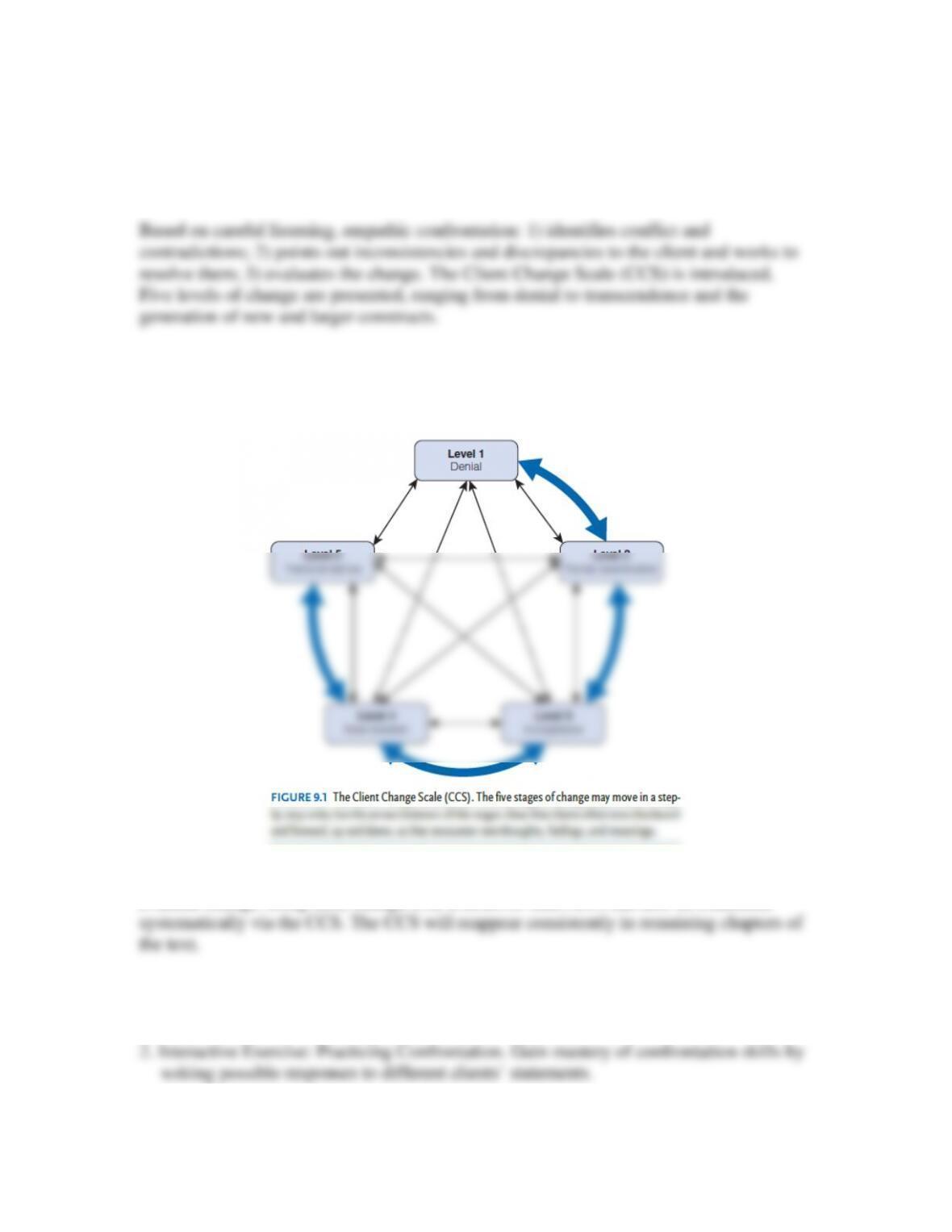
in promoting developmental change in the client. The Client Change Scale (CCS) is
presented as a framework for evaluating the impact of a confrontation—and the CCS is
also a framework for evaluating short- and long-term change in response to any skill or
strategy.
The CCS is a useful process way of thinking that will enable students to identify the
effectiveness of client’s efforts toward change. Remember, the CCS is viable for all client
change, not just responses to confrontation skills.
OVERVIEW OF THE CHAPTER AND MINDTAP SUPPORT
DEFINING EMPATHIC CONFRONTATION
The chapter begins with a definition of empathic confrontation and a discussion of
intentionality as contrasted with inability to act. We list some key words that relate to this
issue starting with Fritz Perls’s useful term “stuckness.” We go on to list the many terms
we use to describe conflict, problems, concerns, and issues. This section defines
List of MindTap resources available for this section:
2. Weblink: Ohio Commission on Dispute Resolution and Conflict Management
Programs.
DISCERNING THE BASIC SKILLS OF CONFRONTATION
The combination skill of empathic confrontation is divided into three steps in this section.
The first is listening and observing; the second is providing feedback on internal and
3
external conflict; the third is evaluating how the client received the confrontation and did
whether it they led to change. The third step includes the Confrontation Client Change
Scale (CCS), a systematic way to determine how the client heard you. This CCS is also a
way to measure how your client changes and develops over a series of sessions.
The CCS is particularly important as it is a system that, with practice, will enable
interviews to assess the impact and effectiveness of their leads and interventions “on the
spot” in the here and now of the interview.
The CCS can also be used with all microskills, whether listening or influencing, to
evaluate change. Long-term change over a series of interviews can also be examined
List of MindTap resources available for this section:
1. Interactive Exercise: Practice with the Client Change Scale. Test your knowledge
about the CCS by classifying different clients’ statements.
3. Weblink: Communicating Well in Conflict: Competence Skills and Collaboration.
5. Weblink: Elisabeth Kubler-Ross.
6. Weblink: Coping with Loss—Loss in Late Life.
OBSERVING EMPATHIC CONFRONTATION IN ACTION
This session presents Ryan, the counselor, with Dominic, who is concerned about how
much responsibility he has for work around the house. This example interview
List of MindTap resources available for this section:
PRACTICING: BECOMING COMPETENT IN EMPATHIC CONFRONTATION
Several exercises are offered in this section to practice empathic confrontation and master
the skill.
List of MindTap resources available for this section:
1. Interactive Exercise: Writing Confrontation Statements: Balancing Family
2. Case Study: Confronting a Difficult Client in Romania. A good invitation to explore
the skill of confrontation in a multicultural context.
DEMONSTRATIONS AND VIDEOS TO SUPPLEMENT ESSENTIALS OF
INTENTIONAL INTERVIEWING, Third Edition
• Live instructor demonstration.
• Basic Influencing Skills has a modeling tape on confrontation. The instructional tape
• Lesbian, Bisexual, Gay, and Transgendered Counseling by Stuart Chen-Hayes and
Lynn Banez offers useful vignettes of clients facing serious conflicts externally with
society.
• Advanced Microskills for Cognitive Counseling and Therapy and others in this series
on humanistic and behavior therapy by Jeff Brooks-Harris and Jill Oliveira-Berry
CLASS PROCEDURES
1. Confrontation. Confrontation is based on observing our clients’ verbal and nonverbal
behavior and noting their reactions to our confrontations. The three steps of the
confrontation process seem to be useful to students, particularly Step 2 working
2. Kübler-Ross and issues of death and dying. To bring home varying levels of the
Client Change Scale, we suggest you visit websites related to Kübler-Ross’s death
and dying theory. We find that students find it helpful in understanding these
concepts emotionally, as well as intellectually, if they share some of their own
3. The change process and its parallels to Kübler-Ross. Students who have mastered
the concepts of death and dying find it fairly easy to see how change in counseling
4. The change process and its parallels to cultural identity theory. As a person moves
5. Examination of the Client Change Scale. The scale can be introduced and discussed.
6. Students are encouraged to look at the CCS in their own interviews. Students have
presented a number of interview practice sessions by this point and it is helpful to ask
7. The importance of microskill practice in classrooms. Although we have mentioned
8. Portfolio of competence. We need to remind students from time to time to keep their
portfolios up to date.
GROUP PRACTICE WITH CONFRONTATION
Step 1: Divide into groups.
Step 2: Select a group leader.
7
interviewer as well. Pay special attention to the microskill leads of the
interviewer.
Step 4: Plan. State the goal of the session. The interviewer’s task is to use the basic
listening sequence to draw out a conflict in the client and then to confront this
conflict or incongruity. Your ability to observe and note discrepancies on the spot
• Virtually any type of interpersonal conflict
• Moral decisions ranging from telling the truth when one has held it back, to
differences of opinion on abortion, divorce, or making a commitment, to
issues of diversity or the role of spirituality in one’s family
Step 5: Conduct a five-minute practice session using confrontation skills as part of your
listening and observation demonstration.
Step 6: Review the practice session using confrontation skills.
Step 7: Rotate roles.