CHAPTER 9
Cocaine Misuse and Cocaine Use Disorder
LEARNING OBJECTIVES
After studying this chapter, students should be able to:
•
9.2: Describe the scope of the problem of cocaine use and misuse
•
9.4: Describe the subjective effects of cocaine use
•
9.5: Understand the complications of cocaine misuse
CHAPTER OUTLINE
A Brief History of Cocaine
Cocaine in U.S. History
Current Medical Uses of Cocaine
Scope of the Problem of the Cocaine Use Disorders
Pharmacology of Cocaine
Drug Interactions Involving Cocaine
How Illicit Cocaine Is Produced
Methods of Cocaine Misuse
Insufflation
Intravenous Cocaine Administration
Subjective Effects of Misused Cocaine
Complications of Cocaine Misuse and Cocaine Use Disorder
Death
Addiction
Respiratory System Problems
Cardiovascular System Damage
Cocaine Misuse as a Cause of Digestive System Damage
Cocaine Misuse as a Cause of Central Nervous System Damage
Cocaine’s Effects on Emotions and Perceptions
Other Problems Associated with Cocaine Misuse
Cocaine Withdrawal
CNS Stimulant Misuse and the Diagnostic and Statistical Manual of Mental Disorders, 5th Edition
CHAPTER OVERVIEW
The purpose of this chapter is to briefly examine the history of cocaine, and how its current
classification as an illegal substance in the United States came about. The actions of cocaine, its
medical uses, its subjective effects when used as a pharmaceutical, the reasons for its misuse,
25
physical consequences of its misuse and mechanism through which it is able to induce addiction,
and the scope of cocaine misuse and cocaine use disorder are also reviewed.
DISCUSSION QUESTIONS
Break-Out Discussion #1:
Equality? Imagine for a moment that you are a police detective on a stakeout, watching a street-
corner drug dealer from an apartment window across the street. Your hidden observation post
On one occasion, a Caucasian woman, apparently from the middle class, drives up to the dealer,
and a packet is exchanged for a set amount of cash. You radio the vehicle description and
license number to a waiting cohort of marked police vehicles hidden several blocks away. The
However, would you give every suspected buyer the same treatment? Perhaps 2 minutes later,
a young college student walks up to the dealer, shakes hands, hugs the dealer, and shakes hands
again. You suspect that when the student first shook hands with the dealer, a small packet of
carefully folded bills was passed from the student to the dealer. When they hugged, you suspect
that the student whispered the name of the type of drug that they wanted, and when they
shook hands before parting company, you suspect that a small packet of a controlled substance
was passed from the dealer to the student. Would you radio in to have the student arrested?
Shortly afterward, a newer-model station wagon pulls up to the street corner. Again, you see
money being passed through the open, driver’s-side window, and a small packet of a white
powder passed to the driver. However, this time you note that the driver is dressed in relatively
fashionable clothing, and that there is a car seat with a young child in the backseat. You know
that if the driver is arrested, the child will be placed in a foster home, the vehicle will be
confiscated, the suspect will be interned in jail at least until bail is arranged, his or her name will
be listed in the newspaper as one of those arrested, and there will be rather sizable financial
charges for legal representation, and so on. Do you call the vehicle description in to your waiting
pack of wolves so that the driver can be searched, and, if appropriate, arrested?
job. Do you call the dispatcher to provide this information, knowing that you have arranged for
your friend to be arrested?
Questions
1. Which of the dealer’s customers would you report? Why? Are there some customers whom
you would find harder to turn in than others?
2. Would it matter whether the college student was male or female? What about the parent?
Should the sanctions be different for a woman than a man, or for a parent rather than a single
adult? Why or why not?
3. Suppose that one of the persons arrested claimed that they had been ordered to buy the
cocaine for a famous and successful singer who was performing that evening. Should that
person be charged with the same crime, and prosecuted with the same enthusiasm, as the other
cases? Why or why not?
Break-Out Discussion #2:
Cocaine and 19th-century product safety regulations. As your text noted, cocaine was frequently
a hidden ingredient in “patent” medicines that were sold through the mail, in stores, or by
Questions
1. From your perspective now in the 21st century, what do you think of the laws created in the
early part of the last century? If you disagree with them, what do you think they should have
been like?
1
1
One very real problem in judging such issues is our tendency to place our standards onto the
actions of earlier generations. It is always necessary to judge the behaviors of others on the basis
of the standards of that era and not from those of the 21st century. The people of the era were
living their lives according to their rules, not ours. Does this fact change any of your answers,
and, if so, why?
27
2. Do pronouncements about the dire outcome of cocaine use help deter cocaine use, or
destroy the credibility of those who wish to discourage drug misuse? Why?
3. Have you ever read the abovementioned statistic from Chapter 1 in a print media article
about cocaine use? What is your main source of information for learning about drugs and their
effects? Do you trust the sources?
KEY CONCEPTS AND TERMS
Crack: Cocaine prepared for smoking before sale
Dysphoria: Feelings of sadness, sorrow, depression, and so on. The opposite of euphoria
Presynaptic: Involving the “upstream” neuron, which is to say the neuron that releases
neurotransmitters into the synaptic junction to activate the next neuron in the neural network
∆FosB (delta FosB): A compound found in neurons that controls the process of manufacturing
Hyperthermia: Retention of body heat well above safe levels, which may prove fatal to the
individual if not corrected before the brain is damaged by the abnormally high body
temperature
Cocaethylene: A toxic compound transformed from cocaine in the body in small amounts,
thought to be 25–30 times as likely to induce death as cocaine
Speedballing: Term used to refer to the practice of using cocaine and a narcotic analgesic
simultaneously
Body packer: Individual who will ingest a compound, usually cocaine, wrapped in multiple
“Coke run”: Engaging in extended periods of continuous cocaine use, at times in an attempt to
overpower cocaine-induced tolerance
“Crack lung”: An asthma-like condition resulting from habitual use of crack, also known as
chronic bronchiolitis
Pneumothorax: A condition during which the alveoli of the lungs rupture, allowing air and
bacteria to escape into surrounding tissues
28
and attack foreign cells. Macrophages are also involved in some aspect(s) of the immune
response
Kindling: A process that has been called “reverse tolerance” by some scientists. Through the
process of kindling, the brain becomes more and more sensitive to seizure triggers, which then
initiates a seizure(s). Sometimes this process is called sensitization
Tourette’s syndrome: A movement disorder in which the person will engage in repetitive,
stereotypical movements, and often engage in repetitive vocalizations
Tardive dyskinesia: Condition resulting in abnormal movements of muscles. Technically, the
term “tardive” means “late,” and dyskinesia refers to abnormal muscle movements. This
Formication: The sensation of having unseen bugs crawling on or just under the skin. This
sensation is often induced by large doses of some chemicals, such as the amphetamines or
cocaine
“Coke paranoia”: Symptoms of a psychosis that are very similar to symptoms seen in
schizophrenia, caused by use of cocaine on a chronic basis
Priapism: Extended, painful penile erection, which may cause damage to the vasculature
network of the penis and possibly result in permanent erectile dysfunction
Rhabdomyolysis: Destruction of muscle tissue on a massive scale. When muscle tissues die, they
Choreoathetoid movements: Bodily movements that are not controllable and are caused by
cocaine use; also known as “crack dancing”
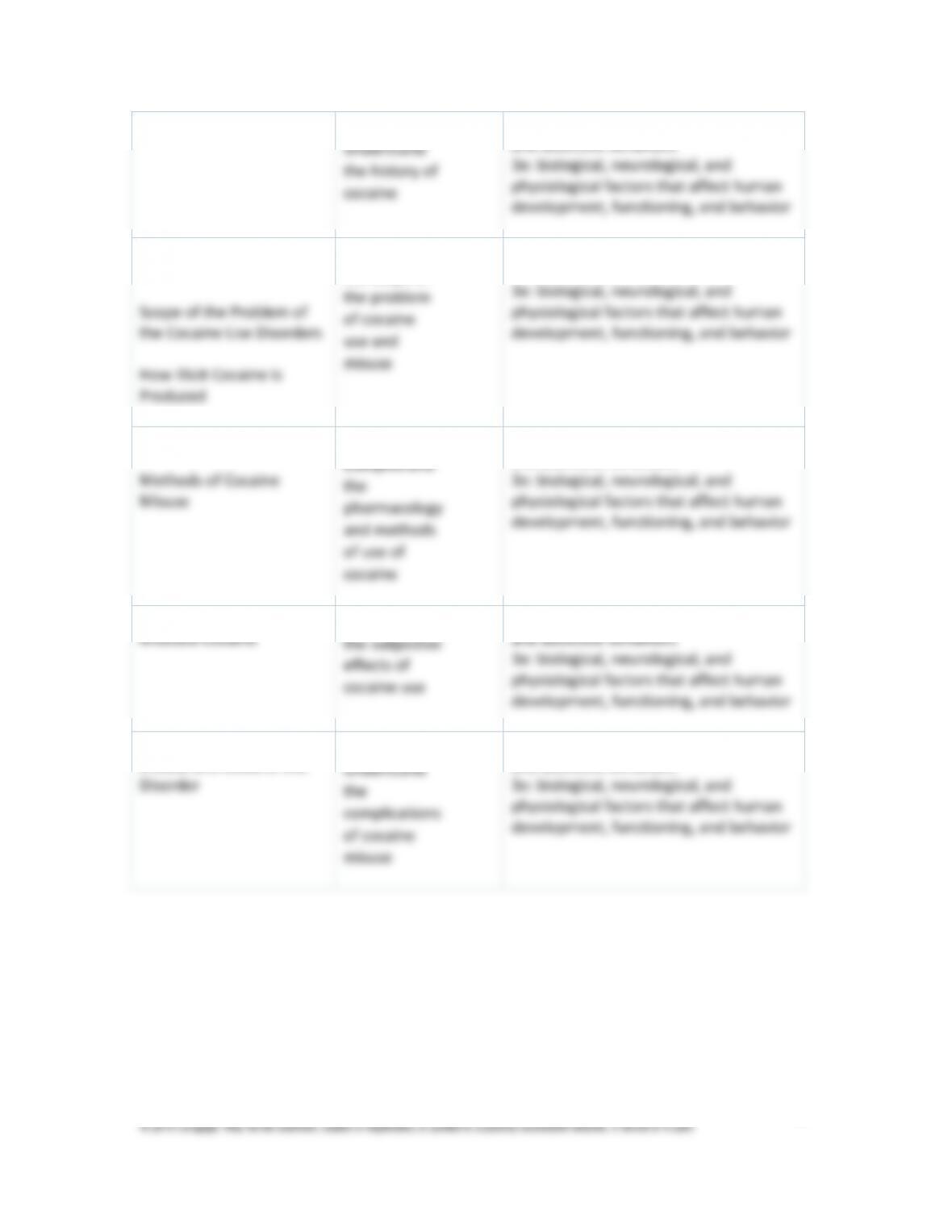
LO/STANDARDS CORRELATION CHART
A-head
LO
Standard—CACREP
A Brief History of Cocaine
9.1:
Understand
the history of
cocaine
3d: theories and etiology of addictions
and addictive behaviors
3e: biological, neurological, and
physiological factors that affect human
development, functioning, and behavior
Current Medical Uses of
Cocaine
Scope of the Problem of
the Cocaine Use Disorders
How Illicit Cocaine Is
Produced
9.2: Describe
the scope of
the problem
of cocaine
use and
misuse
3d: theories and etiology of addictions
and addictive behaviors
3e: biological, neurological, and
physiological factors that affect human
development, functioning, and behavior
Pharmacology of Cocaine
Methods of Cocaine
Misuse
9.3:
Comprehend
the
pharmacology
and methods
of use of
cocaine
3d: theories and etiology of addictions
and addictive behaviors
3e: biological, neurological, and
physiological factors that affect human
development, functioning, and behavior
Subjective Effects of
Misused Cocaine
9.4: Describe
the subjective
effects of
cocaine use
3d: theories and etiology of addictions
and addictive behaviors
3e: biological, neurological, and
physiological factors that affect human
development, functioning, and behavior
Complications of Cocaine
Misuse and Cocaine Use
Disorder
9.5:
Understand
the
complications
of cocaine
misuse
3d: theories and etiology of addictions
and addictive behaviors
3e: biological, neurological, and
physiological factors that affect human
development, functioning, and behavior