Chapter 8: Ethical and Legal Issues Facing Helpers
CHAPTER 8
Ethical and Legal Issues Facing Helpers
LEARNING OBJECTIVES
After studying this chapter, students should be able to:
• Describe what is involved in ethical decision making.
• Explain the difference between law and ethics.
• Identify the purposes that codes of ethics serve.
• Explain how to address unethical behavior by colleagues.
CHAPTER OUTLINE
Aim of the Chapter
Inventory of Ethical Issues
Ethical Decision Making
Law and Ethics
Professional Codes and Ethical Decision Making
Codes of Ethics of the Various Professional Organizations
Documentation and Keeping Records
Ethical Issues in a Managed Care Environment
Key Ethical Issues
Legal Aspects of Managed Care
Chapter 8: Ethical and Legal Issues Facing Helpers
Trends in Managed Care
Malpractice and Risk Management
CHAPTER OVERVIEW
• One of the trends in the helping professions is an increased interest in ethical and professional
practice. This trend stems, at least in part, from a rise in malpractice actions against mental
health practitioners.
• Ethical issues rarely have clear-cut answers. Ethical dilemmas, by their very nature, involve the
application of professional judgment on your part.
• Routinely utilize a systematic ethical decision-making process such as the eight-step model
provided in this chapter or another one that you personally devise. This type of system
encourages objectivity, research, analysis, collaboration, and documentation—all of which are
important elements in effective and ethical practices.
• Confidentiality is limited when you work with couples, families, groups, and minors. These
limitations should be discussed in your informed consent process.
• At times you will have a professional and legal obligation to warn or to protect clients. It is
essential that you know your duties in this area.
• Your job is to teach clients how to help themselves and thus decrease their need to continue
seeing you. Encouraging dependency in your clients is unethical, and it does not lead to client
empowerment.
Chapter 8: Ethical and Legal Issues Facing Helpers
online.
• Helpers who work in a managed care setting inform their clients about the services available and
about potential limitations on the helping relationship due to the focus on cost-effective
methods.
SUGGESTIONS FOR ACTIVITIES
1. Find at least one person in the helping professions to interview about ethical issues in
practice. Focus on the major ethical problem that this person has faced. How did this
helper deal with this ethical concern? What are their concerns, if any, about
malpractice suits?
2. Identify an ethical issue that you may encounter as a practitioner and create a resource
4. Identify what you consider to be the most pressing ethical issue you expect to face, and write
about your concerns and ideas in your journal. If you are involved in fieldwork, keep journal
entries about any potential ethical dilemmas and bring your concerns to your supervision
sessions or class meetings. Write down specific ways for you to increase your likelihood of
becoming an ethical practitioner. What can you do now to move in this direction?
5. Structure a class debate around the arguments for and against suicide prevention. Consider
Chapter 8: Ethical and Legal Issues Facing Helpers
1.
Your client Sarah is angry with you for informing her parents about her suicidal
tendencies. How will you respond?
3.
You overhear your colleague Sean in the restroom, talking about his clients loudly
with your other colleagues who join in and discuss about their clients too. When you
cross them, you are invited to join in the discussion. Sean promises that all of those
present being professionals would never leak information or share it with anyone
else. What would you do?
KEY CONCEPTS AND TERMS
Abandonment involves the desertion of a client by a helper who has assumed responsibility for being
involved in a professional relationship with the client.
Aspirational ethics goes beyond the minimal standards of practice and entails an understanding of the
spirit behind the code and the principles on which the code rests.
Health Insurance Portability and Accountability Act (HIPAA) of 1996 is an act passed by Congress to
promote standardization and efficiency in health care industry. HIPAA is a federal law that contains
detailed provisions regarding client privacy, informed consent, and transfer of records.
HIPAA privacy rule was designed to give patients more rights and more control over their health
information.
Informed consent document refers to a written document, which the counselor and client discuss, that
Chapter 8: Ethical and Legal Issues Facing Helpers
defines boundaries and clarifies the nature of the basic counseling relationship between counselor and
client.
Law provide guidelines for acceptable professional practice, yet neither offers clear-cut answers to most
situational problems. Law defines the minimum standards society will tolerate, which are enforced by
government.
Professional negligence consists of departing from the usual standard of practice or not exercising due
care in fulfilling one’s responsibilities.
Progress notes or the client’s clinical records, are required by law. These notes are behavioral in nature
and address what people say and do.
Risk management is the practice of focusing on the identification, evaluation, and treatment of problems
that may injure clients, lead to filing of an ethics complaint, or lead to a malpractice action.
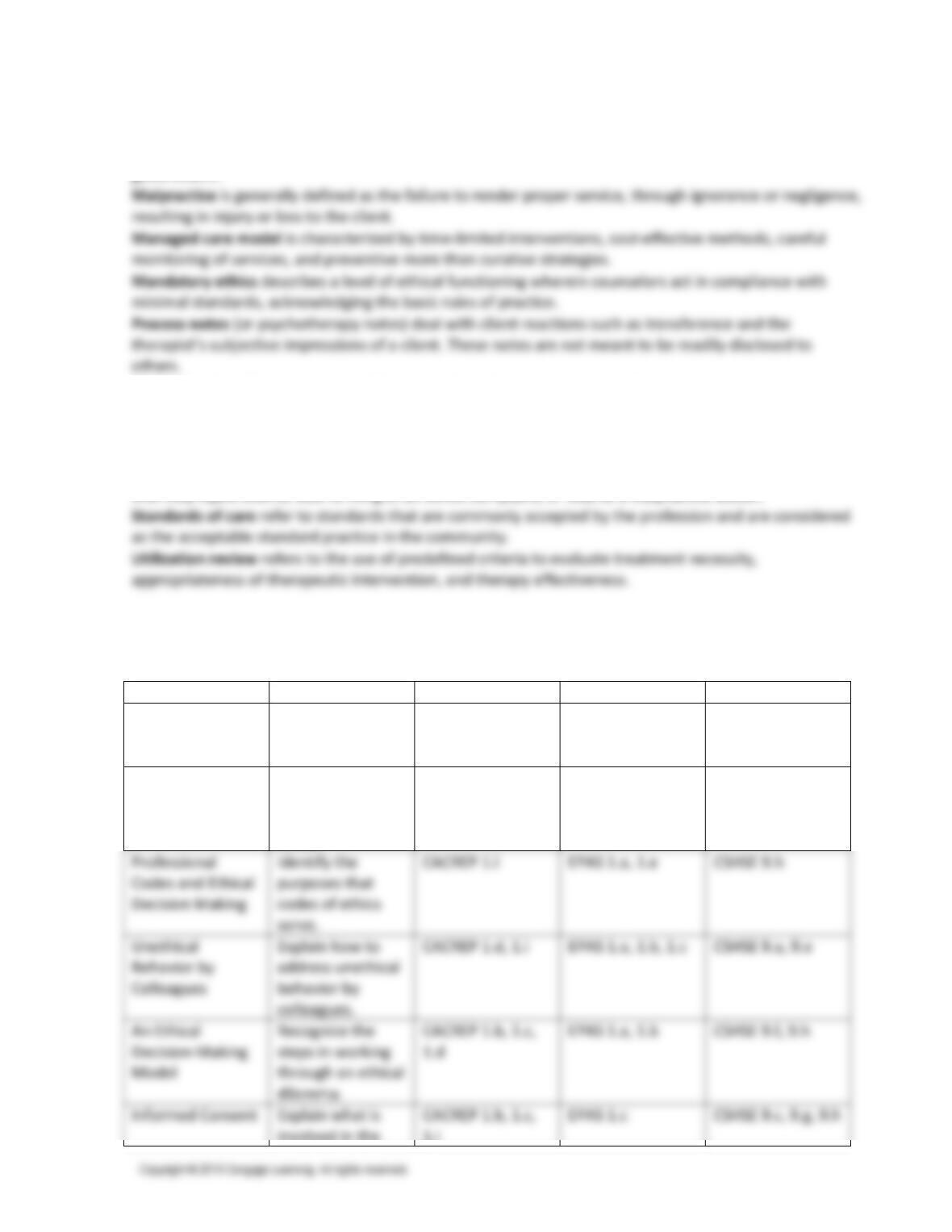
LO/STANDARDS CORRELATION CHART
A-head
LO
Standard 1
Standard 2
Standard 3
Ethical Decision
Making
Describe what is
involved in ethical
decision making.
CACREP 1.d, 1.i
EPAS 1.a, 1.e
CSHSE 9.d
Law and Ethics
Explain the
difference
between law and
ethics.
CACREP 1.i
EPAS 1.a
CSHSE 9.g
Decision Making
codes of ethics
serve.
Behavior by
Colleagues
address unethical
behavior by
colleagues.
Model
through an ethical
dilemma.
Informed Consent
Explain what is
CACREP 1.b, 1.c,
EPAS 1.c
CSHSE 9.c, 9.g, 9.h
involved in the
1.i
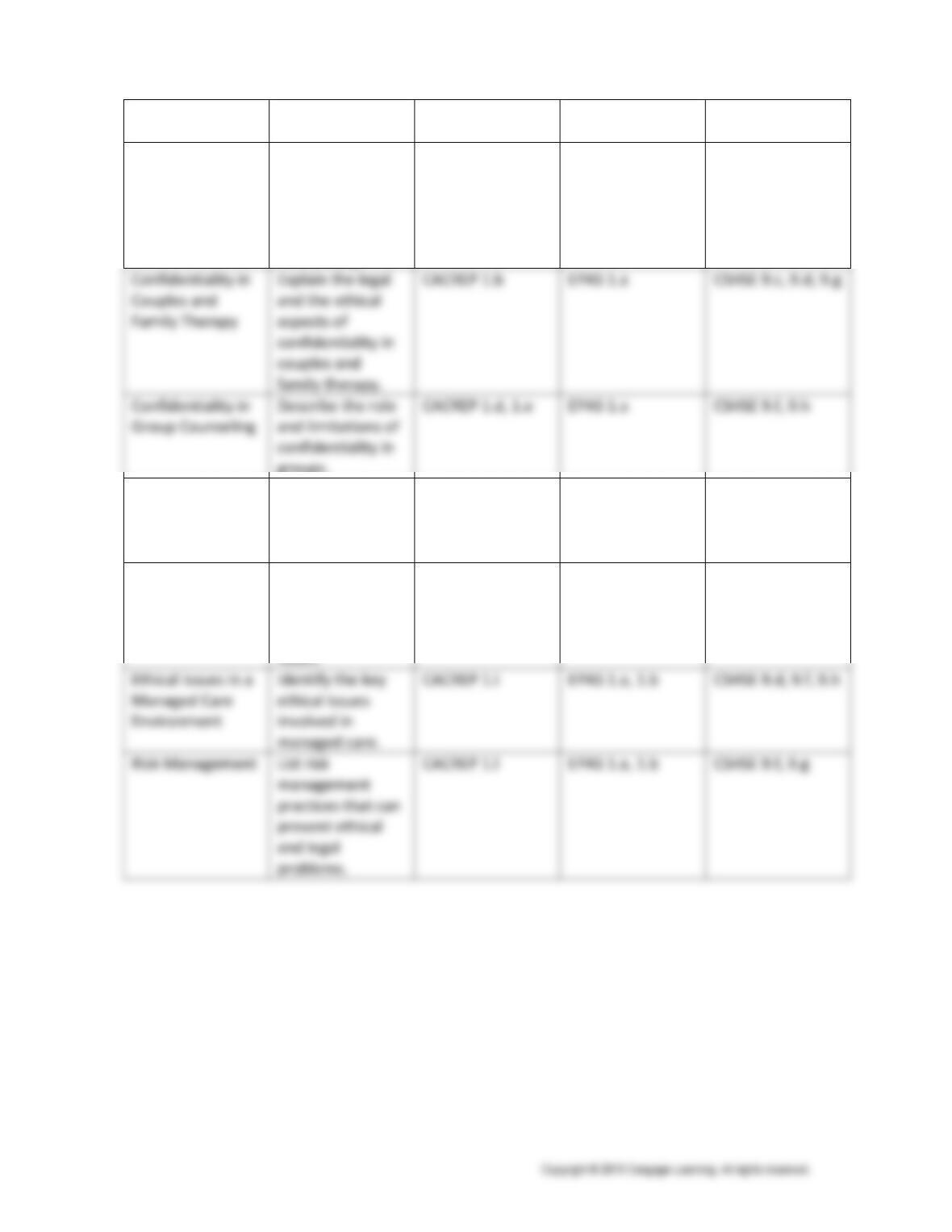
Chapter 8: Ethical and Legal Issues Facing Helpers
informed consent
process.
Confidentiality
and Privacy
Discuss how
confidentiality
and privacy form
the foundation for
a therapeutic
relationship.
CACREP 1.c, 1.d,
1.e
EPAS 1.a
CSHSE 9.c, 9.g
family therapy.
Group Counseling
and limitations of
confidentiality in
groups.
Confidentiality
and Privacy in a
Technological
World
Discuss how
confidentiality
and privacy apply
to technology.
CACREP 1.i, 1.j
EPAS 1.a, 1.d
CSHSE 9.a, 9.c, 9.g
Documentation
and Keeping
Records
notes.
Environment
involved in
managed care.
Risk Management
List risk
management
practices that can
prevent ethical
and legal
problems.
CACREP 1.l
EPAS 1.a, 1.b
CSHSE 9.f, 9.g
Explain the
difference
between progress
notes and process
CACREP 1.a
EPAS 1.b, 1.c
CSHSE 4.e