Chapter 7: Theory Applied to Practice
CHAPTER 7
Theory Applied to Practice
LEARNING OBJECTIVES
After studying this chapter, students should be able to:
•
Provide a general framework for theory applied to practice.
•
Explain how a thinking, feeling, and behaving model can serve as an integrative
approach to counseling practice.
•
Describe the key concepts and techniques of psychoanalytic approaches.
CHAPTER OUTLINE
Aim of the Chapter
Theory as a Roadmap
Our Theoretical Orientation
Psychodynamic Approaches
Psychoanalytic Approach
The Adlerian Approach
Chapter 7: Theory Applied to Practice
Narrative Therapy
Feminist Therapy
Family Systems Perspective
CHAPTER OVERVIEW
• A theoretical orientation that integrates thinking, feeling, and behaving provides the basis for
developing interventions that can be used flexibly with clients at various stages of the helping
process. A theory can be very practical in the sense that it can guide interventions.
• Because there is no one “right” theoretical approach, you would do well to consider adopting
an approach that is congruent with your personality and values. Before you can integrate the
theories, you first must study the various theories in depth. It is not possible to integrate that
which you do not know.
• Psychodynamic theories provide a foundation upon which many of the contemporary theories
have been designed.
• Experiential therapies are based on the therapist developing a quality relationship with clients.
• The postmodern approaches are based on the optimistic assumption that people are healthy,
competent, resourceful, and possess the ability to construct solutions and alternative stories that
can enhance their lives. Individuals, not therapists, are seen as the experts on their lives.
• An assumption of the systems approach is that change in any one part of the system affects all
parts of that system.
SUGGESTIONS FOR ACTIVITIES
Chapter 7: Theory Applied to Practice
1.
Stage 1: Establishing a Working Relationship.
Given that the therapeutic relationship is the
foundation for effective counseling, healing, growth, and change, working with involuntary
2.
Stage 2: Identifying Clients’ Problems.
In this role play, the counselor’s primary task is to
gather some initial information about the client including the client’s problems and
resources. In conducting an initial assessment, the counselor may want to draw from the
series of questions that are posed in the text.
3.
Stage 3: Helping Clients Create Goals.
One of the helper’s roles is to assist clients in
formulating meaningful goals. Thus, it may be a worthwhile exercise to set up a role play in
4.
Stage 4: Encouraging Client Exploration and Taking Action.
A helper’s role in this stage is
to facilitate clients in gaining new perspectives, seeing situations differently, and
5.
Stage 5: Termination.
In this role play scenario, the counselor should practice ending a
session and bringing closure to a client’s work.
6.
Effective versus Ineffective Helpers.
Students can assess the ways in which they might be
effective and/or ineffective with clients. In small groups they can generate ideas of ways to
7.
Critically Evaluating Assumptions.
Some people live in an encapsulated environment and
thereby “see” only what confirms their existing belief system. This is known as
Chapter 7: Theory Applied to Practice
8.
Motivational Interviewing Exercise.
See activity in previous chapter. Since motivational
interviewing is discussed in both chapters, you could introduce this exercise in class while
covering either Chapter 5 or 6.
9.
Brief Interventions.
Have students discuss the pros and cons of using a short-term
approach to counseling. You could also have students envision that they are asked to share
their opinion about short-term versus long-term interventions when applying for a job at
an agency.
10.
Informed Consent.
Educating clients and obtaining informed consent begins at the first
session and continues throughout the duration of the helping process. Pose the following
11.
The DSM-5.
Set up a debate in class in which students argue for or against diagnosis.
DISCUSSION QUESTIONS
1.
In the text, the authors state, “We see theory as a general framework that enables you
to make sense of the many facets of the helping process, providing you with a map that
KEY CONCEPTS AND TERMS
Adlerian approach
is based on the assumption that we are primarily social beings who are
influenced and motivated by societal forces. This approach is based on a growth model that
stresses the individual’s positive capacities to live fully in society.
Behavior therapy
emphasizes current behavior as opposed to historical antecedents, precise
Chapter 7: Theory Applied to Practice
world around us according to some purpose within us
Cognitive behavioral approaches
aim at changing cognitions that are contributing to psychological
problems. These approaches include behavior therapy, rational emotive behavior therapy,
cognitive therapy, reality therapy, and solution-focused brief therapy.
Cognitive therapy
is based on the premise that cognitions are the major determinants of how we
feel and act. This approach consists of changing dysfunctional emotions and behaviors by
modifying inaccurate and dysfunctional thinking.
Family systems perspective
views the family as a functioning unit and as an entity unto itself that
adds up to more than the sum of its members.
Family therapy
involves a conceptual shift from individual dynamics to working within a systems
framework; an approach that comprehensively addresses the other family members as well as the
“identified” client.
Gestalt experiments
take many forms and are part of a collaborative process with full participation
by the client.
Gestalt therapy
is an experiential and existential approach based on the assumption that our
behavior must be understood in the context of our present environment. This approach focuses on
the here and now, direct experiencing, awareness, bringing unfinished business from the past into
the present, and dealing with unfinished business.
Person-centered approach
is based on the assumption that the therapist’s attitudes and beliefs in
the client’s inner resources is what creates the climate for change. This approach stresses that the
client is the center of the therapeutic process and the client who primarily brings about change.
Postmodern approaches
, which include solution-focused brief therapy and narrative therapy, are
based on the premise that the therapist disavows the role of expert, preferring a more
collaborative and consultative stance. These approaches are based on the optimistic assumption
that people are healthy, competent, resourceful, and possess the ability to construct solutions and
Chapter 7: Theory Applied to Practice
session about presession improvements or anything clients have done since scheduling the
appointment that has made a difference in their problems.
Psychoanalytic approach
focuses on the influence of past as a determinant of current personality
functioning.
Psychodynamic approaches
include psychoanalytic therapy and Adlerian therapy.
Rational emotive behavior therapy
is based on the assumption that thinking, evaluating,
analyzing, questioning, doing, practicing, and redeciding are at the basis of behavior change.
Social interest
is the sense of connectedness with others and the desire to contribute usefully to
society by dealing with the tasks of work, friendship, and intimacy— a sense of identification and
empathy with others, a feeling of belonging, and striving for a better future for humanity.
Solution-focused brief therapy
is a postmodern approach that provides a context whereby
individuals focus on recovering and creating solutions rather than talking about their problems.
Summary feedback
refers to comments the therapist makes to clients at the end of a session; this
feedback involves genuine affirmations or pointing out particular strengths that clients have
demonstrated.
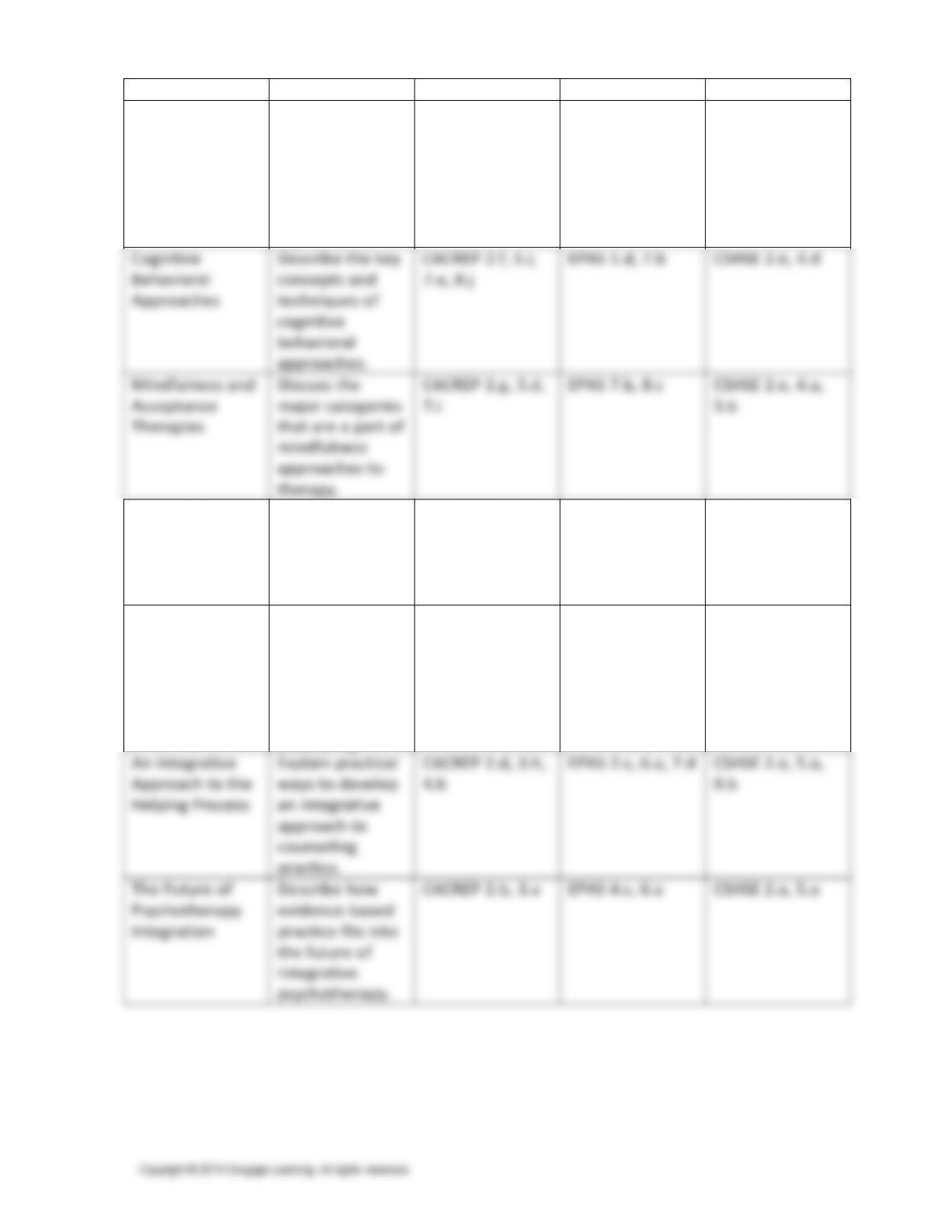
LO/STANDARDS CORRELATION CHART
A-head
LO
Standard 1
Standard 2
Standard 3
Theory as a
Roadmap
Provide a
general
framework for
theory applied to
practice.
CACREP 2.b, 4.a,
5.a
EPAS 6.a
CSHSE 2.a, 6.a
Chapter 7: Theory Applied to Practice
approaches.
Experiential and
Relationship–
Oriented
Approaches
Describe the key
concepts and
techniques of
experiential and
relationship–
oriented
approaches.
CACREP 1.d, 5.f
EPAS 6.b, 7.d
CSHSE 7.c, 9.d
Behavioral
Approaches
concepts and
techniques of
cognitive
behavioral
approaches.
7.e, 8.j
Mindfulness and
Acceptance
Therapies
Discuss the
major categories
that are a part of
mindfulness
approaches to
therapy.
CACREP 2.g, 5.d,
7.i
EPAS 7.b, 8.c
CSHSE 2.e, 4.a,
5.b
Postmodern
Approaches
Describe the key
concepts and
techniques of
postmodern
approaches.
CACREP 2.b, 4.b,
5.d
EPAS 6.b, 7.d,
8.b
CSHSE 2.f, 6.b,
9.d
Family Systems
Perspective
Explain the
unique ways
family systems
approaches
differ from
individual
counseling.
CACREP 3.a, 6.b
EPAS 1.b, 6.b
CSHSE 2.f, 7.b
Approach to the
Helping Process
ways to develop
an integrative
approach to
counseling
practice.
4.b
9.b
Psychotherapy
Integration
evidence-based
practice fits into
integrative
psychotherapy.