Chapter 5: Common Concerns of Beginning Helpers
CHAPTER 5
Common Concerns of Beginning Helpers
LEARNING OBJECTIVES
After studying this chapter, students should be able to:
•
Identify self-doubts about becoming a helper.
•
Explain the differences between transference and countertransference.
CHAPTER OUTLINE
Aim of the Chapter
Exploring Self-Doubts and Fears
Transference and Countertransference
Various Forms of Transference
Understanding and Working With Transference Therapeutically
Working With Transference in Group Counseling
CHAPTER OVERVIEW
• Effective helpers must become aware of clients’ transference and of their own countertransference.
Neither of these factors is to be eliminated but is to be understood and attended to therapeutically.

Chapter 5: Common Concerns of Beginning Helpers
• Defensive behavior and reluctance take many forms, and it is necessary to understand the ways in
which they protect clients. Not all cautiousness or reluctance stems from stubbornness on the part of
the client. Some can be caused, or at least contributed to, by the attitudes and behaviors of helpers.
• The goal in a helping relationship is not to eliminate defensive behavior but to understand what
• Competence is both an ethical and a legal concept, and striving for competence is a lifelong journey.
• Ethics codes explicitly state that it is unethical to practice outside the boundaries of your competence.
It is essential that you be able to make an accurate assessment of your knowledge and skills to
Chapter 5: Common Concerns of Beginning Helpers
• One of the best ways of keeping on the cutting edge of one’s profession is to become involved in a
peer-consultation group that affords professionals opportunities to share their concerns and learn
from one another. Through peer groups, helpers can actively contribute to their own personal and
professional development and that of their colleagues.
SUGGESTIONS FOR ACTIVITIES
1. Exploring Self-Doubts and Fears. On pages 3–5, you will find a questionnaire aimed at helping
dyads, small groups, or the entire class.
2. Identifying Potential Countertransference. On pages 12–21 is a discussion of
3. Working With Clients Who Manifest Problematic Behavior. There is an attitude questionnaire
on understanding and working with problematic behavior displayed by clients [see pages 22 and
23]. After students take this inventory, they could share their responses in either small groups or
4. Working With Client Transference. Choose a few forms of transference that are described in the
text and have students role-play how they would deal with those projections. For instance, one
5. Motivational Interviewing Exercise. Within the MI framework, reluctance to change is regarded
as a normal and expected part of the therapeutic process. Ask students to think about a problem
Chapter 5: Common Concerns of Beginning Helpers
6. Striving for Competence. In this chapter we explore striving for competence, a lifelong endeavor
which is best thought of as a process rather than as something we achieve once and for all. We
7. Making a Referral. Have students engage in the following role play: The counselor feels the need
to refer the client, who suffers from an eating disorder, due to a lack of competence and training
DISCUSSION QUESTIONS
1. Look over the list of statements indicating self-doubts in this section. What negative
messages are you telling yourself, and how might you begin to critically evaluate them if they
are not serving you well?
KEY CONCEPTS AND TERMS
Competence, the personal and professional abilities, knowledge, and skills needed to work with clients,
is a process rather than something we achieve once and for all. It involves ethical and legal dimensions.
Countertransference involves the unrealistic reactions helpers have toward their clients that can
interfere with their objectivity.
Passive-aggressive behavior involves behavioral patterns that clients have learned to use in defending
themselves from hurt by dealing with people indirectly, often with sarcasm.
Political countertransference can be evoked by the helper’s reactions to highly charged political issues.
Political transference occurs when clients project onto helpers reactions to the political context that
has shaped their experience.
Resistance pertains to behavior that keeps us from exploring personal conflicts or painful feelings. It is a
Chapter 5: Common Concerns of Beginning Helpers
process by which we attempt to protect ourselves from anxiety and defend ourselves from pain.
Transference is a process that often operates on the unconscious level and involves clients projecting
onto a helper past feelings or attitudes they had toward significant people in their lives.
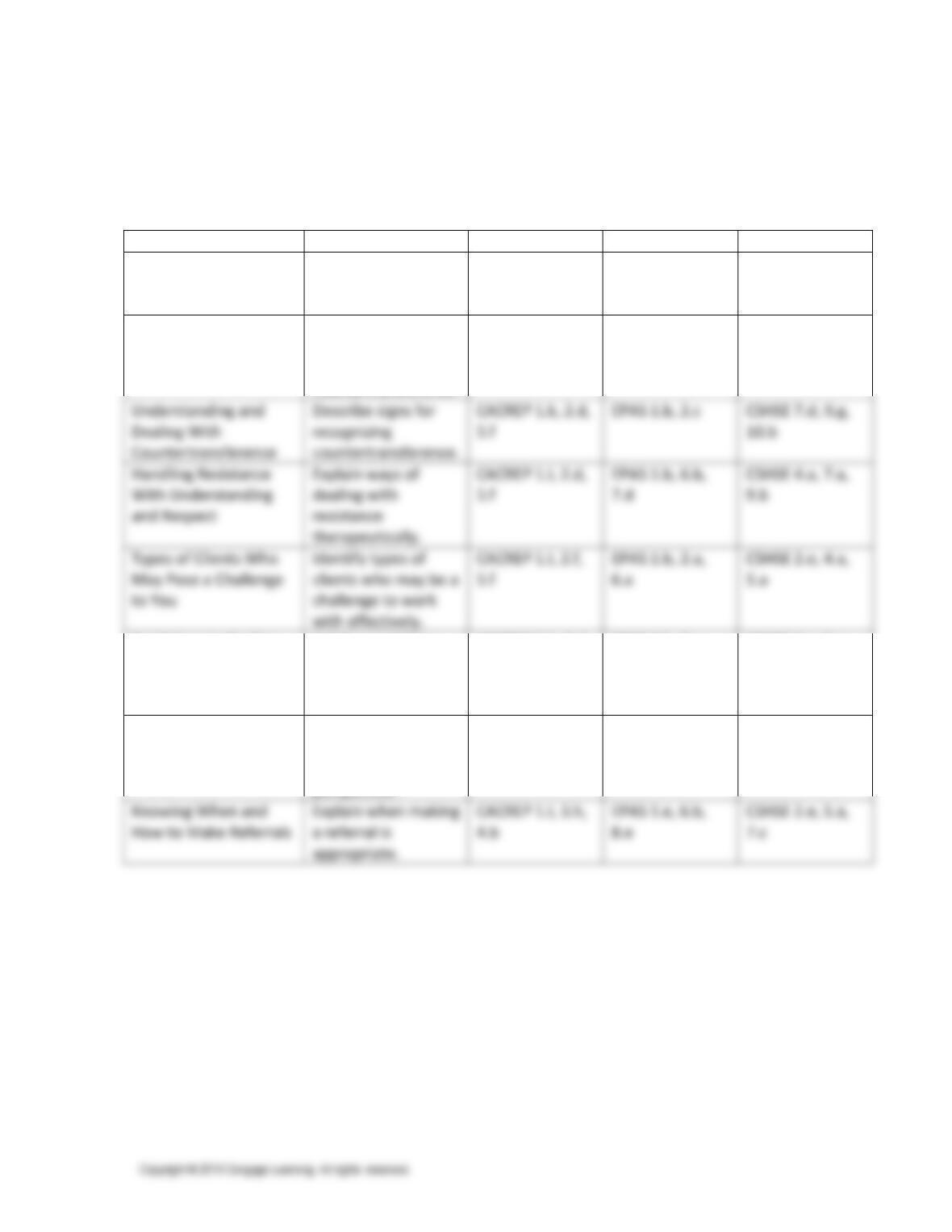
LO/STANDARDS CORRELATION CHART
A-head
LO
Standard 1
Standard 2
Standard 3
Exploring Self-Doubts
and Fears
Identify self-doubts
about becoming a
helper.
CACREP 1.k, 4.e,
5.f
EPAS 1.b, 2.c, 9.c
CSHSE 2.e, 5.a,
10.b
Transference and
Countertransference
Explain the
differences between
transference and
countertransference.
CACREP 2.e, 5.f
EPAS 1.b, 7.a,
9.b
CSHSE 4.a, 5.c,
10.b
Understanding and
Dealing With
Countertransference
Describe signs for
recognizing
countertransference.
CACREP 1.k, 2.d,
5.f
EPAS 1.b, 2.c
CSHSE 7.d, 9.g,
10.b
Handling Resistance
With Understanding
and Respect
Explain ways of
dealing with
resistance
therapeutically.
CACREP 1.I, 2.d,
5.f
EPAS 1.b, 6.b,
7.d
CSHSE 4.a, 7.a,
9.b
Types of Clients Who
May Pose a Challenge
to You
Identify types of
clients who may be a
challenge to work
with effectively.
CACREP 1.I, 2.f,
5.f
EPAS 1.b, 2.a,
6.a
CSHSE 2.e, 4.a,
5.a
Guidelines in Dealing
Effectively With
Ambivalence and
Reluctance
List five guidelines
for dealing
effectively with
ambivalence.
CACREP 1.k, 2.d,
4.e, 5.f
EPAS 1.b, 2.c,
6.b
CSHSE 2.e, 5.a,
7.c
Striving for
Competence
Describe
competence from an
ethical and legal
perspective.
CACREP 1.k, 3.I,
4.j
EPAS 1.e, 5.a,
9.b
CSHSE 2.e, 5.b,
7.d
Knowing When and
How to Make Referrals
Explain when making
a referral is
appropriate.
CACREP 1.I, 3.h,
4.b
EPAS 1.e, 6.b,
8.e
CSHSE 2.e, 5.a,
7.c