Chapter 4: Understanding Diversity
CHAPTER 4
Understanding Diversity
LEARNING OBJECTIVES
After studying this chapter, students should be able to:
•
Describe the components of a multicultural perspective on helping.
•
Explain the concept of cultural tunnel vision.
CHAPTER OUTLINE
Aim of the Chapter
A Multicultural Perspective on Helping
The Need for a Multicultural Emphasis
Ethical Dimensions in Multicultural Practice
Overcoming Cultural Tunnel Vision
Examining Stereotypes Pertaining to Physical Disabilities
Pushing Through Perceived Limitations
Multicultural Counseling Competencies
Beliefs and Attitudes of Culturally Skilled Helpers
CHAPTER OVERVIEW
•
Multiculturalism recognizes and values diversity in helping relationships and calls on
helpers to develop strategies that are culturally appropriate.
Chapter 4: Understanding Diversity
• To function effectively with clients of various cultures, helpers need to know and respect
specific cultural differences and realize how cultural values operate in the helping process.
• Be aware of any tendencies toward cultural tunnel vision. If you have limited cultural
experiences, you may have difficulties relating to clients who have a different view of the
world. You are likely to misinterpret many patterns of behavior displayed by these clients.
• Microaggressions related to a person’s gender, sexual orientation, or disability can be as
powerful and potentially destructive as are racial microaggressions.
• Helpers must be committed to continually monitoring their political countertransference
so their biases and assumptions do not contaminate the therapeutic process.
• In working with people from other cultures, avoid stereotyping and critically evaluate your
assumptions about the use of self-disclosure, nonverbal behavior, trusting relationships,
self-actualization, and directness and assertiveness.
• Acquiring and refining multicultural and social justice competencies should be thought of
as a lifelong developmental process that requires ongoing self-reflection, training, and
Chapter 4: Understanding Diversity
education.
SUGGESTIONS FOR ACTIVITIES
1.
Why Does Cultural Diversity Matter?
Throughout this chapter, we’ve emphasized that
embracing culture can make professional work meaningful. Perhaps one of the most
important lessons is for students to begin to explore messages they’ve picked up about
others who are different from them that tend to lead to prejudice and isolation. It would be
a step forward for students to simply acknowledge some of their biases and begin to open
2.
Tips for Expanding Cultural Tunnel Vision.
It is essential for students to adhere to basic
guidelines of respect as people are talking. The classroom should not be turned into a place
where people ventilate or attack any cultural group. Although students may get emotionally
involved in certain topics, it is important that they avoid being judgmental or telling others
how they should think and act. Actually, this advice applies not only to the topic of diversity
Chapter 4: Understanding Diversity
◼
Understand your own background and biases. Admit it and deal with it.
◼
See diversity as a strength, not something merely to be tolerated.
◼
Look for similarities that unite us, and look for common ground.
3.
Guest Speakers.
Invite people from different cultural groups to come to class and discuss
their cultural identity. Ask representatives from various ethnic/cultural student clubs to
people from different cultural groups.
4.
Video on Racism.
The Color of Fear is an outstanding video that would be most timely to
show in class when you are dealing with the theme of diversity. It is available from StirFry
5.
Personal Background Paper.
Have each student interview family members to get a history
of their cultural background and identity. Depending on the amount of time you can devote
to this chapter, and the purpose of your course, this can be either a required assignment or
an extra credit project. Following are some suggestions to students in organizing this paper.
Background:
Describe your ethnic, racial, and cultural background. Some possible questions include
the following:
◼
What generation in the U.S. do you represent?
◼
Where do your ancestors come from?
Chapter 4: Understanding Diversity
◼
Did they or you experience rejection or prejudice based on race, religion, or
nationality?
Gender Roles:
What, if any, gender stereotypes were you taught as you were growing up? What
were the main expectations for males and females for each of the following?
◼
Education
◼
Importance of individual versus family
Personal Reflection:
Explore the following questions related to your life and your future as a helping
professional.
◼
How do you think your unique background has influenced your personal
expectations, beliefs, and life goals as a woman or man?
6.
Cultural Interview Paper.
Ask the students to interview an individual or family from a
culture other than their own. Depending on the time available, consider making the cultural
interview paper either a basic requirement or an extra credit project. You may give students
an option between selecting the personal background paper or this cultural interview paper.
Chapter 4: Understanding Diversity
◼
Attitudes about mainstream U.S. culture
◼
Social class
◼
Cultural values
7.
Continuing Your Cultural Awareness Journey.
You may want to encourage your students to
enroll in a cultural diversity course as an elective, if such as course is not a basic
awareness and understanding of cultural diversity.
8.
Social Justice Competencies.
Provide students with a copy of the ACA Advocacy
Competencies that were developed by Lewis, Arnold, House, and Toporek in 2002 and
9.
Examining Cultural Assumptions.
The text states that, whether we are aware of them or
not, cultural assumptions significantly influence the ways in which we perceive and think
10.
Debate on Multicultural Education.
In the case of Mac (see text), the question is raised
about whether one should exclusively rely on the client for information about the client’s
cultural background. Some helpers may hold the view that “the client will tell you all you
11.
Political Countertransference.
A helper may have a strong personal reaction to a highly
charged political issue such as terrorism, abortion, immigration reform, or gay marriage.
Chapter 4: Understanding Diversity
12.
Cultural Values.
Since seeking professional help is not typical for many people from diverse
backgrounds, helpers need to expand their perception of mental health practices to include
13.
Serving People With Disabilities.
Helpers’ attitudes are a key factor in successfully
intervening in the lives of people with disabilities. There are a number of ways to work with
this material in class. You could
▪
initiate a dialogue among students about common stereotypes of people dealing
with different types of disabilities and assumptions that the students have about
them,
14.
Ethics in Action
Video Exercises.
This section
at the end of the chapter may give you
some ideas for role-playing scenarios for students.
DISCUSSION QUESTIONS
1.
When you become a helper, you will encounter many individuals from cultures different
from your own. What challenges do you expect to meet in working with diverse client
populations?
KEY CONCEPTS AND TERMS
Chapter 4: Understanding Diversity
Broaching behavior
refers to having an ongoing and consistent attitude of openness with a
genuine commitment by the counselor to continually invite the client to explore issues of diversity.
Cultural pluralism
recognizes the complexity of cultures and values the diversity of beliefs and
values.
Cultural tunnel vision
is a perception of reality that is based on a severely limited set of cultural
experiences.
Modern racism
is any pattern of behavior that, solely because of race or culture, denies access to
opportunities or privileges to members of one racial or cultural group while perpetuating access to
opportunities and privileges to members of another racial or cultural group. Modern racism is
often subtle, indirect, and unintentional, which allows people to remain oblivious to its existence.
Multicultural
is a term that often refers to five major cultural groups in the United States and its
territories: African/Black, Asian, European/White, Hispanic/Latino, and Native American.
Multicultural competence
refers to the ability of practitioners to effectively address diversity
concerns in their work.
Political countertransference
describes a helper’s personal reaction to the political context in
which he or she works with clients.
Racial microaggressions
are brief and commonplace daily verbal, behavioral, or environmental
indignities, whether intentional or unintentional, that communicate hostile, derogatory, or
negative racial slights and insults.
Social justice
in counseling represents a multifaceted approach in which counselors strive to
simultaneously promote human development and the common good through addressing
challenges related to both individual and distributive justice. This approach includes
empowerment
Chapter 4: Understanding Diversity
Stereotyping
pertains to oversimplified and uncritical generalizations about individuals who are
identified as belonging to a specific group.
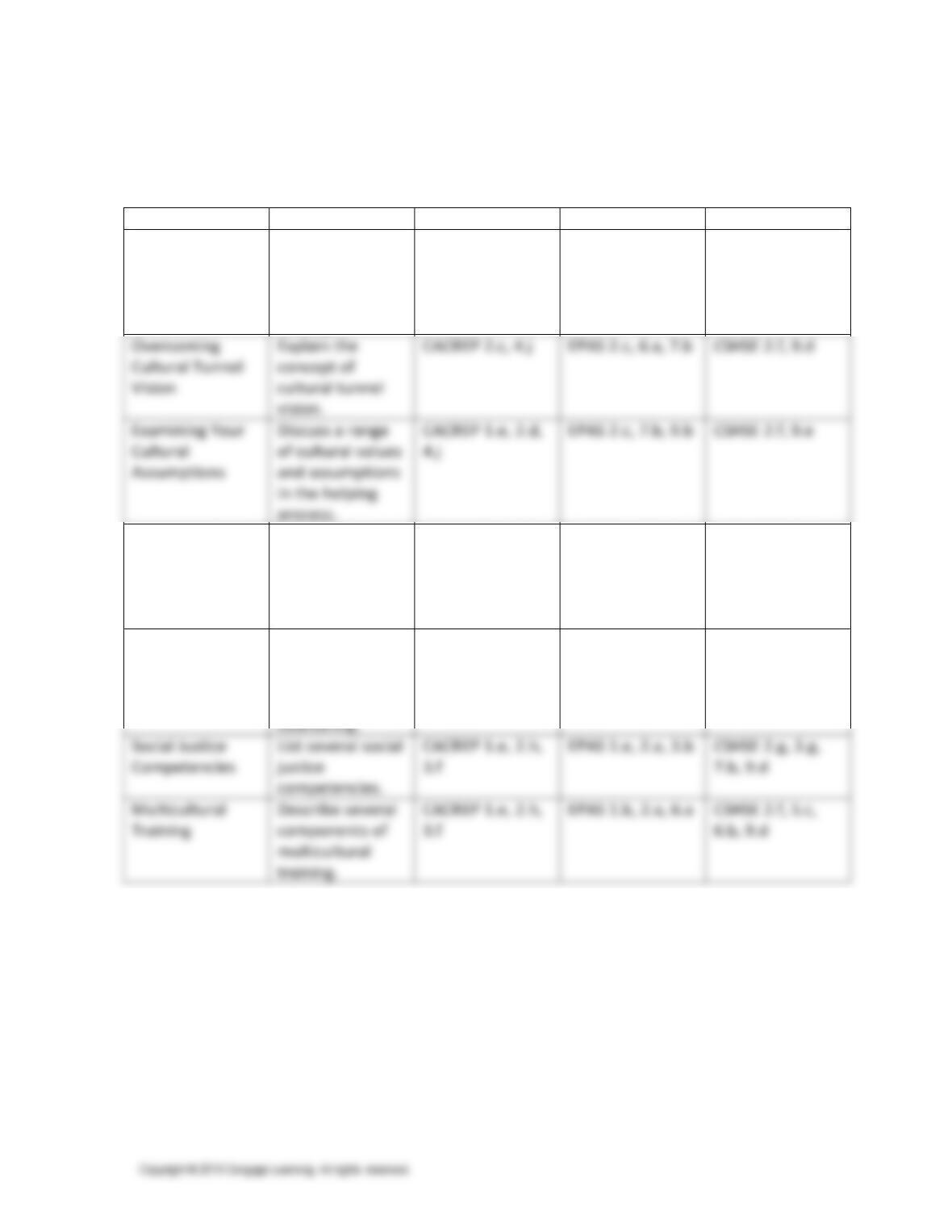
LO/STANDARDS CORRELATION CHART
A-head
LO
Standard 1
Standard 2
Standard 3
A Multicultural
Perspective on
Helping
Describe the
components of a
multicultural
perspective on
helping.
CACREP 2.a, 4.j
EPAS 2.a, 6.a
CSHSE 2.f, 9.d
Vision
cultural tunnel
vision.
Examining Your
Cultural
Assumptions
Discuss a range
of cultural values
and assumptions
in the helping
process.
CACREP 1.e, 2.d,
4.j
EPAS 2.c, 7.b, 9.b
CSHSE 2.f, 9.e
Understanding
People With
Disabilities
Describe the
ethical issues in
working with
people with
disabilities.
CACREP 2.d, 3.h,
4.b, 5.d
EPAS 2.c, 6.b, 7.d
CSHSE 2.f, 9.g,
10.c
Multicultural
Counseling
Competencies
counseling.
Social Justice
Competencies
List several social
justice
competencies.
CACREP 1.e, 2.h,
3.f
EPAS 1.e, 2.a, 3.b
CSHSE 2.g, 3.g,
7.b, 9.d
Multicultural
Training
Describe several
components of
multicultural
training.
CACREP 1.e, 2.h,
3.f
EPAS 1.b, 2.a, 6.a
CSHSE 2.f, 5.c,
6.b, 9.d
Discuss the steps
for acquiring
competence in
multicultural
CACREP 2.c, 4.j
EPAS 2.c, 6.a, 7.d
CSHSE 2.f, 9.d,
10.c