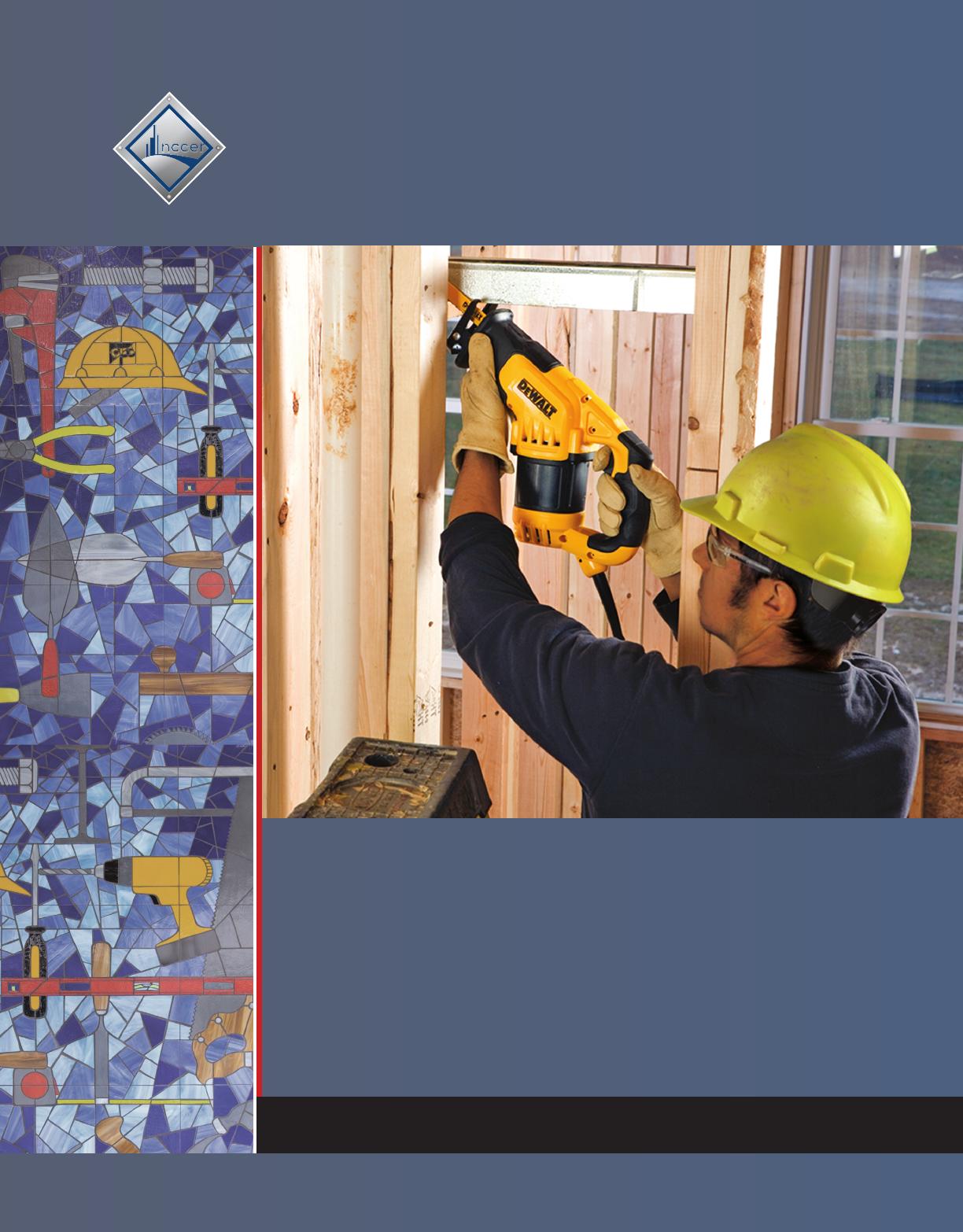
Module Four
Core CurriCulum
Lesson Plans for Instructors
Introduction to
Power Tools
00104-15
Lesson Plans for Module 00104–15
IntroductIon to Power tools
Module Four (00104–15) identifies and describes some of the power tools used by construction workers. The con–
struction of each tool is discussed, along with information regarding the safe usage and typical maintenance re–
quirements of power tools. NOTE: Trainees are required to successfully complete Module 00101–15, Basic Safety
(Construction Site Safety Orientation) before studying this module.
Teaching Time: 10 hours
(Four 2.5–Hour Classroom Sessions)
Session time may be adjusted to accommodate your class size, schedule, and teaching style.
Prerequisites
Core Curriculum Modules 00101-15; 00102-15; and 00103–15.
Before You Begin
Objectives
Learning Objective 1
• Identify and explain how to use various types
of power drills and impact wrenches.
Learning Objective 2
• Identify and explain how to use various types
of power saws.
a. Identify and explain how to use a circular
saw.
b. Identify and explain how to use saber and
reciprocating saws.
c. Identify and explain how to use a portable
band saw.
d. Identify and explain how to use miter and
cutoff saws.
Learning Objective 3
• Identify and explain how to use various grind–
ers and grinder attachments.
Learning Objective 4
• Identify and explain how to use miscellaneous
power tools.
a. Identify and explain how to use pneumatic
Performance Tasks
Performance Task 1
(Learning Objectives 1 through 4)
• Safely and properly demonstrate the use of
three of the following tools:
– Electric drill
– Hammer drill or rotary hammer
– Circular saw
– Reciprocating saw
– Portable band saw
– Miter or cutoff saw
– Portable or bench grinder
– Pneumatic nail gun
– Pavement breaker
00104-15 Introduction to Power Tools Module Four i
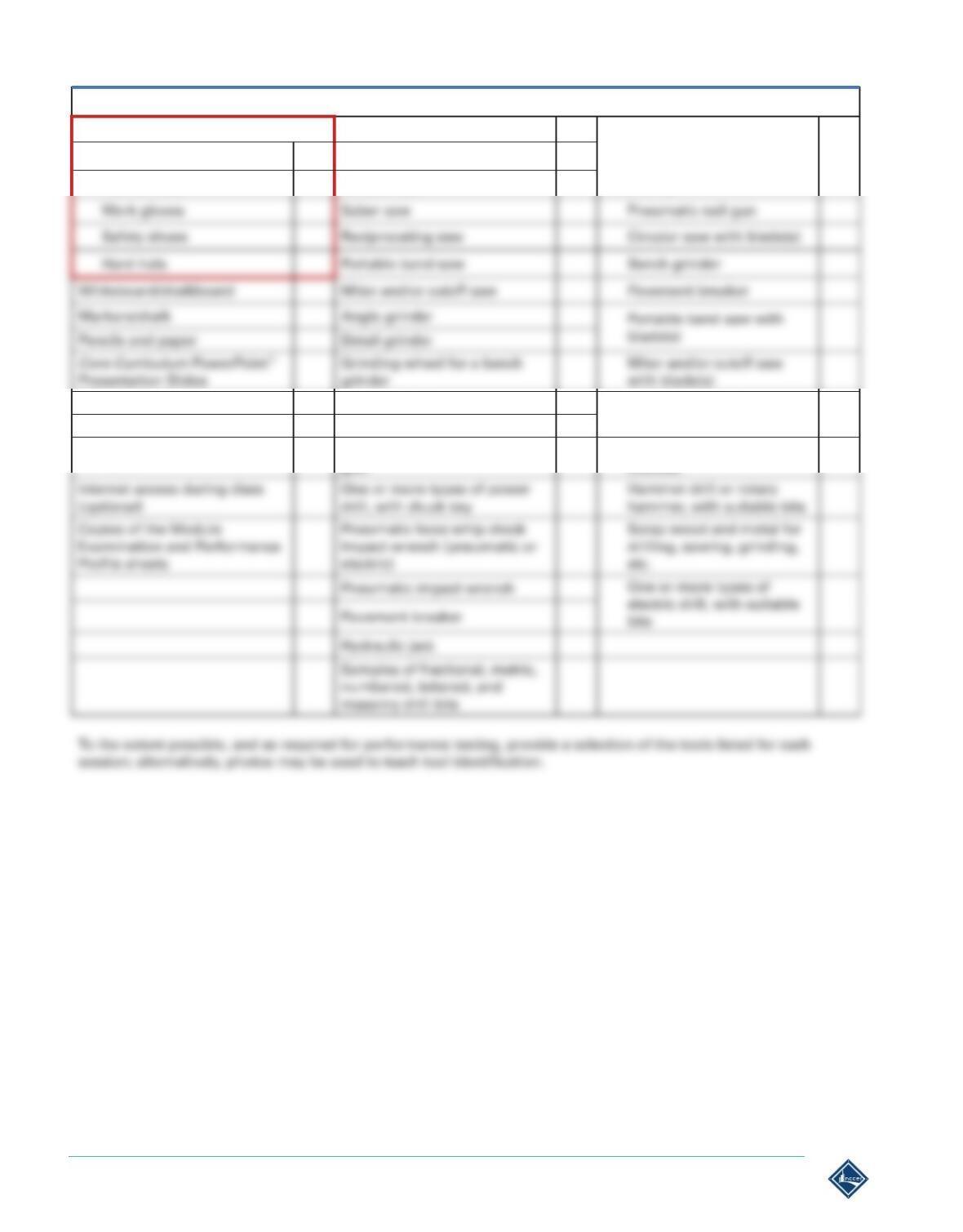
Classroom Equipment
and Materials
Whiteboard/chalkboard
Markers/chalk
Pencils and paper
Core Curriculum PowerPoint®
Presentations
DVD player
LCD projector and screen
Computer
Internet access during class
(optional)
Copies of the Module Examination
Safety Considerations
This module requires that trainees handle and demonstrate the proper use of various power tools. Because
this is likely the first module for new trainees that requires them to work with energized tools and equipment,
Additional Resources
This module presents thorough resources for task training. The following resource material is suggested for
further study.
29 CFR 1926, OSHA Construction Industry Regulations, Latest Edition. Washington, DC: Occupational Safety
and Health Administration, U.S. Department of Labor, U.S. Government Printing Office.
All About Power Tools, Ortho books; Larry Johnston, ed. 2002. Des Moines, IA: Meredith Books.
ii NCCER – Core Curriculum 0 010 4 -15
Appropriate PPE:
Safety glasses
Face shields
Work gloves
Safety shoes
Hard hats
One or more types of power drill,
with chuck key
Hammer drill
Samples of fractional, metric,
numbered, lettered, and masonry
drill bits
Grinding wheel for a bench grinder
Pneumatic nail gun
Powder-actuated fastening gun
Pneumatic impact wrench
Pavement breaker
Hydraulic jack
A minimum of three of the following
power tools are required to conduct
the laboratory:
One or more types of electric drill,
with suitable bits
Equipment and Materials for Laboratories and
Performance Testing
00104-15 Introduction to Power Tools Module Four iii
The Lesson Plan for this module is divided into four 2.5–hour sessions.
This time includes 10 minutes for administrative tasks and a 10–minute break per session.
IntroductIon to Power tools
Session Outline for 00104–15
SeSSion one
Session One introduces various types of power
drills and several types of saws.
saws.
SeSSion Two
Session Two presents additional saws,
including band saws and miter saws. Also
introduced are grinders and miscellaneous
power tools.
SeSSion Three
Session Three is a laboratory session devoted
to the practice and completion of Performance
Task 1.
SeSSion Four
Session Four is a review and testing session.
Have trainees complete the Module Review and
Trade Terms Quiz. Go over the Module Review
and Trade Terms Quiz in class prior to the exam
and answer any questions that the trainees may
iv NCCER – Core Curriculum 0 010 4 -15
Materials Checklist for Module 00104-15, Introduction to Power Tools
Equipment and Materials
Personal protective equipment: Hammer drill A minimum of three of the
following power tools are
required to conduct the
laboratory:
Safety glasses Pneumatic drill
Face shields Circular saw
DVD player Bench grinder Angle grinder with grinding
wheel(s)
LCD projector and screen Pneumatic nail gun
Computer Powder-actuated fastening
gun
Reciprocating saw with
blade(s)
00104-15 Introduction to Power Tools Module Four 1
drIlls; saws, Part one
Classroom Session 1 for 00104–15
Safety Considerations
The following safety considerations should be emphasized when introducing trainees to power tools:
Remind trainees that some forms of PPE may be required any time they are in the shop or on a job site.
Safety Equipment
Safety glasses
Work gloves
Classroom and/or Lab Equipment
One or more types of power drill, with chuck key
Hammer drill
Samples of fractional, metric, numbered, lettered, and masonry drill bits
Pneumatic drill
Pneumatic hose whip check
Resources
No specific resources are required for this session.
Kickoff Activity
Visit the web site of the Power Tool Institute, Inc., located at www.powertoolinstitute.com. Use the
2 NCCER – Core Curriculum 0 010 4 -15
drIlls; saws, Part one
Classroom Session 1 for 00104–15
Session Objectives
When trainees have completed this session, they should be able to do the following:
1. Identify and explain how to use various types of power drills and impact wrenches.
a. Identify and explain how to use common power drills and bits.
Session Performance Requirements
Trainees will not complete a Performance Task during this session.
Instructional Outline
Research has shown that varying instructional methods periodically throughout class sessions helps to
engage and hold trainees’ attention. The Core Curriculum PowerPoint® presentation that you received
with this lesson plan is keyed to the sections of the Trainee Guide indicated below and has been
designed for use with this lesson plan.
Classroom: Section 1.0.0
Classroom: Section 1.1.0
Describe power drills and identify the types of power drills that will be presented. Talk about the
operation of variable-speed models. Describe the different types of drill bits and how they are sized.
Discuss drill chucks. Introduce right-angle drills.
Teaching Tip
As various types of drills and saws are discussed during this session, allow trainees to examine any
Classroom: Section 1.1.1
Introduce cordless drills. Talk about charging and explain that the health and longevity of the battery
must be considered in its care and charging. Point out that many drills have adjustable clutches used
for driving screws and similar hardware.
00104-15 Introduction to Power Tools Module Four 3
drIlls; saws, Part one
Classroom Session 1 for 00104–15
Classroom: Section 1.1.2
Describe an electromagnetic drill. Explain that the electromagnet must be powered electrically along
with the drill. Use the figure to describe how it is operated.
Classroom: Section 1.1.3
Explain how to install a drill bit or other tool into a drill chuck. Point out that keyed chucks with three
Classroom: Section 1.1.4
Discuss the importance of GFCI use. Explain how a GFCI device works. Stress the need to confirm
what is on the opposite side of the workpiece or wall before drilling. Remind trainees that the chuck
key must be removed from the chuck. Emphasize that a stable stance is required to properly control the
drill. Review the safety concerns specifically related to electromagnetic drills.
Classroom: Sections 1.2.0–1.2.1
Explain how a hammer drill works. Point out that special bits are required for masonry drilling.
Classroom: Sections 1.3.0–1.3.1
Discuss the use of compressed air to power a tool.
Identify when a pneumatic drill might be chosen. Identify the common pneumatic drill sizes.
Classroom: Sections 1.3.2–1.3.4
Describe pneumatic impact wrenches and how they are used.
Explain that the compressed air supply must be set to the proper pressure. Describe how to connect the
air source and install a whip check.
Review the safety considerations for working with pneumatic drills.
Classroom: Sections 2.0.0–2.1.0
Identify the types of power saws that will be discussed in this section.
4 NCCER – Core Curriculum 0 010 4 -15
Classroom Session 1 for 00104–15
drIlls; saws, Part one
Classroom: Section 2.1.1
Discuss the proper PPE for circular saw use. Explain that the saw must be set to allow the blade to
penetrate the material, but not extend through the workpiece farther than necessary. Describe how to
properly mark cutting lines, considering the kerf. Talk about how to properly guide and control the saw.
Classroom: Section 2.1.2
Emphasize that the saw blade should be properly installed and the guards must be in place before
a clean, sharp blade. Note that oil and grease should be avoided.
Classroom: Sections 2.2.0–2.2.1
Introduce saber and reciprocating saws and explain they provide the same sawing action. Describe the
saber saw and talk about its versatility in detailed work. Point out that the cutting action only occurs
in one direction, and that it is when the blade is moving toward the tool. Discuss the different types of
blades available. Explain how to make use of variable- or multi-speed models.
Classroom: Section 2.2.2
Compare and contrast saber saws and larger reciprocating saws. Point out that the reciprocating saws
are excellent for demolition work. Describe variable- and multi-speed models. Discuss the two types of
baseplates encountered.
Classroom: Section 2.2.3
Emphasize the need for securing the workpiece, pointing out that saber and reciprocating saws are
often used to cut fixed construction components as well. Explain that the saw blades may dull quickly.
Discuss the need to apply the right amount of pressure to the saw.
Classroom: Section 2.2.4
Discuss the safe operation of saber saws and reciprocating saws. Stress that sharp blades are required to
make good, fast cuts. Emphasize that the operator must be aware of any objects inside or on the opposite
Wrap Up
Consider a role reversal; have trainees guide you. Describe some basic tasks to be done with a drill or
saw that was presented in this session. Ask trainees to provide you with verbal step-by-step guidance
to complete each of the tasks properly and safely, while you manipulate the de-energized power tool.
Homework
Assign the reading of Sections 2.3.0 through 4.3.1. Have trainees complete the 1.0.0, 2.0.0, 3.0.0, and
4.0.0 Section Reviews as they complete the reading assignment.
00104-15 Introduction to Power Tools Module Four 5
saws, Part two; other tools
Classroom Session 2 for 00104–15
Safety Considerations
The following safety consideration should be emphasized when introducing trainees to power tools:
Remind trainees that some forms of PPE may be required any time they are in the shop or on a job site.
Safety Equipment
Safety glasses
Work gloves
Classroom and/or Lab Equipment
Portable band saw
Miter and/or cutoff saw
Angle grinder
Resources
No specific resources are required for this session.
Kickoff Activity
Return to the web site of the Power Tool Institute, Inc., located at www.powertoolinstitute.com. Use
the Safety Video tab and locate the video entitled Angle Grinder Safety. This 22-minute video explores
the use of angle grinders and their safe use. Due to its length, instructors may wish to review the video
and select only certain portions for viewing. Note that this video is also available in Spanish.
Session Objectives
When trainees have completed this session, they should be able to do the following:
2. Identify and explain how to use various types of power saws.
6 NCCER – Core Curriculum 0 010 4 -15
Classroom Session 2 for 00104–15
saws, Part two; other tools
4. Identify and explain how to use miscellaneous power tools.
a. Identify and explain how to use pneumatic and powder-actuated fastening tools.
b. Identify and explain how to use pavement breakers.
c. Identify and explain the uses of hydraulic jacks.
Session Performance Requirements
Trainees will not complete a Performance Task during this session.
Instructional Outline
Research has shown that varying instructional methods periodically throughout class sessions helps to
Review
Review the answers to the 1.0.0 through 4.0.0 Section Reviews.
Classroom: Section 2.3.0
Introduce the portable band saw and explain that it is primarily used for cutting metal. Describe the
blade and point out that band saws operate at relatively low speeds.
Teaching Tip
As various types of saws are discussed during this session, allow trainees to examine any samples you
Classroom: Sections 2.3.1–2.3.2
Stress that the band saw stop must be against the workpiece before starting the saw. Explain that the
weight of the saw is all that is needed for cutting to occur; added pressure wears the blade. Stress that
the stop should never be removed from the saw.
Classroom: Sections 2.4.0–2.4.1
Introduce miter and cutoff saws.
Session Objectives (continued)
00104-15 Introduction to Power Tools Module Four 7
saws, Part two; other tools
Classroom Session 2 for 00104–15
Classroom: Sections 2.4.2–2.4.3
Explain that abrasive cutoff saws are used for hard materials. Point out that they do not slice, but burn
their way through the material.
Discuss the setup of a miter saw to make a proper cut. Point out that abrasive cutoff saws create sparks
when cutting material.
Classroom: Section 2.4.4
Classroom: Sections 3.0.0–3.1.0
Introduce the category of grinding tools.
Describe the uses of angle grinders and their construction. Point out that detail grinders have the tool
Classroom: Section 3.1.1
Explain how to hold and use an angle grinder. Explain that pressure on the tool must be controlled
and light. Discuss the adjustments made to a bench grinder. Emphasize the importance of keeping the
workpiece cool.
Classroom: Section 3.1.2
Discuss the PPE required for grinding. Talk about grinding disc and wheel selection. Describe and
demonstrate how to do a ring test on a grinding wheel.
Classroom: Section 3.2.0
Describe different types of accessories and their uses. Point out that some grinders offer a vacuum
Classroom: Sections 4.0.0–4.1.0
Introduce some of the miscellaneous power tools used in construction.
8 NCCER – Core Curriculum 0 010 4 -15
Classroom Session 2 for 00104–15
saws, Part two; other tools
Classroom: Section 4.1.1
Explain that nail compatibility is important for nailers. Discuss the required air pressure and the
importance of testing on scrap material. Describe how to use the tool. Explain how powder-actuated
tools work. Emphasize that they fire a charge much like a bullet.
Classroom: Section 4.1.2
Classroom: Section 4.2.0
Describe pavement breakers. Point that they are heavy tools. Describe their operation and the use of
available attachments.
Classroom: Sections 4.2.1–4.2.2
Explain how to connect the air source to a pavement breaker. Emphasize that a whip check should be
Classroom: Section 4.3.0
Discuss the exceptional force of hydraulic tools. Describe the construction of a hydraulic jack. Explain
that the pump can be internal or a separate component. Describe jack characteristics such as capacity
and stroke.
Classroom: Section 4.3.1
Wrap Up
Role reversal; have trainees guide you. Describe some basic tasks to be done with a miter saw, grinder,
or other tool presented in this session. Ask trainees to provide you with verbal step-by-step guidance to
complete each of the tasks properly and safely, while you manipulate the de-energized power tool.
Homework
Assign trainees a review of the complete module to prepare for the upcoming power tool laboratory.
00104-15 Introduction to Power Tools Module Four 9
Classroom Session 3 for 00104–15
usIng Power tools
Safety Considerations
The following safety considerations should be emphasized when introducing trainees to power tools:
Remind trainees that some forms of PPE may be required any time they are in the shop or on a job site.
Trainees will be handling and working with a variety of energized power tools during this session.
All work with power tools must be carefully and consistently supervised by the instructor. Ensure
Safety Equipment
Safety glasses
Face shields
Work gloves
Safety shoes
Hard hats
Classroom and/or Lab Equipment
A minimum of three of the following power tools are required to conduct this laboratory:
One or more types of electric drill, with suitable bits
Hammer drill or rotary hammer, with suitable bits
Circular saw with blade(s)
Reciprocating saw with blade(s)
Portable band saw with blade(s)
Resources
No specific resources are required for this session.
Session Objectives
This laboratory is designed to support and emphasize the content of Learning Objectives 1 through 4.
10 NCCER – Core Curriculum 0 010 4 -15
usIng Power tools
Classroom Session 3 00104–15
Session Performance Requirements
By the end of this session, trainees should have completed, or be able to complete, the following
Performance Tasks under the supervision of the instructor:
Safely and properly demonstrate the use of three of the following tools:
– Electric drill
– Hammer drill or rotary hammer
Instructional Outline
This laboratory is devoted to the practice and completion of Performance Tasks required for this
module. As a result, no PowerPoint® slides have been developed for this session. Throughout these
activities, ensure that trainees wear the proper PPE and exhibit safe working habits.
Demonstration
Select the three power tools that trainees will use to complete the Performance Task. Trainees are
Laboratory/Performance Task
Have the trainees practice the use of the power tools demonstrated by performing drilling, sawing,
grinding, and other related tasks. Observe each trainee carefully at all times to ensure their safety.
Wrap Up
Discuss the laboratory session as a class, and use any errors observed as teachable moments. Ask if
trainees have any questions regarding any of the power tools presented in this module. Emphasize the
importance of safety at all times when working with power tools in the construction environment.
Homework
Assign a review of the complete module to prepare for the module exam. Have trainees complete the
Module Review and Trade Terms Quiz.
00104-15 Introduction to Power Tools Module Four 11
revIew and testIng
Classroom Session 4 for 00104–15
This session is reserved for a brief review of the module, administering the module
examination, and any incomplete performance testing.
Safety Considerations
Safety Equipment
The use of specific safety equipment is not anticipated during this session.
Classroom and/or Lab Equipment
Copies of the Module Examination and Performance Profile Sheets
Have the Review Question and Trade Terms Quiz answer keys available for review prior to
administering the module exam.
Resources
No specific resources are required for this session
Review
Ask the trainees if they wish to review any particular information from the module. Have the trainees
Examination and Performance Task Verification
Administer the Module Exam. As they begin, remind trainees that they must answer at least 70 percent
of the questions correctly to pass the module exam.
Wrap Up
Ask the trainees if there were any trouble areas on the exam and to identify a favorite and least favorite
part of this module. As an alternate or if time allows, briey introduce the next topic in your planned
teaching sequence.
Homework
Assign the reading of the next module in the teaching sequence.
Instructor
12 NCCER – Core Curriculum 0 010 4 -15
Module Four (00104–15)
answer Keys
SEcTION REvIEw ANSwER KEy
SEcTION 1.0.0
Answer Section Reference Objective
SEcTION 2.0.0
Answer Section Reference Objective
1. a 2.1.1 2a
SEcTION 3.0.0
Answer Section Reference Objective
SEcTION 4.0.0
Answer Section Reference Objective

00104-15 Introduction to Power Tools Module Four 13
answer Keys
Module Four (00104–15)
ANSwERS TO REvIEw QuESTIONS
Answer Section Reference
1. a 1.0.0
8. d 2.1.1
9. c 2.2.2
14 NCCER – Core Curriculum 0 010 4 -15
TRAdE TERMS QuIz ANSwERS
1. Trigger lock
2. Alternating current (AC)
Module Four (00104–15)
answer Keys
NCCER makes every effort to keep its textbooks up-to-date and free of technical errors. We
ap pre ci ate your help in this process. If you find an error, a typographical mistake, or an in-
ac cu racy in NCCER’s curricula, please fill out this form (or a photocopy), or complete the on-
NCCER Product Development and Revision
13614 Progress Blvd., Alachua, FL 32615
Email: curriculum@nccer.org
Online: www.nccer.org/olf
NCCER CuRRiCula — uSER uPDaTE
❏ Trainee Guide ❏ Lesson Plans ❏ Exam ❏ PowerPoints Other _________________________
Craft / Level: Copyright Date:
Module ID Number / Title:
Section Number(s):
Description:
Recommended Correction:
Your Name:
Address:
Email: Phone: