CHAPTER 37
The Debate over Drugs: The Relationship Between Drug Use and Crime
LEARNING OBJECTIVES
After studying this chapter, students should be able to:
•
37.2: Consider the pathways between criminal activity and SUDs
•
37.4: Describe the impact of adulterants in relation to drugs
CHAPTER OUTLINE
Harry Anslinger
The Lessons of History
The World of Today
The Substance Use Disorders: Symptom or Disease?
Criminal Activity and Drug Misuse: Partners in a Dance, but Who Is Leading?
Criminal Activity and Personal Responsibility
Manufactured Criminals
Drug Use and Violence: The Unseen Connection
Partner-Associated Violence
Adulterants
“Designer” Drugs
Some Existing Drug Analogs
Amphetamine-Like Designer Drugs
Khat
Mephedrone
MDPV (3,4-Methylenedioxypyrovalerone)
Designer Narcotics
Fentanyl
Dextromethorphan (DXM)
Hydromorphone
Desomorphine
Kratom
Salvia (Salvinorin A and Salvia Divinorum)
Atypical Compounds of Misuse
Atypical Antipsychotic Compounds
Fry
Benzypiperazine (BZP)
Medication Diversion
An Emerging Danger
CHAPTER OVERVIEW
The issue of criminal activity and substance use is quite complicated, and on some levels closely
parallels the issue of legalization. This topic is worthy of discussion, and it has been the subject
of many books and lengthy journal articles, without resolution of the basic problems.
Criminologists still question whether substance use precedes or is the result of criminal activity
in some cases. Was the person’s chemical use motivated by criminal intent, or was the criminal
DISCUSSION QUESTIONS
Break Out Discussion #1:
Cognitive enhancement: With each passing year scientists are better able to understand the
chemical and molecular mechanisms that result in human thought (Barondes, 2003). Soon, it
will be possible to utilize highly effective cognitive enhancement compounds that far surpass the
This idea of cognitive enhancers should not surprise anybody. Caffeine, a mild CNS stimulant, is
a cognitive enhancement compound. Few people think of it as such, but every morning millions
of people have that first cup of coffee to help them wake up, followed by a second, then a third .
. . So, society now accepts the concept of cognitive enhancement compounds, although it does
These compounds might be said to reflect the first generation of cognitive enhancers, which
permit a modest degree of memory improvement (Greely et. al., 2008). Some of the compounds
used to treat Alzheimer’s disease also allow the normal user a modest degree of memory
college who has normal cognitive abilities and is in the same program of study as you are; this
student’s use of such compounds might appear different. An unforeseen danger might be seen
in the parallel between cognitive enhancement compounds and anabolic steroid abuse. Many
athletes began to abuse steroids to gain an advantage over the competition. Many other
It has been argued that such compounds should be freely available on the grounds that they are
morally equivalent to the more traditional cognitive enhancement tools such as nutrition,
exercise, proper sleep, and caffeine (Greely et. al., 2008). This team further argues that some
form of enforcement program, with policies that could be enforced, should be put in place so
Questions
1. If cognitive enhancement compounds become freely available, would an enhancement drug
“arms race” break out in which one person would start to take a cognitive enhancement
compound because of the assumption that the competition was doing so? Would different
pharmaceutical companies then embark on a quest to develop ever more potent cognitive
enhancers to gain a larger share of the market for such compounds?
2. Imagine that you were a college student in a biological sciences program, who hoped to gain
admission to a medical school. If you had reason to suspect that one or more of your classmates
was using a cognitive enhancement compound, what would you do? The number of openings
for medical school students is limited; would you start to use such compounds to level the
playing field? How would you feel if, after gaining admission to one of the coveted medical
schools, you were to learn that your perception was wrong, and that the other students were
not using cognitive enhancers?
3. The above discussion illustrates the evolving social dilemma: At what point would the use of
such compounds, or their more effective cousins about to emerge as a result of pharmaceutical
company research, become drug misuse? Do such compounds undermine the value of human
effort, if not make it entirely unimportant? Should such compounds be outlawed just because
they are “drugs?” What would make one compound “legal” and another compound “illegal?”
4. Would such freely available cognitive enhancement compounds be suitable for general
distribution? Should they be controlled in some manner? If so, how and by whom?
5. If a cognitive enhancement compound were to become available that were to possibly induce
dementia 30 years later, do you believe people would still misuse it for the immediate gain?
6. Such compounds would also be attractive to the manufacturing segment of society, since
employees who had used such compounds would be more productive, and able to work longer
than traditional employees. Would employer-mandated use of such cognitive enhancement
compounds be legal?
Break-Out Discussion #2:
Dextromethorphan: As was discussed in your text, about 10% of the general population is
unable to produce an enzyme necessary to help biotransform DXM. These individuals, known as
Questions
1. Would it be acceptable for this person to knowingly ingest a massive dose of DXM to
experience its effects?
2. Since the hypothetical individual using DXM in the last paragraph lacks the CYP2D6 enzyme, a
higher-than prescribed dose would also have a prolonged effect and increase the odds of a toxic
dose being ingested. Is this an acceptable risk for an adolescent who wishes to engage in DXM
misuse? Why or why not?
Break-Out Discussion # 3:
In defense of marijuana availability: The author of your text had an informal discussion with the
Chief of Police of a community that will remain unnamed while playing golf one afternoon. The
Chief of Police was asked whether marijuana should be legalized, and curtly replied “no.” If it
were to be legalized, the Chief of Police said, there would be a dealer standing on every street
corner selling marijuana.
Questions
1. Would either of these European models be better solutions to the problem of marijuana use
in the United States than the current system? Why or why not?
2. Should marijuana be a legal drug? Why or why not? What should the boundaries for its use
be, and who should regulate them?
REFERENCES
Barondes, S. H. (2003). Better than Prozac: Creating the Next Generation of Psychiatric Drugs.
London: Oxford University Press.
Greely, H., Sahakian, B., Harris, J., Kessler, R. C., et al., (2008). Towards responsible use of
cognitive-enhancing drugs by the healthy. Nature (published online:) doi:10.1038/456702a.
KEY CONCEPTS AND TERMS
Vasoconstriction: Constriction of the blood vessels, especially veins. This condition can develop
in the brain, the vessels around the heart, or the peripheral regions of the body
Anterograde amnesia: Inability to remember events after a specific point in time. This condition
usually results from any of a wide range of forms of neurological trauma or a wide range of
chemical compounds
Serotonin syndrome: A potentially life-threatening drug-induced neurological condition. In spite
of the best of medical care, up to 11% of patients who develop this condition will fail to survive.
NMDA (N-Methyl-D-aspartate): Protein that forms a receptor site in the neural wall for the
excitatory neurotransmitter glutamate
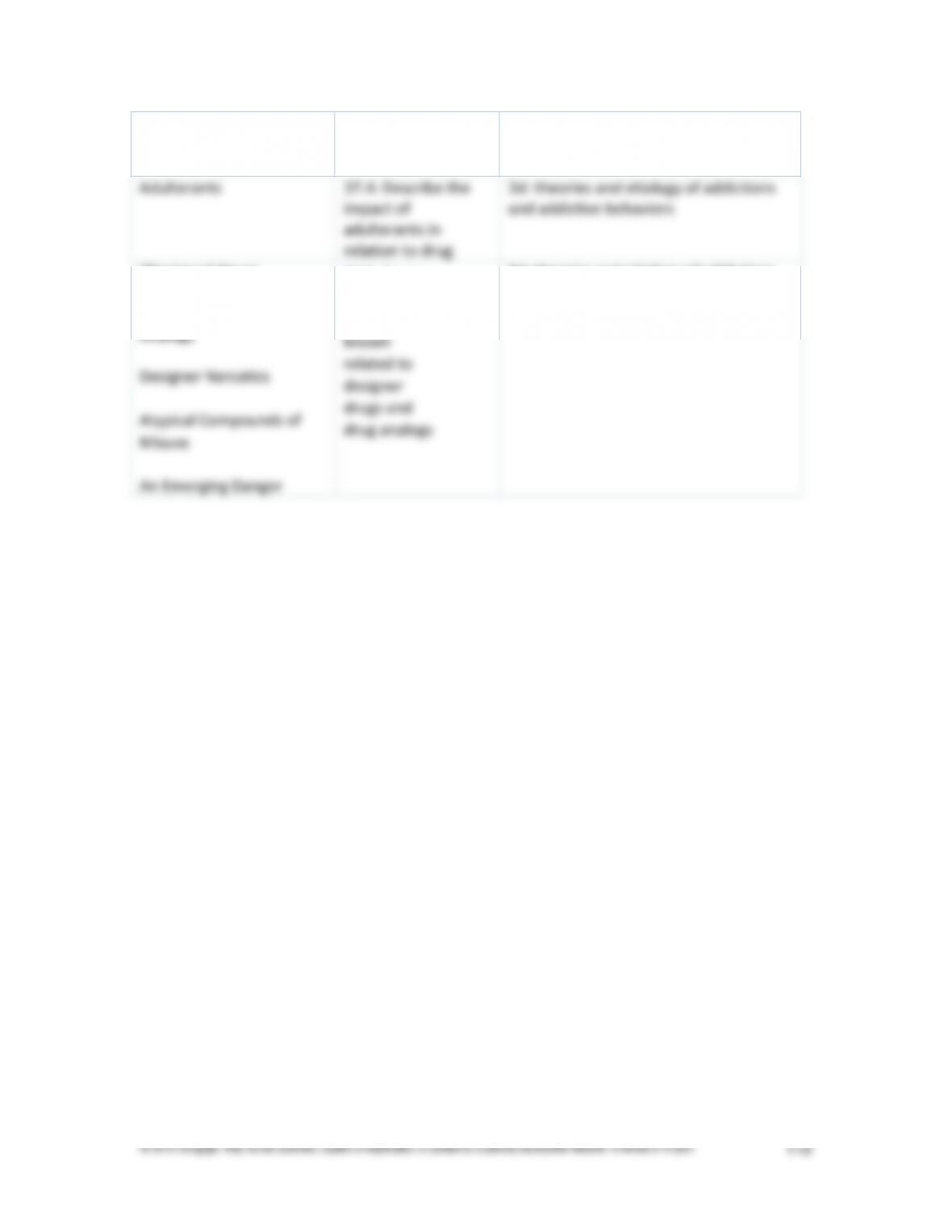
LO/STANDARDS CORRELATION CHART
A-head
LO
Standard—CACREP
Harry Anslinger
The Substance Use
Disorders: Symptom or
Disease?
37.1:
Understand
the history of
prohibition
and the
impact on
the world
today
1a: history and philosophy of the
counseling profession and its specialty
areas
3d: theories and etiology of addictions
and addictive behaviors
Criminal Activity and Drug
Misuse: Partners in a
Dance, but Who Is
Leading?
37.2:
Consider the
pathways
between
criminal
activity and
SUDs
3d: theories and etiology of addictions
and addictive behaviors
3f: systemic and environmental factors
that affect human development,
functioning, and behavior
Drug Use and Violence:
The Unseen Connection
37.3: Review
the
connection
between
3d: theories and etiology of addictions
and addictive behaviors
3f: systemic and environmental factors
that affect human development,
violence
Adulterants
37.4: Describe the
impact of
adulterants in
relation to drug
3d: theories and etiology of addictions
and addictive behaviors
“Designer” Drugs
Some Existing Drug
Analogs
Designer Narcotics
Atypical Compounds of
Misuse
An Emerging Danger
37.5: Review
what is
currently
known
related to
designer
drugs and
drug analogs
3d: theories and etiology of addictions
and addictive behaviors