CHAPTER 36
Substance Use Disorders and Infectious Disease
LEARNING OBJECTIVES
After studying this chapter, students should be able to:
•
36.1: Understand why infectious disease is a concern for those with SUDs
•
36.3: Review the pneumonias that may be seen in those with SUDs
•
36.5: Review the history related to HIV and the impact in relation to SUDs
•
36.6: Identify the hepatitis infections that may be encountered in those
with SUDs
CHAPTER OUTLINE
Why Is Infectious Disease Such a Common Complication for People with an SUD?
Sterile Technique
Contamination
Assorted Bacterial Infections Seen in Individuals Using Intravenous Drugs
Infective Endocarditis
Skin Abscesses
Necrotizing Fasciitis
The Pneumonias
Fungal Pneumonia
Aspiration Pneumonia
Community-Acquired Pneumonia (CAP)
Tuberculosis
What Is Tuberculosis?
How Is Tuberculosis Transmitted, and How Does It Kill?
The Treatment of TB
The Viral Infections
Acquired Immune Deficiency Syndrome (AIDS)
A Short History of AIDS
What Is AIDS?
Where Did HIV Come From?
The Scope of HIV Infection
Pediatric AIDS
How Does AIDS Kill?
The Treatment of HIV Infection
AIDS and Suicide
AIDS and Neurocognitive Dysfunction
HIV Infection and Employment
HIV and Mood Disorders
Section Summary
Viral Hepatitis
A Brief History of Viral Hepatitis
Hepatitis A Virus
CHAPTER OVERVIEW
The purpose of this chapter is not to discuss every possible form of infection that might be
found in individuals who misuse substances. That would be an impossible task and even if it
DISCUSSION QUESTIONS
Break-Out Discussion #1:
Bias and other uncomfortable topics: Imagine that you live off-campus in a small apartment.
1
Your best friend stops by unexpectedly, stating that she needs to talk to somebody that she can
trust. Your friend looks rather agitated, so you invite her to come in to have a cup of coffee,
calm down, and discuss the problem. First, she asks to use your bathroom. Then, over coffee,
2
Questions
1. After your friend leaves, you look at the coffee cup that she used, and think about her trip to
the bathroom shortly after her arrival. What would you do with the coffee cup (be honest!) after
she left? How often would you wash it? After washing the cup, would you feel comfortable
drinking coffee from it in the future?
2. Would you want to keep this person as a friend? Would you invite her over to share dinner,
and, if you did, would you let her use the flatware that you normally use? If it was normal for
3. Now imagine the same scenario, except rather than saying that she had contracted HIV, she
1
Or, if you do live off campus in a small apartment, imagine that you are home.
2
Technically it is not called AIDS until the CD-4 cell count falls below a designated level.
said that she had contracted a Hepatitis B infection. How would your reaction be different than
if had she said that she had HIV? How and why? How would you answer the previous two
questions, given this new scenario?
4. Are there differences between how you reacted to the news that your friend had HIV as
compared with Hepatitis B? If she was to indicate that she had just been diagnosed with a
Hepatitis C infection rather than Hepatitis B, would your answer to any of these questions be
different? Why?
Break-Out Discussion #2:
Viral infections: Someone is at a party with friends, having a great time. Suddenly, two people
meet for the first time. One thing leads to another,
3
and another, and both decide to go
someplace to be alone. However, just then, both discover that neither has any condoms
available. What should they do in a situation like that?
4
The relevance of that question to this material is based on the fact that the virus that causes
Hepatitis types “B” and “C” as well as the virus that causes AIDS all can be transmitted through
All of these infections can also be transmitted by contaminated needles, such as those used to
inject drugs, or, more importantly for this discussion, those used for tattoos. Reputable tattoo
Questions
1. How should the couple in the above example handle this situation? How many couples do you
think would handle the situation this way? Why?
2. Let us say that you are going to have a tattoo,
6
and you have reason to suspect that the tattoo
artist “palmed” an older needle to reuse it. Would you ask him or her to take the suspect needle
out of the tattoo device and insert a new one where you could see it being done, or just live
with your doubts (and possibly a viral infection)?
Break-Out Discussion #3:
Tuberculosis: A century ago, there were no effective cures for tuberculosis, and infected persons
were sequestered away to “sanitariums” to receive what treatment(s) were available, and to
await their eventual death. The disorder was often called “consumption” then, a reflection of
the manner in which the bacteria destroyed the victim’s lungs.
Questions
1. Imagine that you are sitting in church, on an airplane, or on a bus. The person next to you is
coughing incessantly. Days later you learn that this person had tuberculosis, and you were thus
exposed to this infection. How would you feel, and why? Would your answer(s) change if you
were to discover that this person had multidrug-resistant tuberculosis?
2. Does society have the right to force treatment on a person with tuberculosis? Such treatment
3. Let us assume that the infected individual in Question 1 is homeless. This means that once
treatment is started that there is a high probability that he or she will not complete the course
of treatment. Does society have the right to hold that person against their will until the infection
is cured (which might take 1–2 years)? Should they be allowed to take the medication(s) on their
own, or should medications for the treatment of tuberculosis be supervised?
REFERENCES
KEY CONCEPTS AND TERMS
Pneumonia: Acute infection of the lungs, usually caused by bacteria or fungi
Tuberculosis (TB): An infection caused by one of the genetically similar strains of
Mycobacterium tuberculosis
Lymphocytes: Generalized disease-fighting cells
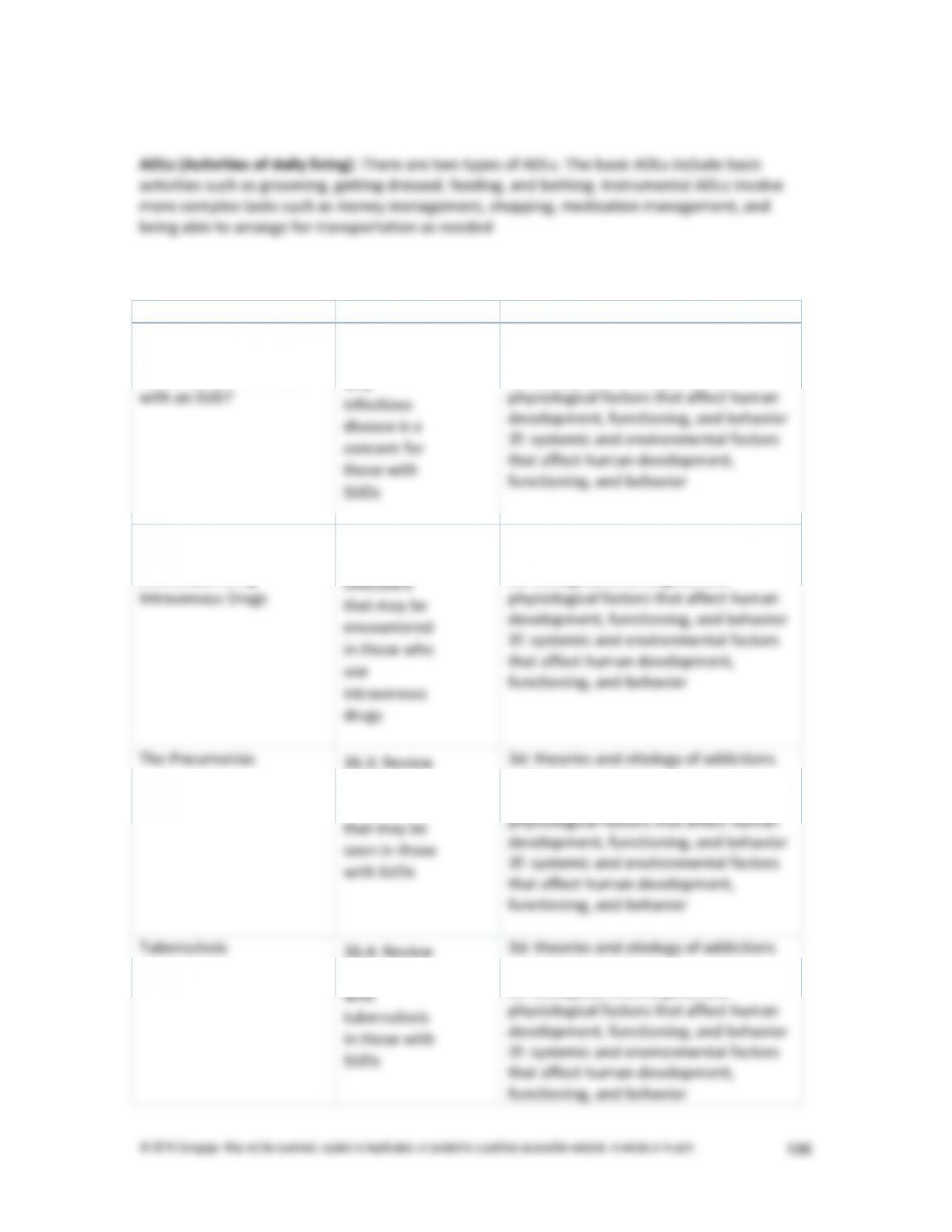
LO/STANDARDS CORRELATION CHART
A-head
LO
Standard 1—CACREP
Why Is Infectious Disease
Such a Common
Complication for People
with an SUD?
36.1:
Understand
why
infectious
disease is a
concern for
those with
SUDs
3d: theories and etiology of addictions
and addictive behaviors
3e: biological, neurological, and
physiological factors that affect human
development, functioning, and behavior
3f: systemic and environmental factors
that affect human development,
functioning, and behavior
Assorted Bacterial
Infections Seen in
Individuals Using
Intravenous Drugs
36.2: Identify
the bacterial
infections
that may be
encountered
in those who
use
intravenous
drugs
3d: theories and etiology of addictions
and addictive behaviors
3e: biological, neurological, and
physiological factors that affect human
development, functioning, and behavior
3f: systemic and environmental factors
that affect human development,
functioning, and behavior
The Pneumonias
36.3: Review
the
pneumonias
that may be
seen in those
with SUDs
3d: theories and etiology of addictions
and addictive behaviors
3e: biological, neurological, and
physiological factors that affect human
development, functioning, and behavior
3f: systemic and environmental factors
that affect human development,
functioning, and behavior
Tuberculosis
36.4: Review
the concerns
with
tuberculosis
in those with
functioning, and behavior
3d: theories and etiology of addictions
and addictive behaviors
3e: biological, neurological, and
physiological factors that affect human
development, functioning, and behavior
3f: systemic and environmental factors
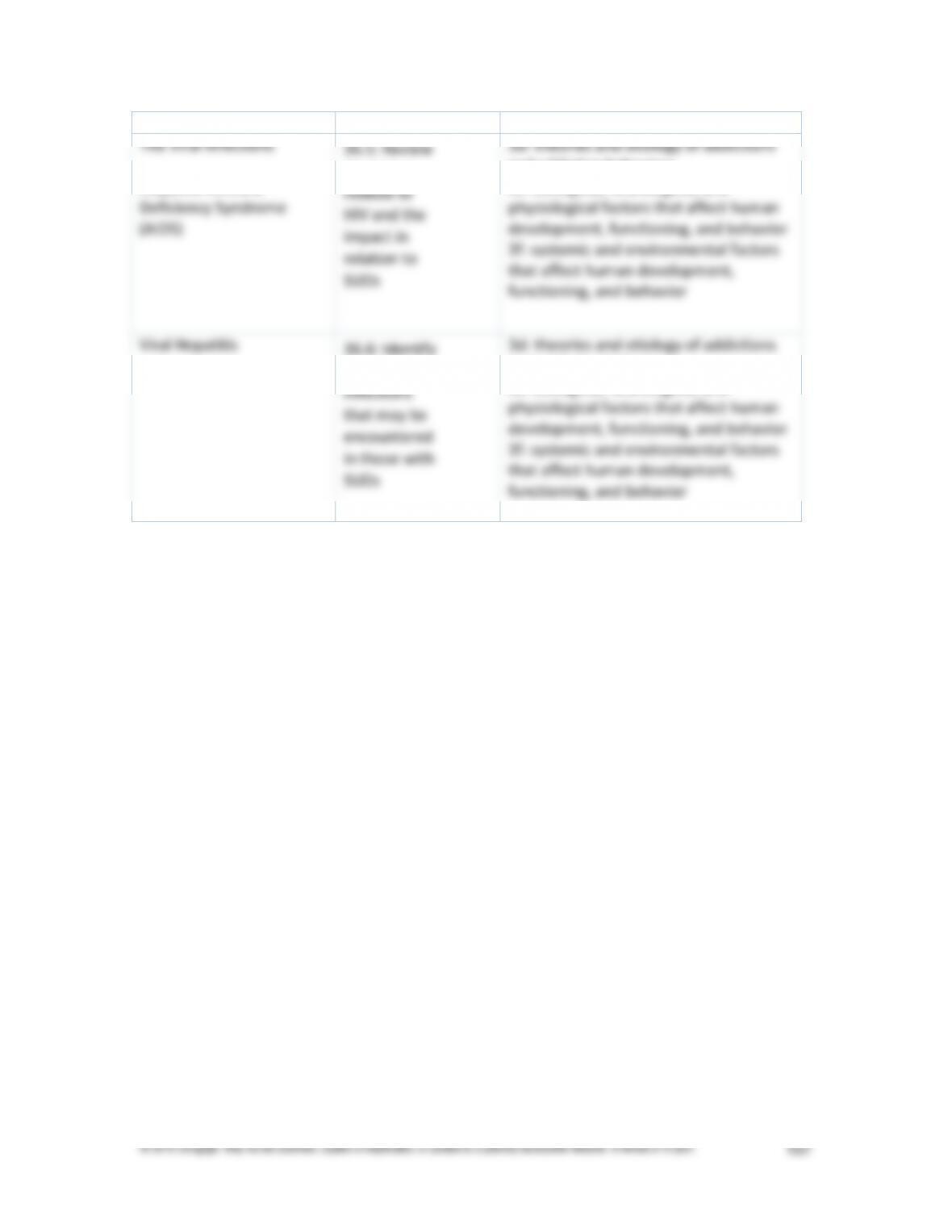
The Viral Infections
Acquired Immune
Deficiency Syndrome
(AIDS)
36.5: Review
the history
related to
HIV and the
impact in
relation to
SUDs
3d: theories and etiology of addictions
and addictive behaviors
3e: biological, neurological, and
physiological factors that affect human
development, functioning, and behavior
3f: systemic and environmental factors
that affect human development,
functioning, and behavior
Viral Hepatitis
36.6: Identify
the hepatitis
infections
that may be
encountered
in those with
SUDs
3d: theories and etiology of addictions
and addictive behaviors
3e: biological, neurological, and
physiological factors that affect human
development, functioning, and behavior
3f: systemic and environmental factors
that affect human development,
functioning, and behavior