
CHAPTER 32
The Process of Treatment
LEARNING OBJECTIVES
After studying this chapter, students should be able to:
•
32.2: Identify the stages of recovery from SUDs
•
32.4: Outline specific points that should be addressed in relation to
particular substances when treating SUDs
•
32.5: Review reactions to the concept of treatment for SUDs
CHAPTER OUTLINE
The Decision to Seek Treatment
Methods of Treatment
Motivational Interviewing
Cognitive-Behavioral Therapies
Voucher-Based Reinforcement
The Stages of Recovery
Reactions to Stage Models of Recovery
Then What Works in Predicting Recovery from SUDs?
Should Abstinence Be the Goal of Treatment?
Specific Points to Address in Substance Rehabilitation
Alcohol
Narcotic Analgesics
CNS Stimulants
Marijuana
Anabolic Steroids
Hallucinogens
Reactions to the Concept of Addictions Treatment
CHAPTER OVERVIEW
In this chapter, a brief overview of the process of treatment is provided. It is not the purpose of
this chapter to completely describe the process of treatment; that is a topic that would require
dozens of textbooks in its own right! However, in this chapter, a brief overview of the process of
treatment, the framework within which it might be understood, and some basic questions are
all explored.
DISCUSSION QUESTIONS
Break-Out Discussion #1:
Motivational interviewing: The core concept around which motivational interviewing is centered
is that the clients are capable of solving their dilemmas, and that the therapist acts as a guide as
they discover the solutions to their problems. Below is a hypothetical conversation between a
client and a counselor who is using a motivational interviewing approach:
Counselor: Well, Bob, could you tell me a little about why you are here today?
Counselor: It sounds frustrating! Can you give me some examples of the situations for which
you were arrested?
Counselor: Well, it says here (looking at court documents that the client had provided) that
you also took a swing at one of the arresting officers . . .
Client: That’s what they say!! I was too drunk to try and fight! I was just unsteady on my feet
and they charge me with a crime when all I did was (expletive deleted) slip!
Counselor: Well, I do not know about that as it is a legal issue and I am not trained in that
area. Could you give me another example or two of when you were arrested
without cause, in your opinion?
you dropped was a half empty can of beer. Is that right?
Client: Well, I think that was it . . . it was a long time ago . . .
Counselor: All right: We do not need to get into that right now. Can you give me another
example of how the police just hassle you?
Counselor: Well, it says in the police report that you just handed to me that your driver’s
license had been suspended, and that you were driving while intoxicated and
without a license. Is there a common element in all of these arrests?
Client: Yeah! The bastards have it in for me!
Counselor: Well, let us write down the different theories that we come up with on a sheet,
here. First, that they have it fiin” for you. Are there other possible theories?
Counselor: All right. Help me understand this: You have lived here in this town for how many
years now?
Client: Seventeen.
Counselor: All right, seventeen years. When you met with the county assessor earlier this
month you said that you started drinking heavily after your wife died. When was
that?
Client: Three years ago! What does that have to do with it?
Counselor: Well, work with me here. I think that I see something and want to make sure that
I have all the facts right before I share the theory with you. I am sorry to hear about
your wife’s death, by the way. I am sure that it was a terrible loss. How did you cope
with the pain of her death?
Client: Well, I started to spend more time with some friends from work, at the bar.
Counselor: Is that when you started to drink more than you did before?
Counselor: All right. I want to run a theory past you, and you can tell me whether you think
that it fits the facts. Here goes: (1) Your wife dies unexpectedly. (2) After this you
spend more time with coworkers and friends at the bar as you do not want to come
home to an empty house. (3) You start to drink more than usual to help with the
pain of her death, and because it helps you have something to do with your friends.
So far, does this sound right?
Client: Yeah. I guess so.
Counselor: Then, (4) You are arrested for driving while under the influence of alcohol in
June, and during this incident you supposedly tried to hit one of the cops because
you were so intoxicated. Finally, (5) On July 4th you are arrested for driving under
the influence of alcohol again. Now here is the theory: It would seem that alcohol is
involved in each incident, one way or another. If you had not been drinking, would
any of these events taken place?
Client: Well, maybe . . . I don’t know.
Counselor: All right. Well, let’s try this as a theory until we find a better theory that fits the
known facts. Can you totally abstain from alcohol for the next four weeks? I will still
want to see you but want to see what happens if you do not drink for the next four
weeks and whether the police hassle you. Does that make sense, and can you do it?
Client: Well, I can try.
Questions
1. Does this hypothetical exchange between Bob and his counselor fit into your preconception
of what it is like to work with an alcohol use disorder? Why or why not?
2. Would you have handled things differently? At what points? What would you have specifically
said differently? Do you think that this scenario would have worked? Why or why not?
Break-Out Discussion #2:
Confrontation: Harsh confrontation is generally counterproductive at best, and harmful at its
worst. Imagine if you were in a relapse-prevention group in which six or eight clients are seated
in a circle. One member admits that he relapsed back to drinking over the past weekend, but
that he was able to limit the relapse to just one day.
Client # 1: Well, I only used alcohol on Sunday.
Client # 2: Did you try to avoid the relapse by calling somebody?
Client # 1: Well, no. It was Sunday and I did not want to disturb anybody on the weekend.
Client # 3: Well, you could have called me. I could have helped you find something to do
besides drinking. Did you drink while watching the football game?
Client # 1: Yes. It was a terrible game! Did you see that interception that cost us the game?
Counselor: While it was a difficult game, the issue here is your relapse over the weekend.
Were you drinking before or after the game?
Client # 1: Well, before the game I was just drinking soda, but . . .
Client # 2: Where were you during the game?
Client # 1: I was over at (names a friend), with a couple of the guys from work.
Client # 2: Were they drinking [alcohol]?
Client # 1: Well, yes, but I was only drinking soda at first. Then (names a friend) put one in
my hand, and I couldn’t say ‘no’ and after that I thought that since I already had
one, that I might as well keep going . . . Then the game ended with the interception,
and everyone felt bad and they kept drinking, so I drank with them.
Client # 3: Well that was pretty stupid! Why were you around people who were drinking?
That was a dumb thing to do . . .
(Turns to client # 1): I am impressed by the fact that you were able to stop drinking after
that one day! That says a lot about your motivation and strength. Further, some of
the mistakes sound that you might have made sound as if they were things we all
have done at some point in our lives. It would be helpful for all of us to look at these
mistakes to be forewarned if we should encounter that, or a similar situation in the
future. Can we use the events of this past weekend to help us understand the
dangers and possible mistakes that were made? Do you feel comfortable doing
that?
was probably correct, everybody in the group had probably either made the same, or at least a
similar, mistake in the past. It was not as if Client # 1 was unique, and the counselor turned the
experience into a chance for the whole group to learn rather than slamming the individual with
harsh confrontation that might make Client # 1 so angry and defensive that he would not come
back to the group.
Questions
1. Imagine that you were the counselor. Would you have handled the discussion differently?
Could you have handled the conflict differently? At what points? What would you have
specifically said differently?
2. Would your alternative have been more effective, less effective, or about as effective as the
simulation provided above? Why?
KEY CONCEPTS AND TERMS
Motivational interviewing: A therapeutic technique used in short-term intervention therapy
that places great emphasis on helping the individual identify how one is currently living and how
one wishes to be living in the future
Precontemplation: Stage during which the individual misusing substances has no thought of
trying to abstain from the misuse within the next 6 months
Contemplation: Stage during which the individual begins to consider thoughts of stopping
misuse of substances within the next 6 months
Preparation: Stage during which the individual misusing substances is ready to change attitudes
and behaviors, and may have begun the initial steps of the change process
Termination stage: Stage during which an individual faces no temptations of use of substances
once misused
LO/STANDARDS CORRELATION CHART
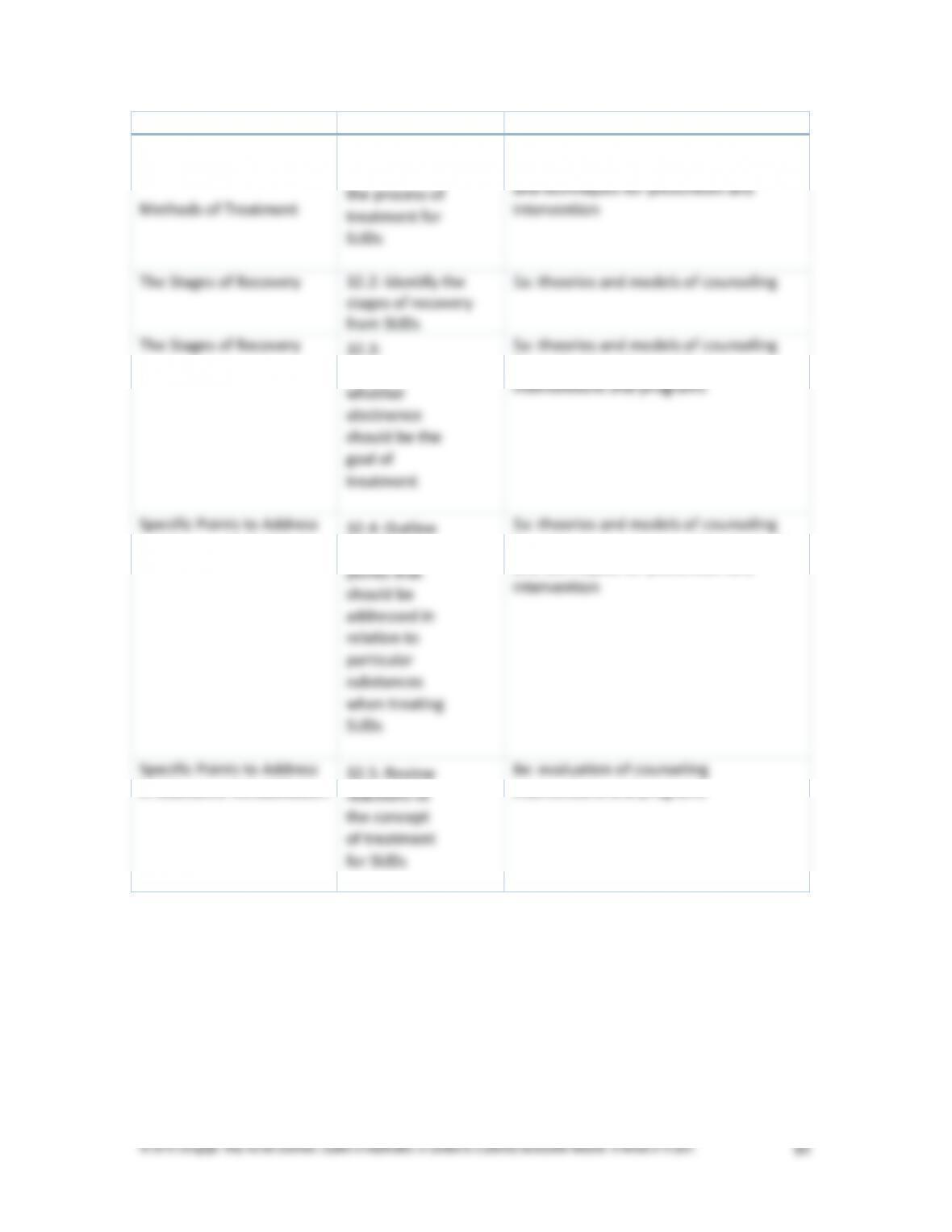
A-head
LO
Standard—CACREP
The Decision to Seek
Treatment
Methods of Treatment
32.1:
Understand
the process of
treatment for
SUDs
5a: theories and models of counseling
5j: evidence-based counseling strategies
and techniques for prevention and
intervention
The Stages of Recovery
32.2: Identify the
stages of recovery
from SUDs
5a: theories and models of counseling
The Stages of Recovery
32.3:
Consider
whether
abstinence
should be the
goal of
treatment
5a: theories and models of counseling
8e: evaluation of counseling
interventions and programs
Specific Points to Address
in Substance Rehabilitation
32.4: Outline
specific
points that
should be
addressed in
relation to
particular
substances
when treating
SUDs
5a: theories and models of counseling
5j: evidence-based counseling strategies
and techniques for prevention and
intervention
Specific Points to Address
in Substance Rehabilitation
32.5: Review
reactions to
the concept
of treatment
for SUDs
8e: evaluation of counseling
interventions and programs