Chapter 3: Knowing Your Values
CHAPTER 3
Knowing Your Values
LEARNING OBJECTIVES
After studying this chapter, students should be able to:
•
Describe how helper values operate in the counseling process.
•
Discuss the ethical issues involved in imposing helper values.
•
List several guidelines for dealing with end-of-life issues.
CHAPTER OUTLINE
Aim of the Chapter
Role of Values in Helping
Avoiding Imposing Values
Our Perspective on Values in the Helping Relationship
Dealing With Value Conflicts
Referral Is Not an Answer to Resolving Value Conflicts
CHAPTER OVERVIEW
•
There are numerous areas in which your values can potentially conflict with the
values of your clients. Ethical practice dictates that you seriously consider the
impact of your values on your clients and that you learn how to manage any value
conflicts you may have with clients.
Chapter 3: Knowing Your Values
•
Students and practicing counselors have a right to embrace their own personal and
moral values, but it is crucial that they do not use their personal values as a
yardstick by which to measure the validity of the values of their clients.
avoid harming the client or practicing beyond one’s level of competence.
•
Counselors who work with LGBTQI clients have a responsibility to understand the
special concerns of these individuals and are ethically obligated to acquire the
knowledge and skills to competently deliver services to them.
•
With self-reflection, it is possible for helpers to become more culturally sensitive
and more gender sensitive and to avoid imposing their personal values on
individuals, couples, and families.
•
In two Supreme Court cases, the university’s right to require students to comply
with nondiscrimination guidelines in counseling clients were found not to infringe
•
Assess your own sexual attitudes and values, and ask yourself whether you would
be able to work objectively with a person whose sexual values are very different
from your own.
•
With continuing efforts by states to legalize physician-assisted suicide, an increasing
SUGGESTIONS FOR ACTIVITIES
1. Self-Assessment. Have students complete the following assessment and discuss their responses
in class in dyads or small groups.
Self-Assessment: An Inventory of Your Values Pertaining to the Helping Relationship. This
Chapter 3: Knowing Your Values
viewpoint at this time. In many cases the answers are not mutually exclusive, and you may
We suggest that you bring the completed inventory to class so that you can compare your views with
those of others in the class. Such a comparison might stimulate some debate and help get the class
involved in the topics to be discussed.
1. Ethical Bracketing. Counselors are expected to be able to set aside their personal beliefs and
values when working with a wide range of clients. Effective helpers rise to the challenge of
meeting the needs of clients with diverse worldviews and values. Provide students with the
2. Value Conflicts. For this exercise, have students work in pairs or in small groups. Develop a role
play based on a possible value conflict. Refer to the chapter for ideas of scenarios to role-play.
3. Alternatives to Referral. The text suggests that referrals are unethical unless the counselor lacks
4. Court Cases on Value Conflicts. Ask students to break into small groups and discuss the
implications of the Ward v. Wilbanks (2010) case. Do you think that the faculty at Eastern
Chapter 3: Knowing Your Values
5. LGBT Issues. The Association for Lesbian, Gay, Bisexual and Transgender Issues in Counseling
(ALGBTIC) has developed Competencies for Counseling With Transgender Clients (2009). Have
6. Family Values. As noted in the text, helpers have their own values pertaining to a number of
family-related issues (e.g., marriage, the preservation of the family, divorce, same-sex marriages,
gender roles and the division of responsibility in the family, adoption of children by same-sex
couples, child rearing, and extramarital affairs.) In small groups, have students discuss which
7. Dealing With Religious and Spiritual Themes in Counseling. Religion and spirituality are
oftentimes part of the client’s problem, and they can also be part of the client’s solution to a
problem. Exploring spiritual or religious values with clients can be integrated with other
therapeutic tools to enhance the helping process. In groups, explore how spirituality can ethically
be integrated into the therapeutic process or interact with client struggles.
8. The Issue of Abortion. As noted in the chapter, deciding whether to terminate a pregnancy or to
Chapter 3: Knowing Your Values
9. End-of-Life Decisions. It is likely that an increasing number of clients will seek professional
assistance in making end-of-life decisions. Your students may one day have to assist clients who
10. Ethics in Action Video Exercises. This section at the end of the chapter may give you some ideas
for role-playing scenarios for students.
DISCUSSION QUESTIONS
1. Values are embedded in therapeutic theory and practice. What major values can you identify
that you deem most essential in a helping relationship?
KEY CONCEPTS AND TERMS
Abortion, the decision to terminate a pregnancy, is an issue that often presents a challenge to helping
professionals, both legally and ethically.
Discrimination involves behaving differently and usually unfairly toward a specific group of people and
is regarded as unethical and unacceptable.
Heterosexism is a worldview and a value system that can undermine the healthy functioning of the
sexual orientations, gender identities, and behaviors of LGBT individuals.
Homosexuality is a sexual orientation in which people seek emotional and sexual relationships with
same-gendered individuals. In 1973, the American Psychiatric Association stopped labeling it as a form
of mental illness.
Chapter 3: Knowing Your Values
society.
Religious and Spiritual Values can play a major part in human life; thus, these values should be viewed
as a potential resource in the helping relationship.
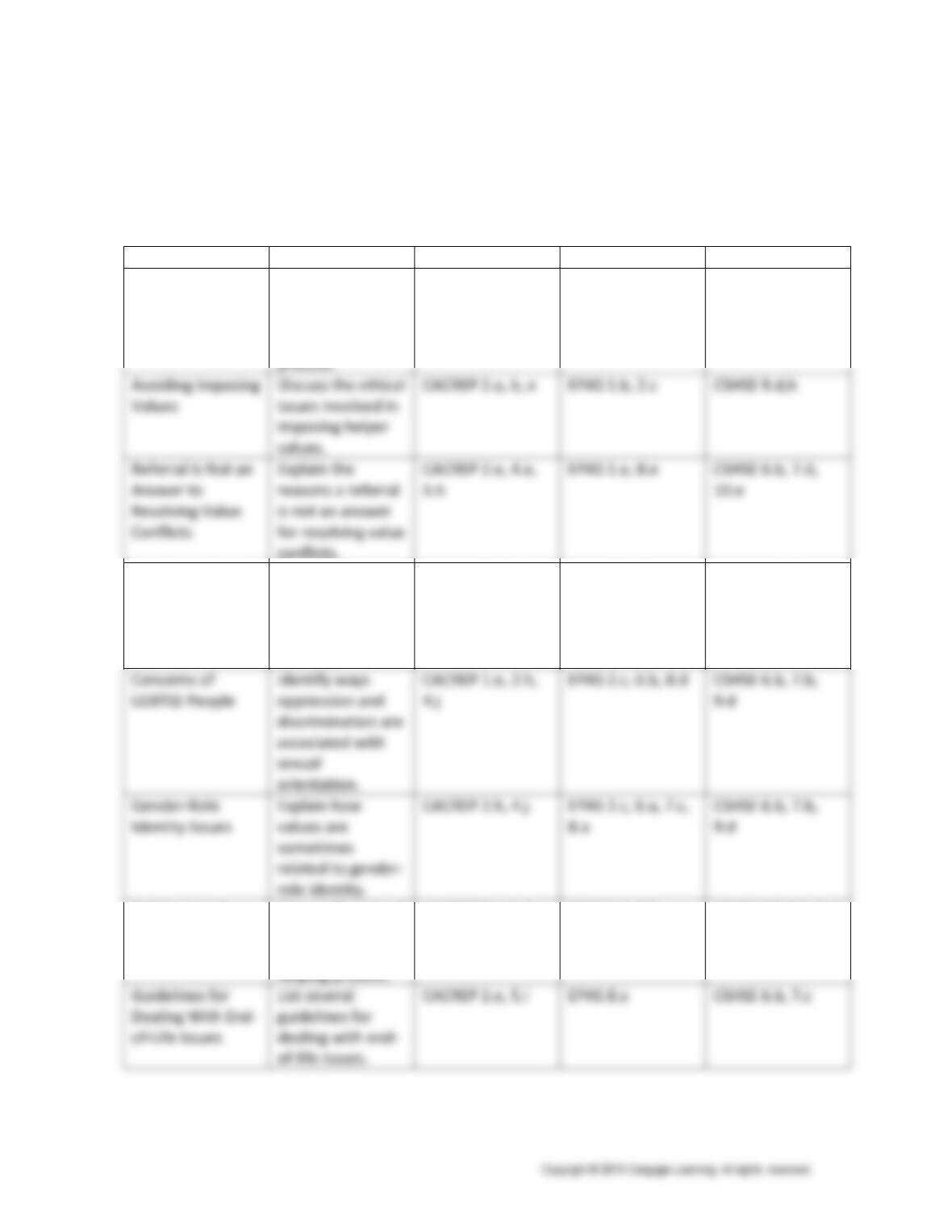
LO/STANDARDS CORRELATION CHART
A-head
LO
Standard 1
Standard 2
Standard 3
Role of Values in
Helping
process.
imposing helper
values.
Referral Is Not an
Answer to
Resolving Value
Conflicts
Explain the
reasons a referral
is not an answer
for resolving value
conflicts.
CACREP 2.e, 4.e,
EPAS 1.e, 8.e
CSHSE 6.b, 7.d,
10.e
Describe how
helper values
operate in the
counseling
CACREP 1.k, 2.d
EPAS 1. B, 2.c
9.d,a
Significant Court
Cases on Value
Conflicts
Explain the
implications of
significant court
cases on value
conflicts.
CACREP 1.i, 2.e
EPAS 1.b, 2.b
CSHSE 7.b, d
associated with
sexual
orientation.
Gender-Role
Identity Issues
Explain how
values are
sometimes
related to gender-
role identity.
CACREP 2.h, 4.j
EPAS 2.c, 6.a, 7.c,
8.a
CSHSE 6.b, 7.b,
9.d
Religious and
Spiritual Values
Discuss the role of
spiritual/religious
values in the
CACREP 2.g,d, 4.e
EPAS 7.d, 8.b
CSHSE 2.f, 6.b, 9.d
helping process.