
Module Three
Core CurriCulum
Lesson Plans for Instructors
Introduction to
Hand Tools
00103-15
Lesson Plans for Module 00103–15
IntroductIon to Hand tools
Module Three (00103-15) instructs trainees in the identification, use, and care of hand tools. Developing the
knowledge to properly choose and safely use hand tools is an essential part of the construction industry.
Objectives
Learning Objective 1
• Identify and explain how to use various types
of hand tools.
a. Identify and explain how to use various
types of hammers and demolition tools.
b. Identify and explain how to use various
types of chisels and punches.
Learning Objective 2
• Identify and describe how to use various types
of measurement and layout tools.
a. Identify and explain how to use rules and
other measuring tools.
b. Identify and explain how to use various
types of levels and layout tools.
Learning Objective 3
• Identify and explain how to use various types
of cutting and shaping tools.
a. Identify and explain how to use handsaws.
b. Identify and explain how to use various
types of files and utility knives.
Learning Objective 4
• Identify and explain how to use other common
hand tools.
Performance Tasks
Performance Task 1
(Learning Objectives 1 through 4)
• Visually inspect a minimum of five of the follow–
ing tools to determine if they are safe to use:
– Hammer or demolition tool
– Chisel or punch
– Screwdriver
– Utility knife
– Shovel or other earth tool
– Chain fall or hoist
– Clamps
Performance Task 2
(Learning Objectives 1 through 4)
• Safely and properly use a minimum of three of
the following tools:
– Hammer or demolition tool
– Chisel or punch
– Screwdriver
– Adjustable or non-adjustable wrench
– Socket
– Torque wrench
– Pliers
– Wire cutters
– Measuring tool
– Layout tool
Performance Task 3
(Learning Objectives 1 through 4)
• Make a straight, square cut in framing lumber
using a crosscut saw.
00103-15 Introduction to Hand Tools Module Three i
ii NCCER – Core Curriculum 0 0103 -15
Teaching Time: 10 hours
(Four 2.5–Hour Classroom Sessions)
Session time may be adjusted to accommodate your class size, schedule, and teaching style.
Prerequisites
Core Curriculum Modules 00101-15 and 00102-15.
Before You Begin
As you prepare for each session, allow sufficient time to review the course objectives, content, visual aids (in–
Classroom Equipment
and Materials
Whiteboard/chalkboard
Markers/chalk
Pencils and paper
Copies of the Module Examination
and Performance Profile sheets
Safety Considerations
Trainees will be handling and working with a wide variety of hand tools. Ensure that trainees are equipped
with the appropriate PPE at all times, including times when they are examining hand tools in the classroom
environment. All work with hand tools must be directly supervised by the instructor to ensure the safety of
the trainees.
Appropriate PPE:
Safety glasses
Work gloves
Old and/or unusual hand tools
Socket sets and torque wrenches
Pliers and wire cutters
Measuring tapes and rules
Levels
Squares
Plumb bobs
Chalk lines
Hand saws
Files and rasps
Utility knives
Hard hats as required by the
instructor, training, provider, or the
environment
Hammers or demolition tools
Pliers
Wire cutters
Measuring tools
Layout tools
Levels
Hand saws
Files
Utility knives
Shovels or similar earth tools
Equipment and Materials for Laboratories and
Performance Testing

00103-15 Introduction to Hand Tools Module Three iii
Additional Resources and References
This module presents thorough resources for task training. The following resource material is suggested for
further study.
iv NCCER – Core Curriculum 0 0103 -15
Session Outline for 00103–15
rough–terrain forklift components and controls
The Lesson Plan for this module is divided into four 2.5–hour sessions.
This time includes 10 minutes for administrative tasks and a 10–minute break per session.
IntroductIon to Hand tools
Session Outline for 00103–15
SeSSion one
Session One discusses the various types, uses,
safety, and maintenance of various hand tools
covered by Objectives 1 and 2.
1. Show the Session One PowerPoint®
presentation.
SeSSion Two
Session Two identifies and explains how to
use cutting and shaping tools, as well as other
common hand tools.
1. Show the Session Two PowerPoint®
presentation.
2. Identify and explain how to safely use
measuring and layout tools.
SeSSion Three
Session Three is a laboratory session devoted
to the practice and completion of Performance
Tasks 1 through 3.
1. Note that there is no PowerPoint®
presentation associated with this session.
7. Trainees should complete the tasks
associated with Performance Tasks 1 through
3 in this hands–on session.
SeSSion Four
Session Four is a review and testing session.
Have trainees complete the Module Review and
Trade Terms Quiz. Alternatively, the Module
Review and Trade Terms Quiz may be assigned
00103-15 Introduction to Hand Tools Module Three v
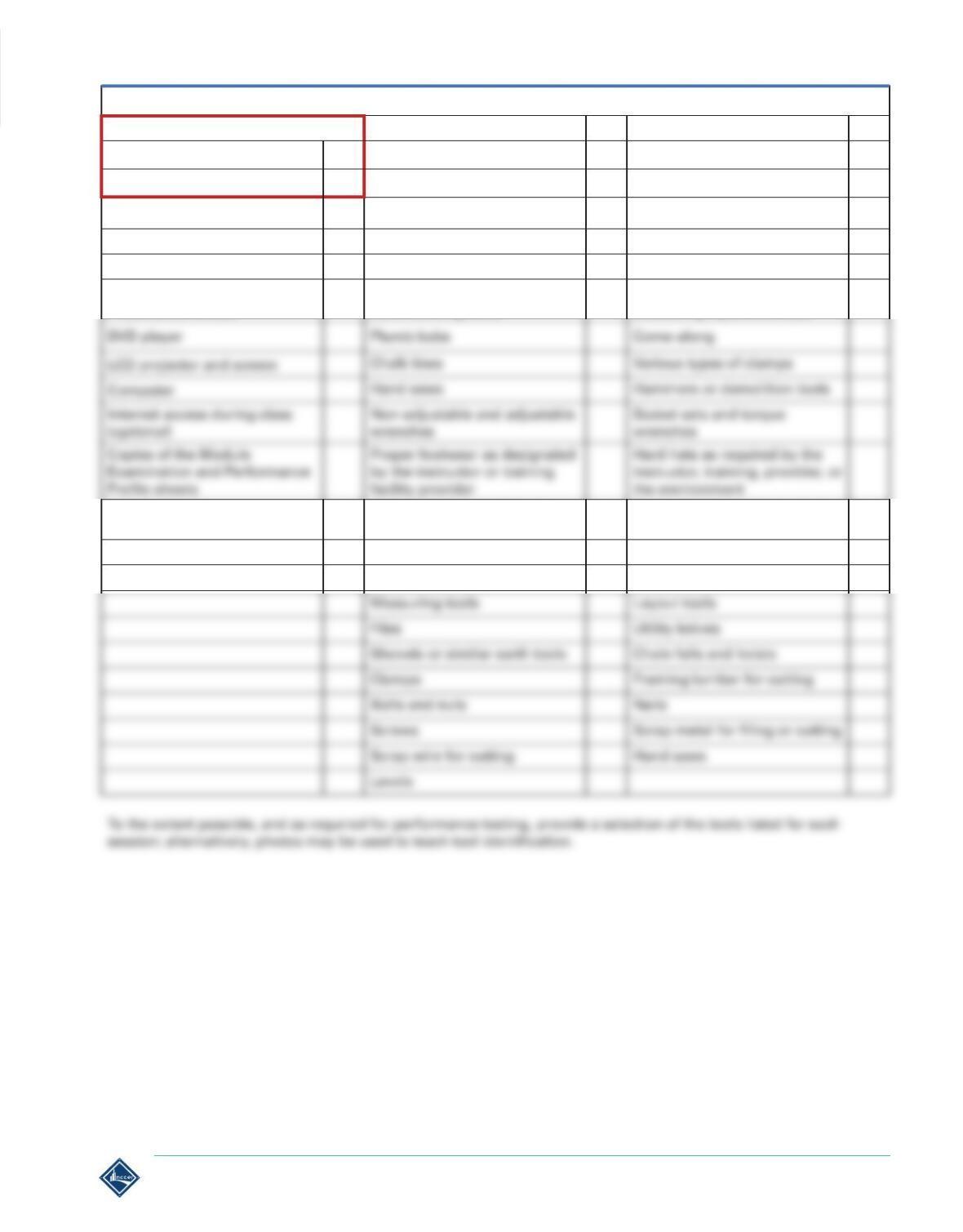
Materials Checklist for Module 00103-15, Introduction to Hand Tools
Equipment and Materials
Personal protective equipment: Old and/or unusual hand tools Files and rasps
Safety glasses Hammers and demolition tools Utility knives
Work gloves Chisels and punches Chain fall
Whiteboard/chalkboard Different types of screwdrivers Ratcheting chain hoist
Markers/chalk Levels Chisels or punches
Pencils and paper Squares Screwdrivers
Core Curriculum PowerPoint®
Presentation Slides
Shovels, picks, and related
earth-working tools
Pliers and wire cutters
Measuring tapes and rules
Adjustable or non-adjustable
wrenches
Appropriate load for vertical
lifting
Socket sets Torque wrenches
Pliers Wire cutters
00103-15 Introduction to Hand Tools Module Three 1
Classroom Session 1 for 00103–15
common Hand tools
Safety Considerations
The following safety consideration should be emphasized when introducing trainees to the tools used
in the construction environment:
Remind trainees that some forms of PPE may be required any time they are in the shop or on a job site.
Safety Equipment
Safety glasses
Work gloves
Classroom and/or Lab Equipment
Old and/or unusual hand tools
Hammers and demolition tools
Chisels and punches
Resources
No specific resources are required for this session.
Kickoff Activity
Prepare several unique or antique tools to show the trainees and discuss their use. These should be
tools that are not presented in this module. When showing unique and/or old tools, ask the trainees
2 NCCER – Core Curriculum 0 0103-15
common Hand tools
Classroom Session 1 for 00103–15
Session Objectives
When trainees have completed this session, they should be able to do the following:
1. Identify and explain how to use various types of hand tools.
a. Identify and explain how to use various types of hammers and demolition tools.
b. Identify and explain how to use various types of chisels and punches.
c. Identify and explain how to use various types of screwdrivers.
Session Performance Requirements
Trainees will not complete a Performance Task during this session.
Instructional Outline
Research has shown that varying instructional methods periodically throughout class sessions helps to
engage and hold trainees’ attention. The Core Curriculum PowerPoint® presentation that you received
with this lesson plan is keyed to the sections of the Trainee Guide indicated below and has been
designed for use with this lesson plan.
Teaching Tip
Have the tools that will be presented and discussed during this session on-hand for trainee examination
Classroom: Sections 1.0.0–1.1.0
Identify the hand tools that will be presented in this session.
Introduce the two most common hammers.
Classroom: Section 1.1.1
Classroom: Section 1.1.2
Describe a ball peen hammer. Define peening. Describe differences in the heads and their uses. Talk
about the range of weights available. Emphasize that nails should not be driven with this tool, and why.
00103-15 Introduction to Hand Tools Module Three 3
comon Hand tools
Classroom Session 1 for 00103–15
Classroom: Sections 1.1.3–1.1.4
Point out the uses of a sledgehammer. Explain that the shape of the head may vary, and that handle
length varies as well. Review the bulleted list of safety and usage information. Emphasize the related
warning.
Introduce various types of nail-pulling tools and discuss their differences. Stress the importance of
proper PPE.
Classroom: Sections 1.1.5–1.1.6
Discuss the uses of a ripping bar. Stress the importance of proper PPE for the user and those in the area
Classroom: Sections 1.2.0–1.2.1
Introduce chisels and punches.
Compare and contrast cold and wood chisels. Discuss the common types of cold chisels and the pur–
Classroom: Sections 1.2.2–1.2.3
Describe a punch and how it is typically used.
Review the list of safety and maintenance guidelines for chisels and punches.
Classroom: Section 1.3.0
Explain that screwdrivers are identified by the type of screw they drive. Introduce the common screw
Classroom: Section 1.3.1
Review the list of safety and maintenance guidelines for screwdrivers.
Classroom: Sections 1.4.0–1.4.1
Point out that the difference between adjustable and non-adjustable wrenches.
4 NCCER – Core Curriculum 0 0103-15
common Hand tools
Classroom Session 1 for 00103–15
Classroom: Section 1.4.2
Describe the characteristics and uses of adjustable wrenches. Show trainees the difference between
Classroom: Section 1.4.3
Review the list of safety and maintenance guidelines for wrenches. Emphasize the need to keep the
mechanism clean.
Classroom: Sections 1.5.0–1.5.1
Describe the use of socket and torque wrenches.
Classroom: Sections 1.5.2–1.5.3
Explain when torque wrenches are used. Discuss both Imperial and metric torque values. Discuss how
each type of torque wrench is used and for what purpose. Emphasize that torque wrenches should not
be used for any type of disassembly work.
Review the list of safety and maintenance guidelines for sockets, ratchets, and torque wrenches.
Classroom: Sections 1.6.0–1.6.6
Explain the purposes of pliers and how they differ from wrenches. Identify the pliers that will be
introduced in this session.
Discuss the characteristics and uses for slip-joint pliers. Explain how to properly use them.
Discuss the characteristics and uses for long-nose or needle-nose pliers. Point out that some have jaws
for cutting small wire. Explain how to properly use them.
00103-15 Introduction to Hand Tools Module Three 5
common Hand tools
Classroom Session 1 for 00103–15
Classroom: Sections 2.0.0–2.1.1
Introduce the concept of measurement. Discuss the effect incorrect measurements and improper
leveling can have on a project.
Identify the basic measuring tools. Talk about the considerations for choosing a measuring tool.
Discuss the characteristics and uses of a steel rule.
Classroom: Sections 2.1.2–2.1.3
Discuss the measurement markings on a tape measure. Explain the concave shape and how it is used.
Classroom: Section 2.1.4
Explain how a laser measuring tool functions. Discuss the advantages and disadvantages of laser
measuring tools. Talk about their capabilities. Point out that smoke or shiny surfaces can create errors.
Stress the importance of following the manufacturer’s recommendations for use.
Classroom: Section 2.1.5
Review the list of safety and maintenance guidelines for measuring tools.
Classroom: Sections 2.2.0–2.2.1
Explain the difference between plumb and level. Point out that some layout tools differ among crafts.
Describe the characteristics of a spirit level. Using the figure, explain how to read the vials for level and
plumb readings.
Classroom: Sections 2.2.2–2.2.4
Describe the features and capabilities of digital levels.
Describe the uses for laser levels. Discuss their mounting capabilities. Point out that they are best used
Classroom: Section 2.2.5
Review the various types of squares. Discuss the uses for carpenter’s squares. Describe the
measurement markings, tables and formulas shown on the square. Describe the different combinations
6 NCCER – Core Curriculum 0 0103-15
common Hand tools
Classroom Session 1 for 00103–15
Classroom: Sections 2.2.6–2.2.8
Review the list of safety and maintenance guidelines for squares.
Explain the purpose of a plumb bob. Point out the common weights. Review the steps on how to prop-
erly use a plumb bob.
Wrap Up
Demonstrate how to use as many of the tools presented in this section as possible. The instructor
should attempt to move quickly through them, without belaboring points. For example, locate a typical
Homework
00103-15 Introduction to Hand Tools Module Three 7
Classroom Session 2 for 00103–15
cuttIng and sHapIng tools; otHer common Hand tools
Safety Considerations
The following safety consideration should be emphasized when introducing trainees to the tools used
in the construction environment:
Remind trainees that some forms of PPE may be required any time they are in the shop or on a job
site.
Safety Equipment
Safety glasses
Work gloves
Classroom and/or Lab Equipment
Hand saws
Files and rasps
Resources
No specific resources are required for this session.
Session Objectives
When trainees have completed this session, they should be able to do the following:
1. Identify and explain how to use various types of cutting and shaping tools.
a. Identify and explain how to use handsaws.
b. Identify and explain how to use various types of files and utility knives.
Session Performance Requirements
Trainees will not complete a Performance Task during this session.
8 NCCER – Core Curriculum 0 0103-15
Instructional Outline
Research has shown that varying instructional methods periodically throughout class sessions helps to
engage and hold trainees’ attention. The Core Curriculum PowerPoint® presentation that you received
with this lesson plan is keyed to the sections of the Trainee Guide indicated below and has been
designed for use with this lesson plan.
Review
Review the answers to the 1.0.0 through 4.0.0 Section Reviews.
Classroom: Sections 3.0.0–3.1.0
Discuss the versatility of handsaws.
Classroom: Sections 3.1.1–3.1.2
Explain how handsaws are classified. Discuss how the design of the saw teeth affects the kerf. Describe
how a crosscut saw cuts and its characteristics. Review the list and discuss how a crosscut saw is used.
Describe how a ripsaw cuts in comparison to a crosscut saw. Explain how to use a ripsaw. Remind
trainees that they will cut lumber for a Performance Task.
Review the list of safety and maintenance guidelines for saws.
Classroom: Section 3.2.0
Point out that files and rasps can be used as a final finishing step or to prepare a surface for other work
such as welding.
Classroom: Section 3.2.1
Explain the purposes of files and rasps. Describe the different types of files, rasps, and handles while
Classroom: Sections 3.2.2–3.2.3
Explain the typical uses for utility knives. Describe the characteristics of each type. Point out that self-
retracting utility knives are commonly used for safety purposes. Discuss the safe and proper use of a
utility knife. Emphasize the importance of wearing gloves and retracting the blade any time cutting is
not in progress.
Review the list of safety and maintenance guidelines for saws, files, and rasps.
Classroom Session 2 for 00103–15
cuttIng and sHapIng tools; otHer common Hand tools
00103-15 Introduction to Hand Tools Module Three 9
Classroom: Sections 4.0.0–4.1.1
Discuss the importance of proper training in the use of earth-working tools.
Describe the shovel blade shapes and the uses for each shape. Discuss leverage. Explain how to choose
Classroom: Sections 4.2.0–4.2.3
Discuss the purposes of chain falls and come-alongs.
Describe the components of a chain fall. Explain that the lifting power comes from a series of internal
gears.
Classroom: Sections 4.3.0–4.3.1
Describe the different types of clamps and their uses. Explain how they are sized. Review each of the
different clamp types along with the figure provided. Emphasize the importance of protecting the
workpiece from clamp damage.
Review the list of safety and maintenance guidelines for clamps.
Wrap Up
Divide the trainees into teams. Use the prepared slides in the PowerPoint® presentation that will show
Homework
Have trainees review the complete module to prepare for the hand tool laboratory.
Classroom Session 2 for 00103–15
cuttIng and sHapIng tools; otHer common Hand tools
00103-15 Introduction to Hand Tools Module Three 11
Classroom Session 3 for 00103–15
Hand tool laboratory
Safety Considerations
The following safety considerations should be emphasized when introducing trainees to the tools used
in the construction environment:
Remind trainees that some forms of PPE are required any time they are in the shop or on a job site.
Trainees will be working with and around many types of hand tools. Ensure that they have and use
the appropriate PPE at all times. Correct any safety-related errors immediately.
Safety Equipment
Standard eye protection
Work gloves
Classroom and/or Lab Equipment
The Performance Tasks for this module do not require that all listed tools be used in the task. Review
the requirements of the Performance Tasks carefully and plan accordingly.
Hammers or demolition tools
Chisels or punches
Screwdrivers
Adjustable or non-adjustable wrenches
Socket sets
Torque wrenches
Pliers
Files
Utility knives
Shovels or similar earth tools
Chain falls and hoists
Clamps
Framing lumber for cutting
Bolts and nuts
Resources
Shop area with work benches where work with the various hand tools can be conducted safely
An outdoor area with soil or gravel for digging
Appropriate anchor point for a chain fall or hoist
Session Objectives
This session is intended to support and emphasize Learning Objectives 1 through 4.
12 NCCER – Core Curriculum 0 0103 -15
Hand tool laboratory
Classroom Session 3 for 00103–15
Session Performance Requirements
By the end of this session, trainees should have completed, or be able to complete, the following
Performance Tasks under the supervision of the instructor:
Visually inspect a minimum of five of the following tools to determine if they are safe to use:
– Hammer or demolition tool
– Chisel or punch
– Layout tool
– Level
Safely and properly use a minimum of three of the following tools:
– Hammer or demolition tool
– Chisel or punch
– Screwdriver
– Measuring tool
– Layout tool
– Level
Instructional Outline
This laboratory is devoted to the practice and completion of Performance Tasks required for this
module. As a result, no PowerPoint® slides have been developed for this session. Throughout these
activities, ensure that trainees wear the proper PPE and exhibit safe working habits.
00103-15 Introduction to Hand Tools Module Three 13
Laboratory/Performance Task
Under your direct supervision, have trainees visually inspect at least five of the following tools to
determine if they are safe to use:
Hand tool laboratory
Classroom Session 3 for 00103–15
Hammer or demolition tool
Chisel or punch
Screwdriver
Layout tool
Level
Hand saw
Demonstration
Using the correct PPE for the task, demonstrate the proper use of any hand tools that have not been
previously demonstrated.
Laboratory/Performance Task
Under your direct supervision and using the correct PPE for the task, have trainees safely demonstrate
the proper use of a minimum of three of the following tools:
Hammer or demolition tool
Chisel or punch
Screwdriver
Measuring tool
Layout tool
Level
Demonstration
Using the correct PPE for the task, demonstrate the proper way to make a straight, square cut in
framing lumber using a crosscut saw.
14 NCCER – Core Curriculum 00103-15
Hand tool laboratory
Classroom Session 3 for 00103–15
Laboratory/Performance Task
Under your direct supervision and using the proper PPE for the task, have each trainee safely
demonstrate the ability to make a straight, square cut in framing lumber using a crosscut saw. The work
should begin with the trainee using a square to mark the cut line and properly securing the material to
be cut. This activity corresponds to Performance Task 3.
Wrap Up
Ensure that all tools and equipment are returned to their proper storage location.
Homework
revIew and testIng
Classroom Session 4 for 00103–15
This session is reserved for a brief review of the module, administering the module
examination, and any incomplete performance testing.
Safety Considerations
The following safety consideration should be emphasized when introducing trainees to the tools used
in the construction environment:
Remind trainees that some forms of PPE are required any time they are in the shop or on the job site.
Safety Equipment
The use of specific safety equipment is not anticipated during this session.
Classroom and/or Lab Equipment
Resources
No specific resources are required for this session
Review
Ask the trainees if they wish to review any particular information from the module. Have the trainees
complete the Module Review and Trade Terms Quiz. Alternatively, if the Module Review and Trade
Examination and Performance Task Verification
Administer the Module Exam. As they begin, remind trainees that they must answer at least 70 percent
of the questions correctly to pass the module exam.
Wrap Up
Ask the trainees if there were any trouble areas on the exam and to identify a favorite and least favorite
part of this module. As an alternate or if time allows, briey introduce the next topic in your planned
teaching sequence.
Homework
Instructor
16 NCCER – Core Curriculum 0 0103 -15
SECTION REVIEW ANSWER KEY
SECTION 1.0.0
Answer Section Reference Objective
1. c 1.1.2 1a
SECTION 2.0.0
Answer Section Reference Objective
1. d 2.1.3 2a
SECTION 3.0.0
Answer Section Reference Objective
SECTION 4.0.0
Answer Section Reference Objective
Module Three (00103–15)
answer Keys

00103-15 Introduction to Hand Tools Module Three 17
ANSWERS TO REVIEW QUESTIONS
Answer Section Reference
1. d 1.1.0
2. b 1.1.4
Module Three (00103–15)
answer Keys
18 NCCER – Core Curriculum 0 010 3-15
answer Keys
Module Three (00103–15)
ANSWERS TO TRADE TERMS QUIZ
1. Try square
2. Hex-key wrench
3. Ball-peen hammer
15. Flats
16. Bell-faced hammer
17. Foot-pounds
24. Chisel bar
25. Open-end wrench
26. Peening
38. Tang
39. Tempered
40. Planed
NCCER makes every effort to keep its textbooks up-to-date and free of technical errors. We
ap pre ci ate your help in this process. If you find an error, a typographical mistake, or an in-
present your suggestions to the Authoring Team.
NCCER Product Development and Revision
13614 Progress Blvd., Alachua, FL 32615
Email: curriculum@nccer.org
Online: www.nccer.org/olf
NCCER CuRRiCula — uSER uPDaTE
❏ Trainee Guide ❏ Lesson Plans ❏ Exam ❏ PowerPoints Other _________________________
Craft / Level: Copyright Date:
Module ID Number / Title:
Section Number(s):
Description:
Recommended Correction:
Your Name:
Address:
Email: Phone: