
CHAPTER 3
A Brief Introduction to the Science of Pharmacology
LEARNING OBJECTIVES
After studying this chapter, students should be able to:
3.1: Understand the impact substances can have on the body
3.3: Describe the forms of administration of substances
3.5: Distinguish between the different types of half-lives for substances
3.6: Describe the difference between effective dose and lethal dose
CHAPTER OUTLINE
A Basic Misconception
The Prime Effects and Side Effects of Chemicals
The Method by Which a Compound Is Administered
Typical Forms of Drug Administration
Bioavailability
Absorption
Distribution
Transport
Biotransformation
Elimination
Drug Half-Life
The Effective Dose
The Lethal Dose and Therapeutic Index
Therapeutic Threshold and Peak Effects
The Site of Action
The Receptor Site
The Process of Neurotransmission
Neurotransmitters
Neurotransmitter Reuptake/Destruction
Co-Transmission
Tolerance
Up-/Down-Regulation of Receptor Sites
Drug Agonists/Antagonists
Potency
The Blood-Brain Barrier
CHAPTER OVERVIEW
The purpose of this chapter is to provide the student with a basic working knowledge of the
principles of pharmacology that are necessary to understand the actions of each of the drugs of
misuse. The topics of drug biotransformation and elimination, as well as the principles of the
therapeutic half-lives as opposed to the elimination half-lives of these compounds will also be
discussed to help the student better understand the actions of many of the drugs of misuse.
DISCUSSION QUESTIONS
Break-Out Discussion #1:
The nature of pharmacy: Peter Breggin (2008) is very critical of psychopharmaceuticals, pointing
out that these compounds are not condition-specific but affect the entire brain. He suggests
that these compounds do not “cure” the conditions for which they are intended, but that they
suppress neural function across the brain to the point where the patient is no longer bothered
by the symptoms of any specific disorder. This is achieved, Breggin points out, at the significant
risk of various side effects.
percentage of the other neurons in the brain might fire to pass their electrochemical message
on to the next neuron in line. Patients who take phenytoin often complain of being clumsy or of
feeling tired much of the time, both side effects that are reflections of this general suppression
of neural function.
Questions
1. What is the difference between treatment and symptom suppression?
2. Given Breggin’s (2008) criticisms of the pharmaceutical industry, are there any conditions in
which a simple suppression of the psychiatric symptoms is appropriate? Are the side effects
worth the benefit of suppressing seizure activity?
3. Do you know of somebody who has experienced this “blanket” phenomenon from a
medication? Did the person continue to take the medication, or discontinue the medication
because of the side effects?
Break-Out Discussion #2:
Are we too dependent on the pharmaceutical industry? To begin this discussion, the author
pharmaceuticals at a profit.
1
For example, a given medication may be sold at $100 for a month’s
supply in the United States, but for only $55 per month in a neighboring country, even though
the medication is manufactured by the same pharmaceutical company in both countries. If the
pharmaceutical company’s production facility is in another country, say the country where it is
sold for $55 for a month’s supply, it may also be imported to the United States to be sold for
$100 for a month’s supply.
Pharmaceutical companies have been entitled to engage in “direct advertising,” or “consumer–
directed” advertising, which is done under the guise of providing information to the consumer
about a product. One apparent outcome of this process is that patients now often go to their
Questions
1. Do you think that the pricing practices in the above example can be justified? Why or why
not?
2. How should the prices that consumers must pay for these medications be set?
3. Have you, or has anyone you know, ever requested a particular type or brand of medication
from a doctor? Do you think that the patient in the case was correct in doing so? Why?
4. In what other ways could the pharmaceutical industry influence what medications people
take, and when?
5. Are we too dependent on the pharmaceutical industry? Why or why not?
Reference
Breggin, P. R. (2008). Brain-Disabling Treatments in Psychiatry (2nd ed.). New York: Springer
Publishing.
KEY CONCEPTS AND TERMS
Pharmacokinetics: How time impacts a drug moving through the body
Pharmacodynamics: The way in which a drug impacts the body
Prime effects: The desired effect of the compound. For example, a person who has a fever
1
Some critics of the pharmaceuticals industry point out that the profit margin for medications sold
in the United States are the highest in the world.
might take an aspirin tablet with the goal of reducing his or her fever to a more tolerable level.
Compare this with the side effect of a compound. This is sometimes referred to as the
therapeutic effect of the compound
Secondary effects: Unwanted side effects
Enteral: Enters the body by the gastrointestinal tract, usually administered orally
Parenteral: Enters the body by injection
Over-the-counter medications: There are more than 100,000 compounds that may be
purchased without a prescription, thus earning the title of an over-the-counter compound
Sublingually: Administration under the tongue for absorption
Subcutaneous: Injection of the compound just under the skin, allowing for a reservoir of the
drug to be established in the body and a slower rate of absorption than the intravenous method
“Skin popping”: Term used by some individuals to refer to the subcutaneous method of drug
administration, which is injecting the compound under the skin
Intramuscular: Injection of a compound in the muscle tissue
Intravenous (IV): Injected directly into a vein
Bioavailability: Concentration of the unchanged chemical at the site of action
Water-soluble: Chemicals that are able to mix freely with the blood plasma
Lipid-soluble/lipophilic: The characteristics of some drug molecules allow them to bind to one
of the fat molecules that circulate through the body
Zero-order biotransformation: The biotransformation mechanisms quickly become saturated,
and only a set amount of a given compound can be biotransformed each hour, regardless of the
concentration of that chemical in the brain
First-order biotransformation: A set percentage of the compound(s) in question is
biotransformed each hour, independent of the concentration of that substance in the blood
Presystemic elimination (also called first-pass metabolism effect): The effect by which the
human digestive tract is designed not to let any chemical that is absorbed pass directly into
circulation, but to filter it first through the liver
Half-life: The rough estimate of a compound’s effectiveness, duration of effect, and the length
of time that it will remain in the body
Alpha half-life: Period following peak concentration of the drug in the blood and when it is
redistributed to various blood tissues
Ceiling dose effect: A dose above which additional drug molecules will not have any additional
effect
Therapeutic window (or index): The difference between the minimal effective dose of a
medication and the level that will induce toxic effects. Alcohol, for example, has a “therapeutic”
window of 1:3, which is to say that the amount of alcohol necessary to be ingested for its
intended effect is about one-third of the amount necessary to induce toxic effects and possible
death
Therapeutic threshold: The amount of a compound in the individual’s circulation will increase
until it reaches the minimal level at which that compound might be effective
Site of action: Where the compound(s) carries out the main effects
Synapses: Microscopic spaces that separate neurons
Synaptic junctions: The small gaps that separate neurons
Tolerance: A shortened duration and decreased intensity of drug effects after repeated
administration (Ghoneim, 2004b, p. 1279)
Neuroadaptation: The term used to describe tolerance, when to a mood-altering substance that
was prescribed by a physician
Down-regulation: Process through which a neuron decreases the number of receptor sites in
response to large amounts of the enzyme or neurotransmitter at the receptor site, making that
neuron less sensitive to that enzyme or neurotransmitter
Agonist: A compound that activates a receptor site by being able to mimic or enhance the
actions of a natural neurotransmitter
Antagonists: A compound that is able to fit into the receptor site without activating it
Pericytes: Cells in the brain that help to stabilize the blood-brain barrier
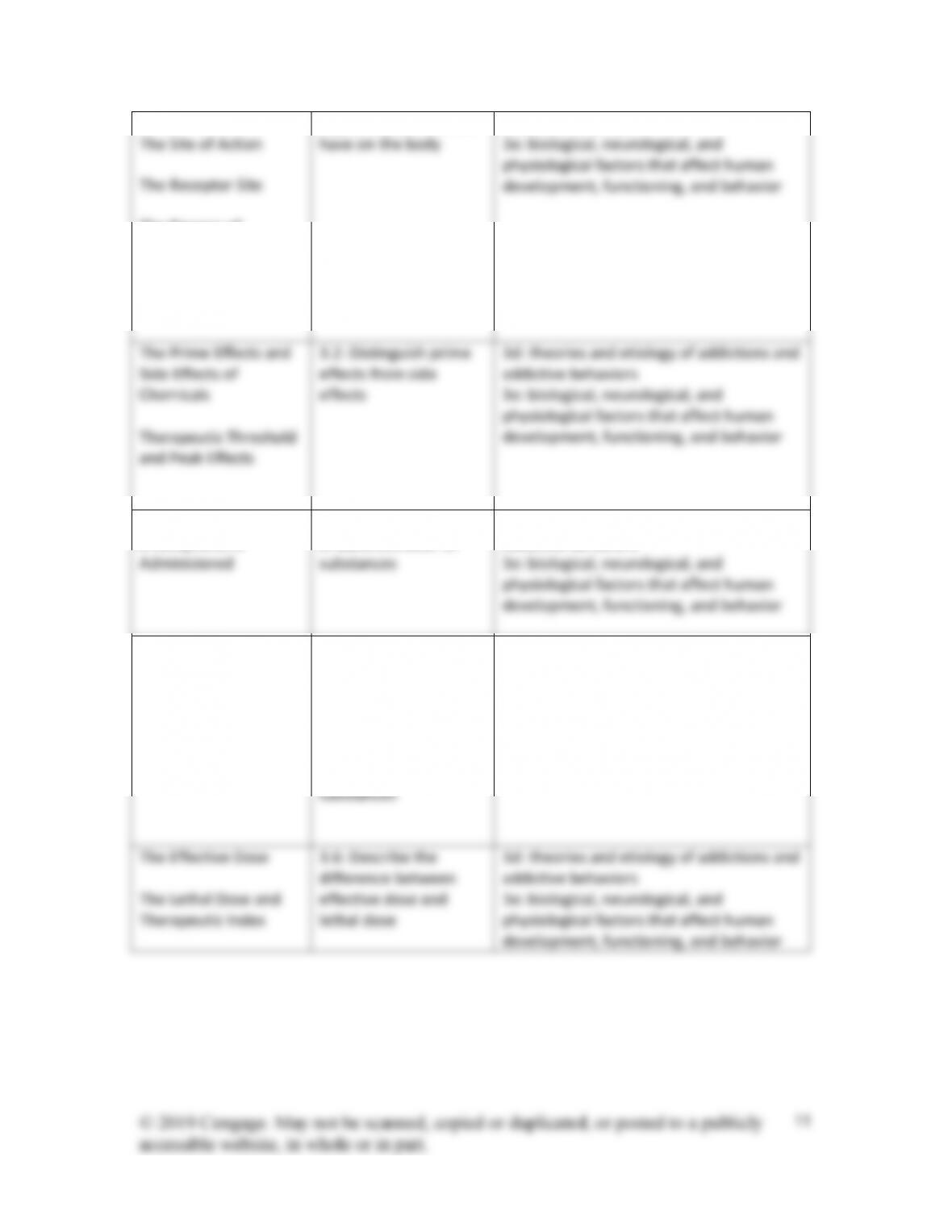
LO/STANDARDS CORRELATION CHART
A-head
LO
Standard 1- CACREP
A Basic Misconception
3.1: Understand the
3d: theories and etiology of addictions and
The Site of Action
The Receptor Site
The Process of
Neurotransmission
The Blood-Brain
Barrier
impact substances can
have on the body
addictive behaviors
3e: biological, neurological, and
physiological factors that affect human
development, functioning, and behavior
The Prime Effects and
Side Effects of
Chemicals
Therapeutic Threshold
and Peak Effects
3.2: Distinguish prime
effects from side
effects
3d: theories and etiology of addictions and
addictive behaviors
3e: biological, neurological, and
physiological factors that affect human
development, functioning, and behavior
The Method by Which
a Compound Is
Administered
3.3: Describe the forms
of administration of
substances
3d: theories and etiology of addictions and
addictive behaviors
3e: biological, neurological, and
physiological factors that affect human
development, functioning, and behavior
Bioavailability
3.4: Understand the
factors that impact the
bioavailability of
substances
3.5: Distinguish
between the different
types of half-lives for
substances
3d: theories and etiology of addictions and
addictive behaviors
3e: biological, neurological, and
physiological factors that affect human
development, functioning, and behavior
The Effective Dose
The Lethal Dose and
Therapeutic Index
3.6: Describe the
difference between
effective dose and
lethal dose
3d: theories and etiology of addictions and
addictive behaviors
3e: biological, neurological, and
physiological factors that affect human
development, functioning, and behavior