CHAPTER 23
Substance Use Disorders and the Family
LEARNING OBJECTIVES
After studying this chapter, students should be able to:
•
23.2: Consider the multiple influences that impact how SUDs are managed
in families
•
23.4: Review the history and criticisms of the Adult Children of Alcoholics
movement
CHAPTER OUTLINE
Scope of the Problem
Addiction and the Family Unit
The Family System’s Perspective
Parental Rules
Marriage with a Partner with an SUD
Marital Intimacy
Financial Stability
The Cost of Adolescent SUDs
Interventions
The Adult Children of Alcoholics (ACOA) Movement
The Growth of ACOA Support Groups
Criticism of the ACOA Movement
CHAPTER OVERVIEW
The purpose of this chapter is to provide the student with an overview of how addictions affect
the family structure. A person with a substance use disorder (SUD) does not exist in a vacuum
but is part of a family that might include siblings, parents, and possibly a spouse and children.
Although long considered a destabilizing influence on the family, it is possible that an
individual’s misuse of a substance is an unhealthy attempt on the part of the individual and the
family to find some degree of stability, a point that is often overlooked by professionals. Thus,
one point that should be stressed is that the assessor must determine what role within the
family constellation the individual’s substance use assumes. Is it an expression of anger or
hostility by one partner toward another or does the individual’s substance use provide an
avenue through which he or she might withdraw from the responsibilities of parenthood? These
issues are briefly explored in this chapter, to help students better understand the impact of the
SUDs on the family system.
DISCUSSION QUESTIONS
Break-Out Discussion #1:
An argument against the Adult Children of Alcoholics movement: Many proponents of the Adult
Children of Alcoholics” (ACOA) support group movement point to theories suggesting that large
numbers of children raised where there is parental alcoholism have suffered psychological
trauma. Indeed, just having a parent with an alcohol use disorder (AUD) is suggested to be
traumatic for the child. Yet are such conclusions justified?
One characteristic of human behavior is to engage in what is known as “post–hoc reasoning.”
This means that researchers look for commonalities in groups of people with a certain condition,
However, it may be possible that both the parental AUD and the child’s subsequent
development of a depression later in life might reflect the effects of the same gene’s influence
that is expressed in different ways between generations. After all, the child inherited 50% of his
or her genes from each parent. This biological explanation suddenly puts the impact of parental
alcoholism on the child’s later growth in an entirely new light. If it is a genetic disorder, as is
suggested here, then could self-help groups really assist in the treatment of this condition?
Further, many children who later grew up to become depressed never had a parent with an
AUD. Many proponents of the ACOA movement point out that having a parent with an AUD is
just one of a wide range of abnormal conditions in which the child might be raised. Having a
violent parent, or a parent who went on to develop schizophrenia, or being raised in a home
where there is incest, all are “dysfunctional” homes, it has been suggested, and thus the
individual could benefit from the insights that the ACOA movement has to offer.
Questions
1. Do you believe that growing up in a home where there is a parent with an AUD the same as
growing up in a home where a parent has a condition such as schizophrenia? Why or why not?
Do you agree with the idea that all children raised in dysfunctional homes can benefit from
being part of ACOA?
2. Say that one parent in a family developed a kidney disease that resulted in the need for that
parent to be placed on dialysis. This is also a statistically abnormal event; the parent would need
dialysis three times a week, would need to follow a special diet, and would develop fatigue
rapidly. Does this condition induce the same form of trauma in the child that parental AUD is
said to cause? If not, what are the differences?
3. One of the core concepts of the ACOA philosophy is that no matter what the trauma, all
suffering is equal. Do you believe that this statement is true? Why or why not?
4. Consider the various reasons that a parent might be absent from a child’s life: if the parent
had passed away from illness or an accident, if the parent misused alcohol or another substance
and therefore did not participate in the child’s life, or if the parent had left the family following a
divorce or separation. What are the similarities and differences in the way that these
circumstances might affect the child?
5. Do you agree with the author’s position as described here? Why or why not?
KEY CONCEPTS AND TERMS
Individuation: A term developed by Carl Jung for the process of becoming aware of one’s inner
“self,” including expectations about how others behave and how the world functions. This
process is influenced by social and cultural forces, but especially by the family environment in
which the child is raised.
Differentiation: “The ability to be in emotional contact with others yet still autonomous in ones’
emotional functioning” (Mate, 2010, p. 237)
LO/STANDARDS CORRELATION CHART
A-head
LO
Standard—CACREP
Scope of the Problem
23.1:
Understand
the ways in
which SUDs
impact the
family
3d: theories and etiology of addictions
and addictive behaviors
3f: systemic and environmental factors
that affect human development,
functioning, and behavior
Addiction and the Family
Unit
23.2:
Consider the
multiple
influences
that impact
how SUDs
3d: theories and etiology of addictions
and addictive behaviors
3f: systemic and environmental factors
that affect human development,
functioning, and behavior
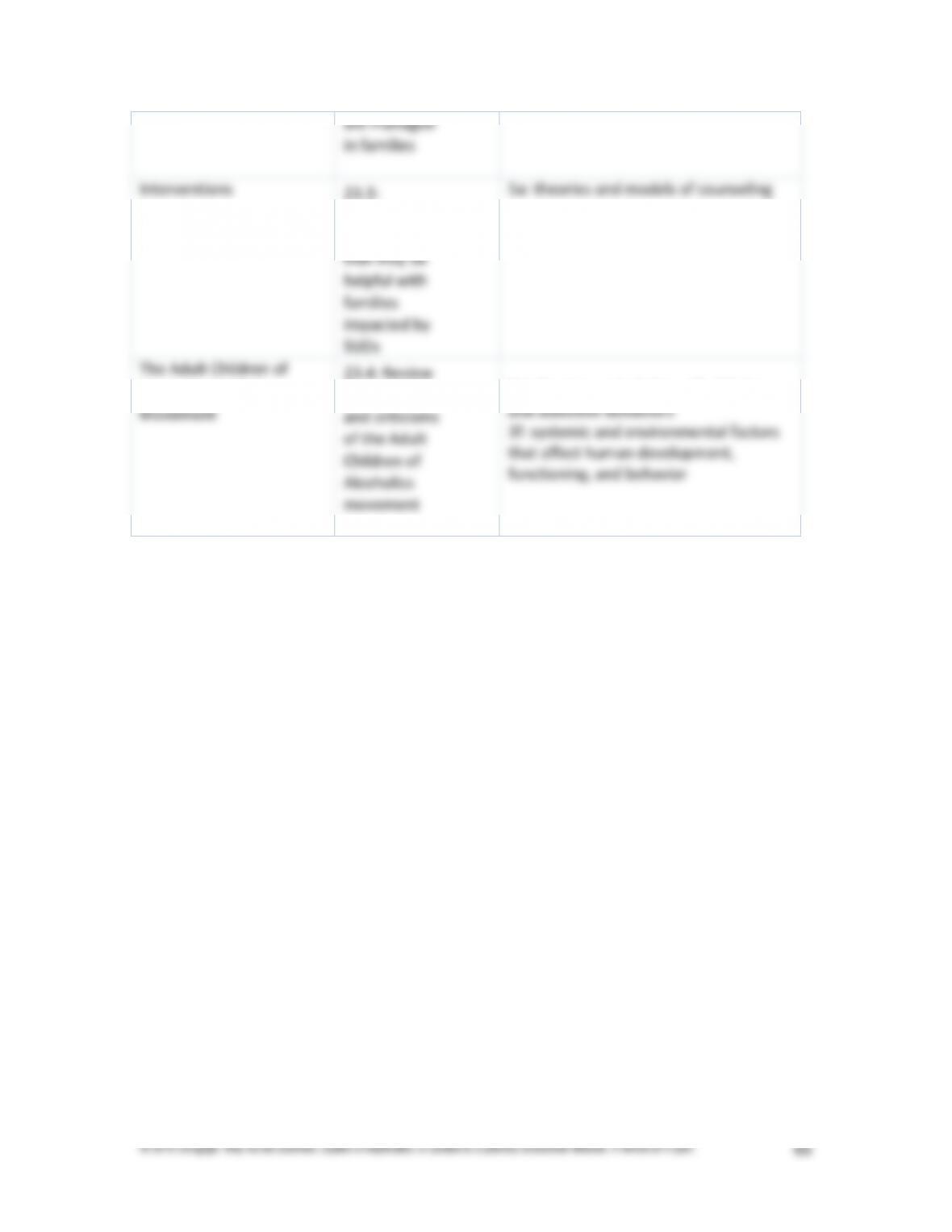
are managed
in families
Interventions
23.3:
Describe
interventions
that may be
helpful with
families
impacted by
SUDs
5a: theories and models of counseling
The Adult Children of
Alcoholics (ACOA)
Movement
23.4: Review
the history
and criticisms
of the Adult
Children of
Alcoholics
movement
3d: theories and etiology of addictions
and addictive behaviors
3f: systemic and environmental factors
that affect human development,
functioning, and behavior