CHAPTER 21
Substance Use and Substance Use Disorders in College Students
LEARNING OBJECTIVES
After studying this chapter, students should be able to:
•
21.2: Understand the level of concern for substance use and misuse for
college students
•
21.4: Describe the protective factors that may help college students avoid
development of SUDs
CHAPTER OUTLINE
Why Worry About College Substance Use?
A Special Environment
Peer Relationships
An Evolving Relationship
Scope of the Problem
Group Insulation
Consequences of Substance Use Disorders in the College Population
Binge Drinking
Energy Drinks
CNS Simulants
Tobacco use
Illicit Drug Use
Intervention
Post-Graduation and Graduate School
Are There Forces That Help Protect the Student from SUDs?
CHAPTER OVERVIEW
A growing body of evidence has emerged demonstrating that the course of the substance use
disorders, especially the alcohol use disorders, follows a different trajectory in college students
as compared with young adults who do not elect to attend college. The purpose of this chapter
is to identify ways in which the substance use behaviors of college students differ from those of
their non-college peers. Secondary goals include the identification of ways in which substance
use by college students impacts their social, emotional, and educational lives during the college
experience.
DISCUSSION QUESTIONS
Break-Out Discussion:
It should not surprise any college student that alcohol is a popular recreational drink for this age
cohort. Although specific figures for college students are not available, it is logical to assume
that much of this alcohol is consumed by college students in the under-21 age cohort.
There is a significant body of evidence suggesting a bidirectional relationship between college
students’ substance use behaviors and their peer groups. Students tend to seek out peer groups
whose substance use patterns are similar to their own; simultaneously, peer groups encourage
students to engage in substance use in a manner that is consistent with the norms of that group.
Unfortunately, substance misuse has the potential to interfere with academic pursuits,
especially if the student chooses to follow the allure of the substances over those of academic
goals. The student has to decide where his or her priorities lie—substance misuse, or academic
studies.
Questions
1. What factors influence college students’ substance use behaviors, and how do they decide
where to draw the line between acceptable substance use and substance use behaviors that
they will not engage in? What factors influenced you when you first went to college?
2. Who is to blame for the alcohol industry being allowed to sell almost a fifth of its product to
persons under the legal age of 21? Is this a problem that needs to be solved, and if so, how and
by whom?
3. What kind of policy did/does your college have regarding alcohol use? Do you believe that it
was/is reasonable? Why or why not?
KEY CONCEPTS AND TERMS
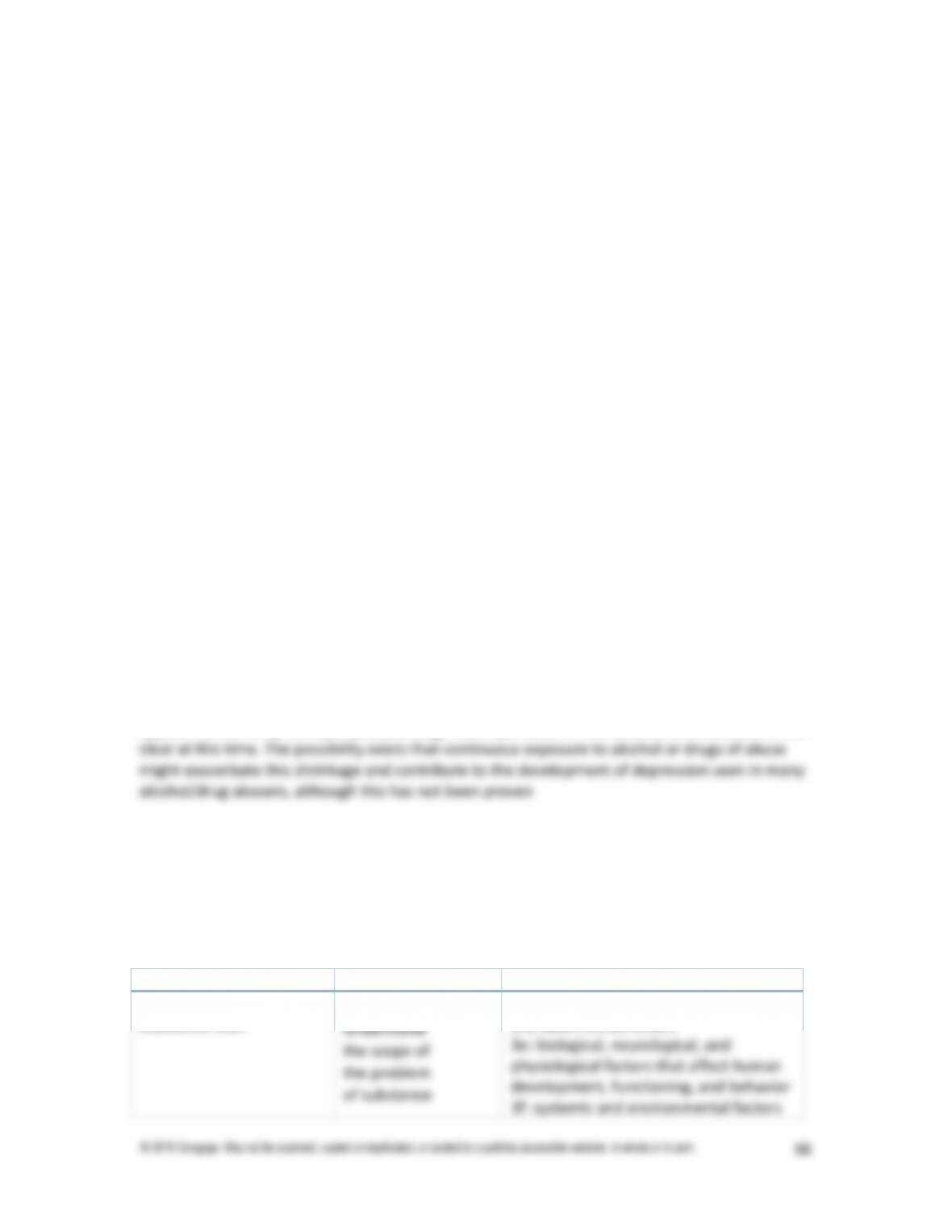
Hippocampus: A region of the brain that is thought to be involved in processing sensory
information, as well as the formation and retrieval of memories. In normal healthy adults, it
appears to shrink by 0.5% per year, although the importance of this data to the addictions is not
C-reactive protein: Protein molecule involved in inflammatory response
Transitional adolescent: A person who is legally defined as an adult and who presents
personality traits normally seen in young adults as well as other traits more traditionally seen in
adolescents
LO/STANDARDS CORRELATION CHART
A-head
LO
Standard—CACREP
Why Worry About College
Substance Use?
21.1:
Understand
the scope of
the problem
of substance
3d: theories and etiology of addictions
and addictive behaviors
3e: biological, neurological, and
physiological factors that affect human
development, functioning, and behavior
3f: systemic and environmental factors
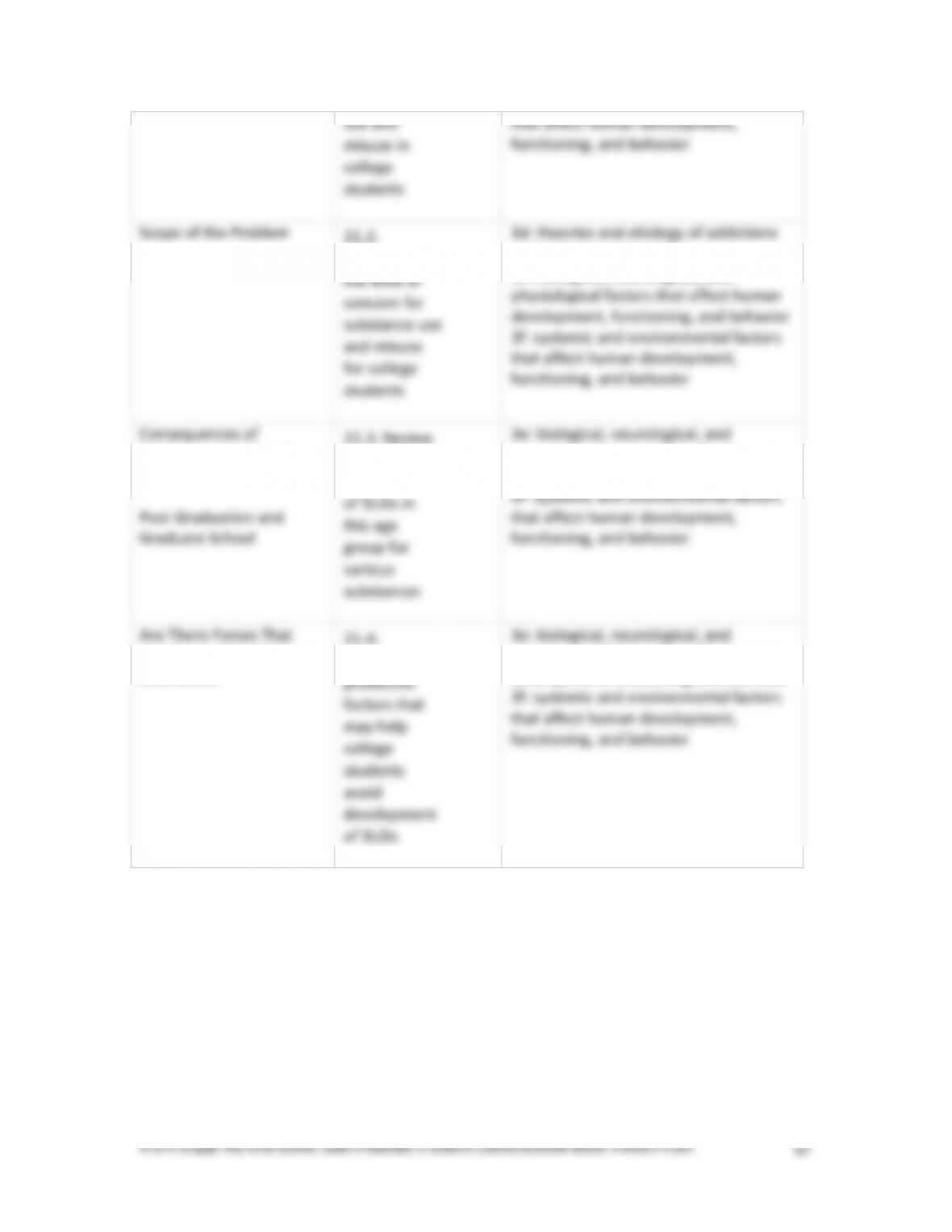
use and
misuse in
college
students
that affect human development,
functioning, and behavior
Scope of the Problem
21.2:
Understand
the level of
concern for
substance use
and misuse
for college
students
3d: theories and etiology of addictions
and addictive behaviors
3e: biological, neurological, and
physiological factors that affect human
development, functioning, and behavior
3f: systemic and environmental factors
that affect human development,
functioning, and behavior
Consequences of
Substance Use Disorders
in the College Population
Post-Graduation and
Graduate School
21.3: Review
the
consequences
of SUDs in
this age
group for
various
substances
3e: biological, neurological, and
physiological factors that affect human
development, functioning, and behavior
3f: systemic and environmental factors
that affect human development,
functioning, and behavior
Are There Forces That
Help Protect the Student
from SUDs?
21.4:
Describe the
protective
factors that
may help
college
students
avoid
development
of SUDs
3e: biological, neurological, and
physiological factors that affect human
development, functioning, and behavior
3f: systemic and environmental factors
that affect human development,
functioning, and behavior