Core CurriCulum
Lesson Plans for Instructors
Introduction to
Construction Math
00102-15
Module Two
Lesson Plans for Module 00102-15
IntroductIon to constructIon Math
Module Two (00102-15) introduces trainees to basic math skills needed in the construction environment. The
module reviews whole numbers and fractions; working with decimals; the four primary math operations; reading
rulers and tape measures; the Imperial and metric units of measurement; basic geometric figures; and area and
volume calculations for two–dimensional and three–dimensional objects.
Objectives
Learning Objective 1
• Identify whole numbers and demonstrate how
to work with them mathematically.
a. Identify different whole numbers and their
Learning Objective 2
• Explain how to work with fractions.
a. Define equivalent fractions and show how to
find lowest common denominators.
b. Describe improper fractions and
demonstrate how to change an improper
fraction to a mixed number.
c. Demonstrate the ability to add and subtract
fractions.
d. Demonstrate the ability to multiply and
divide fractions.
Learning Objective 3
• Describe the decimal system and explain how
Learning Objective 5
• Identify and convert units of length, weight,
volume, and temperature between the imperial
and metric systems of measurement.
a. Identify and convert units of length
measurement between the imperial and
metric systems.
d. Identify and convert units of temperature
measurement between the imperial and
metric systems.
Learning Objective 6
• Identify basic angles and geometric shapes and
explain how to calculate their area and volume.
a. Identify various types of angles.
b. Identify basic geometric shapes and their
characteristics.
c. Demonstrate the ability to calculate the area
of two-dimensional shapes.
00102-15 Introduction to Construction Math Module Two i
Teaching Time: 10 hours
(Four 2.5-Hour Classroom Sessions)
Session time may be adjusted to accommodate your class size, schedule, and teaching style.
Classroom Equipment
and Materials
Whiteboard/chalkboard
Markers/chalk
Safety Considerations
During the course of this module, trainees may be in the vicinity of electrical energy sources and potentially
hazardous tools, equipment, and materials. In those instances, trainees should be carefully observed to
ensure that they wear the proper PPE, follow safe practices, and give due respect to the hazards associated
with the energy sources, tools, equipment, and materials.
Additional Resources
This module presents thorough resources for task training. The following resource material is suggested for
further study.
Applied Construction Math: A Novel Approach. NCCER. 2006. Upper Saddle River, NJ: Prentice Hall.
Mathematics for Carpentry and the Construction Trades. Alfred P. Webster; Kathryn B. Judy. 2001.
Upper Saddle River, NJ: Prentice Hall.
Mathematics for the Trades: A Guided Approach. Robert A. Carman Emeritus; Hal M. Saunders. 2014.
Pearson Learning.
Metric–conversion.org : Metric Conversion Charts and Calculators.
There are a number of on–line resources available for trainees who would like more information on trade-related
Calculators
Rulers
Equipment and Materials for Laboratories and
Performance Testing
ii NCCER – Core Curriculum 0 0102-15
Prerequisites
Core Curriculum Module 00101–15.
Before You Begin
As you prepare for each session, allow sufficient time to review the course objectives, content, visual aids
00102-15 Introduction to Construction Math Module Two iii
Session Outline for 00102-15
IntroductIon to constructIon Math
SeSSion one
Session One reviews basic numbers and
the four primary mathematical operations
of addition, subtraction, multiplication, and
division. These four operations are also applied
to fractions.
1. Show the Session One PowerPoint®
presentation.
SeSSion Two
Session Two Introduces mixed numbers in
the form of decimals. The four operations
are applied to decimal numbers, along with
the conversion of fractions, decimals, and
percentages. The session concludes with
instruction on measuring with and reading with
SeSSion Three
Session Three presents Imperial and metric
units of measurement for length, weight,
volume, and temperature. In addition, basic
geometry is introduced.
1. Show the Session Three PowerPoint®
presentation.
2. Introduce the most common units of measure
SeSSion Four
Session Four is a review and testing session.
Have trainees complete the Module Review and
Trade Terms Quiz. Alternatively, the Module
Review and Trade Terms Quiz may be assigned
as homework. Go over the Module Review and
Trade Terms Quiz in class prior to the exam and
answer any questions that the trainees may
have.
The Lesson Plan for this module is divided into four 2.5-hour sessions.
This time includes 10 minutes for administrative tasks and a 10-minute break per session.
iv NCCER – Core Curriculum 0 0102-15
Materials Checklist for Module 00102-15, Introduction to Construction Math
Equipment and Materials
Personal protective equipment: Calculators
None Rulers
Whiteboard/chalkboard Tape measures
Markers/chalk
00102-15 Introduction to Construction Math Module Two 1
Whole nuMbers and FractIons
Classroom Session 1 for 00102-15
Safety Considerations
The following safety consideration should be emphasized when introducing trainees to the
construction environment:
Remind trainees that some forms of PPE may be required any time they are in the shop or on a job site.
Safety Equipment
The use of specific safety equipment is not anticipated for this session.
Classroom and/or Lab Equipment
Calculators
Resources
No specific resources are required for this session.
Kickoff Activity
Amaze the trainees with your ability to quickly look at a series of five three-digit numbers and add
Session Objectives
When trainees have completed this session, they should be able to do the following:
1. Identify whole numbers and demonstrate how to work with them mathematically.
a. Identify different whole numbers and their place values.
b. Demonstrate the ability to add and subtract whole numbers.
Session Performance Requirements
This is a knowledge-based module; there are no Performance Tasks.
2 NCCER – Core Curriculum 0 0102-15
Whole nuMbers and FractIons
Classroom Session 1 for 00102-15
Instructional Outline
Research has shown that varying instructional methods periodically throughout class sessions helps to
Teaching Tip
Most of the major sections in the Trainee Guide provide study problems for concept practice. When
used in class following lecture and demonstrations, engage trainees in working these study problems
by having them work at the whiteboard or direct another’s actions at the whiteboard. Take steps
to ensure that each trainee is grasping the math concepts and can complete the study problems
successfully.
Classroom: Section 1.0.0
Explain the importance of math skills in the construction workplace. Use various examples of the need
for math in the workplace.
Classroom: Sections 1.1.0–1.1.1
Classroom: Sections 1.2.0–1.2.1
Define sum. Demonstrate how to align digits for addition. Use the example to demonstrate addition.
Explain what difference means, in math terms. Demonstrate how to align numbers for subtraction. Use
the example to demonstrate subtraction.
Review the individual study problems related to adding and subtracting whole numbers.
Classroom: Section 1.3.0
Classroom: Sections 1.3.1–1.3.2
Define equation and explain the importance of using a specific order of operations. Present the two
acronyms to help trainees remember.
Review the individual study problems related to multiplying and dividing whole numbers.
00102-15 Introduction to Construction Math Module Two 3
Whole nuMbers and FractIons
Classroom Session 1 for 00102-15
Classroom: Section 2.0.0
Define fractions and show how they are written. Point out the numerator and the denominator. Explain
that all fractions with equal numbers top and bottom are equal to one.
Classroom: Sections 2.1.0–2.1.2
Describe and demonstrate equivalent fractions. Introduce the concept of a lowest common
denominator.
Classroom: Sections 2.1.3–2.1.4
Present the practical example of comparing fractions to determine which fraction represents a larger
value. Point out the advantage of changing fractions to a common denominator for comparison.
Review the steps to finding common denominators for fractions.
Review the individual study problems related to finding equivalent fractions.
Classroom: Sections 2.2.0–2.2.1
Define improper fractions and mixed numbers. Remind trainees that fractions are another way of writing a
division problem. Show how to change an improper fraction to a mixed number.
Review the individual study problems related to improper fractions and mixed numbers.
Classroom: Sections 2.3.0–2.3.1
Classroom: Sections 2.4.0–2.4.1
Point out that common denominators are not needed to multiply and divide fractions. Demonstrate the
steps required to multiply and divide fractions.
Review the individual study problems related to multiplying and dividing fractions.
Wrap Up
Review one or more study problems from each major section covered during this session to work on
the whiteboard with trainees. Call on individual trainees to provide the steps, one step at a time.
Homework
00102-15 Introduction to Construction Math Module Two 5
decIMals; takIng MeasureMents
Classroom Session 2 for 00102-15
Safety Considerations
The following safety consideration should be emphasized when introducing trainees to the
construction environment:
Remind trainees that some forms of PPE may be required any time they are in the shop or on a job site.
Safety Equipment
The use of specific safety equipment is not anticipated for this session.
Classroom and/or Lab Equipment
Calculators
Rulers
Tape measures
Resources
No specific resources are required for this session.
Session Objectives
When trainees have completed this session, they should be able to do the following:
3. Describe the decimal system and explain how to work with decimals.
Session Performance Requirements
This is a knowledge-based module; there are no Performance Tasks.
Instructional Outline
Research has shown that varying instructional methods periodically throughout class sessions helps to
Review
Review the answers to the 1.0.0 through 4.0.0 Section Reviews.
6 NCCER – Core Curriculum 0 0102-15
Classroom Session 2 for 00102-15
decIMals; takIng MeasureMents
Teaching Tip
Most of the major sections in the Trainee Guide provide study problems for concept practice. When
Classroom: Sections 3.0.0–3.1.0
Emphasize that the decimal system is based on the number 10. Point out that the decimal system and
Classroom: Sections 3.1.1–3.1.3
Describe how to round decimal numbers to fewer digits. Demonstrate how to compare two decimal
numbers.
Review the individual study problems related to decimals.
Classroom: Sections 3.2.0–3.2.1
Classroom: Sections 3.2.2–3.2.3
Use the practical example provided to demonstrate how decimal numbers are multiplied. Demonstrate
how long division is done with decimals.
Classroom: Sections 3.2.4–3.2.5
Classroom: Sections 3.3.0–3.3.1
Explain that changing numbers from one form to another is often necessary to work with them on
equal terms. Use examples such as the dollar to explain percentages. Point out that decimals and
fractions all represent parts of a whole, or less than 100 percent. Review the steps in changing decimals
to percentages and vice versa.
Classroom: Sections 3.3.2–3.3.3
00102-15 Introduction to Construction Math Module Two 7
Classroom Session 2 for 00102-15
decIMals; takIng MeasureMents
Classroom: Section 3.3.4
Classroom: Sections 3.3.5–3.3.6
Review the individual study problems and the practical applications related to conversions.
Classroom: Sections 4.0.0–4.1.0
Classroom: Sections 4.1.1–4.1.3
Use the figure to show the fractional values on a standard ruler. Review how to call out fractional
measurements. Use the figure to show the increments on a metric ruler. Explain how millimeter and
centimeter measurements are read.
Review the individual study problems related to reading rulers as found on the figures.
Classroom: Section 4.2.0
Classroom: Sections 4.2.1–4.2.2
Review the English measuring tape in detail. Point out its unique markings and explain how they are
Classroom: Sections 4.2.3–4.2.4
Discuss why the measuring tape is shaped as it is. Review the steps for using a measuring tape. Show
how to use the tape to make inside measurements.
Review the individual study problems related to reading measuring tapes as found on the figures.
Wrap Up
Homework
00102-15 Introduction to Construction Math Module Two 9
Classroom Session 3 for 00102-15
unIts oF MeasurMent; geoMetry
Safety Considerations
Safety Equipment
The use of specific safety equipment is not anticipated for this session.
Classroom and/or Lab Equipment
Calculators
Tape measures
Resources
No specific resources are required for this session.
Session Objectives
When trainees have completed this session, they should be able to do the following:
5. Identify and convert units of length, weight, volume, and temperature between the imperial and
metric systems of measurement.
a. Identify and convert units of length measurement between the imperial and metric systems.
Session Performance Requirements
This is a knowledge-based module; there are no Performance Tasks.
Instructional Outline
Research has shown that varying instructional methods periodically throughout class sessions helps to
engage and hold trainees’ attention. The Core Curriculum PowerPoint® presentation that you received
with this lesson plan is keyed to the sections of the Trainee Guide indicated below and has been
designed for use with this lesson plan.
10 NCCER – Core Curriculum 0 0102-15
Classroom Session 3 for 00102-15
unIts oF MeasurMent; geoMetry
Review
Review the answers to the 5.0.0 and 6.0.0 Section Reviews.
Teaching Tip
Most of the major sections in the Trainee Guide provide study problems for concept practice. When
Classroom: Section 5.0.0
Introduce the metric system and emphasize its popularity and simplicity. Emphasize the need to
understand both the Imperial and metric systems in a global economy. Identify the most common
metric units of measure. Review the metric unit prefixes and explain that they work the same for
all units of metric measurement. Ask trainees to identify which metric values have already become
familiar to them and how that occurred.
Classroom: Sections 5.1.0–5.1.1
Introduce the topic of length-related units of measurement.
Classroom: Section 5.1.2
Identify the most common metric units of length measurement. Review the abbreviations for the units.
Demonstrate how to convert values within the metric system. Point out that moving a decimal point
has the same effect as multiplication.
Classroom: Sections 5.1.3–5.1.4
Describe the math required to make length unit conversions across the two systems. Explain that
Classroom: Sections 5.2.0–5.2.1
Introduce the topic of units for weight measurement.
Define weight, force, and mass. Review the abbreviations for these units. Demonstrate how to make a
conversion within the Imperial system from one unit to another.
00102-15 Introduction to Construction Math Module Two 11
unIts oF MeasurMent; geoMetry
Classroom Session 3 for 00102-15
Classroom: Sections 5.2.2–5.2.4
Identify the most common metric units of weight and their abbreviations. Demonstrate how to convert
weight units within the metric system.
Classroom: Sections 5.3.0–5.3.1
Point out that the units of volume measurement as discussed here apply to three-dimensional objects
rather than liquid measures. Explain how volume measurements are determined. Discuss the use of the
word cubic as applied to volume measurements.
Review the common Imperial units of volume and their abbreviations. Demonstrate a simple
conversion within the Imperial system.
Classroom: Sections 5.3.2–5.3.4
Introduce metric units of volume measurement. Remind trainees that metric prefixes remain the same
Classroom: Sections 5.4.0–5.4.1
Classroom: Sections 6.0.0–6.1.0
Introduce geometry. Define plane and solid geometry.
Define angle. Review angle terminology and angle units of measure (degrees). Use the figure to present
the bulleted list of angle types.
Classroom: Sections 6.2.0–6.2.2
Define rectangle. Point out the 90-degree angles at all the corners.
12 NCCER – Core Curriculum 0 0102-15
unIts oF MeasurMent; geoMetry
Classroom Session 3 for 00102-15
Classroom: Sections 6.2.3–6.2.4
Define triangle and describe the angle characteristics of different triangles. Use the figure to point out
the various triangle types.
Define circle and explain the terminology and characteristics of circles. Point out that circles are
composed of 360 equal degrees.
Classroom: Sections 6.3.0–6.3.1
Define area and describe area units of measure. Review the formulas for calculating the area of various
Classroom: Section 6.4.0
Define volume. Identify the units of measure for the volume of three-dimensional shapes. Emphasize
that the units used in volume calculations must be the same; provide examples of significant errors that
can otherwise result. Refer trainees to the formulas for calculating volume in the Appendix.
Classroom: Sections 6.4.1–6.4.3
Describe three-dimensional rectangles. Use the example problem to demonstrate the volume
calculation.
Describe the cube and demonstrate how to calculate its volume.
Describe cylinders. Demonstrate how to calculate the volume of a cylinder using the formula.
Classroom: Sections 6.4.4–6.4.6
Wrap Up
Select one study problem or practical application problem from each topic covered in this session and
review on the whiteboard to strengthen trainee understanding. Alternatively, have them measure
Homework
Assign a review of the complete module to prepare for the module exam. Have trainees complete the
Module Review and Trade Terms Quiz as homework.
00102-15 Introduction to Construction Math Module Two 13
Classroom Session 4 for 00102-15
revIeW and testIng
This session is reserved for a brief review of the module and administering the module
examination.
Safety Considerations
The following safety consideration should be emphasized when introducing trainees to the
construction environment:
Safety Equipment
The use of specific safety equipment is not anticipated during this session.
Classroom and/or Lab Equipment
Copies of the Module Examination
Have the Review Question and Trade Terms Quiz answer key available for review prior to
administering the module exam.
Resources
No specific resources are required for this session
Review
Ask the trainees if they wish to review any particular information from the module. Have the trainees
Examination
Administer the Module Exam. As they begin, remind trainees that they must answer at least 70 percent
of the questions correctly to pass the module exam.
Wrap Up
Ask the trainees if there were any trouble areas on the exam and to identify a favorite and least favorite
Homework
Assign the reading of the next module in the teaching sequence.
Instructor
Record the testing results on the Registration of Training Modules Form, and submit the report to your
Training Program Sponsor.
14 NCCER – Core Curriculum 0 0102-15
SECTION REVIEW ANSWERS
*The math calculations for these answers are provided below the answer keys.
SECTION 1.0.0
Answer Section Reference Objective
1. d 1.1.0 1a
SECTION 2.0.0
Answer Section Reference Objective
1. b* 2.1.0 2a
2.
76⁄64 = 76 ÷ 64 = 1, with a remainder of 12 or 12⁄64
Module Two (00102-15)
ansWer keys
00102-15 Introduction to Construction Math Module Two 15
SECTION 3.0.0
Answer Section Reference Objective
1. c 3.1.0 3a
3. 3.625 + 4.9 = 8.525
SECTION 4.0.0
Answer Section Reference Objective
2. b 4.2.3 4b
SECTION 5.0.0
Answer Section Reference Objective
1. b 5.1.2 5a
Module Two (00102-15)
ansWer keys
16 NCCER – Core Curriculum 0 0102-15
SECTION REVIEW ANSWERS
(Continued)
SECTION 6.0.0
Answer Section Reference Objective
1. d 6.1.0 6a
ansWer keys
Module Two (00102-15)
00102-15 Introduction to Construction Math Module Two 17
ANSWERS TO REVIEW QUESTIONS
Answer Section Reference
1. b 1.1.0
2. a* 1.2.0
15. c 3.3.1
ansWer keys
Module Two (00102-15)
18 NCCER – Core Curriculum 0 0102-15
REVIEW QUESTION CALCULATIONS
2. Total bricks laid = 649 bricks + 632 bricks + 478 bricks
11. 51.5 nanometers + 89.7 nanometers = 141.2 nanometers
ansWer keys
Module Two (00102-15)
00102-15 Introduction to Construction Math Module Two 19
ANSWERS TO TRADE TERMS QUIZ
ansWer keys
Module Two (00102-15)
1. Radius
30. Base
20 NCCER – Core Curriculum 0 0102-15
ANSWERS TO STUDY PROBEMS
*The math calculations for these answers are provided on the pages that follow these answer keys.
SECTION 1.1.1 PLACE VALUES OF WHOLE NUMBERS
ansWer keys
Module Two (00102-15)
SECTION 1.2.1 ADDING AND SUBTRACTING WHOLE NUMBERS
*3. 156 hours
SECTION 1.3.2 MULTIPLYING AND DIVIDING WHOLE NUMBERS
SECTION 2.1.4 FINDING EQUIVALENT FRACTIONS
SECTION 2.2.1 CHANGING IMPROPER FRACTIONS TO MIXED NUMBERS
*1. 12 bags
*3. 13 lengths of pipe needed;
00102-15 Introduction to Construction Math Module Two 21
ansWer keys
Module Two (00102-15)
SECTION 2.3.1 ADDING AND SUBTRACTING FRACTIONS
1. 3⁄8*
6. 1⁄16*
11. 71⁄4*
SECTION 2.4.1 MULTIPLYING AND DIVIDING FRACTIONS
SECTION 3.1.3 WORKING WITH DECIMALS
1. b
5. d
9. b
SECTION 3.2.5 DECIMALS
1. 11.70*
12. 0.41*
23. 52*
22 NCCER – Core Curriculum 00102-15
SECTION 3.3.5 CONVERTING DIFFERENT VALUES
ansWer keys
Module Two (00102-15)
1. 62%*
8. 0.125*
15. 9⁄20*
SECTION 3.3.6 PRACTICAL APPLICATIONS
1. 1⁄2 in
6. 5⁄8 in
11. 0.1 cm
SECTION 4.2.4 READING MEASURING TAPES
1. 813⁄16 in
5. 411⁄16 in
9. 11 cm
SECTION 4.1.3 READING RULERS
00102-15 Introduction to Construction Math Module Two 23
ansWer keys
Module Two (00102-15)
SECTION 5.1.4 CONVERTING MEASUREMENTS
SECTION 5.2.4 CONVERTING WEIGHT UNITS
SECTION 5.3.4 CONVERTING VOLUME UNITS
SECTION 5.4.1 CONVERTING TEMPERATURES
SECTION 6.3.1 CALCULATING AREA
SECTION 6.4.5 CALCULATING VOLUME
SECTION 6.4.6 PRACTICAL APPLICATIONS
24 NCCER – Core Curriculum 0 0102-15
STUDY PROBLEM CALCULATIONS
SECTION 1.2.1 ADDING AND SUBTRACTING WHOLE NUMBERS
ansWer keys
Module Two (00102-15)
SECTION 1.3.2 MULTIPLYING AND DIVIDING WHOLE NUMBERS
1. 12
2. Step 1. 4
3. Step 1. 45 + 30 = 75
4. a. 3 × 800 = 2,400
1. 847
4. Step 1. 874
00102-15 Introduction to Construction Math Module Two 25
ansWer keys
Module Two (00102-15)
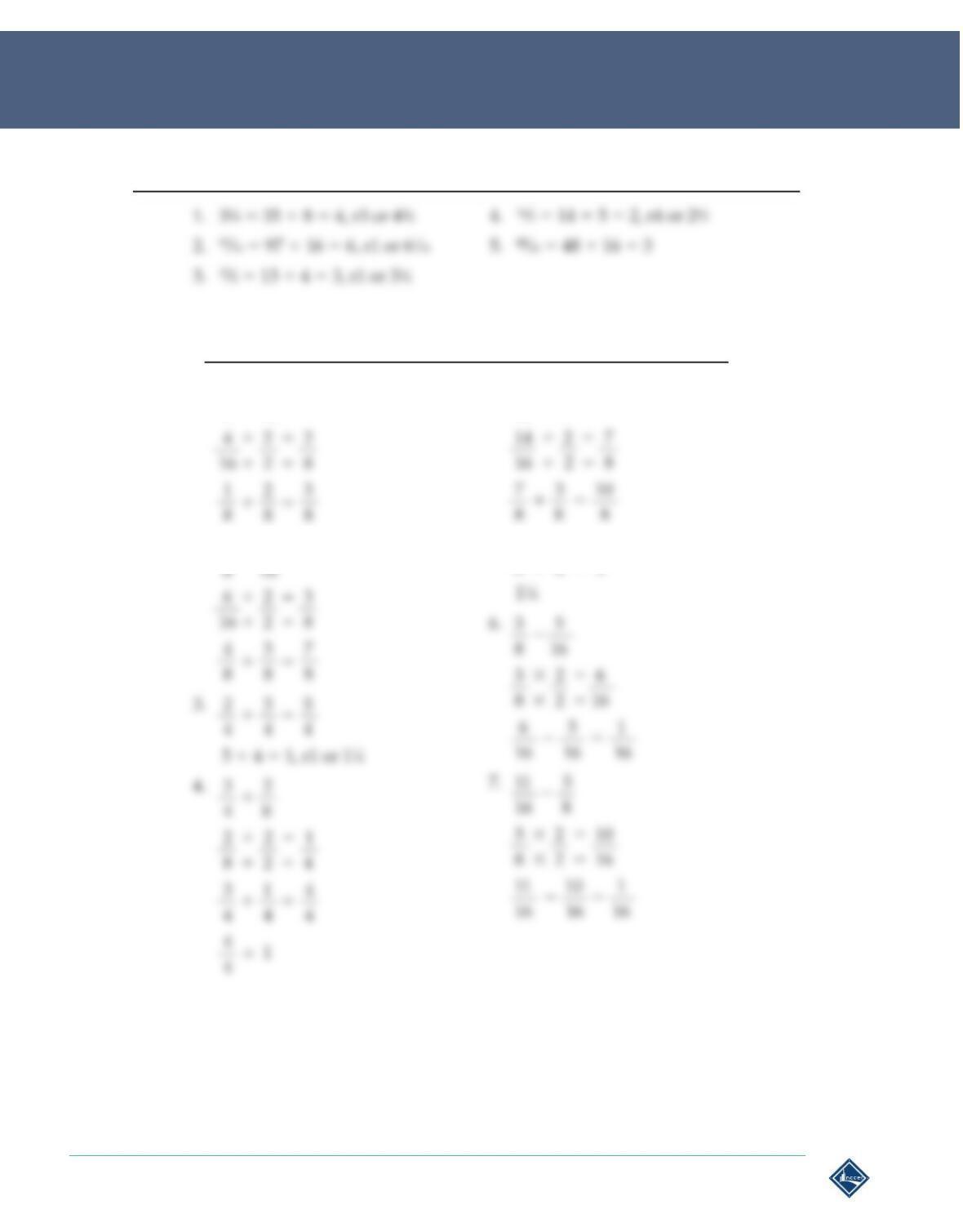
SECTION 2.1.4 FINDING EQUIVALENT FRACTIONS
1. 1 × 4 = 4
__ __ ___
4 × 4 = 16
10. 4 ÷ 4 = 1
___ __ ___
12.
1
4,
3
8
1
×
4
=
4
26 NCCER – Core Curriculum 0 0102-15
SECTION 2.2.1 CHANGING IMPROPER FRACTIONS TO MIXED NUMBERS
ansWer keys
Module Two (00102-15)
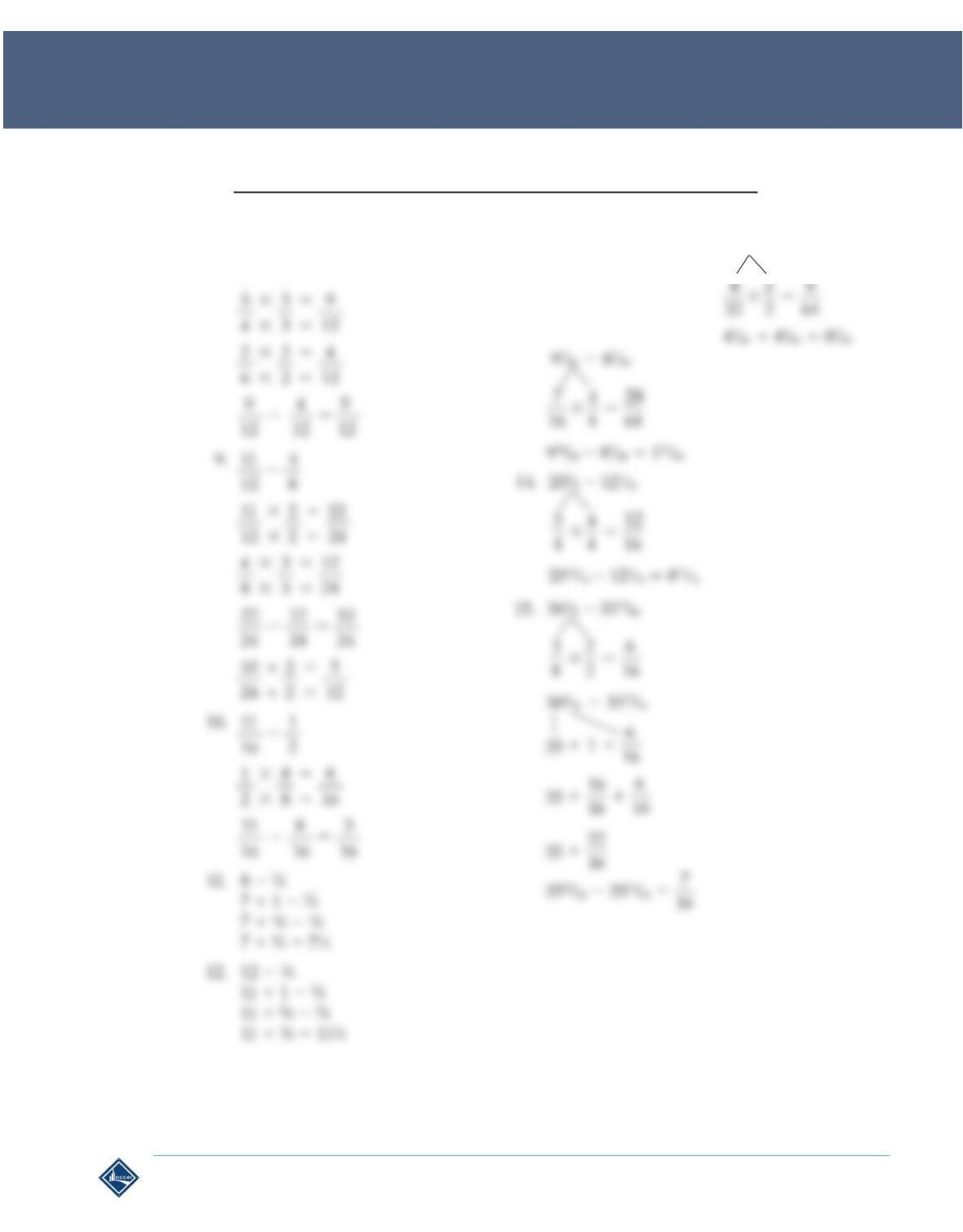
SECTION 2.3.1 ADDING AND SUBTRACTING FRACTIONS
1. 1 4
__ ___
8 + 16
2. 4 6
__ ___
5. 14 + 3
___ __
16 8
2 ÷ 2 = 1
__ __ __
8 ÷ 2 = 4
00102-15 Introduction to Construction Math Module Two 27
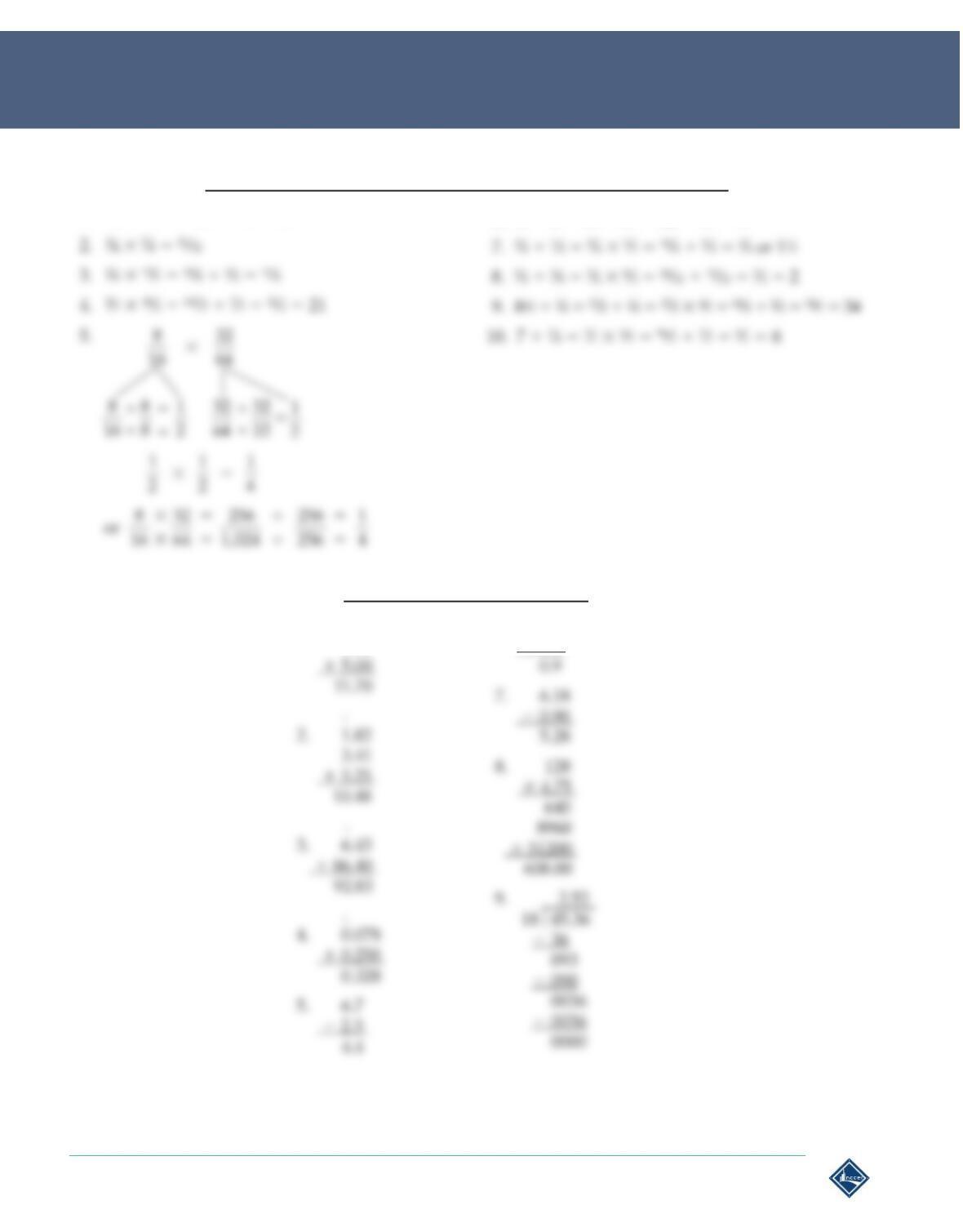
ansWer keys
Module Two (00102-15)
8. 3 − 2
__ __
4 6
13.
Two punches = 41⁄
64
+ 43⁄
32
SECTION 2.3.1 ADDING AND SUBTRACTING FRACTIONS
(Continued)
28 NCCER – Core Curriculum 00102-15
ansWer keys
Module Two (00102-15)
SECTION 2.4.1 MULTIPLYING AND DIVIDING FRACTIONS
1. 4⁄16 × 5⁄8 = 20⁄128 ÷ 4⁄4 = 5⁄32
6. 3⁄8 ÷ 3 = 3⁄8 × 1⁄3 = 3⁄24 ÷ 3⁄3 = 1⁄8
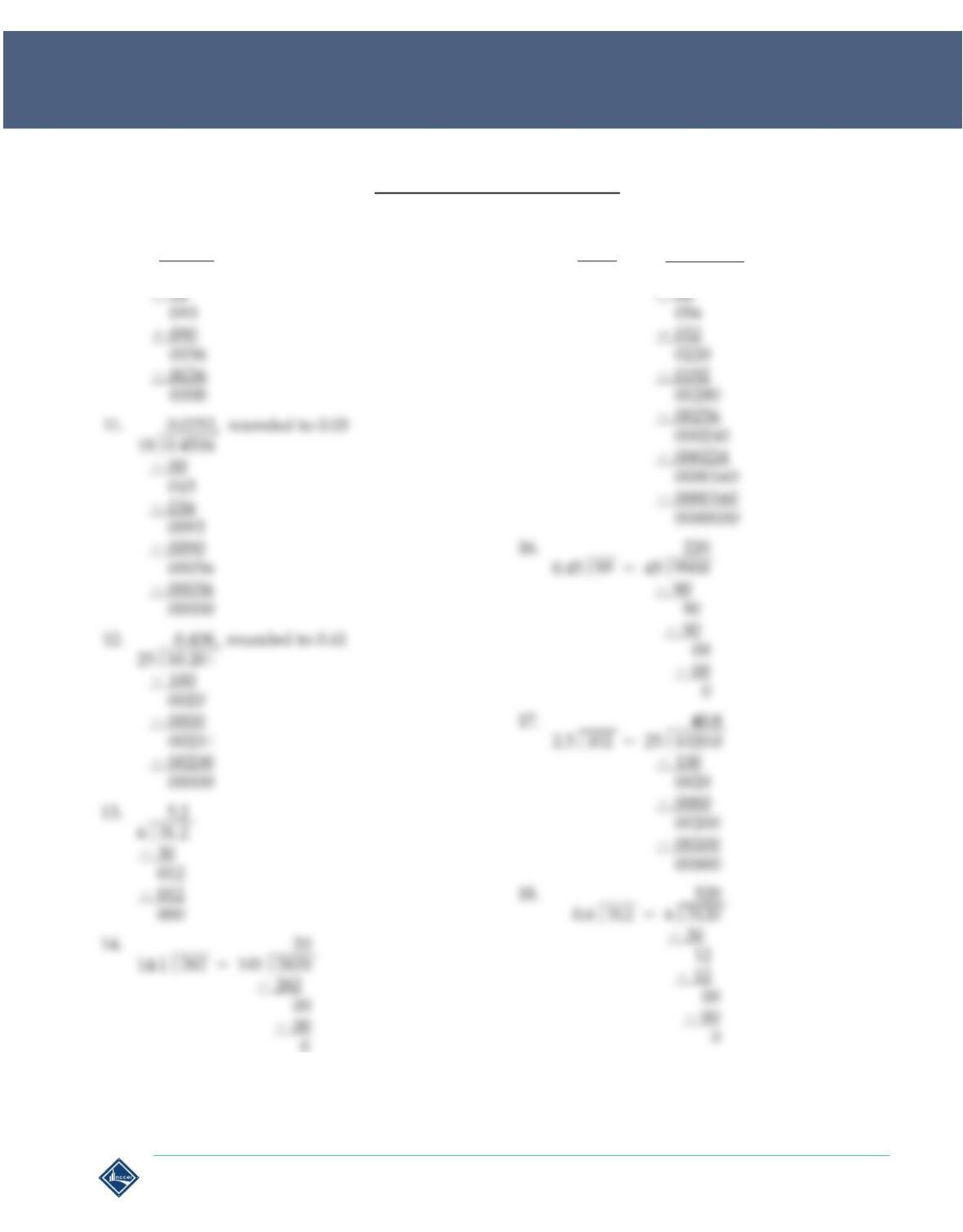
SECTION 3.2.5 DECIMALS
1. 2.50
4.20
6. 3
× 0.3
00102-15 Introduction to Construction Math Module Two 29
ansWer keys
Module Two (00102-15)
SECTION 3.2.5 DECIMALS
(Continued)
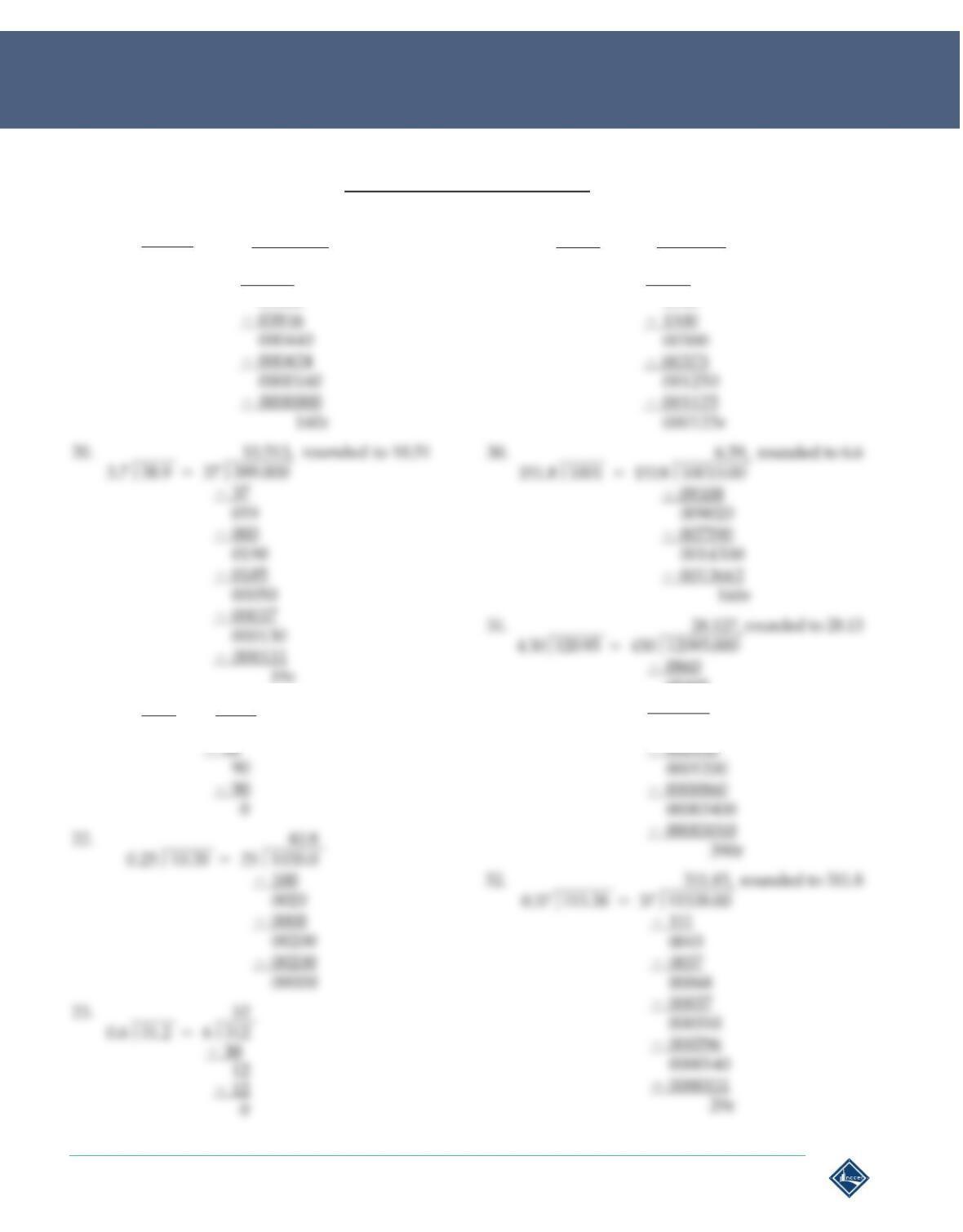
10. 0.252, rounded to 0.25
18 + 4.536
15. 216.875, rounded to 216.88
3.2 + 694 = 32 + 6940.000
30 NCCER – Core Curriculum 0 0102-15
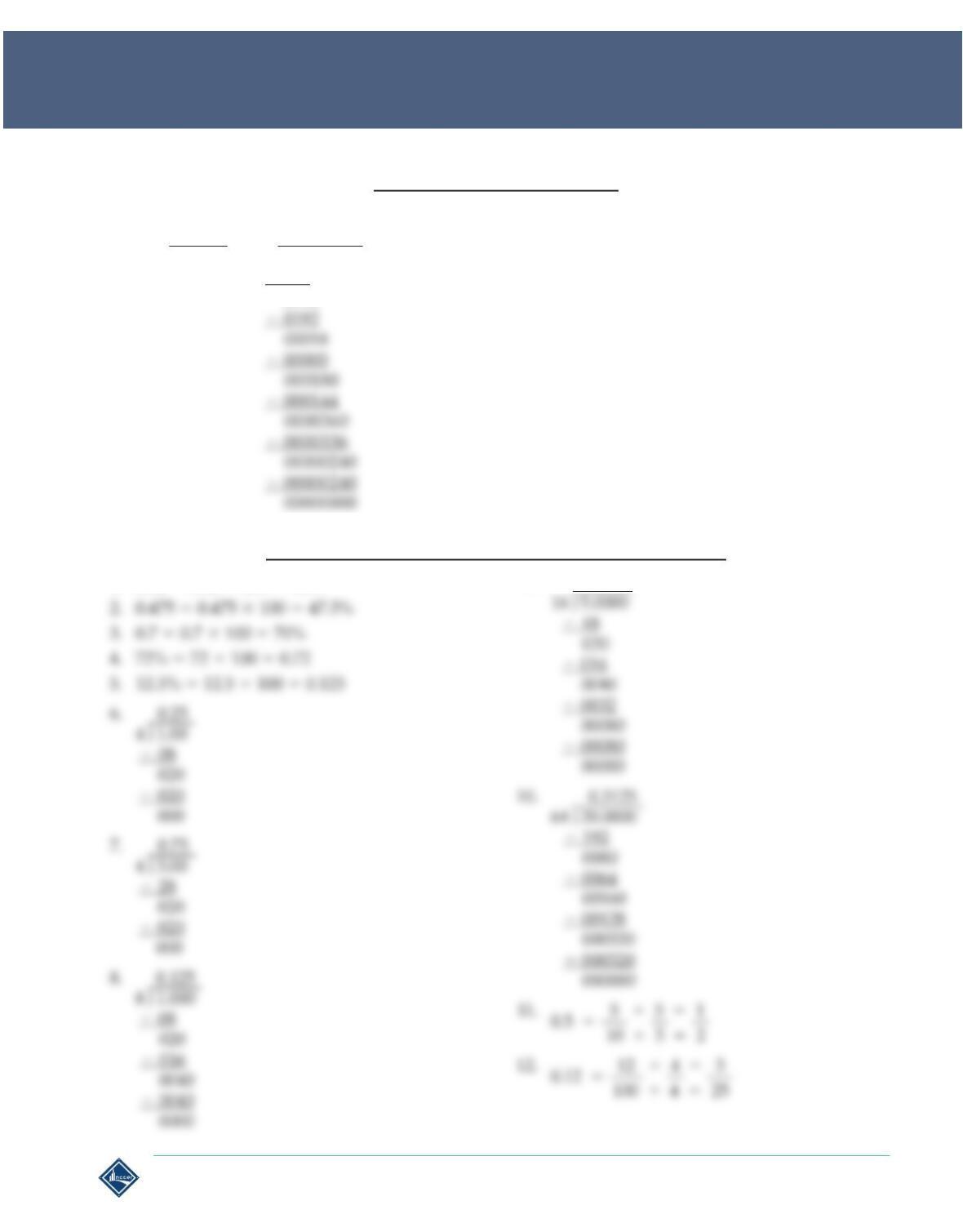
19. 4.910
4.24 + 20.82 = 424 + 2082.000
− 1696
03860
21. 22
0.45 + 9.9 = 45 + 990
ansWer keys
Module Two (00102-15)
29. 24.13, rounded to 24.1
3.75 + 90.5 = 375 + 9050.00
− 750
1550
03495
− 03440
000550
SECTION 3.2.5 DECIMALS
(Continued)
00102-15 Introduction to Construction Math Module Two 31
ansWer keys
Module Two (00102-15)
SECTION 3.2.5 DECIMALS
(Continued)
33. 240.375, rounded to 240.4
0.48 + 115.38 = 48 + 11538.000
− 096
0193
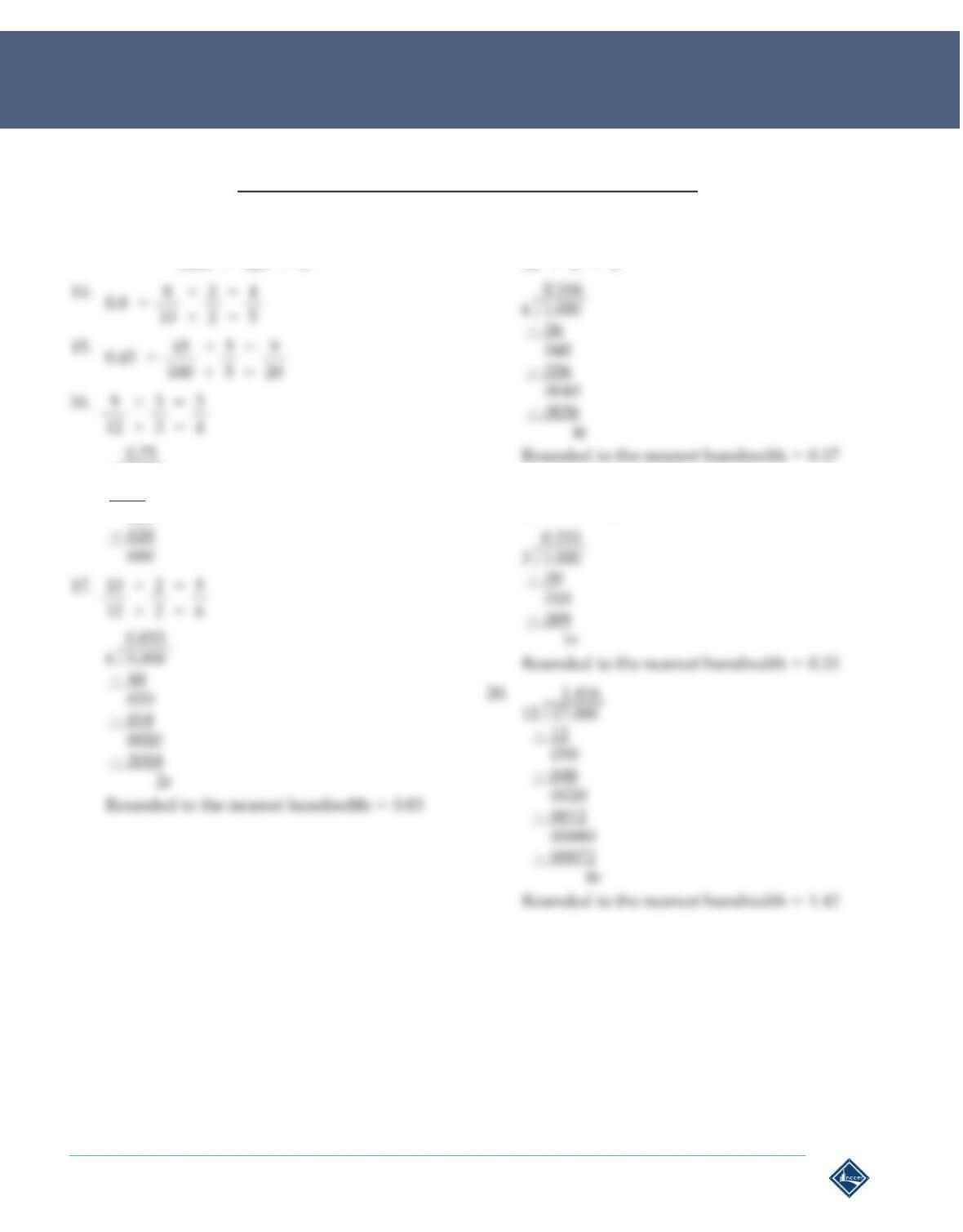
SECTION 3.3.5 CONVERTING DIFFERENT VALUES
9. 0.3125
1. 0.62 = 0.62 × 100 = 62%
32 NCCER – Core Curriculum 0 0102-15
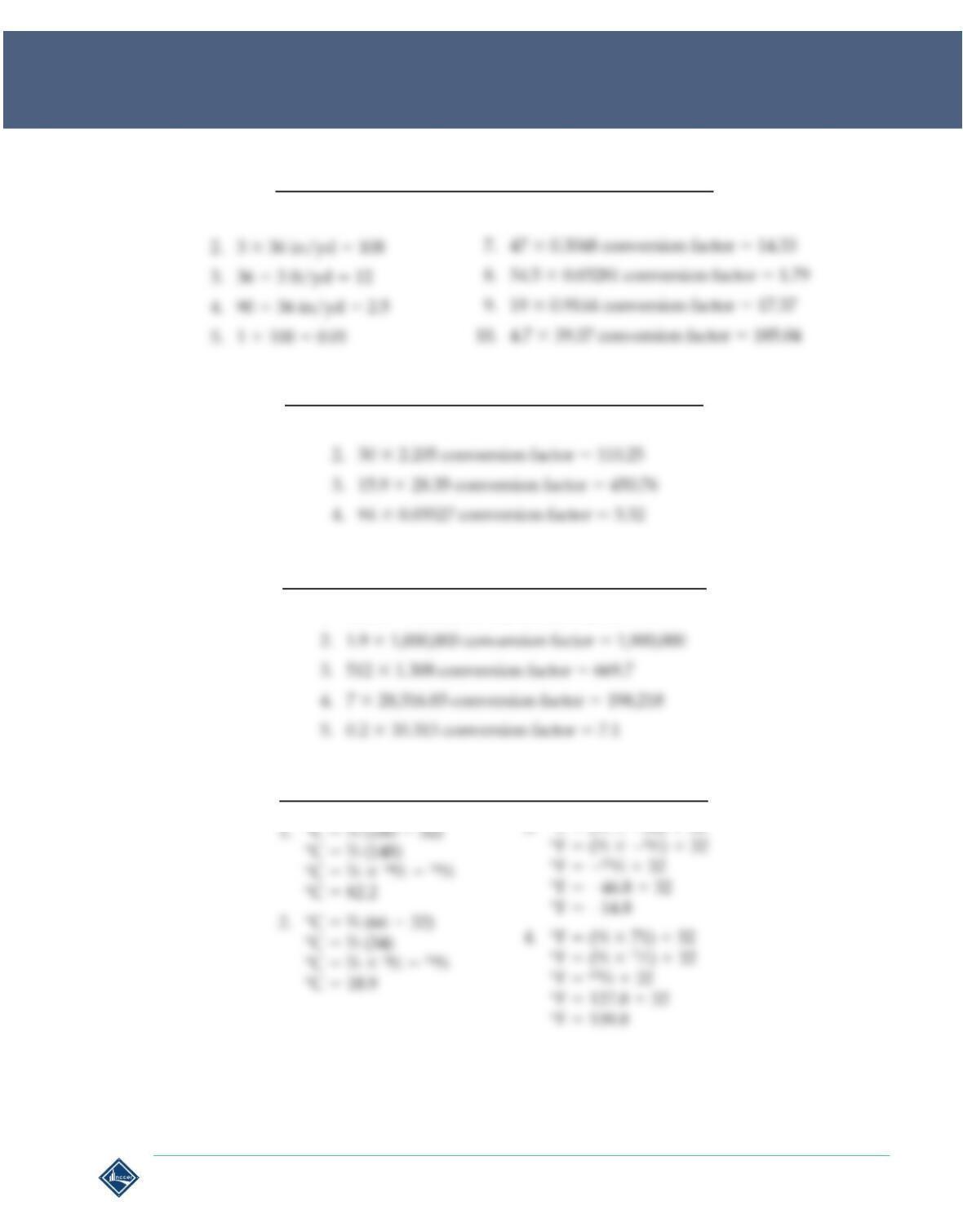
18. 2 ÷ 2 = 1
___ __ __
12 ÷ 2 = 6
19. 4 ÷ 4 = 1
___ __ __
12 ÷ 4 = 3
ansWer keys
Module Two (00102-15)
13. 0.125 = 125 ÷ 125 = 1
_____ ____ __
1000 ÷ 125 = 8
4 + 3.00
− 28
020
SECTION 3.3.5 CONVERTING DIFFERENT VALUES
(Continued)
00102-15 Introduction to Construction Math Module Two 33
ansWer keys
Module Two (00102-15)
SECTION 5.1.4 CONVERTING MEASUREMENTS
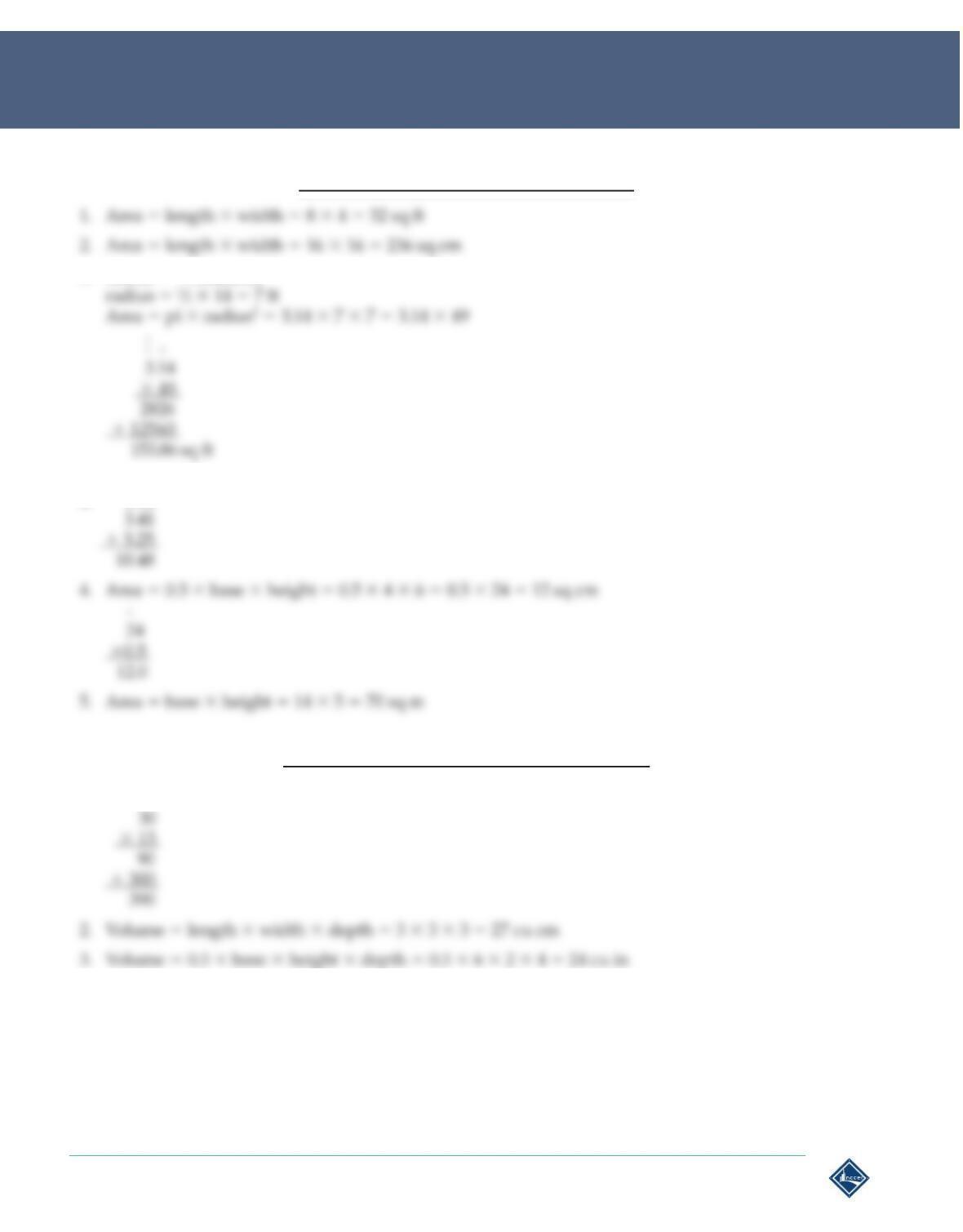
1. .45 × 100 = 45
6. 66 × 2.54 conversion factor = 167.64
SECTION 5.2.4 CONVERTING WEIGHT UNITS
1. 50 × 0.4536 conversion factor = 22.68
SECTION 5.3.4 CONVERTING VOLUME UNITS
1. 11600 × 0.0005787 conversion factor = 6.7
SECTION 5.4.1 CONVERTING TEMPERATURES
3. °F = (9⁄5 × −26) + 32
34 NCCER – Core Curriculum 0 0102-15
ansWer keys
Module Two (00102-15)
SECTION 6.3.1 CALCULATING AREA
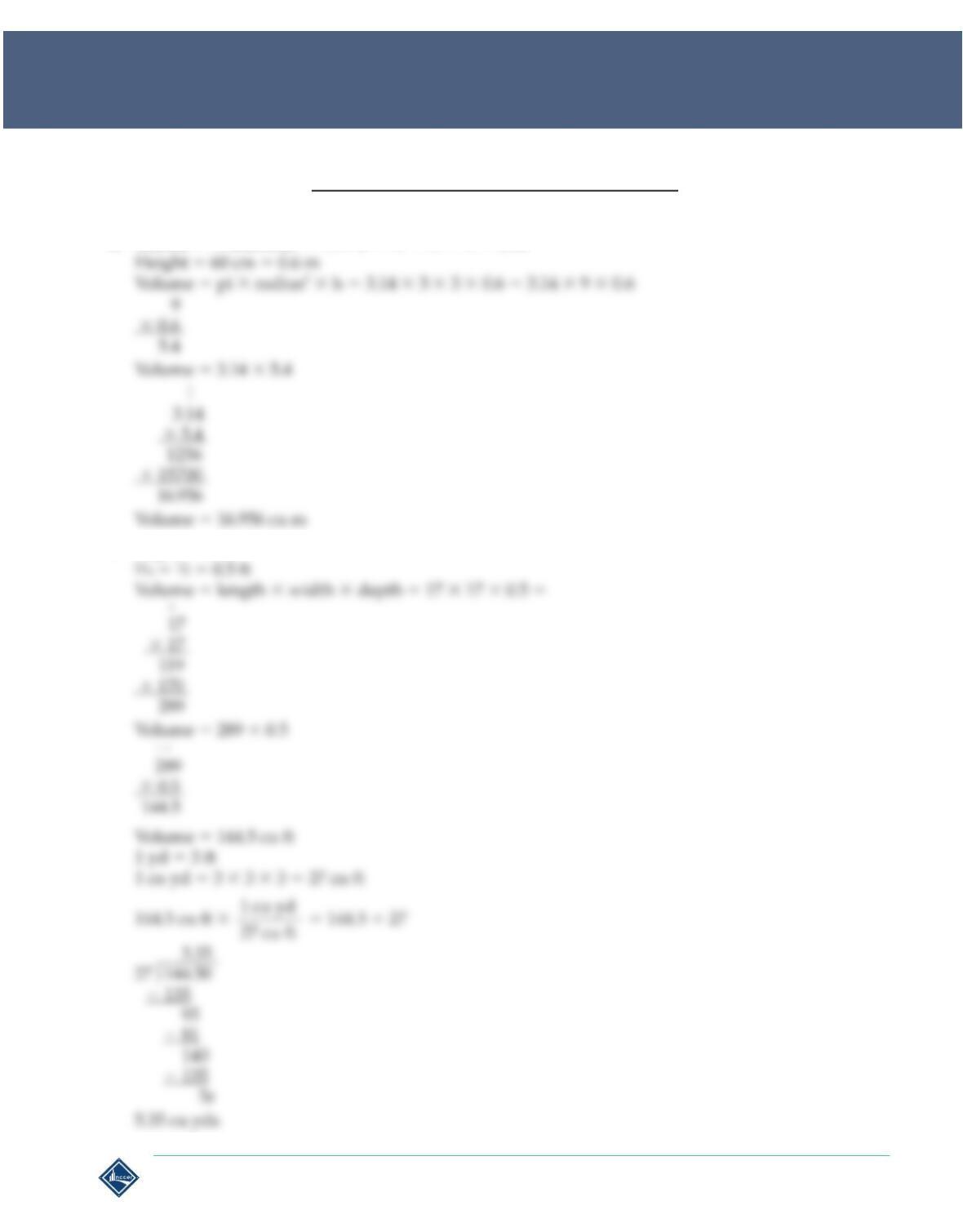
3. radius = 1⁄2 diameter
1
2. 1.82
SECTION 6.4.5 CALCULATING VOLUME
1. Volume = length × width × depth = 5 × 6 × 13 = 30 × 13 = 390 cu ft
00102-15 Introduction to Construction Math Module Two 35
ansWer keys
Module Two (00102-15)
SECTION 6.4.5 CALCULATING VOLUME
(Continued)
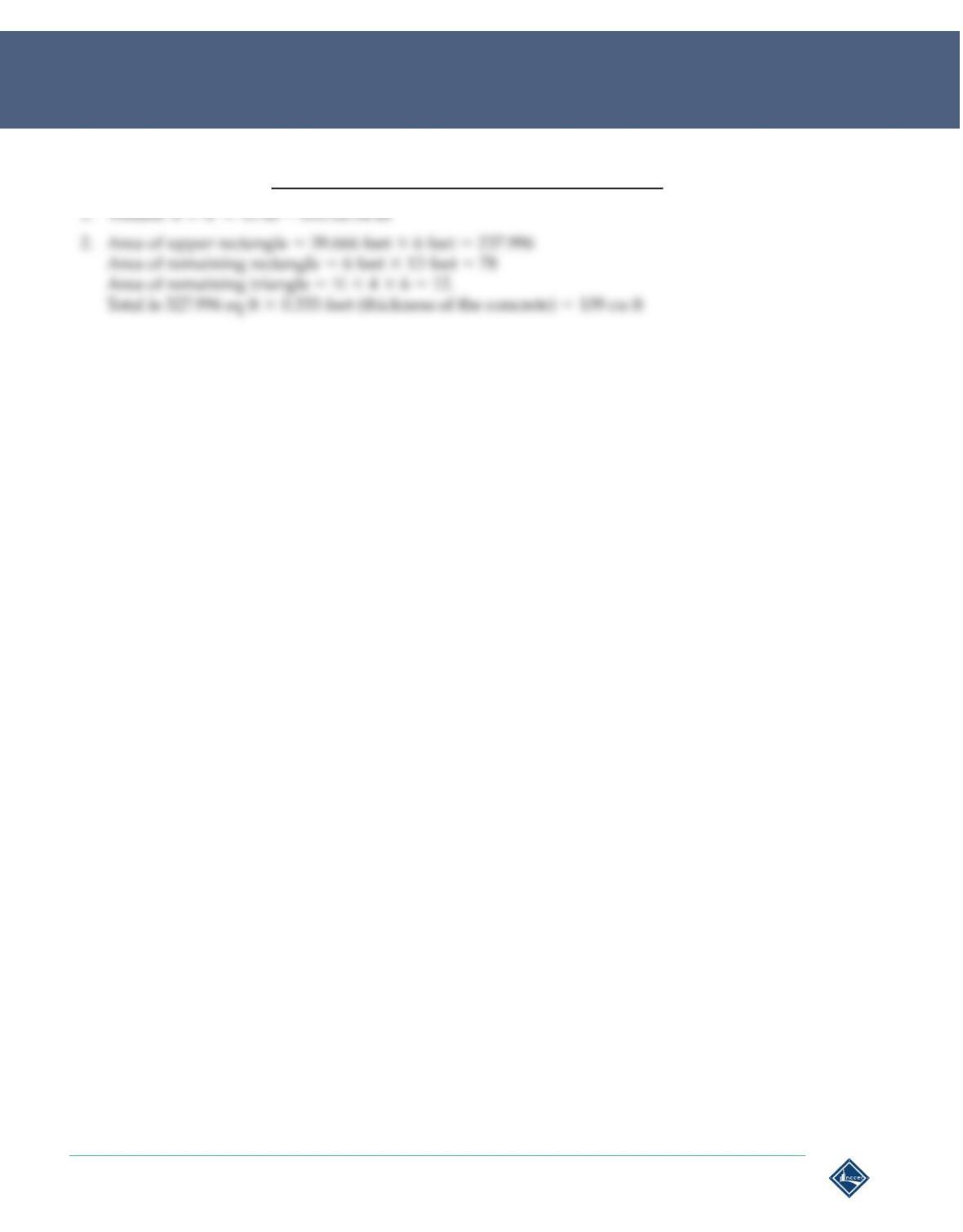
4. Radius = 1⁄2 diameter = 1⁄2 × 6 = 6⁄2 ÷ 2⁄2 = 3⁄1 = 3 m
5. Depth = 6 in
36 NCCER – Core Curriculum 0 0102-15
ansWer keys
Module Two (00102-15)
SECTION 6.4.6 PRACTICAL APPLICATIONS
NCCER makes every effort to keep its textbooks up-to-date and free of technical errors. We
ap pre ci ate your help in this process. If you find an error, a typographical mistake, or an in-
NCCER Product Development and Revision
13614 Progress Blvd., Alachua, FL 32615
Email: curriculum@nccer.org
Online: www.nccer.org/olf
NCCER CuRRiCula — uSER uPDaTE
❏ Trainee Guide ❏ Lesson Plans ❏ Exam ❏ PowerPoints Other _________________________
Craft / Level: Copyright Date:
Module ID Number / Title:
Section Number(s):
Description:
Recommended Correction:
Your Name:
Address:
Email: Phone: