CHAPTER 19
Hidden Faces of Substance Use Disorders
LEARNING OBJECTIVES
After studying this chapter, students should be able to:
•
19.2: Identify the impact of substance use disorders on those in the military
•
19.4: Describe the impact of SUDs on those who have a disability
•
19.5: Understand the impact of substance use disorders within ethnic
minorities
CHAPTER OUTLINE
Substance Use Disorders and the Homeless
Substance Use Disorders in the Military
Combat Veterans and Substance Use Disorders
Substance Use Disorders in the Lesbian, Gay, Bisexual, and Transgender Communities
Substance Misuse and Individuals with a Disability
Traumatic Brain Injuries
Ethnic Minorities and Substance Use Disorders
Native Americans
Hispanic (Latino) Clients
Asian Americans
African Americans
CHAPTER OVERVIEW
The purpose of this chapter is to help the student examine some of the many “hidden” victims
of the substance use disorders (SUDs). The complex problem of how to define a “Native
American” and some of the reasons why many different research studies about the prevalence
of SUDs in this population arrive at different conclusions are examined, along with the issue of
whether the SUDs is a major problem for the gay/lesbian/bisexual/transgender communities,
and the reasons why the prevalence of the SUDs in this population might be over-estimated.
DISCUSSION QUESTIONS
Break-Out Discussion #1:
Globalization of diagnostic protocols? Language helps to shape the brain’s growth (Kenneally,
2010). Given the variety of different languages spoken on this planet, the potential exists for a
wide variety of neural growth patterns based on each individual’s language. Therefore, the
diagnostic classification system utilized by the American Psychiatric Association is not without
cultural bias. It was conceived of, and shaped by, psychiatrists who speak English. Their brains
were designed to speak and understand English, and thus have subtle differences from the
brains of those individuals who grew up in an indigenous culture that had its own language.
Thus, the American Psychiatric Association’s diagnostic nomenclature system reflects certain
cultural (lingual?) biases.
2010). In light of the globalization of diagnostic nomenclature, as the Diagnostic and Statistical
Questions
1. Consider the above example. If this drinking is a recognized and accepted reaction to the loss
of a spouse within that culture, should our values and diagnoses be used to assess this person?
2. Can diagnostic standards created within one culture be exported to others? Give an example
3. Is “mental illness” universal or is it shaped by culture? Why or why not? Do we have the right
to impose our perspective on mental illness onto other cultures?
Break-Out Discussion #2:
There are many subcultures within the United States, each with their own traditions and beliefs.
One such example is the Native American Church.
Prior to the historical accident in which Columbus stumbled upon the continents so
inconveniently placed along the path that he wished to follow to the far east, native cultures
viewed the peyote cactus as a central element to their religion. The specific role that peyote
For many years, the use of peyote was contentious, and various State and Federal agencies
sought to restrict, if not deny, its use in these religious ceremonies. The courts have ultimately
ruled, however, that the use of peyote in religious ceremonies by members of the Native
American Church is permitted as an acceptable religious practice and thus exempt from the drug
classification system established by the Drug Enforcement Administration. However, its use by
nonmembers of this religious group remains a violation of the law and peyote remains classified
as a Category I compound. In this manner, the practices of a minority population were
accommodated by that of the predominant culture.
Questions
1. To what degree has the Native American population been assimilated into the larger society
of the United States? For example, are those members of the tribal unit who live on a
reservation exposed to the same drug use “cues” as those who live outside of the reservation in
a major metropolitan area?
2. What social forces on the reservation might fuel, or inhibit, the individual’s interest in
misusing alcohol or another drug? Are the substance use cues for members of a tribe living on a
reservation in Maine the same as those for a tribal member living on a reservation in Nevada,
for example?
3. If the traditions and beliefs of a hypothetical tribe living in southern Wyoming were to inhibit
the growth of SUDs, would those traditions and beliefs be of value to another hypothetical tribe
living in southern New England? Should a single form of treatment be established for Native
Americans, or should treatment centers in each region develop region-specific treatment
modalities to accommodate the needs of the Native Americans who live in that area? Who
would make these decisions? If a person who grew up in a specific tribe in New England should
move to Washington State, should that person be forced to adapt to the treatment program
developed for Native Americans indigenous to Washington State?
4. When does a minority custom become something the majority must tolerate? Can you think
of examples other than the one above, in which the dominant culture learned to tolerate, if not
accept, the practices of a minority culture?
References
Kenneally, C. (2010). Talking heads. New Scientist, 206 (2762), 32–35.
Watters, E. (2010). Invasion of the mind snatchers. New Scientist, 205 (2744), 26–27.
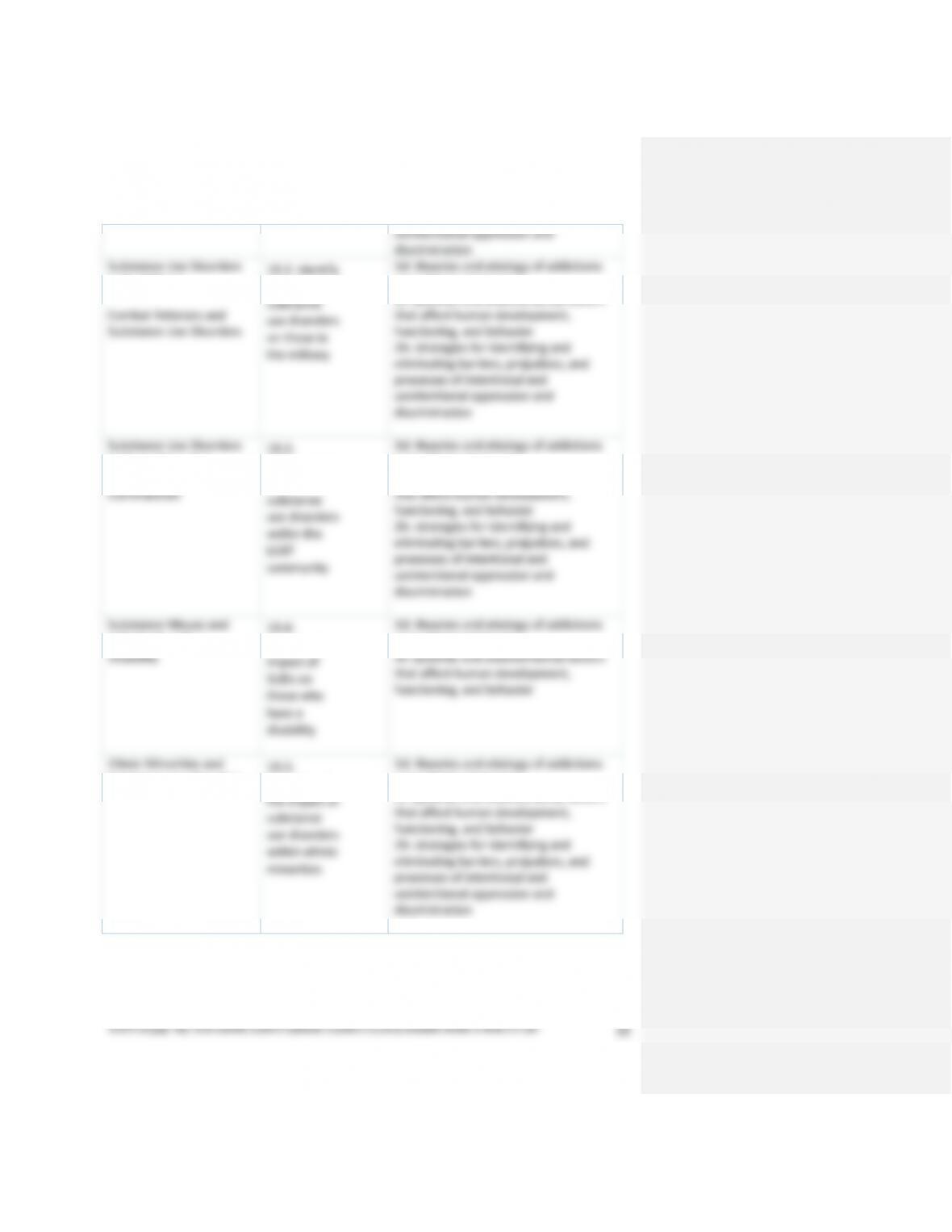
LO/STANDARDS CORRELATION CHART
A-head
LO
Standard 1—CACREP
Substance Use Disorders
and the Homeless
19.1:
Understand
the impact of
substance
use disorders
on those who
are homeless
3d: theories and etiology of addictions
and addictive behaviors
3f: systemic and environmental factors
that affect human development,
functioning, and behavior
2h: strategies for identifying and
eliminating barriers, prejudices, and
processes of intentional and
Commented [CE1]: AU: Please provide key concepts and
terms as is given in other chapters, if applicable.
unintentional oppression and
discrimination
Substance Use Disorders
in the Military
Combat Veterans and
Substance Use Disorders
19.2: Identify
the impact of
substance
use disorders
on those in
the military
3d: theories and etiology of addictions
and addictive behaviors
3f: systemic and environmental factors
that affect human development,
functioning, and behavior
2h: strategies for identifying and
eliminating barriers, prejudices, and
processes of intentional and
unintentional oppression and
discrimination
Substance Use Disorders
in the Lesbian, Gay,
Bisexual, and Transgender
Communities
19.3:
Understand
the
substance
use disorders
within the
LGBT
community
3d: theories and etiology of addictions
and addictive behaviors
3f: systemic and environmental factors
that affect human development,
functioning, and behavior
2h: strategies for identifying and
eliminating barriers, prejudices, and
processes of intentional and
unintentional oppression and
discrimination
Substance Misuse and
Individuals with a
Disability
19.4:
Describe the
impact of
SUDs on
those who
have a
disability
3d: theories and etiology of addictions
and addictive behaviors
3f: systemic and environmental factors
that affect human development,
functioning, and behavior
Ethnic Minorities and
Substance Use Disorders
19.5:
Understand
the impact of
substance
use disorders
within ethnic
minorities
3d: theories and etiology of addictions
and addictive behaviors
3f: systemic and environmental factors
that affect human development,
functioning, and behavior
2h: strategies for identifying and
eliminating barriers, prejudices, and
processes of intentional and
unintentional oppression and
discrimination