CHAPTER 16
Over-the-Counter Analgesics: Unexpected Agents of Misuse and Danger
LEARNING OBJECTIVES
After studying this chapter, students should be able to:
•
16.2: Understand the medical uses of over-the-counter analgesics
•
16.4: Comprehend the pharmacology of over-the-counter analgesics
•
16.5: Understand the concern with over-the-counter analgesic overdoses
CHAPTER OUTLINE
A Short History of the OTC Analgesics
The Origins of the Term NSAID
Medical Uses of the OTC Analgesics
Aspirin
Acetaminophen
The Propionic Acids
Normal Dosage Levels of the OTC Analgesics
Aspirin
Acetaminophen
Ibuprofen
Naproxen
Pharmacology of OTC Analgesics
Aspirin
Acetaminophen
Ibuprofen
Naproxen
Complications Caused by OTC Analgesic Use
Acetaminophen
Medication Interactions Involving Acetaminophen
Aspirin
Medication Interactions Involving Aspirin
Ibuprofen
Medication Interactions Involving Ibuprofen
Naproxen
Medication Interactions Involving Naproxen
OTC Overdoses
Acetaminophen
Aspirin
Ibuprofen
Naproxen
(5th Edition)
CHAPTER OVERVIEW
The purpose of this chapter is to help the reader become aware of the mechanism by which
these compounds reduce the user’s subjective sense of pain. Some of the potential interactions
between the over-the-counter analgesics and other pharmaceutical compounds will be
reviewed, as will the potential dangers of their use, even when used as directed. The potential
dangers of their misuse will also be discussed.
DISCUSSION QUESTIONS
Break-Out Discussion:
Are we stuck with the NSAIDS? As the population ages, a larger and larger percentage of people
1. Have you ever considered the effects of the diseases of aging on your generation? Do you
believe that your generation will have the same over-the-counter options as the current older
generation or there will be other options? If the latter, what might they be?
2. List some of the dangers of over-the-counter medications. When was the last time that you
read the instructions printed on the side of a box in which a bottle of an over-the-counter
medication was sold? Is there a ceiling effect to the compound in that bottle? Could that
medication cause physical or emotional harm if it is used at above-normal dosage levels? Are
there other over-the-counter compounds that might contain one or more of the substances in
another over-the-counter medication that you are taking?
3. If you choose to self-medicate with over-the-counter medications, do you follow any “rules”
(self-imposed or otherwise)? Have you ever thought that if a designated dose of an over-the-
counter medication was good, then a higher dose was most certainly better?
4. Do you know anybody who has received an organ as a result of a transplant procedure? Was
this transplant made necessary, or the need at least exacerbated, by their misuse of an over–
the-counter medication?
KEY CONCEPTS AND TERMS
Prostaglandins: Any of a family of compounds found in the body, some of which are involved in
Cyclooxygenase: An enzyme involved in the process of prostaglandin production. One form of
cyclooxygenase (COX-1) is involved in the regulation of kidney and stomach functions, where it
carries out a protective function.
Tinnitus: Loss of hearing, and a persistent “ringing” in the ears, which can be induced by loud
Hepatoxicity: Toxic to the liver
Diaphoresis: Perspiration, especially copious amounts
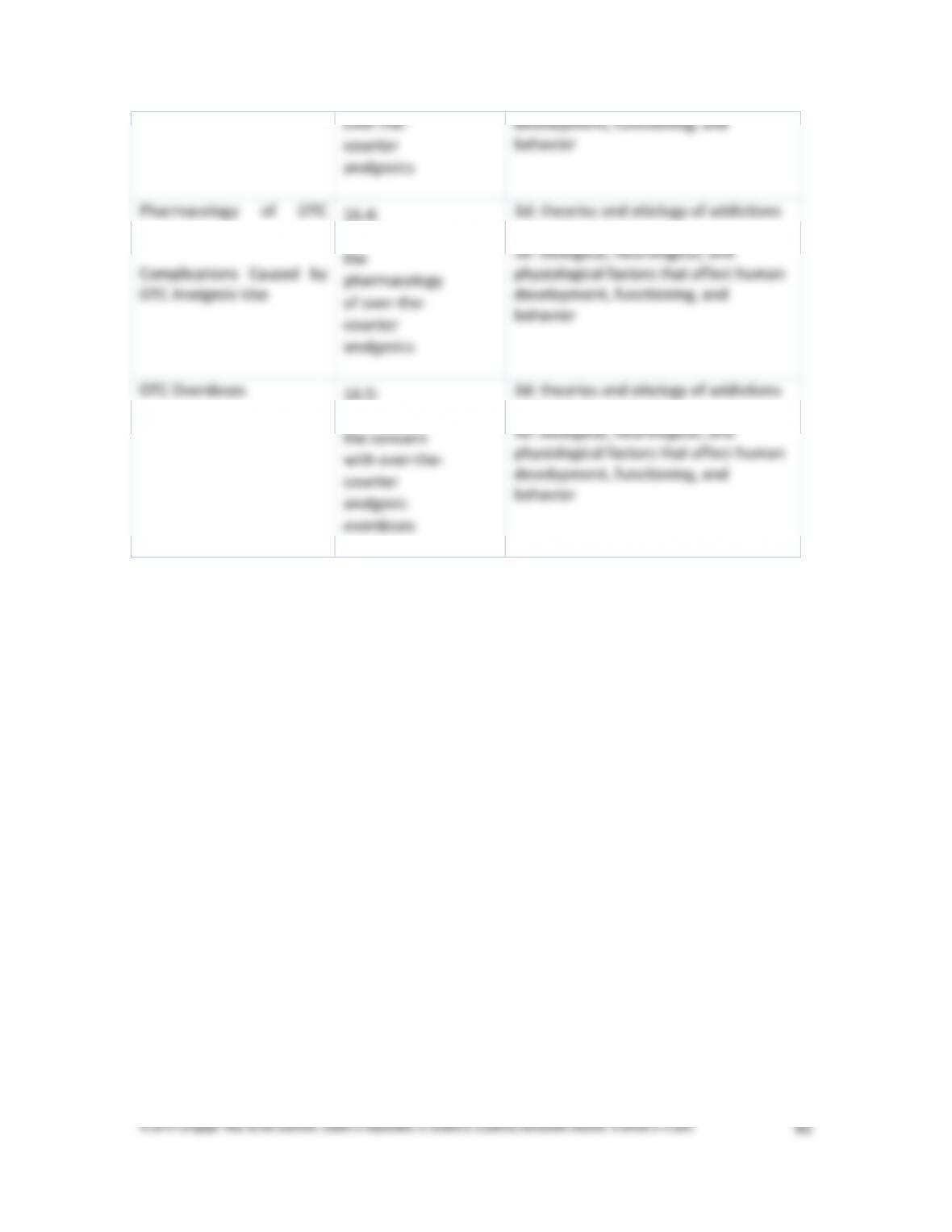
LO/STANDARDS CORRELATION CHART
A-head
LO
Standard—CACREP
A Short History of the OTC
Analgesics
16.1:
Understand
the history of
over-the-
counter
analgesics
3d: theories and etiology of addictions
and addictive behaviors
Medical Uses of the OTC
Analgesics
16.2:
Understand
the medical
uses of over-
the-counter
analgesics
3d: theories and etiology of addictions
and addictive behaviors
3e: biological, neurological, and
physiological factors that affect human
development, functioning, and
behavior
Normal Dosage Levels of
the OTC Analgesics
16.3: Describe
the normal
dosages and
effects of
3d: theories and etiology of addictions
and addictive behaviors
3e: biological, neurological, and
physiological factors that affect human
over-the-
counter
analgesics
development, functioning, and
behavior
Pharmacology of OTC
Analgesics
Complications Caused by
OTC Analgesic Use
16.4:
Comprehend
the
pharmacology
of over-the-
counter
analgesics
3d: theories and etiology of addictions
and addictive behaviors
3e: biological, neurological, and
physiological factors that affect human
development, functioning, and
behavior
OTC Overdoses
16.5:
Understand
the concern
with over-the-
counter
analgesic
overdoses
3d: theories and etiology of addictions
and addictive behaviors
3e: biological, neurological, and
physiological factors that affect human
development, functioning, and
behavior