Chapter 15:
DETERMINING PERSONAL STYLE
IN A WORLD OF MULTIPLE THEORIES
How can determining your own style help you and your clients?
Chapter 15, Determining Personal Style in a World of Multiple Theories, begins by
discussing how the microskills framework can be used with many different counseling
and psychotherapy frameworks. The chapter then reviews the major concepts of the book
and suggests ideas for your future plans in the helping fields.
CHAPTER GOALS
Awareness, knowledge, skills, and actions developed through the concepts of this chapter
will enable you to:
▲ Briefly examine theories of counseling and psychotherapy as possible future systems
for your own practice of helping.
▲ Review skills and strategies competencies that you have developed during the term.
INTRODUCTION
This last chapter has two major objectives: to facilitate student self-evaluation of their degree of
competence in the concepts of this text and to ask students to continue on the important journey
of identifying their own preferred style of helping. The chapter is brief, but we also believe it is
useful as a way to point toward the future.
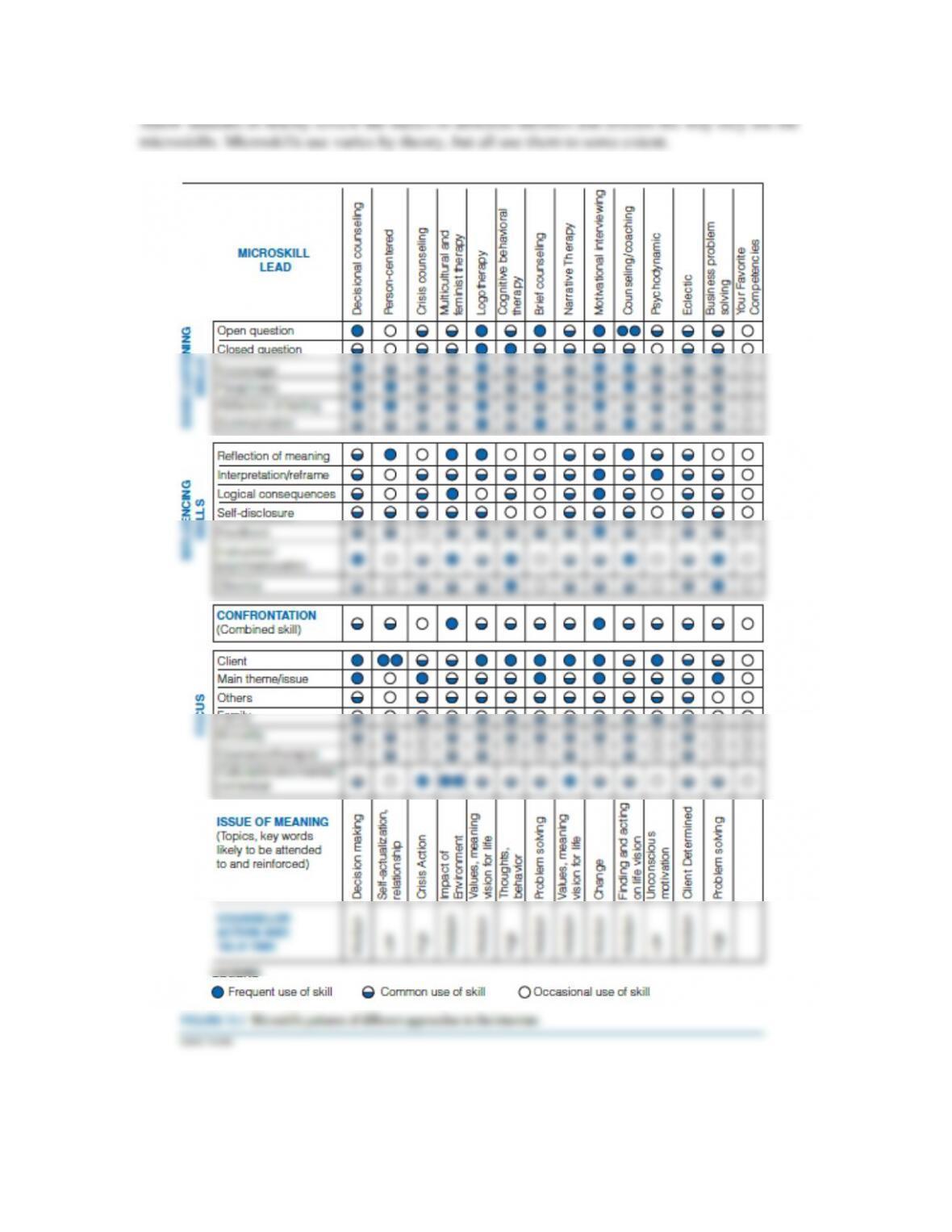
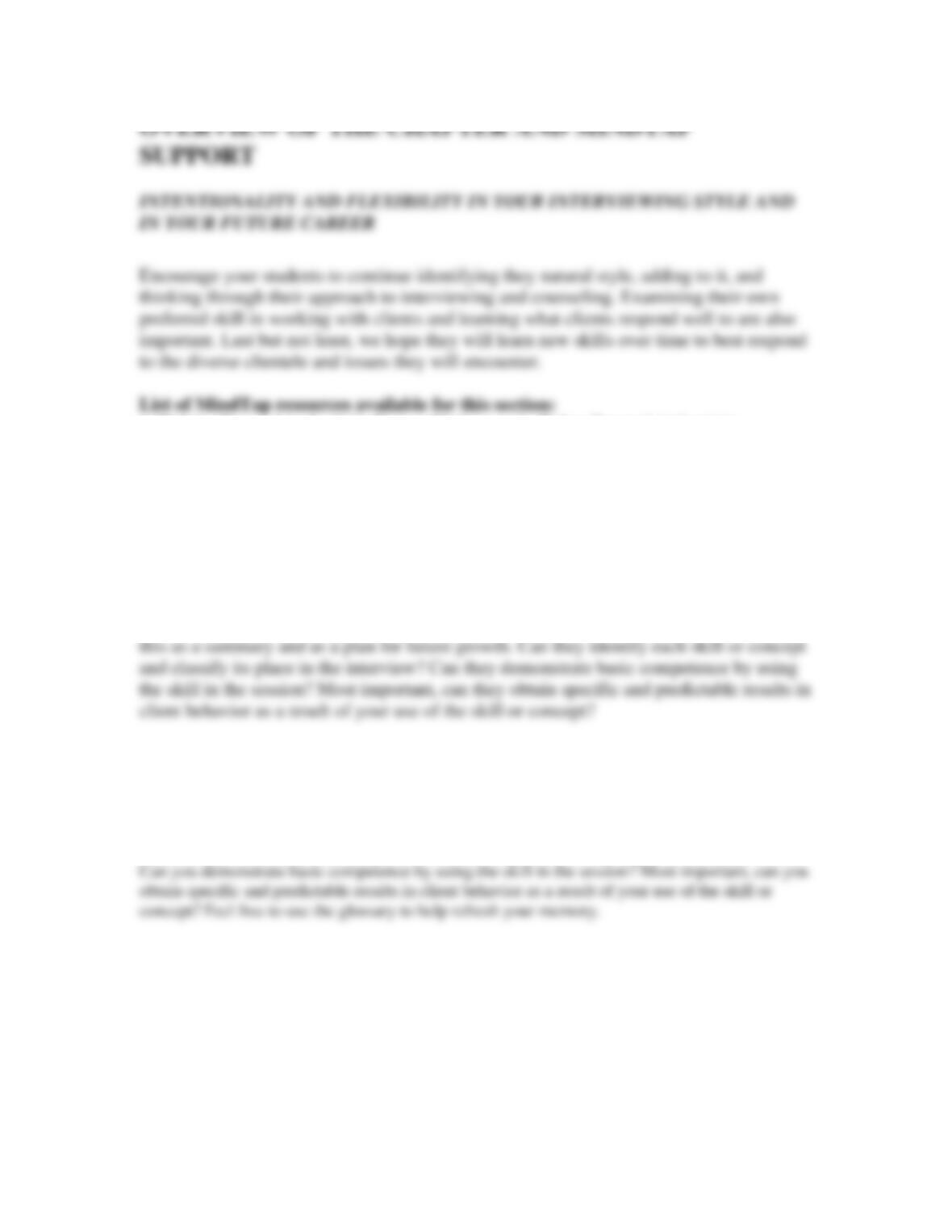
1. Website: Personal Authenticity Project. Markers on the Path to Personal Authenticity.
TIME TO PAUSE, REFLECT, ASSESS, AND TAKE STOCK
Help students review their recorded sessions. Exercise 15.1, Revisiting Your First Audio
or Video Recording, will help with this task.
Take some time to allow students to review their competence levels in each of the major
areas and indicate their personal competencies on the chart in Box 15.2. Students may use
SELF-ASSESSMENT OF ESSENTIAL SKILLS, STRATEGIES, AND
CONCEPTS
Take some time to review your own competence levels in each of the major microskill areas and
indicate your personal competencies on this chart. You may use this as a summary and as a plan
for future growth. Can you identify each skill or concept and classify its place in the interview?
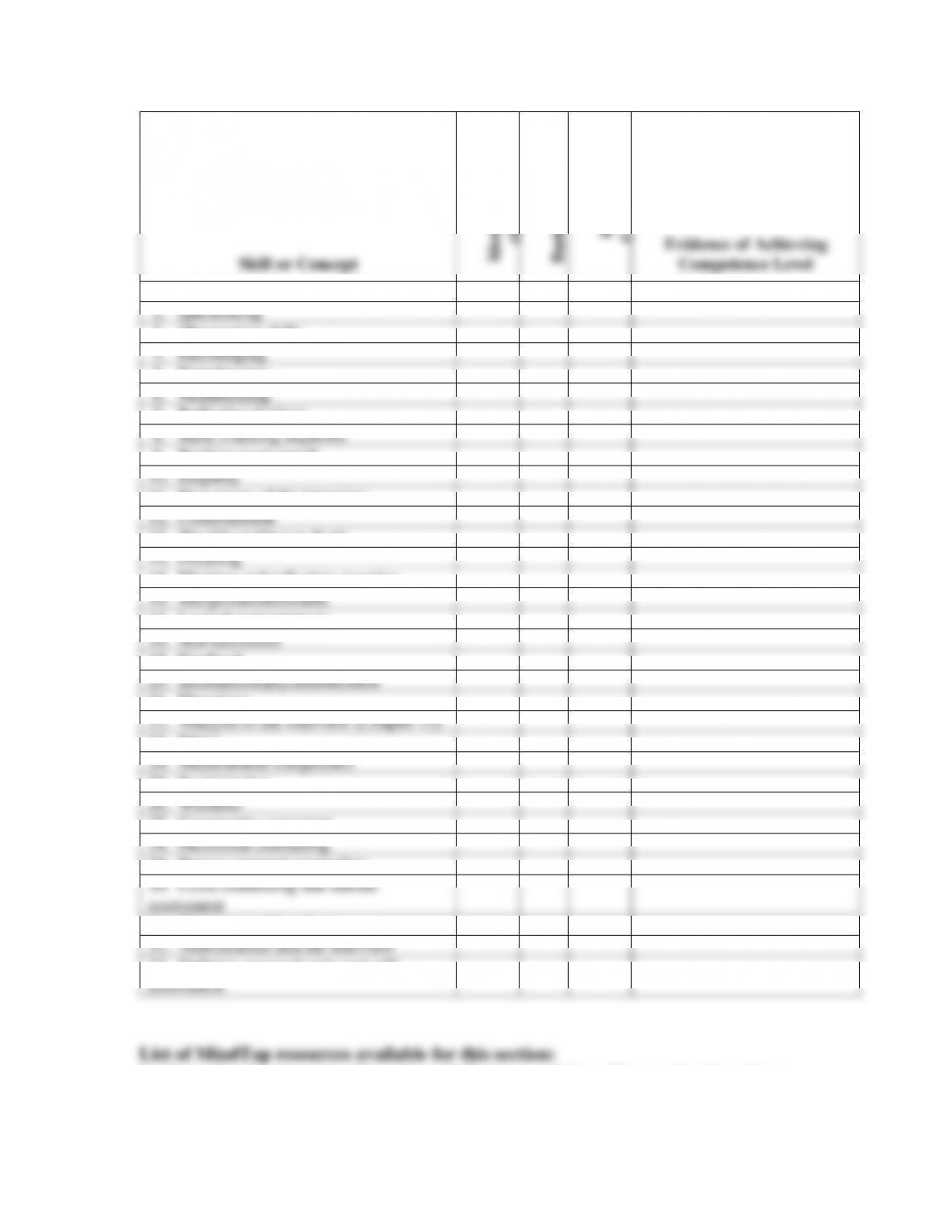
Skill or Concept
Identification and
classification
Basic Competence
Intentional
Competence
Evidence of Achieving
Competence Level
1. Attending behavior
2. Questioning
3. Observation skills
4. Encouraging
5. Paraphrasing
6. Summarizing
7. Reflecting feelings
8. Basic listening sequence
9. Positive asset search
10. Empathy
11. Five stages of the interview
12. Confrontation
13. The Client Change Scale
14. Focusing
15. Eliciting and reflecting meaning
16. Interpretation/reframe
17. Logical consequences
18. Self-disclosure
19. Feedback
20. Information/psychoeducation
21. Directives
22. Analysis of the interview (Chapter 13)
23. Ethics
24. Multicultural competence
25. Social justice
26. Wellness
27. Community genogram
28. Decisional counseling
29. Person-centered counseling
30. Crisis counseling and suicide
assessment
31. Therapeutic lifestyle change
32. Neuroscience and the interview
33. Defining personal style and self-
assessment
1. Group Practice Exercise: Share Your Reflections and Your Plans to Continue Your
Journey.
YOUR PERSONAL STYLE
Students are asked to define their natural style in Box 15.3. Individual and group activities can be
used to advance this section.
List of MindTap resources available for this section:
1. Interactive Exercise: Self-Awareness and Emotional Understanding Self-Assessment
3. Interactive Exercise: Multicultural Self-Assessment
5. Interactive Exercise: Assess Your Competencies.
YOUR JOURNEY IN INTERVIEWING AND COUNSELING CONTINUES NOW
You did it! You’ve reached the end of this part of your journey, and many of those concepts,
theories, and skills that once seemed awkward and overwhelming are now more familiar and a
DEMONSTRATIONS AND VIDEOS
• Live instructor demonstration or videos that we ourselves have made in the past.
• Carl Rogers’s Gloria tape from the famous Three Approaches to Counseling.
However, students are starting to “roll their eyes” at this older material.
• David Hutchinson has a wonderful video, Humanistic-Existential Theory in
Practice.
• Jeff Brooks-Harris and Jill Oliveira’s video Experiential Counseling and
Psychotherapy presents a skills-oriented approach to person-centered work.
• A video demonstration of assertiveness training from Basic Influencing Skills.
• Mary Bradford Ivey’s new video Counseling Children presents two complete
interviews, one of about 15 minutes with a sixth grader and another of about 10
with a first grader. Both focus clearly on listening skills.
CLASS PROCEDURES
1. Summary of skills. About ten days before the course ends, we like to ask students to reread
the material on the microskills hierarchy at the beginning of this chapter. We ask them as part
of their final assignment to present their portfolio with data that indicate they have mastered
2. Alternative theories of helping. Table 15.2 is a useful transition from the skills orientation of
this text to counseling theory. A student armed with microskills and the five-stage structure of
the interview is prepared to enter into virtually any theory of helping. Extensions of this basic
3. Natural Style and Story of Interviewing and Counseling. You may wish to ask students to
write their own narrative and theory of the interview at this point. The reflections asked to
4. Brain Research. Looking toward the future, you may wish to discuss newer findings in
neuroscience that illustrate how counseling and therapy changes the mind and the brain. Of